Wednesday, April 1, 2015

Neal A. Maxwell on Christ's victory over death

Elder Neal A. Maxwell (1926-2004) served as a Seventy from 1976-1981, then as a member of the Quorum of Twelve until his death from cancer in 2004.
"The gift of immortality to all mankind through the reality of the Resurrection is so powerful a promise that our rejoicing in these great and generous gifts should drown out any sorrow, assuage any grief, conquer any mood, dissolve any despair, and tame any tragedy. Those who now see life as pointless will one day point with adoration to the performance of the Man of Galilee in those crowded moments of time known as Gethsemane and Calvary. Those who presently say life is meaningless will yet applaud the Atonement which saves us from meaninglessness. Christ's victory over death ended the human predicaments, and from these too we may be rescued by following the teachings of him who rescued us from general extinction.
"Our 'brightness of hope,' therefore, means that at funerals our tears are genuine, but not because of termination—rather because of interruption. Though just as wet, our tears are not of despair but are of appreciation and anticipation. Yes, for disciples, the closing of a grave is but the closing of a door which later will be flung open with rejoicing.
"We say, humbly but firmly that it is the garden tomb—not life—that is empty."
- Neal A. Maxwell, "All Hell Is Moved," BYU Devotional, Nov 8, 1977
Click here to read the full talk
Elder Maxwell provides a powerful suggestion. If we consider the magnitude of the "great and generous gifts" provided to us by the Savior through the Resurrection alongside the sorrows and despairs of mortality, the former should completely drown out and overwhelm the latter. What a marvelous perspective; if our understanding is deep enough, all else falls into place.


As an example, he discusses the challenge of dealing with the loss of a loved one to death. Real disciples, who understand the doctrine, respond differently to this part of life:


And that leads us to the profound but simple testimony that is at the core of Elder Maxwell's remarks, the Easter season, and indeed the very core of Christianity:


Tuesday, March 31, 2015

James E. Faust on Jesus and the Resurrection

President James E. Faust (1920-2007) was called as a Seventy in 1976, then as a member of the Quorum of Twelve in 1978. He served as a counselor to President Hinckley until his death in 2007 at age 87.
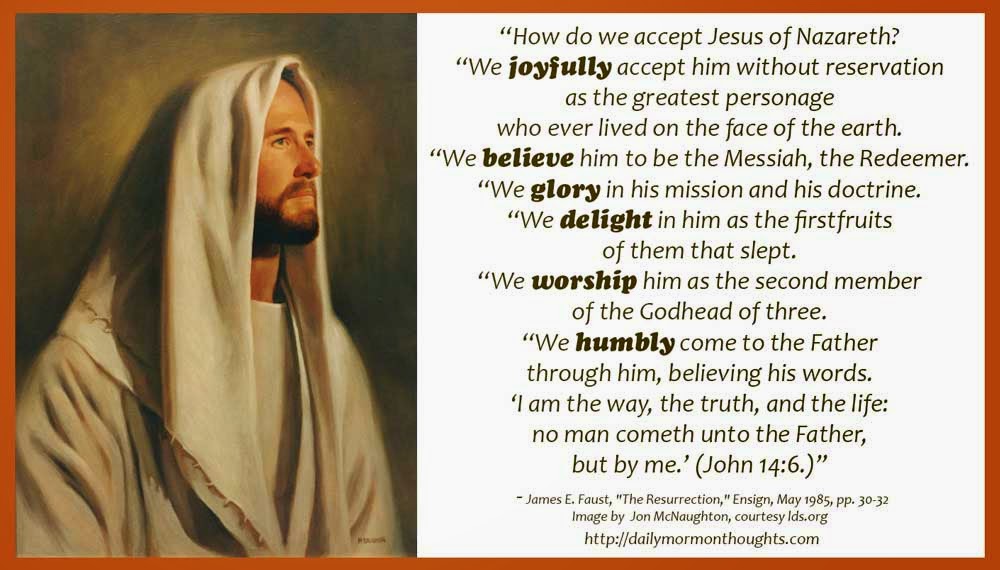
"How do we accept Jesus of Nazareth?
"We joyfully accept him without reservation as the greatest personage who ever lived on the face of the earth.
"We believe him to be the Messiah, the Redeemer.
"We glory in his mission and his doctrine.
"We delight in him as the firstfruits of them that slept.
"We worship him as the second member of the Godhead of three.
"We humbly come to the Father through him, believing his words. 'I am the way, the truth, and the life: no man cometh unto the Father, but by me.' (John 14:6.)
"A hallmark of a disciple is described in the words of the Master: 'By this shall all men know that ye are my disciples, if ye have love one to another.' (John 13:35.) ...
"With the abundance of testimony, both ancient and modern, sealed by the witness of the Holy Spirit of God, we stand firm and unequivocating in our knowledge that Jesus of Nazareth is the resurrected Savior. His arms are stretched forth to all men... who, by accepting Him in His appointed way, may become not just believers but true disciples and with Paul hope to 'obtain a better resurrection.' (Heb. 11:35.)
"To all we say, 'May Christ lift thee up, and may... the hope of his glory and of eternal life, rest in your mind forever.' (Moro. 9:25.)"
- James E. Faust, "The Resurrection," Ensign, May 1985, pp. 30-32
Click here to read the full talk

This beautiful invitation and testimony from a life-long disciple of the Savior encapsulates the spirit of the Easter season. Much is embodied in that question, "How do we accept Jesus of Nazareth?" We much accept him with joy, with delight, with worship. But especially with our whole hearts, and our whole lives.


Monday, March 30, 2015

Richard G. Scott offers an Easter invitation

Elder Richard G. Scott (1928- ) served as a Seventy from 1977-1988, when he was called to the Quorum of Twelve Apostles.
"I energetically encourage you to establish a personal study plan to better understand and appreciate the incomparable, eternal, infinite consequences of Jesus Christ's perfect fulfillment of His divinely appointed calling as our Savior and Redeemer. Profound personal pondering of the scriptures accompanied by searching, heartfelt prayer will fortify your understanding of and appreciation for His priceless Atonement. Another powerful way to learn of Jesus Christ and His Atonement is through consistent temple attendance....
"This Easter, resolve to make the Lord Jesus Christ the living center of your home. Be sure that every decision you make, whether it be of a spiritual or physical nature, be guided by the thought 'What would the Lord Jesus Christ have me do?' When the Savior is the center of your home, it is filled with peace and serenity. There is a spirit of calm assurance that pervades the home."
- Richard G. Scott, "He Lives! All Glory to His Name!", Ensign, May 2010, pp. 75-78
Click here to read the full talk

The Easter season is such a wonderful time to reflect on the Savior's love for us and on our relationship to Him. We have beautiful music and programs to help us do that, reminders in our literature,  and this year we will have a general conference Easter Sunday.

Elder Scott gives a worthwhile suggestion to start a "personal study plan," including "profound personal pondering" and "searching, heartfelt prayer," to deepen our understanding and appreciation of the "priceless Atonement."  We would certainly be blessed in this Easter season, and beyond, to accept that invitation.


Sunday, March 29, 2015

Harold B. Lee on holding on to testimony

President Harold B. Lee (1899-1973) was called to the Quorum of Twelve Apostles in 1941. He served as a counselor in the First Presidency from 1970-1972, then as Church president from July 1972 until his passing less than 18 months later in December 1973.
"Testimony is as elusive as a moonbeam; it's as fragile as an orchid; you have to recapture it every morning of your life. You have to hold on by study, and by faith, and by prayer. If you allow yourself to be angry, if you allow yourself to get into the wrong kind of company, you listen to the wrong kind of stories, you are studying the wrong kind of subjects, you are engaging in sinful practices, there is nothing that will be more deadening as to take away the Spirit of the Lord from you until it will be as though you had walked from a lighted room when you go out of this building, as though you had gone out into a darkness."
- Harold B. Lee, address to LDS Student Association and Young Adults, 4 November 1972; see The Teachings of Harold B. Lee, p. 139

This is another truly classic excerpt from the teachings of President Lee. The imagery he chooses to describe how fragile testimonies are is memorable and compelling:


It takes all three activities to "hold on" to testimony: study, faith, and prayer. If we neglect either of those things, our testimony will struggle. The word "recapture" is very descriptive; the testimony will flee and fade if we don't take the action to recapture and retain it—"every morning of your life."

Then President Lee warns of "deadening" activities that will actively diminish the light of testimony:
  • If you allow yourself to be angry
  • If you allow yourself to get into the wrong kind of company
  • You listen to the wrong kind of stories
  • You are studying the wrong kind of subjects
  • You are engaging in sinful practices
We might consider things in our own day, over 40 years after President Lee spoke, that would fall into the same category.

Saturday, March 28, 2015

Spencer W. Kimball on women becoming "sister scriptorians"

President Spencer W. Kimball (1895-1985) was ordained an apostle in 1943 and served as President of the Church from 1973 to 1985. The following excerpt is from a marvelous address given to a women's fireside held September 15, 1979—a precursor to the General Women's Meeting held today.
"I stress again the deep need each woman has to study the scriptures. We want our homes to be blessed with sister scriptorians—whether you are single or married, young or old, widowed or living in a family.
"Regardless of your particular circumstances, as you become more and more familiar with the truths of the scriptures, you will be more and more effective in keeping the second great commandment, to love your neighbor as yourself. Become scholars of the scriptures—not to put others down, but to lift them up! After all, who has any greater need to 'treasure up' the truths of the gospel (on which they may call in their moments of need) than do women and mothers who do so much nurturing and teaching?
"Seek excellence in all your righteous endeavors, and in all aspects of your lives.
"Bear in mind, dear sisters, that the eternal blessings which are yours through membership in The Church of Jesus Christ of Latter-day Saints are far, far greater than any other blessings you could possibly receive. No greater recognition can come to you in this world than to be known as a woman of God. No greater status can be conferred upon you than being a daughter of God who experiences true sisterhood, wifehood, and motherhood, or other tasks which influence lives for good."
- Spencer W. Kimball, "The Role of Righteous Women," Ensign, Nov 1979, 102

This classic address by President Kimball teaches much about the Gospel's view of the potential of women in the Lord's kingdom. His challenge about "sister scriptorians" has been often quoted:


It's an interesting promise to ponder, that one who is more familiar with the scriptures is better able to love her neighbor. And this reminder is a good one, to keep the motivation in the proper place:


And finally, this reminder should ring true in the hearts of the "women of God":


Friday, March 27, 2015

Neal A. Maxwell on the daughters of Zion

Elder Neal A. Maxwell (1926-2004) served as a Seventy from 1976-1981, then as a member of the Quorum of Twelve until his death from cancer in 2004.
"The daughters of the world may grow more shrill, more hard, more selfish, and less motherly—but the faithful daughters of Zion will be ladies of light; they will be elect because they have elected to follow in the footsteps of the faithful women of God who have existed in all dispensations of time. That we know less than we would like of these marvelous women of God should fill us with anticipation for the day when there will be a fulness of their record before us, a part of all that God will yet reveal.
"Service less reported is service still. Contributions are never really measured in column inches of coverage in newspapers or even in the scriptures. Indeed, their deferred recognition only mirrors faintly the quiet queenliness of One we shall meet and greet when we leave 'this frail existence.'"
- Neal A. Maxwell, "Wherefore, Ye Must Press Forward", pp. 80-81

Elder Maxwell often contrasted the world's approach or philosophy with the Gospel version. In this case, he looks at the "daughters of the world" compared to the "daughters of Zion." The divergence he predicts (as have other Church leaders) is often apparent today. This is a wonderful vision for the faithful daughters:


Even though the contributions of the "marvelous women of God" are often less visible and less noted, they are profoundly significant in the eternal sense, where "deferred recognition" will truly make them known. This principle applies not just to women, but to all who serve quietly and faithfully in less prominent ways.


We should be grateful that the worldly records of contributions and worldly recognition for them are relatively insignificant in eternity!

Thursday, March 26, 2015

Joseph B. Wirthlin on the dangers of busy lives

Elder Joseph B. Wirthlin (1917-2008) served as a Seventy from 1976 to 1986, then as a member of the Quorum of Twelve Apostles from 1986 until his passing in 2008 at age 91.
"I do not know of another period in the history of the world that has been so filled with such a variety of entangling nets. Our lives are so easily filled with appointments, meetings, and tasks. It is so easy to get caught in a multitude of nets that sometimes even a suggestion of breaking free of them can be threatening and even frightening to us. 
"Sometimes we feel that the busier we are, the more important we are—as though our busyness defines our worth. Brothers and sisters, we can spend a lifetime whirling about at a feverish pace, checking off list after list of things that in the end really don't matter. 
"That we do a lot may not be so important. That we focus the energy of our minds, our hearts, and our souls on those things of eternal significance—that is essential. 
"As the clatter and clamor of life bustle about us, we hear shouting to 'come here' and to 'go there.' In the midst of the noise and seductive voices that compete for our time and interest, a solitary figure stands on the shores of the Sea of Galilee, calling quietly to us, 'Follow me.'" 
- Joseph B. Wirthlin, "Follow Me," General Conference, April 2002; Ensign, May 2002, pp. 15-18
Click to read the full text

I love this message from Elder Wirthlin; it's good to review it periodically.

We have to be very careful about the expectations set by society or culture in our time; they may be subtly inappropriate in ways that can lead us to undesirable results. Getting caught in those "entangling nets" that fill our lives with too many things of lesser importance is a real danger of our day. This is very wise counsel:


How wise to discern that it's not how much we do that matters; it's making absolutely sure that we "focus the energy of our minds, our hearts, and our souls on those things of eternal significance."

And I think this last phrase is one of the most beautiful statements of recent years—truly profound and wise:


// Customization to close archive widget on first view - DK 3/15