Thursday, July 23, 2015

Russell M. Nelson on becoming the right person

President Russell M. Nelson (1924- ) was an internationally-renowned heart surgeon when he was called to serve as a member of the Quorum of Twelve Apostles in 1984. He was set apart as president of the Quorum of Twelve on July 15, 2015.
"The end for which each of you should strive is to be the person that you can become—the person who God wants you to be. The day will come when your professional career will end. The career that you will have labored so hard to achieve—the work that will have supported you and your family—will one day be behind you.
"Then you will have learned this great lesson: much more important than what you do for a living is what kind of person you become. When you leave this frail existence, what you have become will matter most. Attributes such as 'faith, virtue, knowledge, temperance, patience, brotherly kindness, godliness, charity, humility, [and] diligence' (D&C 4:6) will all be weighed in the Lord's balance.
"From time to time, ask yourself these questions: 'Am I ready to meet my Maker?' 'Am I worthy of all the blessings He has in store for His faithful children?' 'Have I received my endowment and sealing ordinances of the temple?' 'Have I remained faithful to my covenants?' 'Have I qualified for the greatest of all God's blessings—the blessing of eternal life?' (see D&C 14:7)."
- Russell M. Nelson, "Neither Trust in the Arm of Flesh," BYU commencement address, April 23, 2009; see Ensign, March 2010, pp. 24-25
Click here to read the full talk

We spend a lot of time and energy "striving" for various things in our lives each day. Careers and professional activities consume significant portions as we work to sustain ourselves. Sometimes we lose the perspective on what matters most, and President Nelson reminds us that it's far more important to worry about the kind of person we become than what we do for a living. "The end for which each of you should strive is to be the person that you can become—the person who God wants you to be."

He provides this practical suggestion to help evaluate our progress in the things that matter most—a short personal interview of sorts:


Wednesday, July 22, 2015

Dieter F. Uchtdorf on adding beauty to the world

President Dieter F. Uchtdorf (1940- ) served as a Seventy from 1994-2004, when he was called as a member of the Quorum of Twelve.  He has served as second counselor in the First Presidency since 2008.

These remarks are from an address to a General Relief Society meeting soon after he was called to the First Presidency:
"Nearly a century and a half ago, President Brigham Young spoke to the Saints of his day. 'There is a great work for the Saints to do,' he said. 'Progress, and improve upon and make beautiful everything around you. Cultivate the earth, and cultivate your minds. Build cities, adorn your habitations, make gardens, orchards, and vineyards, and render the earth so pleasant that when you look upon your labors you may do so with pleasure, and that angels may delight to come and visit your beautiful locations. In the mean time continually seek to adorn your minds with all the graces of the Spirit of Christ.' (Brigham Young, Deseret News, Aug. 8, 1860, 177.)
"The more you trust and rely upon the Spirit, the greater your capacity to create. That is your opportunity in this life and your destiny in the life to come. Sisters, trust and rely on the Spirit. As you take the normal opportunities of your daily life and create something of beauty and helpfulness, you improve not only the world around you but also the world within you."
- Dieter F. Uchtdorf, "Happiness, Your Heritage," Ensign, Nov. 2008, pp. 117-18
Click here to read the full talk

In past years, I remember President Spencer W. Kimball regularly encouraging members to clean up their yards and beautify their surroundings. I don't recall him ever using this quote from Brigham Young, but he certainly carried on the spirit of the message. I love President Uchtdorf's application of it.


The dual reference to cultivating the earth and cultivating the mind is significant; are they linked in some way? Is the mind more capable of beautiful work when in a beautiful environment? President Uchtdorf seemed to suggest this relationship exists, as he encouraged creativity in his listeners: "As you take the normal opportunities of your daily life and create something of beauty and helpfulness, you improve not only the world around you but also the world within you." And in the beautiful symmetry that often exists, "The more you trust and rely upon the Spirit, the greater your capacity to create."

Tuesday, July 21, 2015

Henry B. Eyring on serving the Lord this day

President Henry B. Eyring (1933- ) served in the Presiding Bishopric from 1985-1992, as a Seventy from 1992-1995, then was called to the Quorum of Twelve Apostles. He has served in the First Presidency since 2007.
"For those who are discouraged by their circumstances and are therefore tempted to feel they cannot serve the Lord this day, I make you two promises. Hard as things seem today, they will be better in the next day if you choose to serve the Lord this day with your whole heart. Your circumstances may not be improved in all the ways which you desire. But you will have been given new strength to carry your burdens and new confidence that when your burdens become too heavy, the Lord, whom you have served, will carry what you cannot. He knows how. He prepared long ago. He suffered your infirmities and your sorrows when He was in the flesh so that He would know how to succor you.
"The other promise I make to you is that by choosing to serve Him this day, you will feel His love and grow to love Him more.... By serving Him this day, you will come to know Him better. You will feel His love and appreciation. You would not want to delay receiving that blessing. And feeling His love will draw you back to His service, wiping away both complacency and discouragement."
- Henry B. Eyring, "This Day," Ensign, May 2007, pp. 89-91
Click here to read the full talk

President Eyring believes a simple principle: we can "choose to serve the Lord" regardless of any challenges or circumstances in our lives. In the midst of our more trying times, that isn't always easy. But that is perhaps the time when it makes the most difference.


Our willingness to serve God at all costs demonstrates a faith that is rewarded with greater strength and capacity to "carry on." And it results in a deepened relationship with Him as we feel His love, and feel more love for Him. Why would anyone want to delay that blessing, if we truly believe it is real?


Monday, July 20, 2015

Thomas S. Monson on living life each day

President Thomas S. Monson (1927- ) was sustained to the Quorum of Twelve Apostles in 1963.  He served as a counselor in the First Presidency with Presidents Benson, Hunter, and Hinckley until becoming Church president in 2008.
"How fragile life, how certain death. We do not know when we will be required to leave this mortal existence. And so I ask, 'What are we doing with today?' If we live only for tomorrow, we'll have a lot of empty yesterdays today. Have we been guilty of declaring, 'I've been thinking about making some course corrections in my life. I plan to take the first step — tomorrow'? With such thinking, tomorrow is forever. Such tomorrows rarely come unless we do something about them today....
"Because life is fragile and death inevitable, we must make the most of each day....
"My brothers and sisters, may we resolve from this day forward to fill our hearts with love. May we go the extra mile to include in our lives any who are lonely or downhearted or who are suffering in any way. May we '[cheer] up the sad and [make] someone feel glad' (Hymns, no. 223). May we live so that when that final summons is heard, we may have no serious regrets, no unfinished business, but will be able to say with the Apostle Paul, 'I have fought a good fight, I have finished my course, I have kept the faith' (2 Tim. 4:7)."
- Thomas S. Monson, "Now Is the Time," Ensign, Nov. 2001, pp. 59-61
Click here to read the full talk

Most of us, if not all, have dealt with the uncertainty of this life, and can appreciate President Monson's warning, "We do not know when we will be required to leave this mortal existence." We have seen loved ones or acquaintances "called home" suddenly or unexpectedly, in what seems to us to be untimely and too early. Given the stark reality of that uncertainty, President Monson reminds us that we should never procrastinate needed changes or our commitments to make the most of each day we are allotted.

This is very practical advice of some of the things we should be considering about how to live life, now, today:


Sunday, July 19, 2015

Joseph Fielding Smith on perfection and the process of salvation

Joseph Fielding Smith (1876-1972) was the son of Joseph F. Smith, 6th president of the Church, and grandson of Hyrum Smith, brother of the Prophet Joseph. He was called as an apostle in 1910, and served as the 10th president of the Church from 1970 until his death in 1972 at age 95.
"Salvation does not come all at once; we are commanded to be perfect even as our Father in heaven is perfect. It will take us ages to accomplish this end, for there will be greater progress beyond the grave, and it will be there that the faithful will overcome all things, and receive all things, even the fulness of the Father's glory.
"I believe the Lord meant just what he said: that we should be perfect, as our Father in heaven is perfect. That will not come all at once, but line upon line, and precept upon precept, example upon example, and even then not as long as we live in this mortal life, for we will have to go even beyond the grave before we reach that perfection and shall be like God.
"But here we lay the foundation.  Here is where we are taught these simple truths of the gospel of Jesus Christ, in this probationary state, to prepare us for that perfection.  It is our duty to be better today than we were yesterday, and better tomorrow than we are today.  Why?  Because we are on that road, if we are keeping the commandments of the Lord, we are on that road to perfection, and that can only come through obedience and the desire in our hearts to overcome the world."
- Joseph Fielding Smith, Doctrines of Salvation, 2:18–19

President Smith was a prolific writer during his long lifetime of service to the Church, and along with his father, one of the great doctrinal authorities of the modern era. In this excerpt, he reassures us that the requirement to seek perfection is very real; but he gives perspective, helping us understand that the process of getting to that point is one that extends beyond our mortal existence; and that there will actually be "greater progress beyond the grave."

However, lest we use that as an excuse to postpone our efforts, he also explains the importance of laying the foundation now in order to progress later. Now is the time to learn the gospel and implement its principles, so that we'll be prepared to make that progress in the life to come.


Saturday, July 18, 2015

Gordon B. Hinckley on happiness in marriage

President Gordon B. Hinckley (1910-2008) was called to the Quorum of Twelve in 1961, served as a counselor in the First Presidency from 1981-1995, then as Church President until his death in 2008 at age 97.
"I have long felt that happiness in marriage is not so much a matter of romance as it is an anxious concern for the comfort and well-being of one's companion. That involves a willingness to overlook weaknesses and mistakes.
"One man has said, 'Love is not blind—it sees more, not less. But because it sees more, it is willing to see less' (Julius Gordon).
"Many of us need to stop looking for faults and begin to look for virtues. Booth Tarkington once remarked that 'an ideal wife is any woman who has an ideal husband.' Unfortunately, some women want to remake their husbands after their own design. Some husbands regard it as their prerogative to compel their wives to fit their standards of what they think to be the ideal. It never works. It only leads to contention, misunderstanding, and sorrow.
"There must be respect for the interests of one another. There must be opportunities and encouragement for the development and expression of individual talent....
"Husbands, wives, respect one another. Live worthy of the respect of one another. Cultivate that kind of respect which expresses itself in kindness, forbearance, patience, forgiveness, true affection, without officiousness and without show of authority."
- Gordon B. Hinckley, "Cornerstones of a Happy Home," satellite broadcast for husbands and wives, January 29, 1984
Click here to read the full talk

I love this counsel from dear President Hinckley. Every married person should be actively and eagerly seeking for ways to increase "happiness in marriage" and he gives very practical advice on how to do it. This is a great key: it comes from eagerness to seek the "comfort and well-being of one's companion" first and foremost:


Those who have fallen into traps of being critical or negative "need to stop looking for faults and begin to look for virtues." That is a hard transition to make, but is perhaps the only way to effectively change directions once started down the path of negativity. And this is a pointed warning, especially for husbands, though occasionally for wives as well:


Instead, President Hinckley counsels us to learn to respect differences, to honor and encourage one another's interests and talents.  And finally, this very profound counsel to not only respect one another but to be worthy of respect in all ways, thus working together to cultivate the highest and best in a relationship. What profound counsel!


Friday, July 17, 2015

Richard L. Evans on the importance of patience and perspective

Elder Richard L. Evans (1906-1971) served as a Seventy from 1938-1953, when he was called to the Quorum of Twelve Apostles.  He died in 1971 at age 65.  He was known as "the voice of the Tabernacle Choir" from the beginning of its broadcasts in 1929 until his passing.
"There seems to be little evidence that the Creator of the universe was ever in a hurry. Everywhere on this bounteous and beautiful earth, and out into the farthest reaches of the firmament, there is evidence of patient purpose and planning and working and waiting.
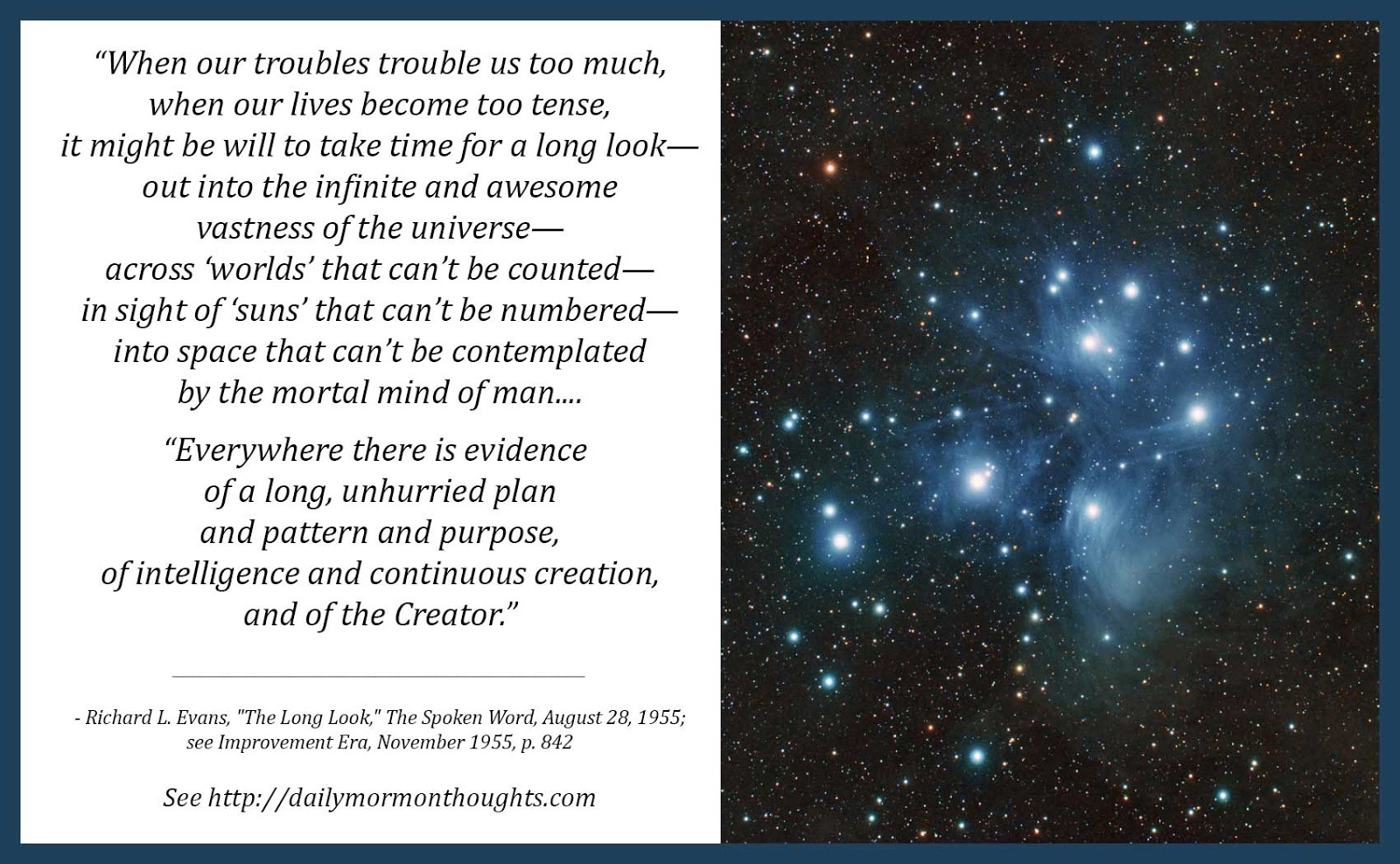
"This is a point to remember when we become too impatient with our own problems or with the many unanswered questions that are in the minds of most of us.  And when our troubles trouble us too much, when our lives become too tense, it might be will to take time for a long look—out into the infinite and awesome vastness of the universe—across 'worlds' that can't be counted—in sight of 'suns' that can't be numbered—into space that can't be contemplated by the mortal mind of man....
"Everywhere there is evidence of a long, unhurried plan and pattern and purpose, of intelligence and continuous creation, and of the Creator....
"And a long look at the endless, orderly plan and purpose of the Father of us all may make some of the petty and passing things appear not so important as they sometimes seem. And when we find ourselves in conflict and confusion, we can well learn to wait a while for all the evidence and all the answers that now evade us.
"Thank God for a glorious and interesting world, for truth, for 'infinity,' and for 'eternity' in which to find it—and for faith and assurance of the limitless and everlasting future."
- Richard L. Evans, "The Long Look," The Spoken Word, August 28, 1955; see Improvement Era, November 1955, p. 842; see also Conference Report, Oct. 1952, p. 95
Click here to read the full talk

Elder Evans was such a poetic writer and speaker. His "Music and the Spoken Word" comments were always sensitive and insightful. This is a great example of that; he describes what he understands of God's role as a creator, and how the creation is a manifestation of God's love.


The implication is that we should hurry less, and be more patient and deliberate in our planning and execution. And that we should take time to notice the evidence of God's infinite and awe-inspiring work throughout the vast universe:


During the past week, the world has been in awe as the "New Horizons" spacecraft that was launched almost a decade ago flew near to Pluto, billions of miles away from earth. We've had a small glimpse of the immensity of our own solar system, which is a fraction of the known galaxy, which is a dot within the known universe. But I wonder how many people have taken the time to consider, as Elder Evans suggests, what this says about the Creator and His "intelligence and continuous creation" that surrounds us??
// Customization to close archive widget on first view - DK 3/15