Monday, October 5, 2015

Neal A. Maxwell on feelings of inadequacy

Elder Neal A. Maxwell (1926-2004) served as a Seventy from 1976-1981, then as a member of the Quorum of Twelve until his death from cancer in 2004.
"Now may I speak, not to the slackers in the Kingdom, but to those who carry their own load and more; not to those lulled into false security, but to those buffeted by false insecurity, who, though laboring devotedly in the Kingdom, have recurring feelings of falling forever short.
"Earlier disciples who heard Jesus preach some exacting doctrines were also anxious and said, 'Who then can be saved?' (Mark 10:26.)
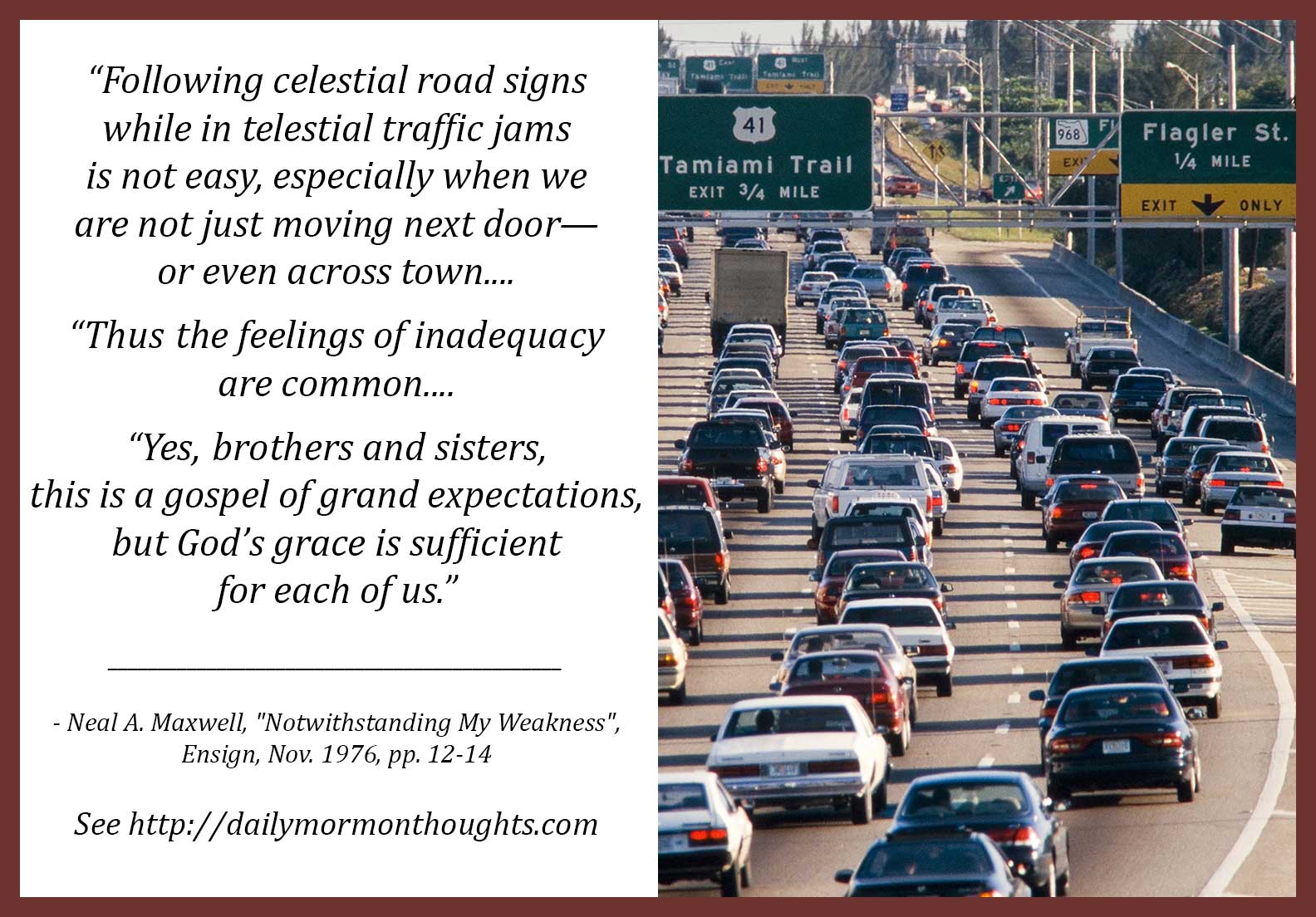
"The first thing to be said of this feeling of inadequacy is that it is normal. There is no way the Church can honestly describe where we must yet go and what we must yet do without creating a sense of immense distance. Following celestial road signs while in telestial traffic jams is not easy, especially when we are not just moving next door—or even across town....
"Thus the feelings of inadequacy are common. So are the feelings of fatigue; hence, the needed warning about our becoming weary of well-doing. (See D&C 64:33.)
"The scriptural advice, 'Do not run faster or labor more than you have strength' (D&C 10:4) suggests paced progress, much as God used seven creative periods in preparing man and this earth. There is a difference, therefore, between being 'anxiously engaged' and being over-anxious and thus underengaged....
"Yes, brothers and sisters, this is a gospel of grand expectations, but God's grace is sufficient for each of us. Discouragement is not the absence of adequacy but the absence of courage, and our personal progress should be yet another way we witness to the wonder of it all!"
- Neal A. Maxwell, "Notwithstanding My Weakness," Ensign, Nov. 1976, pp. 12-14
Click here to read the full talk

It's a marvelous gift to understand and share "things as they really are" (Jacob 4:13); it's a gift Elder Maxwell possessed. He speaks of feelings that so many of us experience — "false insecurity", inadequacy, spiritual fatigue, weariness in well-doing. Life is hard, and it sometimes gets harder because of how we react in our discouragement.

Elder Maxwell warns us to keep perspective; to be "anxiously engaged" without becoming overwhelmed. We are able to do that with God's grace, as we stay aware of our own "paced progress."


Sunday, October 4, 2015

Robert D. Hales on the continuing benefits of general conference

Elder Robert D. Hales (b. August 24, 1932) served as a Seventy from 1976 to 1985, when he was called as a member of the Quorum of Twelve Apostles.
"The greatest blessings of general conference come to us after the conference is over. Remember the pattern recorded frequently in scripture: we gather to hear the words of the Lord, and we return to our homes to live them....
"We accept the Savior's invitation when we ponder and pray to understand what we have been taught and then go forward and do His will. Remember President Spencer W. Kimball's words: 'I have made up my mind that when I go home from this [general] conference ... there are many, many areas in my life that I can perfect. I have made a mental list of them, and I expect to go to work as soon as we get through.' President Monson recently said: 'I encourage you to read the talks... and to ponder the messages contained therein. I have found in my own life that I gain even more from these inspired sermons when I study them in greater depth.'
"In addition to inviting us to hold personal and family scripture study, Heavenly Father wants us to regularly study and apply what we have learned in conference. I testify that those who put their trust in the Lord and heed this counsel in faith will gain great strength to bless themselves and their families for generations to come."
- Robert D. Hales, "Strengthening Faith and Testimony," Ensign, Nov 2013, pp. 6-8
Click here to read the full talk
This is a crucial message.  It's wonderful to enjoy General Conference messages and feel the blessing of inspired leaders giving counsel and direction. But the power comes in the application. The crucial question is, will it make a difference? Will my life be changed in any way? Have I listened carefully (both to spoken words and silent impressions) to find areas where the Lord invites me to grow and improve? And do I have a plan on how to make sure I don't forget those impressions and resolves?


At least part of the key comes in President Monson's encouragement to read the talks (they are available online almost immediately, and in print very soon) and ponder the messages. There is more to be gained as we continue to "regularly study and apply what we have learned in conference"!

Saturday, October 3, 2015

Joseph B. Wirthlin on following prophetic counsel

Elder Joseph B. Wirthlin (1917-2008) served as a Seventy from 1976 to 1986, then as a member of the Quorum of Twelve Apostles from 1986 until his passing in 2008 at age 91.
"The Lord has given us prophets to guide us and keep us from evil if we will accept and follow their instruction. The Lord would say to us today as he said to the ancient Israelites: 'Be not afraid nor dismayed... for the battle is not yours, but God's.... The Lord will be with you.... Believe in the Lord your God, so shall ye be established; believe the prophets, so shall ye prosper.' (2 Chronicles 20:15, 17, 20; emphasis added)
"In our conferences, we sustain the First Presidency and the Twelve Apostles as prophets, seers, and revelators. The Lord has appointed them as watchmen to warn the people....
"The statements of the prophets are not given to compel, coerce, dictate, control, or infringe on any person's right to choose. Church leaders are guided by the Lord's injunction in the Doctrine and Covenants: 'No power or influence can or ought to be maintained by virtue of the priesthood, only by persuasion, by long-suffering, by gentleness and meekness, and by love unfeigned; by kindness, and pure knowledge, which shall greatly enlarge the soul without hypocrisy, and without guile.' (D&C 121:41-42.)
"The prophets and other Church leaders have never misled the Latter-day Saints on a principle of righteousness. Every principle is for our benefit. However, if we choose to ignore the prophets, we choose the consequences that follow. We have the God-given agency to either follow the prophets or not, but we cannot choose the consequences of exercising that agency. They will follow with absolute certainty. If we ignore the prophets, we become like the people the Savior chastised when he said, 'Why call ye me, Lord, Lord, and do not the things which I say?' (Luke 6:46.)"
- Joseph B. Wirthlin, "The Lord's Side," address given at a Brigham Young University nineteen-stake fireside, 2 August 1992; see Ensign March 1993, p. 69
Click here to read the full talk

In the setting of General Conference, members of the Church of Jesus Christ of Latter-day Saints are given the privilege to sustain leaders. This is not a "vote" on whether we like the selections that are made; it's a chance for us to commit our hearts and deed to listen and follow counsel. Elder Wirthlin points out that the divine call comes from the Lord; these prophets will "guide us and keep us from evil if we will accept and follow their instruction." Quite a promise — but that "if" provides the all-important conditional to claim the promise!


I love that message.  We choose whether or not to sustain — as demonstrated not only by raising our hand, but also by our discipleship that will follow.  But we can not choose the consequences of our commitment to sustain or not sustain. If we raise our hand but then ignore their counsel, we receive no blessing.

Friday, October 2, 2015

Jeffrey R. Holland on peace through conference teachings

Elder Jeffrey R. Holland (b. 1940) served as Church Commissioner of Education from 1976-1980, as the president of BYU from 1980-1989, as a Seventy from 1989-1994, and as a member of the Quorum of Twelve Apostles since 1994.
"A general conference of this Church is a remarkable occasion indeed—it is an institutional declaration that the heavens are open, that divine guidance is as real today as it was for the ancient house of Israel, that God our Heavenly Father loves us and speaks His will through a living prophet....
"Peace and good tidings; good tidings and peace. These are among the ultimate blessings that the gospel of Jesus Christ brings a troubled world and the troubled people who live in it, solutions to personal struggles and human sinfulness, a source of strength for days of weariness and hours of genuine despair. This entire general conference and The Church of Jesus Christ of Latter-day Saints which convenes it declare that it is the Only Begotten Son of God Himself who gives us this help and this hope. Such assurance is as 'firm as the mountains around us.'"
- Jeffrey R. Holland, "The Peaceable Things of the Kingdom," Ensign, Nov. 1996, pp. 82-84
Click here to read the full talk

Elder Holland expresses the joy and anticipation that we feel as we anticipate the blessing of a Conference weekend—"a remarkable occasion indeed." This is a beautiful expression of the feelings of peace and joy that accompany this event, for those whose hearts are open and prepared.


 And the greatest message of all is that the "Son of God Himself" is the one who provides the inspiration that will bring "solutions to personal struggles and... a source of strength for days of weariness and hours of genuine despair." Prepare to be refreshed and reinforced!

Thursday, October 1, 2015

Howard W. Hunter on the blessing of living prophets

President Howard W. Hunter (1907-1995) was called to the Quorum of Twelve in 1959.  He served as Church President from June 5, 1994 to his death on March 3, 1995.
"A prophet is one who has been called and raised up by the Lord to further God's purposes among his children. He is one who has received the priesthood and speaks with authority. Prophets are teachers and defenders of the gospel. They bear witness of the divinity of the Lord Jesus Christ. Prophets have foretold future happenings, but this is not the most important of their responsibilities, although it may be some evidence of prophetic power....
"To peoples of past dispensations and ages, the most important prophet was the one then living, teaching, and revealing the will of the Lord in their time. In each of the past dispensations, prophets have been raised up by the Lord as his spokesmen to the people of that particular age and for the specific problems of that age.
"It is the present living prophet who is our leader, our teacher. It is from him we take direction in the modern world. From all corners of the earth, we who sustain him as a prophet of the Lord, express our appreciation for this source of divine guidance. We are grateful for his life, his example, his teachings, his leadership....
"As the prophets from the beginning to the present day pass in review before our memory, we become aware of the great blessing which comes to us from the influence of a living prophet."
- Howard W. Hunter, "Prophets in This Dispensation," Conference Report, October 1963, pp. 99-101
Click here to read the full talk

What is a prophet? What does he do? Why does it matter? A young Elder Hunter addressed these questions as a junior member of the Twelve, not knowing that years later he would be called upon to assume that prophetic role in leading the Lord's church.

A key message is that the current prophet is key to each dispensation. While we appreciate and follow the teachings of those who preceded, it's the one sent to us today who matters most to us.


How blessed we are to be living in a time when the Lord has again sent His messengers to provide direct and pertinent guidance and counsel to us!

Wednesday, September 30, 2015

Neil L. Andersen on learning to love and follow our leaders

Elder Neil L. Andersen (1951- ) served as a Seventy beginning in 1993, and was called to the Quorum of Twelve Apostles in 2009.
"For most of us, our contact with [the prophets, seers, and revelators] comes through general conference twice each year.... it is when children are young that parents must be innovative in helping them develop good habits regarding conference participation. As our children are given opportunities to observe and learn the role of these special witnesses, they will receive a spiritual confirmation of the sacred calling of their Church leaders, and they will feel a deeper love for and interest in these leaders and their message.
"Viewing the general conference sessions with our family is not sufficient to bring a love for the prophets. On one occasion some years before my call as a General Authority, I conducted a meeting presided over by one of the Apostles. After the meeting, I asked him about his stake conference talks. 'Do you prepare something specific for each stake conference?' I asked. He replied that he generally did not, but relied upon the promptings received just prior to and during the conference. But then he added, 'But my general conference talk is very different. I will normally go through twelve to fifteen drafts to be certain that it is what the Lord would have me say.' Many times since then I have asked myself, 'If an Apostle will go through twelve to fifteen drafts, is it pleasing to the Lord if I listen to or read his message one or two times? I don't think so.'"
- Neil L. Andersen, "Teaching Our Children to Love the Prophets," Ensign, April 1996, pp. 44-47
Click here to read the full talk

Elder Andersen gives every parent of young children something to ponder. They "must be innovative in helping them develop good habits regarding conference participation." A love for Church leaders and interest in their message can be set in childhood.


Elder Andersen then instructs that it's not sufficient to just sit together and watch conference. Our effort to draw inspiration from the talks should match the spiritual efforts put into preparing the talks.

Tuesday, September 29, 2015

Boyd K. Packer on following inspired leaders and preparing for conference

President Boyd K. Packer (1924-2015) served as an Assistant to the Quorum of the Twelve (a position that no longer exists) from 1961 to 1970, when he was called to the Quorum of Twelve Apostles.  He served as president of that Quorum from 1994 until his death on July 3, 2015 at age 90.
"In closing, I say again, FOLLOW THE BRETHREN. In a few days there opens another general conference of the Church. The servants of the Lord will counsel us. You may listen with anxious ears and hearts, or you may turn that counsel aside. As in these devotionals, what you shall gain will depend not so much upon their preparation of the messages as upon your preparation for them....
"On one occasion [Karl G. Maesar] was leading a party of young missionaries across the Alps. As they slowly ascended the steep slope, he looked back and saw a row of sticks thrust into the glacial snow to mark the one safe path across the otherwise treacherous mountains.
"Something about those sticks impressed him, and halting the company of missionaries he gestured toward them and said, 'Brethren, there stands the priesthood. They are just common sticks like the rest of us—some of them may even seem to be a little crooked, but the position they hold makes them what they are. If we step aside from the path they mark, we are lost.'
"I bear witness, my brethren and sisters, fellow students, that in this Church men are as they indeed must be—called of God by prophecy. May we learn in our youth this lesson; it will see us faithful through all of the challenges of our lives. May we learn to follow the brethren."
- Boyd K. Packer, "Follow the Brethren," BYU Devotional, March 23, 1965
Click here to listen to the full talk

This is one of the classic messages offered by President Packer, then a young apostle, to a BYU devotional. He points out how critical our personal attitude is, as we prepare for and listen to general conference addresses — either "with anxious ears and hearts" or casually ignoring the counsel.


The example from Karl G. Maesar's story is another classic analogy President Packer used. Priesthood leaders may be "common sticks" but their position makes them a critical guide for our lives if we are willing to watch and heed. It's vital to learn that the Church leaders will help to "see us faithful through all the challenges of our lives."
// Customization to close archive widget on first view - DK 3/15