Monday, December 14, 2015

Hugh B. Brown on the Spirit of Christmas and of Christ

Elder Hugh B. Brown (October 24, 1883–December 2, 1975) was called as an Assistant to the Twelve in 1953, then as an apostle in 1958.  He served as a counselor to President David O. McKay from 1961 until President McKay's death in 1970, then for five more years as a member of the Quorum of Twelve until he passed away.
"To catch the real meaning of the 'Spirit of Christmas' we need only to drop the last syllable of the word, and it becomes the 'Spirit of Christ.' It beckons us to follow Him and become worthy of the blessedness which He promised to the most unlikely people—the poor in spirit, the sorrowful, the meek, the seekers after righteousness, the merciful, the pure in heart, the peace makers, and even the persecuted and the oppressed.
"It is a blessed spirit and is available to all, not alone to the rich, the influential, the heralded or popular. It may pervade the humblest cottage or the palace of the king, but only when it is in the hearts of men.
"Let each man examine his own heart as he gives thanks for the peace of this Christmas and try to discover his true feelings toward his fellow men, toward those who are his neighbors, his brothers in the Church, his new friends of an allied country. Let him vigorously weed out all envy, jealousy, greed, and hatred and undertake to radiate the spirit of goodwill, of love of fellow men, not for the season only but throughout the year. 
"If this formula for happiness—love one another—is effective for one day, may it not work at other times, at all times? If by giving we receive, and by dividing we increase, why not make happiness permanent by carrying the Christmas spirit throughout the year? May we all enjoy the spirit of Christmas for the next 365 days."
- Hugh B. Brown, "The Abundant Life," pp. 305-307

President Brown was one of the beloved leaders of my youth, and I still recall the calm assurance of his teachings and testimonies. I'm not sure if he was the first to suggest this linkage between the "Spirit of Christmas" and "Spirit of Christ" but he certainly taught the idea effectively:


For those of us blessed to live in relative peace, he encouraged that "each man examine his own heart" as a part of the Christmas season, to ensure we have no inappropriate feelings towards other individuals or groups. Instead, we must "radiate the spirit of goodwill, of love" — at Christmastime and throughout the year.


Sunday, December 13, 2015

Jeffrey R. Holland on keeping a balanced Christmas perspective

Elder Jeffrey R. Holland (b. 1940) served as Church Commissioner of Education from 1976-1980, as the president of BYU from 1980-1989, as a Seventy from 1989-1994, and as a member of the Quorum of Twelve Apostles since 1994.
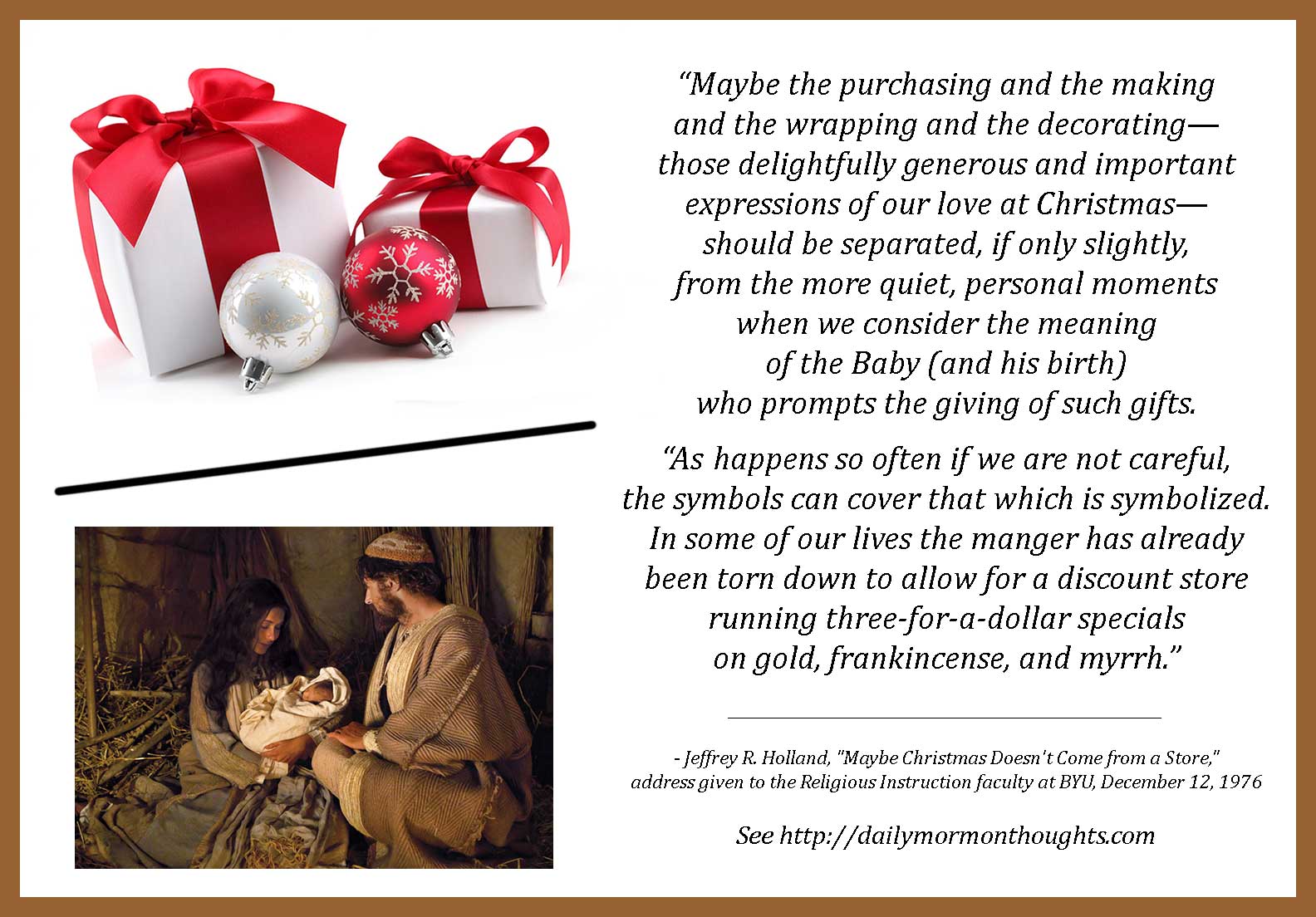
"Maybe the purchasing and the making and the wrapping and the decorating—those delightfully generous and important expressions of our love at Christmas—should be separated, if only slightly, from the more quiet, personal moments when we consider the meaning of the Baby (and his birth) who prompts the giving of such gifts.
"As happens so often if we are not careful, the symbols can cover that which is symbolized. In some of our lives the manger has already been torn down to allow for a discount store running three-for-a-dollar specials on gold, frankincense, and myrrh.
"I do not feel—or mean this to sound—like a modern-day Scrooge. The gold, frankincense, and myrrh were humbly given and appreciatively received, and so they should be, every year and always. As my wife and children can testify, no one gets more giddy about the giving and receiving of presents than I do.
"But for that very reason, I, like you, need to remember the very plain scene, even the poverty, of a night devoid of tinsel or wrapping or goods of this world. Only when we see that single, sacred, unadorned object of our devotion—the Babe of Bethlehem—will we know why 'tis the season to be jolly' and why the giving of gifts is so appropriate."
- Jeffrey R. Holland, "Maybe Christmas Doesn't Come from a Store," address given to the Religious Instruction faculty at BYU, December 12, 1976; see Ensign, Dec. 1977, pp. 63-66
Click here to read the full talk

Elder Holland has given some wonderful Christmas messages. I loved this suggestion, that we consider "separating" — even "if only slightly" — the secular and the spiritual portions of our Christmas celebration. This helps prevent our tendency to let the symbols of the holiday "cover" the things they symbolize.


It is ONLY when we focus appropriately on the Savior's birth and all that means and represents, that we can truly appreciate the joy and blessing of the rest of the Christmas season in the appropriate spirit. What a great testimony!

Saturday, December 12, 2015

James E. Faust on the Christmas message of service to God and man

President James E. Faust (1920 - 2007) was called as a Seventy in 1976, then as a member of the Quorum of Twelve in 1978. He served as a counselor to President Hinckley from 1995 until his death in 2007 at age 87.
"At this Christmas season, let us take time to ponder the significance of the birth, the life, and the death of the Savior of the world. Of all the pronouncements in sacred or profane literature, the announcement of the angel to the shepherds keeping watch over their flock by night was highly significant.
"'And the angel said unto them, Fear not: for, behold, I bring you good tidings of great joy, which shall be to all people.
"'For unto you is born this day in the city of David a Saviour, which is Christ the Lord' (Luke 2:10–11)....
"You have heard it said that the Christian ideal has not been tried and found wanting. It has been found difficult and left untried.
"At the heart of the message of the Savior of the world is a single, glorious, wonderful, still largely untried concept. In its simplest terms the message is that we should seek to overcome the selfishness we all seem to be born with, that we should overcome human nature and think of others before self. We should think of God and serve Him, and think of others and serve them."
- James E. Faust, "A Pattern of Love," Ensign, Dec. 1999, pp. 2-4
Click here to read the full talk

President Faust offered a wonderful summary of the spirit of the Christmas season, as embodied in the central message of the Savior's entire mortal ministry.


This message should be the core of our Christmas celebration, this year and always. How may I better love and serve God? How may I better love and serve my fellowmen? This "Christian ideal" must not be neglected just because it may be difficult. But it ceases to become difficult as we follow more faithfully and become more like Him who showed us the way.

Friday, December 11, 2015

Howard W. Hunter on the power of having Christ formed in us

President Howard W. Hunter (1907-1995) was called to the Quorum of Twelve in 1959.  He served as Church President for only nine months, from June 5, 1994 to his death on March 3, 1995.
"In Paul's short letter to the Galatians, he showed great concern over their apparent disbelief and their forsaking of his teachings regarding Christ. He wrote to them: 'But it is good to be zealously affected always in a good thing, and not only when I am present with you. My little children, of whom I travail in birth again until Christ be formed in you....' (Gal. 4:18–19). In other words, Paul expressed himself as suffering pain and anxiety until Christ be 'formed' in them. This is another way of saying 'in Christ,' as that expression is used by Paul repeatedly in his writings.
"It is possible for Christ to be born in men's lives, and when such an experience actually happens, a man is 'in Christ'—Christ is 'formed' in him. This presupposes that we take Christ into our hearts and make him the living contemporary of our lives. He is not just a general truth or a fact in history, but the Savior of men everywhere and at all times. When we strive to be Christlike, he is 'formed' in us; if we open the door, he will enter; if we seek his counsel, he will counsel us. For Christ to be 'formed' in us, we must have a belief in him and in his atonement. Such a belief in Christ, and the keeping of his commandments, are not restraints upon us. By these, men are set free. This Prince of Peace waits to give peace of mind which may make each of us a channel of that peace.
"The real Christmas comes to him who has taken Christ into his life as a moving, dynamic, vitalizing force. The real spirit of Christmas lies in the life and mission of the Master."
- Howard W. Hunter, "The Real Christmas," BYU Devotional, 5 December 1972
Click here to read the full talk

President Hunter discusses a most fascinating phrase from Paul's teachings: having Christ "formed in us." That occurs, President Hunter states, when Christ is born in our lives. We talk about having His image in our countenance (Alma 5:14, 19); this perhaps describes the beginning of that process. As He is born in us, formed in us, He becomes the primary influence, the core of our being, the center of our choices and priorities. As we become more like Him, we become the "express image" of Him, just as He is of His Father.


The key to the process, according to President Hunter: "This presupposes that we take Christ into our hearts and make him the living contemporary of our lives." It's up to each of us to start the process.

Thursday, December 10, 2015

David O. McKay on communion with God and service to man

President David O. McKay (1873-1970) was called to the Quorum of Twelve Apostles in 1906.  He served as a counselor in the First Presidency to Heber J. Grant and George Albert Smith beginning in 1945, then then as the president of the Church from 1951 to his death in 1970 at age 96.
"All that has been said and done and sung, all the testimonies borne have directly or indirectly led to this divine admonition: 'Seek ye first the kingdom of God, and his righteousness; and all these things shall be added unto you' (Matt. 6:33).
"Let us then make God the center of our lives. That was one of the first admonitions given when the gospel was first preached to man. To have communion with God, through his Holy Spirit, is one of the noblest aspirations in life. It is when the peace and love of God have entered the soul, when serving him becomes the motive factor in one's life and existence that we can touch other lives, quickening and inspiring them, even though no word be spoken. There is operative in the world a spiritual force as active and as real as the waves that have carried the message today to those tens of thousands by radio and television."
- David O. McKay, :Let Us Make God the Center of Our Lives," Conference Report, October 1954, pp. 131-133
Click here to read the full talk

President McKay posits that making God the center of our lives was "one of the first admonitions given when the gospel was first preached to man." Perhaps those words were not used, but it's certainly been a recurring theme at least since the first of the decalogue admonished to have no other gods before God. And certainly Adam was instructed in his devotion to God above all else.

I love the description and promises President McKay offers of the joy this relationship can bring to a humble life.


President McKay's personal testimony seals the message. He knew, from personal experience, the joy of following this divine admonition. God truly was the center for President McKay. May He be in that place for all of us!

Wednesday, December 9, 2015

Neal A. Maxwell on patient growth and progress in life as we trust God

Elder Neal A. Maxwell (1926-2004) served as a Seventy from 1976-1981, then as a member of the Quorum of Twelve until his death from cancer in 2004.
"In life, the sandpaper of circumstances often smooths our crustiness and patiently polishes our rough edges. There is nothing pleasant about it, however. And the Lord will go to great lengths in order to teach us a particular lesson and to help us to overcome a particular weakness, especially if there is no other way.
"In such circumstances, it is quite useless for us mortals to try to do our own sums when it comes to suffering. We can't make it all add up because clearly we do not have all the numbers. Furthermore, none of us knows much about the algebra of affliction.
"The challenges that come are shaped to our needs and circumstances, sometimes in order to help our weaknesses become strengths. Job noted how tailored his challenges were, saying, 'For the thing which I greatly feared has come upon me, and that which I was afraid of is come unto me.' (Job 3:25.) Yet he prevailed—so much so that he was held up as a model to the great latter-day prophet, Joseph Smith. (D&C 121.) ...
"Thus, when we are patiently growing and keeping the commandments of God and doing our duties, we are to that extent succeeding, a fact from which we should derive some quiet, inner reassurance.  Knowing that we are in the process of succeeding, even though we have much to do and much to improve upon, can help us to move forward while, at the same time, being 'of good cheer.'"
- Neal A. Maxwell, Notwithstanding My Weakness [Deseret 19981], pp. 67-68

Elder Maxwell's poetic prose and vivid analogies never fail to inspire me. This suggestion of a "divine sandpaper" being used to help smooth our rough edges is a great one. There is someone who identifies the need, and is willing to employ the remedy, even though it may not be gentle.


Are we willing recipients of that "sanding" that occasionally comes in our lives? Do we learn to recognize it for what it is, to rejoice when it comes, and to know that once the process is over we will be "more fit for the kingdom"?

I also appreciated the next analogy.  As mortals, we often "try to do our own sums when it comes to suffering." We want everything to add up, to make sense. But we can't always "do the math" because we don't understand God's perspective. We don't have all the information needed to make sense of the circumstances. We have to learn to trust Him. As we do, "patiently growing" in the process, we can find not only inner peace but much "good cheer" in knowing that God is in charge.

Tuesday, December 8, 2015

Richard G. Scott on the blessings of pondering scripture

Elder Richard G. Scott (1928-2015) served as a Seventy from 1977-1988, when he was called to the Quorum of Twelve Apostles.  He passed away in September 2015 at the age of 86.
"Pondering a scripture... gives great direction to life. The scriptures can form a foundation of support. They can provide an incredibly large resource of willing friends who can help us. A memorized scripture becomes an enduring friend that is not weakened with the passage of time.
"Pondering a passage of scripture can be a key to unlock revelation and the guidance and inspiration of the Holy Ghost. Scriptures can calm an agitated soul, giving peace, hope, and a restoration of confidence in one's ability to overcome the challenges of life. They have potent power to heal emotional challenges when there is faith in the Savior. They can accelerate physical healing.
"Scriptures can communicate different meanings at different times in our life, according to our needs. A scripture that we may have read many times can take on nuances of meaning that are refreshing and insightful when we face a new challenge in life."
- Richard G. Scott, "The Power of Scripture", Ensign, Nov. 2011, pp. 6-8
Click here to read the full talk

In this message, Elder Scott provided a reminder of the strength and help available as we read, study, ponder, and even memorize the scriptures.


I love the thought of memorized passages becoming "enduring friend[s]" that can continue to bless us over time. I have found that to be the case, as certain passages have been helpful to me time after time. I've also witnessed many times the truth of the last thought of this excerpt—a passage can communicate something today that it never has in dozens of previous readings.

But the essential insight of this message is that we need to claim the blessings the scriptures offer. Passive possession of a sacred record has little value. It is only actively studying, and especially pondering, that can direct our course and bless our journey in life.
// Customization to close archive widget on first view - DK 3/15