Wednesday, April 27, 2016

Howard W. Hunter on meekness and following Christ's way

President Howard W. Hunter (1907-1995) was called to the Quorum of Twelve in 1959.  He served as Church President for only nine months, from June 5, 1994 to his death on March 3, 1995.
"And what of the meek? In a world too preoccupied with winning through intimidation and seeking to be number one, no large crowd of folk is standing in line to buy books that call for mere meekness. But the meek shall inherit the earth—a pretty impressive corporate takeover, and done without intimidation! Sooner or later—and we pray sooner rather than later—everyone will acknowledge that Christ's way is not only the right way, but ultimately the only way to hope and joy. Every knee shall bow and every tongue will confess that gentleness is better than brutality, that kindness is greater than coercion, that the soft voice turneth away wrath. In the end, and sooner than that whenever possible, we must be more like him."
- Howard W. Hunter, "Jesus, the Very Thought of Thee," Ensign, May 1993, pp. 63-65
Click here to read the full talk

Sometimes we speak and write about things we are trying to learn or emulate; sometimes we share the things we have learned personally. In this case, I think President Hunter was speaking from the heart of one who exemplified the virtues he was discussing. I have always thought of him as one of the truly meek and gentle spirits of our time. For him to encourage greater meekness, and more Christlike behavior, seems to be a call to "come, try what I have tried and found to be joyful."


This is interesting reasoning. The day will come when all will acknowledge the validity of "Christ's way" as the only way—the only way to peace, joy, and hope. So why should we not try to follow that way more closely now?

Tuesday, April 26, 2016

Robert D. Hales on the blessings of temples

Elder Robert D. Hales (1932- ) served as a Seventy from 1976 to 1985, when he was called as a member of the Quorum of Twelve Apostles.
"Despite many tribulations in the Prophet Joseph's life, great things were brought to pass for the Restoration of the gospel in these latter days. Joseph came to understand and has taught us that when he was struggling with a challenge, the Lord did not let him perish. Similarly, tests of our faith are priceless opportunities to discover how deeply the Master cares about the welfare of our souls to help us endure to the end.
"In our day, the steadying arm of the Lord reaches us through the ordinances of His holy temples. Said the Prophet Joseph to the early Saints in Nauvoo, 'You need an endowment, brethren, in order that you may be prepared and able to overcome all things' (History of the Church, 2:309). How right he was! Being blessed with the temple covenants and endowed with power made it possible for the Latter-day Saints to endure tribulation with faith. At the end of her own pioneer journey, Sarah Rich recorded, 'If it had not been for the faith and knowledge that was bestowed upon us in that temple... our journey would have been like... taking a leap in the dark' (Sarah DeArmon Pea Rich, Autobiography, 1885-1893, p. 66)."
- Robert D. Hales, "Faith through Tribulation Brings Peace and Joy," Ensign, May 2003, pp. 15-18
Click here to read the full talk
It's always wonderful to ponder what is accomplished despite tribulations. Elder Hales suggests the example of Joseph Smith, who (in spite of great trials) was an instrument in the restoration of many gifts in these latter days.  Elder Hales points out that these times can help us "to discover how deeply the Master cares about the welfare of our souls" as we confront, and survive, the challenges.

I happen to be in Nauvoo as I am preparing this thought. I can look out my hotel window at the marvelous reconstructed temple, that so profoundly represents the faith and sacrifice of a previous generation of Saints. I loved this final thought about the role of the temple and the endowment, and the power that can come to those whose hearts are ready. The testimony of Sarah Rich was especially touching; it is the temple, its ordinances and teachings, that gives power to endure whatever may come.


Monday, April 25, 2016

L. Tom Perry on finding spiritual fuel

Elder L. Tom Perry (1922-2015) was called as an Assistant to the Twelve in 1972, then as a member of the Quorum of Twelve Apostles in 1974. At the time of his passing at age 92, he was the oldest living general authority and the third in seniority among the leading quorum.
"The Lord has given us a beautiful plan about how we can return to Him, but the completion of our mortal journey requires spiritual fuel. We want to emulate the five wise virgins, who had stored sufficient fuel to accompany the bridegroom when he came (see Matthew 25:6-10). What is required to maintain a sufficient store of spiritual fuel? We must acquire knowledge of God's eternal plan and our role in it, and then by living righteously, surrendering our will to the will of the Lord, we receive the promised blessings....
"Just before Thoreau died, he was asked if he had made peace with God. He replied, 'I was not aware we had ever quarreled' (in Mardy Grothe, comp., Viva la Repartee [2005], 181).
"In our search to obtain relief from the stresses of life, may we earnestly seek ways to simplify our lives. May we comply with the inspired counsel and direction the Lord has given us in the great plan of happiness. May we be worthy to have the companionship of the Holy Ghost and follow the guidance of the Spirit as we navigate this mortal journey. May we prepare ourselves to accomplish the ultimate purpose of this mortal test--to return and live with our Heavenly Father."
- L. Tom Perry, "Let Him Do It with Simplicity," Ensign, Nov. 2008, pp. 7-10
Click here to read the full talk
There are several points that interested me in this excerpt. Elder Perry encourages us to have an adequate reserve of "spiritual fuel" for times that require it. We can obtain that fuel, and maintain our store of it, by:

  • acquiring knowledge of God's eternal plan and our role in it
  • living righteously, surrendering our will to the will of the Lord
In simpler words, learn and do.


The final paragraph gives a series of good advice:

  • We can find relief from the stress of life by simplifying our lives
  • Peace comes as we comply with the counsel given to follow the plan of salvation
  • We can best navigate the journey of mortality with the aid of the Holy Ghost
  • The real and final purpose of all we to is to prepare to return to live with God

Sunday, April 24, 2016

Marvin J. Ashton on showing real love to God and one another

Elder Marvin J. Ashton (1915-1994) served as a member of the Quorum of Twelve Apostles from 1971 until his death in 1994 at age 78.
"We must at regular and appropriate intervals speak and reassure others of our love and the long time it takes to prove it by our actions. Real love does take time. The Great Shepherd had the same thoughts in mind when he taught, 'If ye love me, keep my commandments' (John 14:15; italics added) and 'If ye love me feed my sheep' (John 21:16; italics added). Love demands action if it is to be continuing. Love is a process. Love is not a declaration. Love is not an announcement. Love is not a passing fancy. Love is not an expediency. Love is not a convenience. 'If ye love me, keep my commandments' and 'If ye love me feed my sheep' are God-given proclamations that should remind us we can often best show our love through the processes of feeding and keeping....
"Certainly the best way for us to show our love in keeping and feeding is by taking the time to prove it hour by hour and day by day. Our expressions of love and comfort are empty if our actions don't match. God loves us to continue. Our neighbors and families love us if we will but follow through with sustaining support and self-sharing. True love is as eternal as life itself. Who is to say the joys of eternity are not wrapped up in continuous feeding, keeping, and caring? We need not weary in well-doing when we understand God's purposes and his children.
"Undoubtedly our Heavenly Father tires of expressions of love in words only. He has made it clear through his prophets and his word that his ways are ways of commitment, and not conversation. He prefers performance over lip service. We show our true love for him in proportion to our keeping his words and the processes of feeding."
- Marvin J. Ashton, "Love Takes Time," Ensign, Nov. 1975, pp. 108-110
Click here to read the full talk

This is a beautiful summary of an eternally-important principle and doctrine: love, both as we interact with one another and as we interact with God, is not a passive declaration; it is a constant outward demonstration of an inward commitment. While it is important that we "at regular and appropriate intervals speak and reassure others of our love," it is much more important that we demonstrate that love through our actions. As Elder Ashton pointedly says, "Our expressions of love and comfort are empty if our actions don't match."


And while this principle is important as we consider our interactions with one another, it is even more crucial as we think about our relationship to our Father in Heaven. He asked for "commitment, not conversation" and "performance over lip service." The true demonstration of our love for Him is in how we obey His commandments and how we feed His sheep.

Saturday, April 23, 2016

Joseph B. Wirthlin on the Lord's help in life's journey

Elder Joseph B. Wirthlin (1917-2008) served as a Seventy from 1976 to 1986, then as a member of the Quorum of Twelve Apostles from 1986 until his passing in 2008 at age 91.
"We all are going through different life experiences. While some are filled with joy today, others feel as though their hearts could burst with sorrow. Some feel as though the world is their oyster; others feel as though they were the oyster itself, plucked from the ocean, cracked open, and robbed of all that is precious to them....
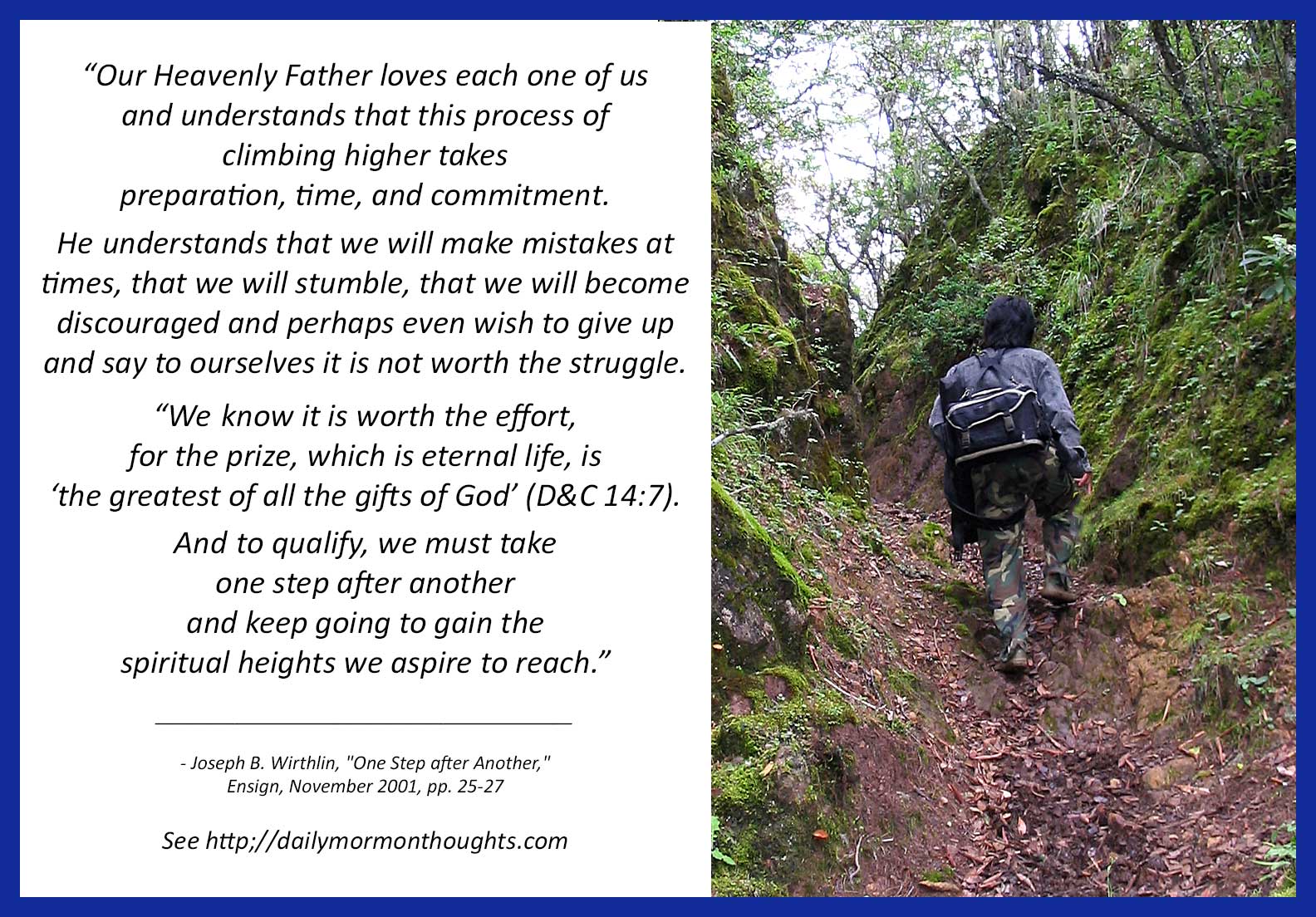
"Our Heavenly Father loves each one of us and understands that this process of climbing higher takes preparation, time, and commitment. He understands that we will make mistakes at times, that we will stumble, that we will become discouraged and perhaps even wish to give up and say to ourselves it is not worth the struggle.
"We know it is worth the effort, for the prize, which is eternal life, is 'the greatest of all the gifts of God' (D&C 14:7). And to qualify, we must take one step after another and keep going to gain the spiritual heights we aspire to reach....
"My brothers and sisters, our time here is so precious and so short. How well I understand the prophet Jacob when he said, 'Our lives passed away like as it were unto us a dream' (Jacob 7:26).
"All too soon, our time is finished. While we can—while we have the time to complete our work—let us walk in the right direction, taking one step after another.
"That is easy enough. We don't have to be perfect today. We don't have to be better than someone else. All we have to do is to be the very best we can.
"Though you may feel weary, though you sometimes may not be able to see the way, know that your Father in Heaven will never forsake His righteous followers. He will not leave you comfortless. He will be at your side, yes, guiding you every step of the way."
- Joseph B. Wirthlin, "One Step after Another," Ensign, November 2001, pp. 25-27
Click here to read the full talk

I can personally confirm the truth of the thoughts of this excerpt:

  • We have varied experiences in this life, including both soul-bursting joy and soul-wrenching sorrow (agony, frustration, annoyance, etc.)
  • Climbing out of our challenges and upward to the heights does indeed take "preparation, time, and commitment"
  • In spite of signs of growth and progress, we often to have frustrations and discouragements along the climb that invite us to give up and fall back
  • Understanding the goal and purpose of the climb makes a tremendous difference on both our ability to continue eagerly upward and our strength to resist discouragement and back-sliding
  • Time is precious and short, and we should eagerly take advantage of each hour of the journey
  • It matters not a whit how we compare to others; only that we ourselves are making our own best effort
  • We do not have to make the climb alone; there is One willing to be by our side as a guide and counselor


Friday, April 22, 2016

Dale G. Renlund on blessings that come as we draw closer to God

Elder Dale G. Renlund (b. November 13, 1952) served in the First Quorum of Seventy starting in 2009, until his call to the Quorum of Twelve in October 2015.
"The closer we are to Jesus Christ in the thoughts and intents of our hearts, the more we appreciate His innocent suffering, the more grateful we are for grace and forgiveness, and the more we want to repent and become like Him. Our absolute distance from Heavenly Father and Jesus Christ is important, but the direction we are heading is even more crucial. God is more pleased with repentant sinners who are trying to draw closer to Him than with self-righteous, faultfinding individuals who, like the Pharisees and scribes of old, do not realize how badly they need to repent (see Luke 15:2; see also Joseph Smith, in History of the Church, 5:260–62)....
"Whatever our current direction or distance to Heavenly Father and Jesus Christ, we can choose to turn toward Them and draw closer to Them....
"To draw closer to the Savior, we must increase our faith in Him, make and keep covenants, and have the Holy Ghost with us. We must also act in faith, responding to the spiritual direction we receive. All of these elements come together in the sacrament. Indeed, the best way I know of to draw closer to God is to prepare conscientiously and partake worthily of the sacrament each week....
"No matter where you stand in your relationship to God, I invite you to draw nearer to Heavenly Father and Jesus Christ, the Ultimate Benefactors and Givers of all that is good. I invite you to attend sacrament meeting each week and partake of the holy emblems of the Savior’s body and blood. I invite you to feel God’s nearness as He is made known to you, as He was to the disciples of old, in the 'breaking of [the] bread.'
"As you do, I promise that you will feel nearer to God. Natural tendencies to childish whining, disgruntled entitlement, and derisive skepticism will dissipate. Those sentiments will be replaced by feelings of greater love and gratitude for Heavenly Father’s gift of His Son. As we draw closer to God, the enabling power of the Atonement of Jesus Christ will come into our lives. And, as with the disciples on the way to Emmaus, we will find that the Savior has been nearby all along."
- Dale G. Renlund, "That I Might Draw All Men unto Me," General Conference, April 2016, Saturday morning session
Click here to read the full talk

I thought Elder Renlund's talk was masterful. He introduced his thoughts with the classic insight once shared by an associate: "The greater the distance between the giver and the receiver, the more the receiver develops a sense of entitlement." That was applied first to the giving of charity, and a review of Church welfare principles. But then it was applied to our relationship with Deity, and the insights were wonderfully beneficial.

This was an invitation to all to "draw near unto" the Savior and our Father in Heaven, and a promise of the blessings that would follow. Some of the specific things Elder Renlund suggested we might do include:
  • increase our faith in Him
  • make and keep covenants
  • have the Holy Ghost with us
  • act in faith, responding to the spiritual direction we receive
He suggested that these items share a focal point in the sacrament, which provides a tool to draw us closer to God as we "prepare conscientiously and partake worthily of the sacrament each week."


I love a challenge with a promise—an invitation to be blessed as we accept inspired counsel. The promises listed here are some I very much desire.

Thursday, April 21, 2016

Gary E. Stevenson on the importance of priesthood keys

Elder Gary E. Stevenson (b. 1955) was called as a Seventy in 2008, then as Presiding Bishop in 2012. He was called as a member of the Quorum of Twelve Apostles in October 2015..
"My heart is filled with overwhelming gratitude for the restoration of priesthood authority and priesthood keys. Without this restoration, we would be locked out from the vehicle necessary to transport us on our journey home to loving heavenly parents. The performance of every ordinance of salvation comprising our covenant pathway back to the presence of our Father in Heaven requires appropriate governance through priesthood keys....
"The priesthood, or priesthood authority, has been defined as 'the power and authority of God' (Handbook 2: Administering the Church (2010), page 8.) and “the consummate power on this earth' (Boyd K. Packer, 'Priesthood Power in the Home.' worldwide leadership training meeting, Feb. 2012; see also James E. Faust, 'Power of the Priesthood,' Ensign, May 1997, 41–43). Priesthood keys are defined for our understanding as well: 'Priesthood keys are the authority God has given to priesthood leaders to direct, control, and govern the use of His priesthood on earth' (Handbook 2, 2.1.1). Priesthood keys control the exercise of priesthood authority. Ordinances that create a record in the Church require keys and cannot be done without authorization. Elder Dallin H. Oaks taught that 'ultimately, all keys of the priesthood are held by the Lord Jesus Christ, whose priesthood it is. He is the one who determines what keys are delegated to mortals and how those keys will be used' (Dallin H. Oaks, 'The Keys and Authority of the Priesthood,' Ensign, May 2014, 50)."
- Gary E. Stevenson, "Where Are the Keys and Authority of the Priesthood?," General Conference, April 2016, Saturday morning session
Click here to read the full talk

This talk, given in the first general session of conference, was a good review of basic priesthood concepts. It might have been a talk shared in a priesthood session, but I think it was wonderful to have it shared with the general membership. I think the concept of priesthood keys continues to not be well understood in the Church; discussions like this one will be helpful.


This is a key concept: "Every ordinance of salvation" is governed and directed by priesthood keys. In other words, no priesthood holder can perform such ordinances on his own, unless authorized and directed by one who holds appropriate keys to direct the performance of those ordinances. This helps maintain order, ensures that proper records are kept, and demonstrates that authority is delegated and not "owned." Great principles!
// Customization to close archive widget on first view - DK 3/15