Tuesday, June 21, 2016

Russell M. Nelson on obtaining spiritual power through sincere prayer

President Russell M. Nelson (b. Sept 9, 1924) was an internationally-renowned heart surgeon when he was called to serve as a member of the Quorum of Twelve Apostles in 1984. He was set apart as president of the Quorum of Twelve on July 15, 2015.
"The source of our spiritual power is the Lord! The ultimate source of spiritual power is God our Father. The messenger of this power is the Holy Ghost. This power differs from electrical power. An electrical appliance consumes power. The use of His spiritual power replenishes our power. While electrical power can be used only for measured periods of time, spiritual power can be used for time and eternity!
"Our spiritual power line is strengthened through prayer. As we counsel with God in all our doings, he will direct us for good. (See Alma 37:37.) Prayer is available whenever we ask for it!
"But the Lord places the initiative upon us. He expects us to reach for his power, just as we must insert the plug in the outlet for electricity. He said, 'If thou shalt ask, thou shalt receive revelation upon revelation, knowledge upon knowledge, that thou mayest know the mysteries and peaceable things—that which bringeth joy, that which bringeth life eternal.' (D&C 42:61; italics added.) Personal worthiness and scripture study enable us to do more with this power."
- Russell M. Nelson, "Protect the Spiritual Power Line," Ensign, Nov 1984, pp. 30-32
Click here to read the full talk

In this talk, President Nelson taught about "Spiritual Power Lines" that connect us to the source of spiritual strength, using the analogy of electrical power. It's critical that we maintain our connection to the source that can bring us that strength; and God is the source, via the Holy Ghost.


Establishing communication with God through prayer is a great key to maintaining those "power lines," enhanced by our scripture study and personal worthiness. It doesn't just happen; it requires our effort to establish and maintain that power connection!

Monday, June 20, 2016

Dieter F. Uchtdorf on the process of perfection

President Dieter F. Uchtdorf (1940- ) served as a Seventy from 1994-2004, when he was called as a member of the Quorum of Twelve.  He has served as second counselor in the First Presidency since 2008.
"God is fully aware that you and I are not perfect.
"Let me add: God is also fully aware that the people you think are perfect are not.
"And yet we spend so much time and energy comparing ourselves to others—usually comparing our weaknesses to their strengths. This drives us to create expectations for ourselves that are impossible to meet. As a result, we never celebrate our good efforts because they seem to be less than what someone else does.
"Everyone has strengths and weaknesses.
"It's wonderful that you have strengths.
"And it is part of your mortal experience that you do have weaknesses.
"God wants to help us to eventually turn all of our weaknesses into strengths (see Ether 12:27), but He knows that this is a long-term goal. He wants us to become perfect (see 3 Nephi 12:48), and if we stay on the path of discipleship, one day we will. It's OK that you're not quite there yet. Keep working on it, but stop punishing yourself.
"Dear sisters, many of you are endlessly compassionate and patient with the weaknesses of others. Please remember also to be compassionate and patient with yourself."
- Dieter F. Uchtdorf, "Forget Me Not," Ensign, Nov 2011, pp. 120-123
Clock here to read the full talk

These remarks were shared by President Uchtdorf as part of an address to a General Relief Society Meeting. They provided a welcome perspective to many, both women and men, who struggle with the perception of their own faults and shortcomings at various times. He helps us all understand that we increase our difficulties in our continual comparisons with others. I thought this warning was very insightful:


The "bottom line" is that we're all imperfect, but we all have the potential to grow and improve towards perfection—individually, in our particular and personal situation. The crucial message is to "stay on the path of discipleship," being compassionate with ourselves, knowing that God will bless and aid us in the journey—one by one.

Sunday, June 19, 2016

Neal A. Maxwell on the example of a righteous father

Elder Neal A. Maxwell (1926-2004) served as a Seventy from 1976-1981, then as a member of the Quorum of Twelve until his death from cancer in 2004.
"A father who truly loves his children, and who is truly striving, for instance, to become a better man, sends off to his children all kinds of messages, in a variety of ways, that lets them know he loves them and that he is a serious disciple of Jesus Christ. Then his children can more easily forgive him the tactical errors, because his basic message is intact: he believes in God and he cares for his family.
"On the other hand, for the father who is not truly serious in his discipleship, no number of compensatory techniques or humanistic sentiments can ever compensate for the failure of that father to teach the truth by precept and by example."
- Neal A. Maxwell, "That My Family Should Partake," p. 108

A father who "truly loves his children" will show them two critical things: he loves them, and he loves God. But often he shows his family he loves them by the way he loves God; by his expression of how he is "a serious disciple of Jesus Christ." That aspect of fatherhood, sadly, seems to be more rare in the world today. This is a powerful reminder for those of us given the privilege to be a father.


Saturday, June 18, 2016

Boyd K. Packer on the sacred, eternal role of fathers

President Boyd K. Packer (1924-2015) served as an Assistant to the Quorum of the Twelve (a position that no longer exists) from 1961 to 1970, when he was called to the Quorum of Twelve Apostles.  He served as president of that Quorum from 1994 until his death on July 3, 2015 at age 90.
"Now, fathers, I would remind you of the sacred nature of your calling. You have the power of the priesthood directly from the Lord to protect your home. There will be times when all that stands as a shield between your family and the adversary's mischief will be that power. You will receive direction from the Lord by way of the gift of the Holy Ghost.
"The adversary is not actively disturbing our Church meetings—perhaps only occasionally. By and large we are free to assemble as we wish without much disruption. But he and those who follow him are persistent in attacking the home and the family.
"The ultimate end of all activity in the Church is that a man and his wife and their children might be happy at home, protected by the principles and laws of the gospel, sealed safely in the covenants of the everlasting priesthood.
"Every law and principle and power, every belief, every ordinance and ordination, every covenant, every sermon and every sacrament, every counsel and correction, the sealings, the calls, the releases, the service—all these have as their ultimate purpose the perfection of the individual and the family, for the Lord has said, 'This is my work and my glory—to bring to pass the immortality and eternal life of man' (Moses 1:39)."
- Boyd K. Packer, "The Power of the Priesthood," Ensign, May 2010, p. 6-10
Click here to read the full talk

It's the "sacred nature" of the "calling" of a father that is often forgotten in today's world, and this is a good reminder from President Packer. The need for priesthood power in protecting the home has never been greater; what a profound and prophetic statement this is: "There will be times when all that stands as a shield between your family and the adversary's mischief will be that power." How critical for every father to honor the gift he has been given!


I liked the strength of that final paragraph, clarifying and summarizing the "ultimate purpose" of all we do in the Church—"the perfection of the individual and the family." That, too, is far too often forgotten in our many programs, efforts, and initiatives!

Friday, June 17, 2016

Henry B. Eyring on friendship and inspired service

President Henry B. Eyring (born May 31, 1933) served in the Presiding Bishopric from 1985-1992, as a Seventy from 1992-1995, then was called to the Quorum of Twelve Apostles. He has served in the First Presidency since 2007.
"I think of [the challenge of enduring] each time I visit with new members of the Church. I get that opportunity often, across the world. I see their trusting faces, and often they tell me about some trial of their faith, and then, with urgency in their voices, they whisper, 'Please pray for me.' At those moments, I feel again the weight of the charge to each of us from the Lord's living prophet. It is to keep the promise we made in the waters of baptism 'to bear one another's burdens' (Mosiah 18:8). It is to be a friend....
"The Holy Ghost is a comforter and a guide. But it is also a cleansing agent. That is why service in the kingdom is so crucial to enduring. When we are called to serve, we can pray for the Holy Ghost to be our companion with assurance it will come. When we ask in faith, a change can come in our natures both for the welfare of our souls and to strengthen us for the tests we all must face."
- Henry B. Eyring, "True Friends," Ensign, May 2002, pp. 26-29
Click here to read the full talk

Much of President Eyring's talk dealt with the ways we should strengthen and care for new members of the Church. I was touched by the tenderness of the first paragraph of this excerpt, and the concern expressed by members as they deal with trials and challenges. What a sacred charge, to "bear one another's burdens."

As we strive to serve and strengthen one another, we have a precious source of help. The Holy Ghost is promised as an agent to cleanse and purify, that we might be better qualified to serve and endure.


Thursday, June 16, 2016

Thomas S. Monson on the heroes in our personal hall of fame

President Thomas S. Monson (b. 1927) was sustained to the Quorum of Twelve Apostles in 1963.  He served as a counselor in the First Presidency with Presidents Benson, Hunter, and Hinckley until becoming Church president in 2008.
"In the interior of our consciousness, each of us has a private Hall of Fame reserved exclusively for the real leaders who have influenced the direction of our lives. Relatively few of the many men who exercise authority over us from childhood through adult life meet our test for entry to this roll of honor. That test has very little to do with the outward trappings of power or an abundance of this world's goods. The leaders whom we admit into this private sanctuary of our reflective meditation are usually those who set our hearts afire with devotion to the truth, who make obedience to duty seem the essence of manhood, who transform some ordinary routine occurrence so that it becomes a vista whence we see the person we aspire to be....
"Some may question, 'But what is the value of such an illustrious list of heroes and heroines, even a private Hall of Fame?' I answer. When we obey, as did Adam, endure as did Job, teach as did Paul, testify as did Peter, serve as did Nephi, give ourselves as did the prophet Joseph, respond as did Ruth, honor as did Mary, and live as did Christ, we are born anew. All power becomes ours. Cast off forever is the old self and with it defeat, despair, doubt, and disbelief. To a newness of life we come—a life of faith, hope, courage, and joy. No task looms too large. No responsibility weighs too heavily. No duty is a burden. All things become possible."
- Thomas S. Monson, "My Personal Hall of Fame," Ensign, Nov 1974, 107; reprinted Ensign, July 1991, 2
Click here to read the full talk

Who are my heroes and heroines? That's a telling question in many ways. It reveals our priorities in life and shows where our focus is. Those we respect and admire most will be those we emulate most, sometimes consciously and sometimes unconsciously.

This was a very interesting talk by President Monson, discussing some of those who are in his "personal hall of fame" and encouraging us to consider the same question. This was a wonderful summary of the transforming power the right kind of hero can have in a life:


Wednesday, June 15, 2016

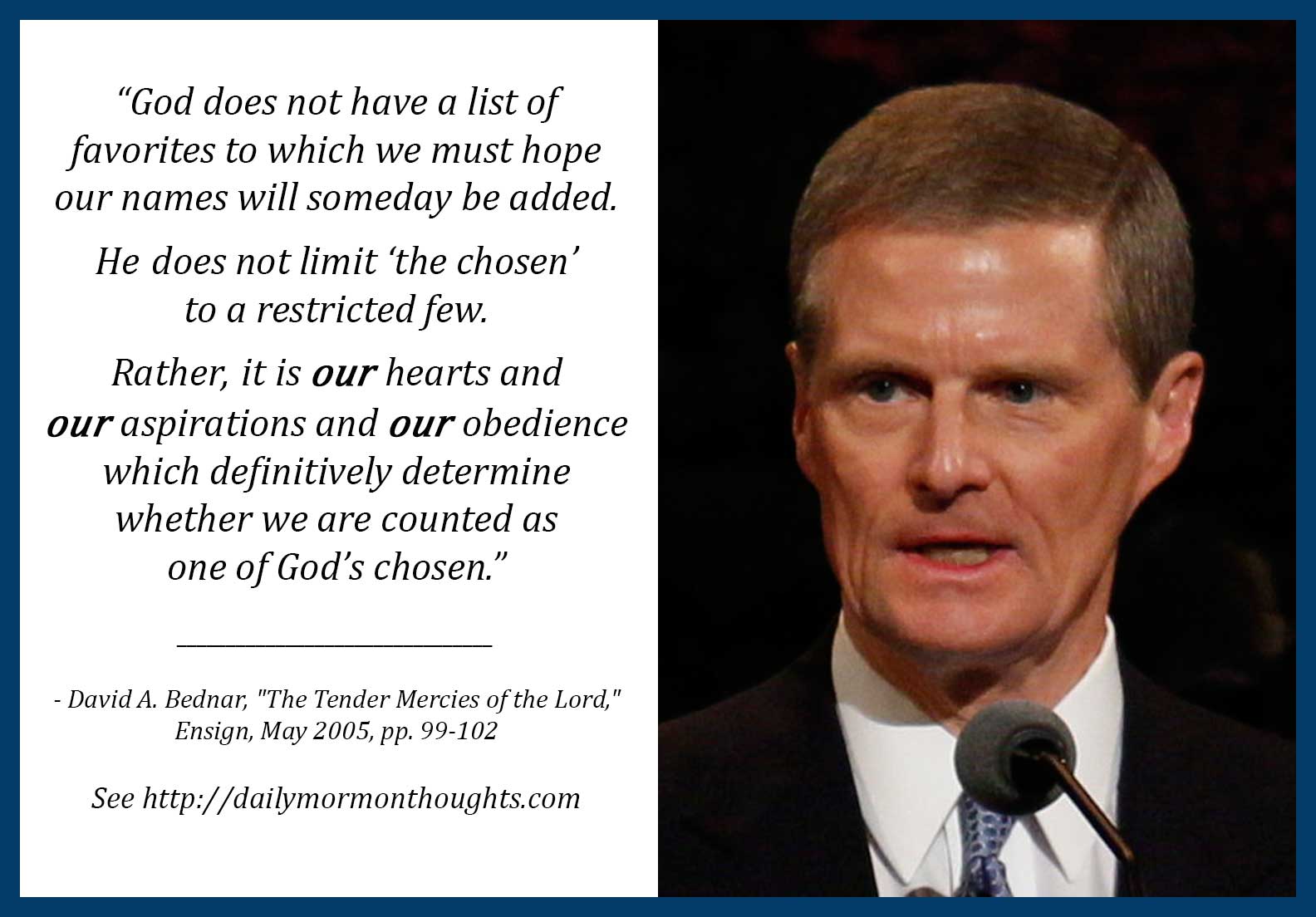
David A. Bednar on becoming chosen by choosing God in our lives

Elder David A. Bednar (born June 15, 1952) was serving as the president of BYU–Idaho when he was called and sustained as a member of the Quorum of Twelve Apostles in October 2004.
"To be or to become chosen is not an exclusive status conferred upon us. Rather, you and I ultimately determine if we are chosen. Please now note the use of the word chosen in the following verses from the Doctrine and Covenants:
"'Behold, there are many called, but few are chosen. And why are they not chosen?
"'Because their hearts are set so much upon the things of this world, and aspire to the honors of men' (D&C 121:34-35; emphasis added).
"I believe the implication of these verses is quite straightforward. God does not have a list of favorites to which we must hope our names will someday be added. He does not limit 'the chosen' to a restricted few. Rather, it is our hearts and our aspirations and our obedience which definitively determine whether we are counted as one of God's chosen....
"The fundamental purposes for the gift of agency were to love one another and to choose God. Thus we become God's chosen and invite His tender mercies as we use our agency to choose God."
- David A. Bednar, "The Tender Mercies of the Lord," Ensign, May 2005, pp. 99-102
Click here to read the full talk

What does it mean to be "chosen"—to be one of "the chosen people" or to be "chosen of God"? Elder Bednar teaches that it has nothing to do with honor or special preparation, or some obscure selection process. Rather, it relates to our own actions in deciding to follow God, accept the love He offers us, and be obedient to his commandments. In short, we choose to be chosen.


// Customization to close archive widget on first view - DK 3/15