Saturday, March 18, 2017

Elder Marvin J. Ashton on the blessings of asking for God's help

Elder Marvin J. Ashton (1915-1994) served as a member of the Quorum of Twelve Apostles from 1971 until his death in 1994 at age 78.
"Our Heavenly Father is so concerned that we do right that he will bless each of us with a sign, if we will ask his counsel. Do we realize that the Lord has promised us a physical manifestation if we but ask him to direct us in the right? In the ninth section of the Doctrine and Covenants, verse 8, we have this commitment from the Lord:
"'But, behold, I say unto you, that you must study it out in your mind; then you must ask me if it be right, and if it is right I will cause that your bosom shall burn within you; therefore, you shall feel that it is right.'
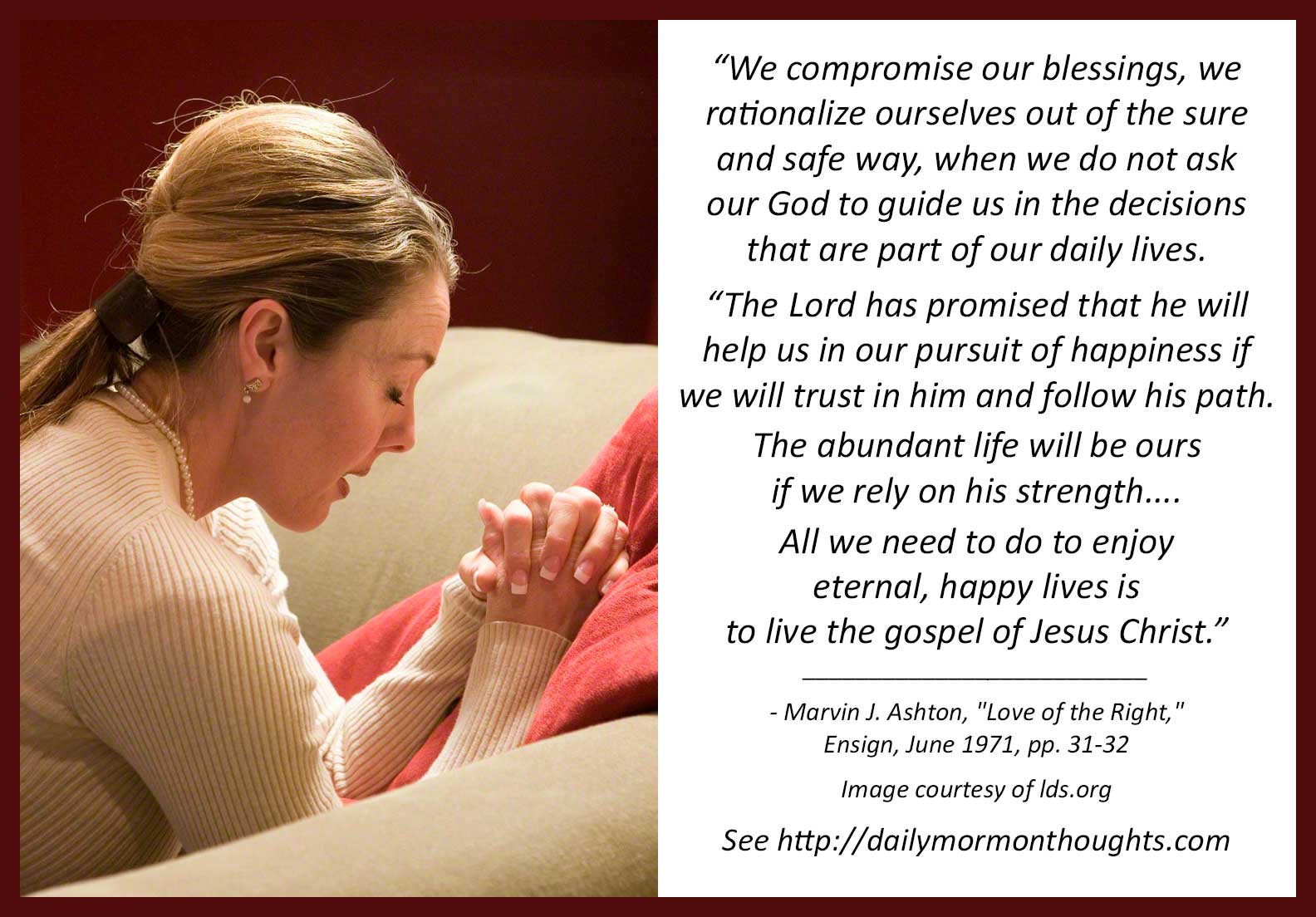
"Brothers and sisters, we compromise our blessings, we rationalize ourselves out of the sure and safe way, when we do not ask our God to guide us in the decisions that are part of our daily lives.
"The Lord has promised that he will help us in our pursuit of happiness if we will trust in him and follow his path. The abundant life will be ours if we rely on his strength.... All we need to do to enjoy eternal, happy lives is to live the gospel of Jesus Christ."
- Marvin J. Ashton, "Love of the Right," Ensign, June 1971, pp. 31-32
Click here to read the full article

Elder Ashton describes God as a loving Father who is eager to guide and assist us on our way in this mortal journey. But He expects that we will ask for help! And as soon as we do, He will confirm to us that our decisions are right and our path is proper. If we fail to ask for guidance, we put ourselves at risk and deny blessings that could otherwise be ours:

I've always loved the phrase "the abundant life," which many leaders have used to describe the path of a faithful disciple. It implies a richness and fulness not available to those not following that path. And that life, according to Elder Ashton, comes simply from living the gospel of Jesus Christ.

Friday, March 17, 2017

President Howard W. Hunter on being a true and living member

President Howard W. Hunter (1907-1995) was called to the Quorum of Twelve in 1959.  He served as Church President for only nine months, from June 5, 1994 to his death on March 3, 1995.
"On November 1, 1831, at a conference of the Church in Hiram, Ohio, the Lord revealed in the preface to the Doctrine and Covenants that this is the 'only true and living church upon the face of the whole earth.' Then he added, 'with which I, the Lord, am well pleased, speaking unto the church collectively and not individually' (D&C 1:30). This should raise a question in our minds of eternal significance: We know that this is the true and living church institutionally, but am I a true and living member individually?
"This question may appear as a play on the words of the Lord when he said this is the true and living church. When I ask, 'Am I a true and living member?' my question is, am I deeply and fully dedicated to keeping the covenants I have made with the Lord? Am I totally committed to live the gospel and be a doer of the word and not a hearer only? Do I live my religion? Will I remain true? Do I stand firm against Satan's temptations? He is seeking to cause us to lose our way in a storm of derision and a tide of sophistry. We can have victory, however, by responding to that inner voice calling 'stand firm!'
"To answer affirmatively the question, 'Am I a living member?' confirms our commitment. It means that we now and always will love God and our neighbors as ourselves. It means our actions will reflect who we are and what we believe. It means that we are every day Christians, walking as Christ would have us walk."
- Howard W. Hunter, "Am I a 'Living' Member?", Ensign, May 1987, p. 16
Click here to read or listen to the full talk

I remember smiling at President Hunter's application of the Lord's description when he offered this talk. If there is a "true and living Church"—is it made up of "true and living members"? If so, what would that imply in our lives and actions? President Hunter offered some suggestions for us to consider in our individual lives:


I think both of those adjectives are very significant: "true," meaning faithful, consistent, firm, fixed; and "living," meaning vibrant, growing, alive.

The concept is summarized President Hunter's phrase "every day Christian"—we strive each day to live the life of a disciple, to walk as Christ would have us walk. That's a beautiful and inspiring challenge.

Thursday, March 16, 2017

President Ezra Taft Benson on overcoming fear by trusting in God

President Ezra Taft Benson (1899-1994) was called to the Quorum of Twelve Apostles in 1943, and served as the 13th President of the Church from 1985 until his death in 1994 at age 94.
"Yes, God is at the helm, my brothers and sisters. I know it, and you know it. Surely no group in all the world has greater evidence of that fact than do the Latter-day Saints. Even during the days of persecution and hardship, the Lord has continually encouraged us to trust in him, to keep his commandments, to do that which is right and then be unafraid.
"We live in a world of fear today. Fear seems to be almost everywhere present. But there is no place for fear among the Latter-day Saints, among men and women who keep the commandments, who place their trust in the Almighty, who are not afraid to get down on their knees and pray to our heavenly Father....
"So among the Latter-day Saints, particularly, there should be no fears, even in a world where many people are concerned about atom bombs, the hydrogen bomb; where many are fearing Communism and some are talking fearfully of a depression. There need be no fear in the hearts of Latter-day Saints. People who live the gospel, who keep the commandments, who trust in God and do that which is right, need never fear because God speaks peace to the honest in heart through his Spirit....
"So, my brethren and sisters, there may come persecution; there may come opposition; there may come reverses; there may come criticism and misrepresentation. Your motives may be questioned. You may be attacked. But if we place our trust in the Almighty and do that which is right, there will come an inner assurance, an inner calm, a peace that will bring joy and happiness to our souls."
- Ezra Taft Benson, "Trust in God and Do the Right," Conference Report, April 1954, pp. 56-59
Click here to read the full talk

Many people live in fear of the challenges of their world. In the times when President Benson shared these remarks, some 63 years ago, the fears were somewhat different from the ones we have today. But they were just as real to that generation as our time, when they are perhaps replaced by terrorism and violence, natural disasters, impacts of drugs and pornography, disintegrating families, moral challenges, economic uncertainty, etc.

But the key message never changes; fear is overcome by faith. For those who know God and trust in Him and in His promises, there is no need to fear. The key is "the Lord has continually encouraged us to trust in him, to keep his commandments, to do that which is right and then be unafraid."


So while there may be temporary setbacks and challenges along the path, we can face them with "an inner calm" in knowing God is in charge. That confidence truly will "bring joy and happiness to our souls."

Wednesday, March 15, 2017

Elder D. Todd Christofferson on the blessings of spiritual rebirth and divine grace

Elder D. Todd Christofferson (b. January 24, 1945) was called to the Seventy in 1993, and as a member of the Quorum of Twelve Apostles in 2008.
"'Jesus answered, Verily, verily, I say unto thee, Except a man be born of water and of the Spirit, he cannot enter into the kingdom of God' (John 3:3-5).
"This rebirth was described more fully to Adam as recorded in the book of Moses. God taught Adam that it was necessary for men to repent, be baptized, and receive the Holy Ghost. Adam, seeking deeper understanding, asked why (see Moses 6:50-53). God explained that man must be clean in order to dwell in His presence and that this requires a cleansing birth into the kingdom of God:
"'By reason of transgression cometh the fall, which fall bringeth death, and inasmuch as ye were born into the world by water, and blood, and the spirit, which I have made, and so became of dust a living soul, even so ye must be born again into the kingdom of heaven, of water, and of the Spirit, and be cleansed by blood, even the blood of mine Only Begotten; that ye might be sanctified from all sin, and enjoy the words of eternal life in this world, and eternal life in the world to come, even immortal glory;
"'For by the water ye keep the commandment; by the Spirit ye are justified, and by the blood ye are sanctified' (Moses 6:59-60).
"We see here the elements that bring about our second birth or entry into the kingdom of God analogized to the elements that accompany our birth into mortality (water, blood, and spirit). This birth from mortal life into eternal life requires the interaction of (1) covenants (symbolized by water, the principal feature of our first covenant: baptism), (2) the grace of Christ (symbolized by His blood), and (3) the Holy Spirit, the medium through whom atoning grace is applied to remit sins and sanctify souls.
"Justification and sanctification are accomplished by the grace of Christ, which grace is a gift to man based on faith. But our moral agency is also a necessary element in this divine process. We must will to repent and act to repent. We must elect to be baptized and receive the Holy Ghost, and we must elect to remain loyal to our covenants thereafter. To receive the gift we must act in the manner He has ordained."
- D. Todd Christofferson, "Justification and Sanctification," Ensign, Jun 2001, pp. 18-25
Click here to read or listen to the full article
Elder Christofferson's discussion of justification and sanctification in this article is very insightful and helpful to me. In this segment, he talks about the power and blessing of spiritual rebirth that comes to those who choose to accept the call of discipleship and walk steadily on that path.

The description from the experience of Father Adam is particularly helpful; I've always been grateful for Adam's audacious questioning of God (but why is this necessary?). This leads to the analysis of the symbols of water (baptism), blood (grace), and spirit (application of the atonement). The power of that grace in our lives in accomplishing God's plan continues to amaze me.


How blessed we are to have such a plan of perfect potential, enabling us to use our agency to choose to receive all the blessings our loving Father offers to us, now and eternally!

Tuesday, March 14, 2017

Elder Quentin L. Cook on the perspective of the eternal plan

Elder Quentin L. Cook (b. September 8, 1940) was called as a Seventy in 1996, then as a member of the Quorum of Twelve Apostles in 2007.
"The Father's plan of happiness for His children includes not only a premortal and mortal life but also an eternal life as well, including a great and glorious reunion with those we have lost. All wrongs will be righted, and we will see with perfect clarity and faultless perspective and understanding.
"From the limited perspective of those who do not have knowledge, understanding, or faith in the Father's plan—who look at the world only through the lens of mortality with its wars, violence, disease, and evil—this life can seem depressing, chaotic, unfair, and meaningless. Church leaders have compared this perspective with someone walking into the middle of a three-act play. Those without knowledge of the Father's plan do not understand what happened in the first act, or the premortal existence, and the purposes established there; nor do they understand the clarification and resolution that come in the third act, which is the glorious fulfillment of the Father's plan....
"However, righteousness, prayer, and faithfulness will not always result in happy endings in mortality. Many will experience severe trials....
"There are many kinds of challenges. Some give us necessary experiences. Adverse results in this mortal life are not evidence of lack of faith or of an imperfection in our Father in Heaven's overall plan. The refiner's fire is real, and qualities of character and righteousness that are forged in the furnace of affliction perfect and purify us and prepare us to meet God."
- Quentin L. Cook, "The Songs They Could Not Sing," Ensign, November 2011, p. 106
Click here to read or listen to the full talk

In the midst of mortality's frustrations, it's easy to forget the eternal nature of the plan of happiness that our Father has provided for us. Eventually, the full extent and scope of that glorious plan will be clear to us again, and we will truly rejoice as all sorrows are replaces with joy and understanding:


Sadly, without the divine and eternal perspective of God's plan for us, the challenges of this life "can seem depressing, chaotic, unfair, and meaningless." Even our most righteous efforts don't guarantee happy results in the limited timeframe of mortality. But all will be made right in God's due time. So meanwhile, it's important to recognize the purpose and power of our trials: the forge "qualities of character and righteousness" and help to "perfect and purify us and prepare us to meet God."

Monday, March 13, 2017

Elder David A. Bednar on the powerful blessings of the Holy Ghost

Elder David A. Bednar (born June 15, 1952) was serving as the president of BYU–Idaho when he was called and sustained as a member of the Quorum of Twelve Apostles in October 2004.
"Obedience opens the door to the constant companionship of the Holy Ghost. And the spiritual gifts and abilities activated by the power of the Holy Ghost enable us to avoid deception—and to see, to feel, to know, to understand, and to remember things as they really are. You and I have been endowed with a greater capacity for obedience precisely for these reasons. Moroni declared:
"'Hearken unto the words of the Lord, and ask the Father in the name of Jesus for what things soever ye shall stand in need. Doubt not, but be believing, and begin as in times of old, and come unto the Lord with all your heart, and work out your own salvation with fear and trembling before him.
"'Be wise in the days of your probation; strip yourselves of all uncleanness; ask not, that ye may consume it on your lusts, but ask with a firmness unshaken, that ye will yield to no temptation, but that ye will serve the true and living God' (Mormon 9:27-28).
"As we heed that inspired counsel, we can and will be blessed to recognize and repel the attacks of the adversary—today and in the days that lie ahead. We can and will fulfill our foreordained responsibilities and contribute to the work of the Lord in all the world."
- David A. Bednar, "Things as They Really Are," CES devotional, BYU-Idaho, May 3, 2009; see Ensign, June 2010, pp. 16-25
Click here to read or listen to the full talk

This is a remarkable description of the blessings that come from obedience. It's the key that "opens the door to the constant companionship of the Holy Ghost"—a most precious gift, one to be sought after and prized greatly. The Holy Ghost then "activates" spiritual gifts that bless us in profound ways:


I love the expression that with the Holy Ghost and the spiritual gifts that follow, we can be blessed "to see, to feel, to know, to understand, and to remember things as they really are." What a profound endowment!

So much follows from the simple and foundational concept of obedience! As we are willing to submit our will to God, and follow in His path, joy and safety will certainly be the result, and a life greatly expanded in richness and opportunity.

Sunday, March 12, 2017

President Spencer W. Kimball on what it means to follow Christ

President Spencer W. Kimball (1895-1985) was ordained an apostle in 1943 and served as President of the Church from 1973 to 1985.
"To be like Christ! What an ambitious goal! What a lofty ideal! The Savior had a pleasing personality, he was kind, he was pleasant, he was understanding, he never went off on tangents, he was perfectly balanced. No eccentricities could be found in his life. Here was no ostentation and show, but he was real and humble and genuine. He made no play for popularity. He made no compromises to gain favor. He did the right thing always, regardless of how it might appeal to men. He drew all good people to him as a magnet.
"'What manner of men ought ye to be?' The answer, 'Even as I am," means that one must be forgiving, there must be no grudges, no hatreds, no bitterness....
"To be like him, then, one must resist evil. One must fortify one's self by keeping away from temptation, out of the devil's area. One must control desire, harness passion, bridle every urge, and keep away from the approach of error. Total cleanliness in thought and action is required if one is to be Christlike.
"'What manner of men ought ye to be?' The answer, 'Even as I am,' brings us to a realization that we must love our neighbor as ourselves.... [It] imposes itself upon us as a command to honor our parents, to be obedient to them, to love and cherish and sustain them and to glorify them with rich and abundant lives. We remember how, even while on the cross suffering the mortal agonies, he remembered and provided for his mother.
"'What manner of men ought ye to be?' he asked. And the answer, 'Even as I am,' brings us to our knees in prayer; for... he, the Son of God with the powers of creation and with control of life and death, went frequently 'into a mountain apart to pray.'
"'What manner of men ought ye to be?' The answer, 'Even as I am,' reflects a studious life—a life of learning. And he says: 'Search the scriptures; for in them ye think ye have eternal life: and they are they which testify of me.' (John 5:39.) "
- Spencer W. Kimball, "What Manner of Men Ought Ye to Be," Jordan Seminary graduation, Sandy, UT, 5/14/54; see TSWK 13-14

What does it mean to follow Christ, to emulate Him, to try to be like Him? President Kimball explores that question in this very interesting excerpt. It's intriguing to see some of the qualities or characteristics he identifies as things we should do, and things we should avoid:


President Kimball takes particular note of the Savior's challenging question and response: "What manner of men ought ye to be? Verily I say unto you, even as I am." (3 Ne 27:27) Answers include such foundational principles as service to others, prayer, and study.
// Customization to close archive widget on first view - DK 3/15