Friday, July 7, 2017

President Harold B. Lee on the refining process of suffering

President Harold B. Lee (1899-1973) was called to the Quorum of Twelve Apostles in 1941. He served as a counselor in the First Presidency from 1970-1972, then as Church president from July 1972 until his passing less than 18 months later in December 1973.
"There is a refining process that comes through suffering, I think, that we can’t experience any other way than by suffering.... We draw closer to Him who gave His life that man might be. We feel a kinship that we have never felt before.... He suffered more than we can ever imagine. But to the extent that we have suffered, somehow it seems to have the effect of drawing us closer to the divine, helps to purify our souls, and helps to purge out the things that are not pleasing in the sight of the Lord."
- Harold B. Lee, address at funeral services for Alfred W. Wesemann, 8 December 1969; see THBL pp. 187-8

We all experience some degree of suffering in life; President Lee is counseling us on how to interpret or react to that suffering. It's important to understand that there is a benefit to the challenges that occur; there is a refining available if we choose to allow it.


This is an interesting approach. As we suffer, we begin to understand a portion of the Savior's suffering, and can draw closer to Him through that process. Our suffering can "purify our souls" as it helps remove the things that are not appropriate or pleasing to God. We become more like Him in small but real ways. So in reality, we should be grateful for those challenges and difficulties as long as we recognize the power they can represent in our lives.

(Compilation and commentary by David Kenison, Orem, Utah, 2017)

Thursday, July 6, 2017

Elder Neal A. Maxwell on blessings for obedience

Elder Neal A. Maxwell (1926-2004) served as a Seventy from 1976-1981, then as a member of the Quorum of Twelve until his death from cancer in 2004.
"In modern revelation we are told very frankly, brothers and sisters, that 'when we obtain any blessing from God, it is by obedience to that law upon which it is predicated' (D&C 130:21). I don’t know how it is for you, but I have felt so often in my life so greatly blessed for what little obedience I have given. My conclusion with regard to that verse is that the Lord’s ratio of blessings to our obedience is a very generous ratio indeed. He is so quick to reward us, so quick to reassure us, and so anxious to take delight when we serve Him. So if you puzzle over that verse, as I have in life, including in recent times, the only bottom line I can give you is that the ratio of blessings to our minuscule obedience is a very, very generous ratio indeed."
- Neal A. Maxwell, "Sharing Insights from My Life," BYU Devotional, Jan. 12, 1999
Click here to read or listen to the full talk

Elder Maxwell struggled with cancer in his later years before having a "reprieve" and being able to teach and serve for some additional years. This address to a BYU student assembly includes many wonderful "life lessons" as he reflected on his insights gained through life's struggles. One of the important insights relates to the blessings promised for obedience. Elder Maxwell considered himself to have been blessed perhaps more than he deserved:


This illustrates an aspect of the power and benefit of "counting our blessings" in life. As we carefully identify the many ways in which God blesses us, we recognize that the "ratio of blessings to our minuscule obedience" described by Elder Maxwell is "very, very generous indeed." I love the description given by King Benjamin:
And secondly, he doth require that ye should do as he hath commanded you; for which if ye do, he doth immediately bless you; and therefore he hath paid you. And ye are still indebted unto him, and are, and will be, forever and ever; therefore, of what have ye to boast? (Mosiah 2:24)

Those who obey willingly and consistently, and who then count the blessings that follow, will know, as did Elder Maxwell, of the "generous ratio" of God's love expressed in our lives.

(Compilation and commentary by David Kenison, Orem, Utah, 2017)

Wednesday, July 5, 2017

President Joseph Fielding Smith on sacred blessings of temple service

Joseph Fielding Smith (1876-1972) was the son of Joseph F. Smith, 6th president of the Church, and grandson of Hyrum Smith, brother of the Prophet Joseph. He was called as an apostle in 1910, and served as the 10th president of the Church from 1970 until his death in 1972 at age 95.
"There is no work connected with the gospel that is of a more unselfish nature than the work in the House of the Lord, for our dead. Those who work for the dead do not expect to receive any earthly remuneration or reward. It is, above all, a work of love, which is begotten in the heart of man through faithful and constant labor in these saving ordinances. There are no financial returns, but there shall be great joy in heaven with those souls whom we have helped to their salvation. It is a work that enlarges the soul of man, broadens his views regarding the welfare of his fellowman, and plants in his heart a love for all the children of our Heavenly Father. There is no work equal to that in the temple for the dead in teaching a man to love his neighbor as himself. Jesus so loved the world that he was willing to offer himself as a sacrifice for sin that the world might be saved. We also have the privilege, in a small degree, of showing our great love for Him and our fellow beings by helping them to the blessings of the gospel which now they cannot receive without our assistance."
- Joseph Fielding Smith, “Salvation for the Dead,” Improvement Era, Feb. 1917, 362; see also Doctrines of Salvation, 2:144

President Smith had a remarkable season of service to the Lord in leadership roles. I remember him only in his very later years, including as a very aged Prophet. These insights were shared when he was much younger, a full century ago now. It's interesting to recognize how little the important truths of the Gospel have changed over that time. The nature of the service we perform in the temple is as critical today as it was then; the "work of love" continues on, greatly hastened but with the same spirit of pure love and sincere concern for the eternal welfare of the souls of those who have passed on. The work continues to "enlarge the soul of man" as we sacrifice other options of where we might use the time and resources we have in our lives to participate in it.


As others have noted, when we participate in family history and temple work, we unite with the Savior in the great work of salvation, helping to open the doors of eternity for those who have passed on. Those who have caught the vision of the work understand that "there shall be great joy in heaven with those souls whom we have helped to their salvation." The foretaste of that joy blesses us now.

(Compilation and commentary by David Kenison, Orem, Utah, 2017)

Tuesday, July 4, 2017

President David O. McKay on the principles of America's founding

President David O. McKay (1873-1970) was called to the Quorum of Twelve Apostles in 1906.  He served as a counselor in the First Presidency to Heber J. Grant and George Albert Smith beginning in 1945, then then as the president of the Church from 1951 to his death in 1970 at age 96.
"As we celebrate the birthday of the Declaration of Independence on July 4... let us catch the spirit of that morning and awaken appreciation for the blessings and privileges that are ours if we but remain loyal and true to the Constitution of the United States as established by our Founding Fathers....
"After the Revolutionary War was over and nine years after the Declaration of Independence was signed, the Founding Fathers met in that same Old State Hall to frame the Constitution of the United States.
"The French historian, Francois Pierre Guillaume Guizot, while visiting in the United States, asked James Russell Lowell, 'How long will the American Republic endure?' Lowell’s answer was: 'As long as the ideas of the men who founded it continue dominant.'...
"Actuated by these two fundamental and eternal principles—the free agency of the individual and faith in an overruling Providence—those 56 men who signed the Declaration of Independence, those who drew up the Constitution of the United States nine years later, gave to the world a concept of government which, if applied, will strike from the arms of downtrodden humanity the shackles of tyranny, and give hope, ambition, and freedom to the teeming millions throughout the world."
- David O. McKay, “The Founding of an American Republic” pp. 249–51
Click here to read the full article

In most of our holiday celebrations, packed with family fun, community celebrations, and many personal traditions, it's easy to forget the origins of the holiday and its significance. President McKay reminds us of the significance of July 4 and the principles of independence and agency represented by that day. He quotes Lowell to point out how critical it is for us to preserve the memory of those principles today in order to help preserve the integrity of the American Republic.


The foundational principles of agency and faith were profoundly present in the founding of the United States of America, and must be preserved today. The Constitution's principles must be protected and defended in order to "give hope, ambition, and freedom to the teeming millions throughout the world."

(Compilation and commentary by David Kenison, Orem, Utah, 2017)

Monday, July 3, 2017

President Heber J. Grant on the inspired Constitution of the United States

President Heber J. Grant (1856-1945) was ordained an apostle in 1882 when he was 25 years old.  He served as president of the Church from 1918 until his death in 1945 at age 88.  His tenure as president lasted over 26 years; only Brigham Young had a longer term (over 29 years).
"From my childhood days I have understood that we believe absolutely that the constitution of our country is an inspired instrument and that God directed those who created it and those who defended the independence of this nation. Concerning this matter it is my frequent pleasure to quote the statement by Joseph Smith, regarding the Constitution:
"'The Constitution of the United States is a glorious standard; it is founded in the wisdom of God. It is a heavenly banner; it is, to all those who are privileged with the sweets of liberty, like the cooling shades and refreshing waters of a great rock in a weary and thirsty land. It is like a great tree under whose branches men from every clime can be shielded from the burning rays of the sun.'
"And such the Constitution of the United States must be to every faithful Latter-day Saint who lives under its protection. That the Lord may help him to think straight, and to pursue a straight course regardless of personal advantage, factional interest, or political persuasion, should be the daily prayer of every Latter-day Saint. I counsel you, I urge you, I plead with you, never, so far as you have voice or influence, permit any departure from the principles of government on which this nation was founded, or any disregard of the freedoms which, by the inspiration of God our Father, were written into the Constitution of the United States."
- Heber J. Grant, "Admonition and Blessing," Conference Report, October 1944, pp. 6-13
Click here to read the full talk

Our understanding of the inspired origins of the United States government have been described by a number of Church leaders. President Grant shared his thoughts in this excerpt, and quoted Joseph Smith for the foundational doctrine:


So what does that foundational idea mean to us? If we believe the Constitution is an inspired document, it should guide our thought and behavior in efforts to preserve the principles it defines—"regardless of personal advantage, factional interest, or political persuasion." It's important that we learn and understand those principles in order to be ready to defend them effectively.

(Compilation and commentary by David Kenison, Orem, Utah, 2017)

Sunday, July 2, 2017

President Ezra Taft Benson on how to live happily

President Ezra Taft Benson (1899-1994) was called to the Quorum of Twelve Apostles in 1943, and served as the 13th President of the Church from 1985 until his death in 1994 at age 94.
"Do we realize that happiness here and now consists in freely, lovingly, joyfully acknowledging God’s will for us—and doing it in all ways and all affairs big and small? To live perfectly is to live happily. To live happily is to grow in spiritual strength toward perfection. Every action performed in accord with God’s will is part of that growth.
"Let us not partition our lives. Let us unify our lives, being contemptuous of fictitious honors and glories that do not come with God’s approval. Let us remember that the real source of our strength and happiness is beyond the reach of men and circumstances."
- Ezra Taft Benson, So Shall Ye Reap [Deseret 1960], p. 318

What is God's will for me—personally, individually? That becomes a key question in the quest for peace and happiness. If I can recognize it and then do it "in all ways and all affairs big and small," President Benson suggests that I will be happy as I experience growth in my spiritual strength.


President Benson then warns us of the temptation to "partition" our lives. If we are seeking for strength and happiness in the "fictitious honors and glories" of men, we will not truly find happiness. It is in God's approval that we will truly find peace.

(Compilation and commentary by David Kenison, Orem, Utah, 2017)

Saturday, July 1, 2017

Elder Orson F. Whitney on being honest seekers of truth

Elder Orson F. Whitney (1855-1931), a journalist, teacher, poet, and historian, was called to the Quorum of Twelve in 1906 and served until his death in 1931 at age 75.
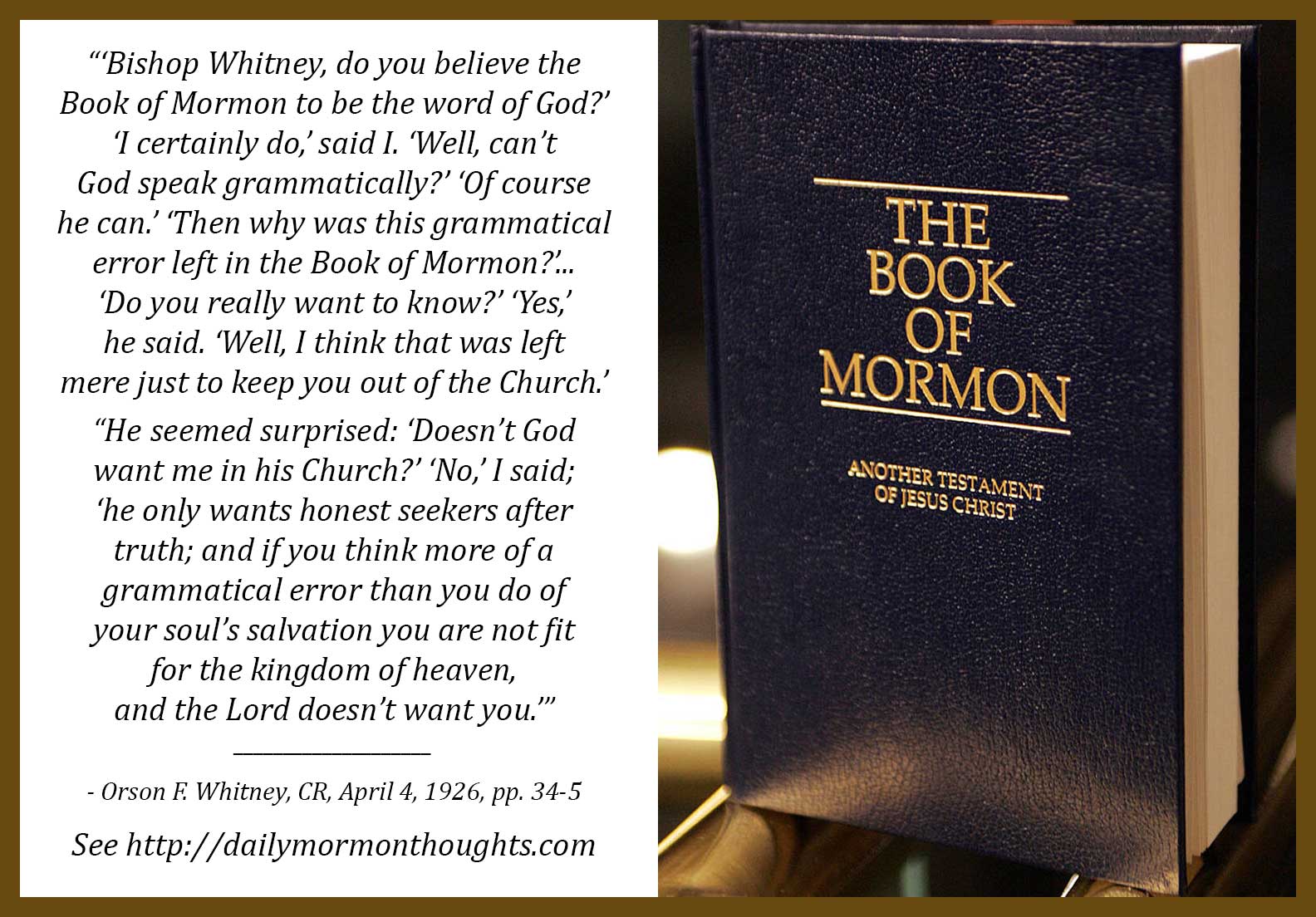
"I had a conversation with another would-be censor of our sacred books. He accosted me on the street with the question: 'Bishop Whitney, do you believe the Book of Mormon to be the word of God?' 'I certainly do,’ said I. 'Well, can't God speak grammatically?' 'Of course he can.' 'Then why was this grammatical error left in the Book of Mormon?'—and he quoted it. 'Do you really want to know?' 'Yes,' he said. 'Well, I think that was left mere just to keep you out of the Church.'
"He seemed surprised: 'Doesn't God want me in his Church?' 'No,' I said; 'he only wants honest seekers after truth; and if you think more of a grammatical error than you do of your soul's salvation you are not fit for the kingdom of heaven, and the Lord doesn't want you.
"He was astonished. It was something he hadn't thought of. He felt much as Goliath did when the stone sank into his forehead—such a thing had never entered his head before."
- Orson F. Whitney, CR, April 4, 1926, pp. 34-5

I enjoyed this anecdote from Elder Whitney. I'm not sure what instance of "grammatical error" the man might have been referring to. Of course, there were many other answers that could have been given to the inquiry, related to the process of translation, the setting of the languages, and so on. But in his somewhat "cheeky" response Elder Whitney taught a lesson about sincerity and humility.


I have heard other speakers use the Goliath and stone reference in that way also. I wonder if Elder Whitney originated it, or if it had existed before? In any case, it's fun to see a 70-year-old apostle inject some good-natured humor into his remarks, but still teach an important lesson on the importance of our attitudes as we approach sacred things.

(Compilation and commentary by David Kenison, Orem, Utah, 2017)
// Customization to close archive widget on first view - DK 3/15