Monday, August 28, 2017

Elder Jeffrey R. Holland on blessings for faithfulness

Elder Jeffrey R. Holland (born December 3, 1940) served as Church Commissioner of Education from 1976-1980, as the president of BYU from 1980-1989, as a Seventy from 1989-1994, and as a member of the Quorum of Twelve Apostles since 1994.
"I testify that God lives, that He is our Eternal Father, that He loves each of us with a love divine. I testify that Jesus Christ is His Only Begotten Son in the flesh and, having triumphed in this world, is an heir of eternity, a joint-heir with God, and now stands on the right hand of His Father. I testify that this is Their true Church and that They sustain us in our hour of need—and always will, even if we cannot recognize that intervention. Some blessings come soon, some come late, and some don’t come until heaven; but for those who embrace the gospel of Jesus Christ, they come. Of that I personally attest. I thank my Father in Heaven for His goodness past, present, and future."
- Jeffrey R. Holland, "An High Priest of Good Things to Come," General Conference October 1999; see Ensign, Nov 1999, p. 36
Click here to read or listen to the full talk

This October 1999 conference address by Elder Holland is a very memorable one, during which he discussed challenges faced by many people in different situations of life—challenges that can bring discouragement, loneliness, and hopelessness. In the midst of those realities of our mortality, Elder Holland testifies, borrowing a phrase from the writings of Paul, of the influence of the "high priest of good things to come" (Heb. 8:6) who can help restore our faith and hope as we open our hearts to Him.

The excerpt included comes at the conclusion of the talk, as Elder Holland testifies of the reality of the Savior's promises to us. It includes this wonderful testimony:


Perhaps one of the great challenges of life is to learn to have the faith and trust to wait until the time is right for the blessings to come—even if that time is after this life. A true disciple doesn't depend on the blessings for his faith.

(Compilation and commentary by David Kenison, Orem, Utah, 2017)

Sunday, August 27, 2017

President Russell M. Nelson on the blessings of heartfelt prayer

President Russell M. Nelson (b. Sept 9, 1924) was an internationally-renowned heart surgeon when he was called to serve as a member of the Quorum of Twelve Apostles in 1984. He was set apart as president of the Quorum of Twelve on July 15, 2015.
"Unfailing faith is fortified through prayer. Your heartfelt pleadings are important to Him. Think of the intense and impassioned prayers of the Prophet Joseph Smith during his dreadful days of incarceration in Liberty Jail. The Lord responded by changing the Prophet’s perspective. He said, 'Know thou, my son, that all these things shall give thee experience, and shall be for thy good.' (D&C 122:7)
"If we pray with an eternal perspective, we need not wonder if our most tearful and heartfelt pleadings are heard. This promise from the Lord is recorded in section 98 of the Doctrine and Covenants:
"'Your prayers have entered into the ears of the Lord … and are recorded with this seal and testament—the Lord hath sworn and decreed that they shall be granted.
"'Therefore, he giveth this promise unto you, with an immutable covenant that they shall be fulfilled; and all things wherewith you have been afflicted shall work together for your good, and to my name’s glory, saith the Lord.' (D&C 98:2-3)
"The Lord chose His strongest words to reassure us! Seal! Testament! Sworn! Decreed! Immutable covenant! Brothers and sisters, believe Him! God will heed your sincere and heartfelt prayers, and your faith will be strengthened."
- Russell M. Nelson, "Face the Future with Faith," General Conference, April 2011
Click here to read or listen to the full story

President Nelson uses some important words to describe the kind of prayer we should be seeking: "tearful and heartfelt pleadings," "intense and impassioned," and "sincere and heartfelt." It's that word "heartfelt," which he uses three times, that intrigues me. The best prayers come from deep within the heart, and are more than superficial expressions of feelings or needs. When we are able to open up about the things that concern us deep inside, and truly converse with God about them, then the blessings will follow.

The other key is to "pray with an eternal perspective," knowing both that our challenges and problems are temporary, and that the promises and hope He offers are eternal:


President Nelson's ringing testimony is that a sincere, heartfelt prayer will not go unheeded or unanswered. What a blessing that is to us!

(Compilation and commentary by David Kenison, Orem, Utah, 2017)

Saturday, August 26, 2017

Elder Dallin H. Oaks on finding true happiness

Elder Dallin H. Oaks (b. August 12, 1932) served as president of BYU from 1971-1980.  He was then appointed as a justice of the Utah Supreme Court, and resigned when he was called to the Quorum of Twelve Apostles in 1984.
"Do not seek happiness in the glittering but shallow things of the world. We cannot achieve lasting happiness by pursuing the wrong things. Someone once said, 'You can never get enough of what you don’t need, because what you don’t need won’t satisfy you.'
"Young and old, turn your eyes and your hearts away from the deceptive messages of the media. There is no happiness in alcohol or drugs, only enslavement. There is no happiness in violence, only pain and sorrow. There is no happiness in sexual relations and physical familiarities outside the bonds of marriage, only degradation and increased momentum along the way to spiritual death.
"There is no lasting happiness in what we possess. Happiness and joy come from what a person is, not from what he or she possesses or appears to be. Youth, hold fast to your standards. Study and use that saving pamphlet, For the Strength of Youth.
"Righteousness fosters righteousness. The effects of righteous examples are felt for generations to come. Good parenting produces youth who make good parents. Just as many of us have been strengthened by the noble examples of our pioneering ancestors in many lands, so the righteous choices and sacrifices of our day can bless our families and our friends and our nations for all the years to come."
- Dallin H. Oaks, "Joy and Mercy," General Conference, October 1991; see also Ensign, Nov. 1991, p. 73
Click here to read or listen to the full talk

The quest for happiness is one of the great challenges of the world. There are many places that claim to offer that result for us; but as Elder Oaks warns, often the sources of happiness in the world offer false promises of providing it for us.


In addition to warning us about the temptations of the world to stray from the path of truth and obedience, Elder Oaks warns about the desire for physical possessions that can also distract from the proper focus. Happiness comes not from what we possess, but from who we are and who we are becoming. The world would have us believe that possessions are far more important than the Lord teaches.

I think we often forget how "the righteous choices and sacrifices of our day can bless our families and our friends and our nations for all the years to come." The impact of one person on his family and neighbors as he strives to be a true disciple of Jesus Christ is much more profound than we realize.

(Compilation and commentary by David Kenison, Orem, Utah, 2017)

Friday, August 25, 2017

Elder M. Russell Ballard on resisting the world's attacks on families

Elder M. Russell Ballard (born October 8, 1928) was called as a Seventy in 1976, and has served as a member of the Quorum of Twelve Apostles since 1985.
"Brothers and sisters, the most important cause of our lifetime is our families. If we will devote ourselves to this cause, we will improve every other aspect of our lives and will become, as a people and as a church, an example and a beacon for all peoples of the earth.
"But this is not easy in a world where hearts are turning in many directions and where the whole planet seems to be constantly moving and changing at a pace never before imagined. Nothing stays the same for long. Styles, trends, fads, political correctness, and even perceptions of right and wrong shift and move. As the prophet Isaiah predicted, wrong is portrayed as right and right as wrong (see Isaiah 5:20).
"The spiritual divide gets even wider as evil becomes ever more deceptive and subtle and pulls people toward it like a dark magnet—even as the gospel of truth and light attracts the honest in heart and the honorable of the earth, who seek what is moral and good....
"The Church is a mooring in this tempestuous sea, an anchor in the churning waters of change and division, and a beacon to those who value and seek righteousness. The Lord uses this Church as a tool in pulling His children throughout the world toward the protection of His gospel."
- M. Russell Ballard, "That the Lost May Be Found," General Conference, April 2012
Click here to read or listen to the full talk

It would be an interesting survey to ask people what they consider "the most important cause of our lifetime." In recent years, the emphasis of the Church has been strong in defense of the family and traditional values related to it. As the family continues to come under attack, that emphasis will continue. As Elder Ballard states, "If we will devote ourselves to this cause, we will improve every other aspect of our lives."

So as the world and the influence of the adversary in it continue to shift and detract from what is of eternal value and importance, we must recognize the danger and seek for safety and calm amidst the storms:


Through the teachings of the Gospel of Jesus Christ and particularly His Atonement on our behalf, we can be given that mooring or anchor to help us ride out the storms and come home to the safe harbor of His peace.

(Compilation and commentary by David Kenison, Orem, Utah, 2017)

Thursday, August 24, 2017

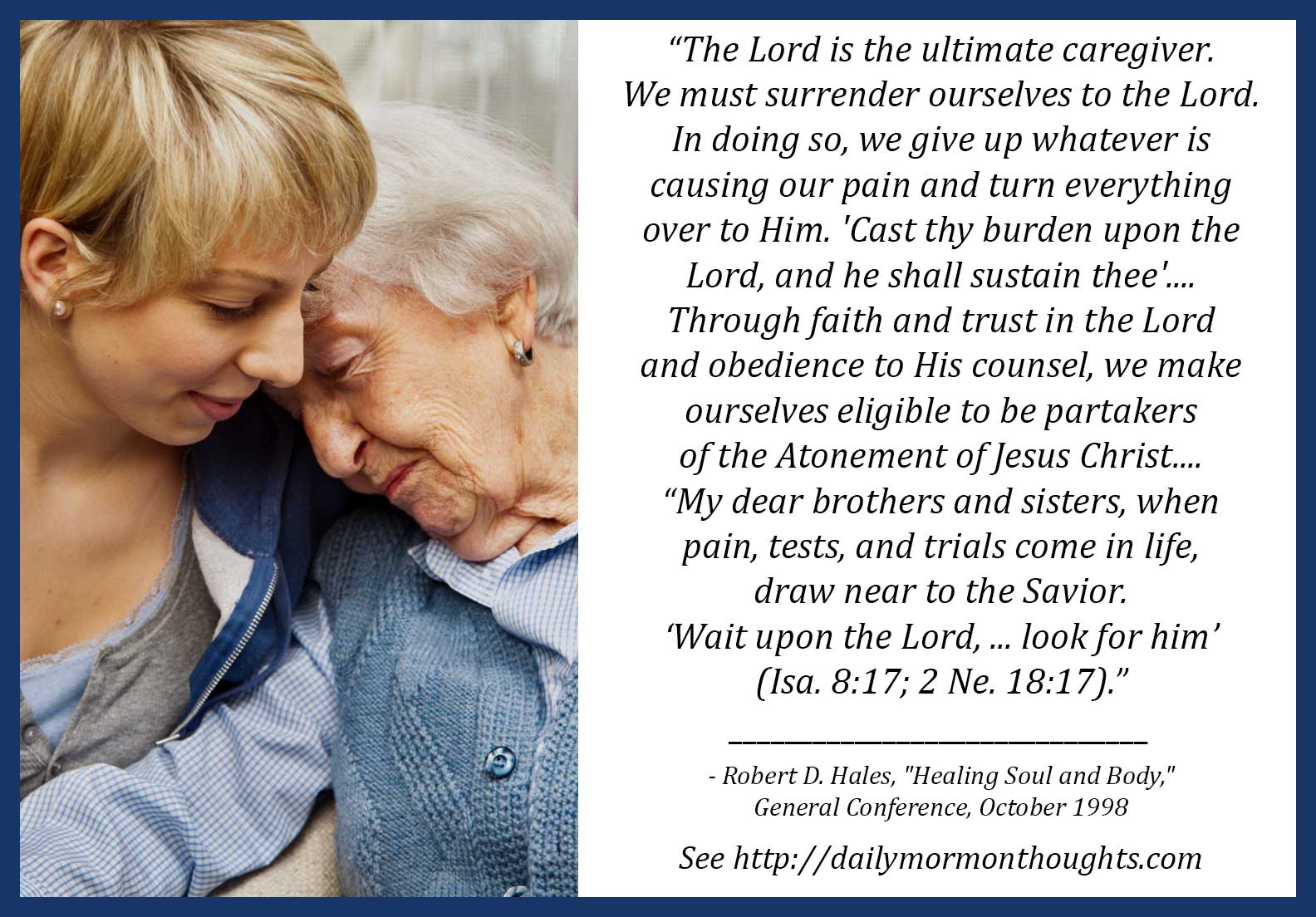
Elder Robert D. Hales on the Lord as the ultimate caregiver

Elder Robert D. Hales (born August 24, 1932) served as a Seventy from 1976 to 1985, when he was called as a member of the Quorum of Twelve Apostles.
"When we are experiencing pain, the caregiver is a very important part of the recovery process. Attentive doctors, nurses, therapists, a loving spouse, parents, children, and friends comfort us when we are ill and speed our recovery process. There are times when, no matter how independent we may be, we must entrust others with our care. We must surrender ourselves to them. Our caregivers are those who assist in the healing process.
"The Lord is the ultimate caregiver. We must surrender ourselves to the Lord. In doing so, we give up whatever is causing our pain and turn everything over to Him. 'Cast thy burden upon the Lord, and he shall sustain thee' (Ps. 55:22). 'And then may God grant unto you that your burdens may be light, through the joy of his Son' (Alma 33:23). Through faith and trust in the Lord and obedience to His counsel, we make ourselves eligible to be partakers of the Atonement of Jesus Christ so that one day we may return to live with Him.
"As we put our faith and trust in the Lord, we must battle our pain day by day and sometimes hour by hour, even moment by moment; but in the end, we understand that marvelous counsel given to the Prophet Joseph Smith as he struggled with his pain of feeling forgotten and isolated in Liberty Jail:
"'My son, peace be unto thy soul; thine adversity and thine afflictions shall be but a small moment;
"'And then, if thou endure it well, God shall exalt thee on high; thou shalt triumph over all thy foes' (D&C 121:7-8).
"My dear brothers and sisters, when pain, tests, and trials come in life, draw near to the Savior. 'Wait upon the Lord, ... look for him' (Isa. 8:17; 2 Ne. 18:17). 'They that wait upon the Lord shall renew their strength; they shall mount up with wings as eagles; they shall run, and not be weary; and they shall walk, and not faint' (Isa. 40:31). Healing comes in the Lord's time and the Lord's way; be patient.
"Our Savior waits for us to come to Him through our scripture study, pondering, and prayer to our Heavenly Father. Great blessings and lessons come from overcoming adversity. As we are strengthened and healed, we can then lift and strengthen others with our faith. May we be instruments in the Lord's hands in blessing the lives of those in pain."
- Robert D. Hales, "Healing Soul and Body," General Conference, October 1998; see Ensign, Nov. 1998, 14
Click here to read or listen to the full talk

The role of caregiver is an important and almost sacred one. When someone faces serious struggles with physical health or handicaps, they often require assistance in basic needs that we normally take for granted in life. Sometimes the need for help is temporary and short-lived; sometimes it is chronic and extended. A caregiver can be a trained medical professional, or it can be a loving family member or friend who lends assistance in the time of need. They truly "assist in the healing process" when possible, or just help to bear the burdens that can't be relieved.

Acknowledging that we each have needs in our spiritual and emotional lives, we recognize that the Lord can function as that kind of caregiver who provides succor and sustaining when we have no where else to turn. Learning to accept and access His assistance is critical in our times of pain and sorrow.


The critical task for us is to learn to draw near to Him in times of need. Elder Hales explains that through our acts of worship and devotion, we gain strength and assistance from the Savior. As we survive and overcome those times, we are then prepared to become the caregiver that can bless others in the future. It's a beautiful process of receiving and giving.

(Compilation and commentary by David Kenison, Orem, Utah, 2017)

Wednesday, August 23, 2017

President Dieter F. Uchtdorf on the pursuit of holiness and happiness

President Dieter F. Uchtdorf (born November 6, 1940) served as a Seventy from 1994-2004, when he was called as a member of the Quorum of Twelve.  He has served as second counselor in the First Presidency since 2008.
"Declaring our testimony of the gospel is good, but being a living example of the restored gospel is better. Wishing to be more faithful to our covenants is good; actually being faithful to sacred covenants—including living a virtuous life, paying our tithes and offerings, keeping the Word of Wisdom, and serving those in need—is much better. Announcing that we will dedicate more time for family prayer, scripture study, and wholesome family activities is good; but actually doing all these things steadily will bring heavenly blessings to our lives.
"Discipleship is the pursuit of holiness and happiness. It is the path to our best and happiest self.
"Let us resolve to follow the Savior and work with diligence to become the person we were designed to become. Let us listen to and obey the promptings of the Holy Spirit. As we do so, Heavenly Father will reveal to us things we never knew about ourselves. He will illuminate the path ahead and open our eyes to see our unknown and perhaps unimagined talents.
"The more we devote ourselves to the pursuit of holiness and happiness, the less likely we will be on a path to regrets. The more we rely on the Savior’s grace, the more we will feel that we are on the track our Father in Heaven has intended for us."
- Dieter F. Uchtdorf, "Of Regrets and Resolutions," General Conference October 2012; see Ensign, November 2012, pp. 21-24
Click here to read the full talk

I was fascinated by President Uchtdorf's explanation in the first paragraph about things that are good, and things that are better.  Having goals and intentions, or declaring our willingness or belief, is one thing; but to truly follow through and act on them, demonstrate them in our lives is so much more important and powerful!


Being a disciple, then, is not just accepting a set of beliefs. It is acting on them—the real "pursuit of holiness" in our lives. And that is truly the path to happiness in life as well. As we follow the Savior in action and lifestyle, we receive more spiritual assistance, and find greater peace and happiness in our life, and will eliminate regrets.

(Compilation and commentary by David Kenison, Orem, Utah, 2017)

Tuesday, August 22, 2017

Pres. Henry B. Eyring on obeying spiritual direction

President Henry B. Eyring (born May 31, 1933) served in the Presiding Bishopric from 1985-1992, as a Seventy from 1992-1995, then was called to the Quorum of Twelve Apostles. He has served in the First Presidency since 2007.
"When the Spirit is invited into a meeting by those in it, truth is communicated beyond what is said aloud. Write down impressions or thoughts that you feel came from God. And, remembering what we have said about building a foundation, think carefully about whether the truth you received requires action. It is by obedience to commandments that we qualify for further revelation of truth and light.
"In this hour you may have committed to act on something you felt was true. Then more truth came to you. That process may slow or stop, if as you go out into daily life you fail to keep the silent commitments you made with God. God not only loves the obedient, He enlightens them. I fear that more people make promises to God than keep them, so you will please Him when you are the exception and you keep your promise to obey. You should test those impressions of what you should do against a simple standard: Is it what the Master has commanded in the accepted revelations? Is it clearly within my calling in His kingdom?
"Keeping some commandments gives you greater power to build your foundation on truth and light. You could think of those as enabling commandments, because they build your power to keep other commandments. Whatever invites the Holy Ghost as your companion will bring you the greater wisdom and the greater ability to obey God."
- Henry B. Eyring, "A Life Founded in Light and Truth," BYU Education Week devotional, 15 August 2000; see also Ensign, July 2001, 13
Click here to read or listen to the full talk

Speaking to a gathering at BYU for an Education Week devotional, President Eyring addressed ways to increase the spiritual influences in our lives. One of the key ways is learning to invite and recognize spiritual promptings as we are instructed; then responding to the promptings that come, enabling us to receive further promptings.

Some key steps:
  • Invite inspiration by prayer and a willing heart as we are in settings where we might be taught
  • Record thoughts and impressions that come to us in those settings
  • Ponder whether the impression just received "requires action"
  • Commit to follow through, and then act promptly on the impression
By following that process, we invite more frequent inspiration from God:


I love the concept of "enabling commandments"—those things we do that open the door to further opportunity and blessing. Each time we choose to obey and act, we are opening the door to greater inspiration and help from God. "Whatever invites the Holy Ghost as your companion will bring you the greater wisdom and the greater ability to obey God."

(Compilation and commentary by David Kenison, Orem, Utah, 2017)
// Customization to close archive widget on first view - DK 3/15