Thursday, September 7, 2017

Elder Neal A. Maxwell on coping with life's challenges

Elder Neal A. Maxwell (1926-2004) served as a Seventy from 1976-1981, then as a member of the Quorum of Twelve until his death from cancer in 2004.
"Occasionally I see individuals who are meeting life’s challenges reasonably well but who unfortunately fail to appreciate the general adequacy of their response. They let the seeming ordinariness of life dampen their spirits. Though actually coping and growing, some lack the quiet inner-soul satisfaction which can steady them. Instead they seem to experience a lingering sense that there is something more important they should be doing or that their chores are somehow not quite what was expected, as if what is quietly achieved in righteous individual living or in parenthood is not sufficiently spectacular.
"Feeling unrequited as to role and feeling underwhelmed do not occur, however, because of a structural failure in this divinely designed second estate. Rather they occur because of a lack of love, for love helps us to see and to respond to those opportunities which have been allotted to us and which lie unused all about us. Before we complain about the curriculum in mortality, or more particularly our current class schedules, we would do well to remember who designed the curriculum and to allow for however many other places it has been successfully used."
- Neal A. Maxwell, "Grounded, Rooted, Established, and Settled," BYU Devotional, Sept 15, 1981
Click here to read or listen to the full talk

Elder Maxwell often spoke with tender sympathy and insight, but sometimes you have to ponder his elegant language to get the full import! In this case, I know exactly what he is referring to. So many times in life, we are facing challenges or struggles of various kinds, and feel overwhelmed and inadequate. We can easily fail to see how well we really are doing in coping with the difficulties we are facing, thinking instead that we are failing and drowning. But we should remember that what we "quietly achieve" in our "righteous individual living or in parenthood" is often truly spectacular, though it may seem just the opposite to us at the time.

The cure for our malaise in life often is to focus on love, Elder Maxwell suggests. When we feel more love, we can "respond to those opportunities" we have all around us more effectively and appropriately. I suppose that includes love for ourselves, love for God, and love for others around us.


This is a good reminder about our faith in God and his plan for us. We can trust that the circumstances through which we are struggling will ultimately "give thee experience, and shall be for thy good" as Joseph Smith was taught (D&C 122:7). God is designing the curriculum that will bless us most if we trust in Him.

(Compilation and commentary by David Kenison, Orem, Utah, 2017)

Wednesday, September 6, 2017

Elder Dale G. Renlund on developing an attitude of charity

Elder Dale G. Renlund (born November 13, 1952) served in the First Quorum of Seventy starting in 2009, until his call to the Quorum of Twelve in October 2015.
"The pure love of Christ or charity is selfless and self-sacrificing, emanates from a pure heart and a good conscience. Charity is more than an act or action. Charity is an attitude, a state of heart and mind that accompanies one’s actions. It is to be an integral part of one’s nature. In fact, all things are to be done in charity. Charity casts out all fears and it is a prerequisite for entering the kingdom of heaven....
"The underlying, fundamental principle that we have shared is that conversion to Heavenly Father and Jesus Christ and His Atonement is the key to developing charity, the pure love of Christ. The development of charity then leads to the development of other Christlike attributes."
- Dale G. Renlund and Ruth L. Renlund, “One in Charity,” BYU Women’s Conference, April 29, 2016
Click here to read the full talk

As one of the three cardinal virtues ("faith, hope, and charity") of discipleship, it is good to ponder what charity is and how we can both develop and express it. This interesting address, by Elder Renlund and his wife, was shared with a BYU Women's Conference and gives a number of insights into the important principle.

We often use phrases like "act of charity" in our conversation, and it's tempting to think that the act is the charity. Elder Renlund points out that charity is the inner attitude that generates the act:


The scriptural injunction "Let all your things be done with charity" (1 Cor 16:14) should give us cause to ponder. Do we truly do all things in an attitude or spirit of charity? Do we allow that underlying "state of heart and mind" help to determine all of our actions?

Elder Renlund concludes with the reminder that "conversion to Heavenly Father and Jesus Christ and His Atonement is the key to developing charity." We should first seek that conversion, knowing that true charity will be a gift that follows.

(Compilation and commentary by David Kenison, Orem, Utah, 2017)

Tuesday, September 5, 2017

Elder Gary E. Stevenson on the essential preparation for success in life

Elder Gary E. Stevenson (b. August 5, 1955) was called as a Seventy in 2008, then as Presiding Bishop in 2012. He was called as a member of the Quorum of Twelve Apostles in October 2015.
"In the same way that certain steps are essential in the very brief performance of an Olympic athlete—jumps or maneuvers for ice skaters and snowboarders, negotiating the turns of a bobsled run, or carving through the gates of a downhill slalom course—so it is in our lives, where certain things are absolutely essential—checkpoints which move us through our spiritual performance on earth. These spiritual markers are the essential God-given ordinances of the gospel: baptism, receiving the gift of the Holy Ghost, priesthood ordinations, temple ordinances, and partaking of the sacrament each week.
"'In the[se] ordinances … , the power of godliness is manifest' (D&C 84:20).
"And in the same way that the discipline of training prepares an athlete to perform elements in his or her sport at the highest level, keeping the commandments will qualify you to receive these saving ordinances.
"Do you sense the urgency? ...
"Self-discipline is needed. Daily prayer, scripture study, and church attendance must be the foundation of your training. A consistent pattern of obeying the commandments, keeping the covenants you have made, and following the Lord’s standard found in For the Strength of Youth is required."
- Gary E. Stevenson, "Your Four Minutes," General Conference, April 2014
Click here to read or listen to the full talk

Elder Stevenson spoke to the youth of the Church in this conference address, using the example of athletes who had recently competed in the Winter Olympic. He spoke of the very short time their performance caught the eye of the world in the international competition, but of the countless hours of preparation that led up to that performance. Then he likened that brief performance to our mortal experience of earthly life.

It's good to consider the "spiritual markers" that ordinances provide, and make sure we are "on track" in our preparations. They help us to be prepared to the challenges and opportunities of our life.

But it's the discipline of obedience that is perhaps the key aspect of Elder Stevenson's analogy:


How critical those simple, daily, ongoing tasks continue to be, not just for the youth but for each of us! As we continue to focus on the basic elements of spiritual preparation, our performance of life will truly be blessed and strengthened.

(Compilation and commentary by David Kenison, Orem, Utah, 2017)

Monday, September 4, 2017

Elder Ronald A. Rasband on establishing a pattern of temple worship

Elder Ronald A. Rasband (b. February 6, 1951) served as a Seventy beginning in 2000.  He was the senior president of the Seventy when he was called to the Quorum of Twelve Apostles in October 2015.
"I would recommend to you today that temple worship is an important pattern for each of you to set—individually and as families—as you consider your own areas of focus and attention, as you put in place firm foundations in your life....
"The First Presidency has issued an invitation to all the members of the Church, which certainly applies to you and me:
"'Where time and circumstances permit, members are encouraged to replace some leisure activities with temple service. . . .
"'All of the ordinances which take place in the House of the Lord become expressions of our belief in that fundamental and basic doctrine of the immortality of the human soul. As we redouble our efforts and our faithfulness in going to the temple, the Lord will bless us.' [Letter from the First Presidency, 11 March 2003; in 'Encouraging Temple Worthiness and Preparation,' Ensign, June 2003, 76, and in Ensign, March 2004, 45]
"As we, my young friends, consider righteous patterns that we want to establish in our lives, we all would be well to continue remembering this admonition from the First Presidency.
"May we also consider the promised blessings by prophets, seers, and revelators as we faithfully attend the temple....
"The statement on the outside facade of every temple reads: 'Holiness to the Lord / The House of the Lord.' I testify that all of the temples of the Lord are His sanctuaries here upon the earth. I invite all of you to attend more frequently, as your circumstances permit, and claim your blessings and protections that have been promised to you by prophets of God."
- Ronald A. Rasband, "Making Temple Worship a Pattern in Your Life," BYU Devotional, Feb 10, 2009
Click here to read or listen to the full talk

The idea of setting patterns in life is one that all of us can consider and implement, whether we are young students in the university (where these remarks were addressed) or in a very different stage of life. Elder Rasband encouraged a pattern of temple worship as a key to personal progress and stability, as individuals and families.

It has now been 14 years since the First Presidency invited members of the Church to "replace some leisure activities with temple service" where possible. We are periodically reminded of that invitation, and it's good for us each to consider how well we have heeded the counsel. The invitation was followed by this promise we should all desire to claim: "As we redouble our efforts and our faithfulness in going to the temple, the Lord will bless us."


Elder Rasband uses the word sanctuary to describe the temples. In a troubled and difficult world, it's a place of refuge and refreshment. We truly should go often, go regularly and frequently, and claim the promised blessings.

(Compilation and commentary by David Kenison, Orem, Utah, 2017)

Sunday, September 3, 2017

Elder Neil L. Andersen on the priceless gift of faith

Elder Neil L. Andersen (born August 9, 1951) served as a Seventy beginning in 1993, and was called to the Quorum of Twelve Apostles in 2009.
"The gift of faith is a priceless spiritual endowment. 'This is life eternal,' Jesus prayed, 'that they might know thee the only true God, and Jesus Christ, whom thou hast sent' (John 17:3).
"Our faith is centered in God, our Father, and in His Son, Jesus Christ, our Savior and Redeemer. It is bolstered by our knowledge that the fulness of the gospel has been restored to the earth, that the Book of Mormon is the word of God, and that prophets and apostles today hold the keys of the priesthood. We treasure our faith, work to strengthen our faith, pray for increased faith, and do all within our power to protect and defend our faith."
- Neil L. Andersen, "Trial of Your Faith," General Conference October 2012; see Ensign, November 2012, pp. 39-42
Click here to read or listen to the full article

We don't always remember that faith is a gift—and a very precious one, as Elder Andersen points out, a "priceless spiritual endowment." It is a gift offered to us as we demonstrate our willingness to follow and obey; and it is a gift we must receive and then act upon to retain and develop.


I love that final instruction from Elder Andersen; we should

  • treasure our faith
  • work to strengthen our faith
  • pray for increased faith
  • do all within our power to protect and defend our faith
Great reminders to consider one by one!


(Compilation and commentary by David Kenison, Orem, Utah, 2017)

Saturday, September 2, 2017

Elder David B. Haight on avoiding the spiritual crevasses of our time

Elder David B. Haight (born Sept 2, 1906, died 2004 July 31, 2004) was sustained as a member of the Quorum of Twelve in 1976. He passed away at age 97, four days after attending the funeral of his colleague Neal A. Maxwell.  He was the oldest person to have served as an apostle in this dispensation.
"When Satan was cast down to earth with his innumerable hosts, he became 'the father of all lies, to deceive and to blind men, and to lead them captive..., even as many as would not hearken unto my voice' (Moses 4:4).
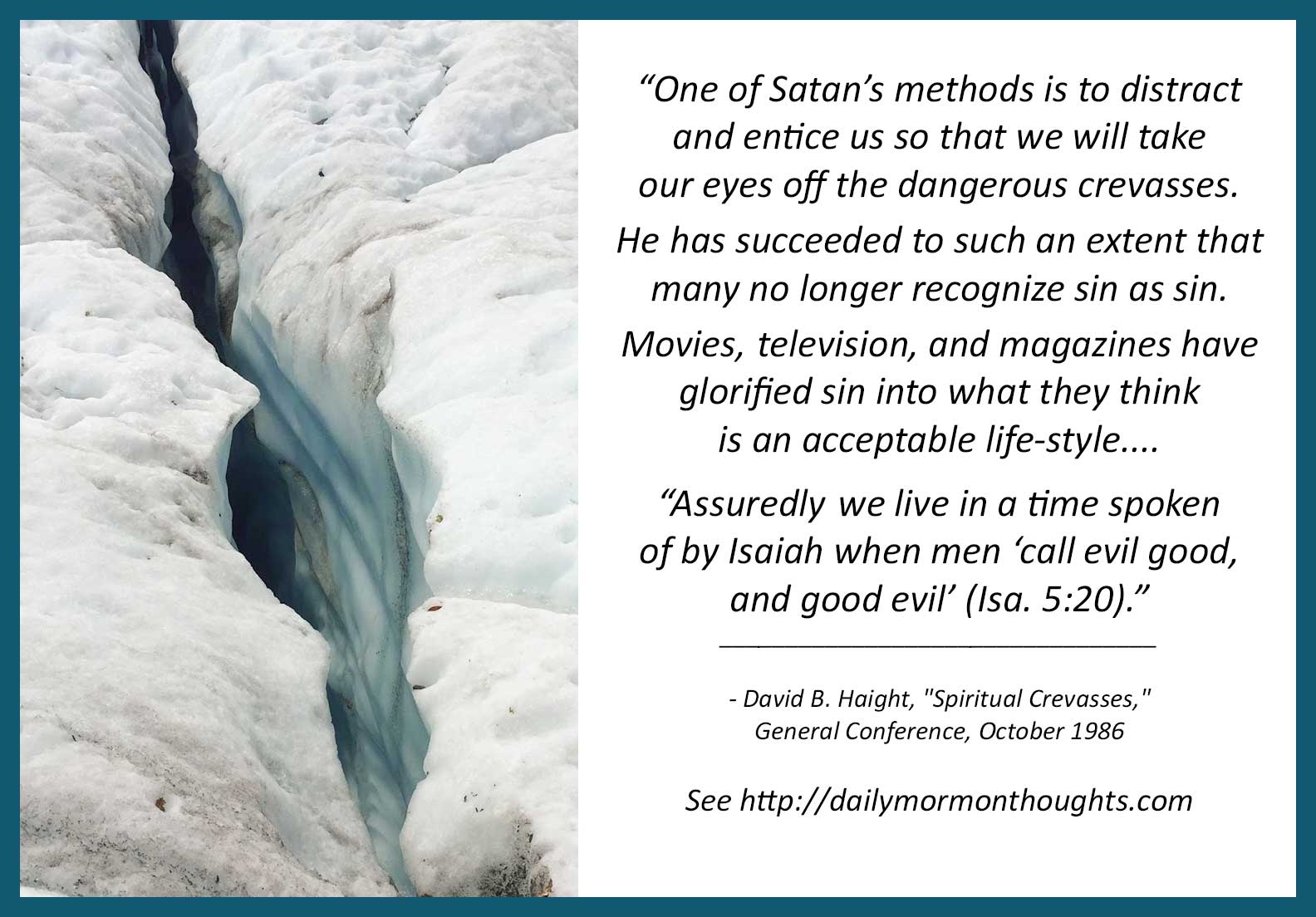
"One of Satan’s methods is to distract and entice us so that we will take our eyes off the dangerous crevasses. He has succeeded to such an extent that many no longer recognize sin as sin. Movies, television, and magazines have glorified sin into what they think is an acceptable life-style: '[fornication], adultery, incest, ... serial marriages, drug abuse, violence and double-dealing of every imaginable variety, [that is] often portrayed as [normal] behavior; where people who do good are not...  rewarded and those who do evil are not punished.' So stated a Los Angeles Times writer (see Salt Lake Tribune, 9 Aug. 1986, p. C7).
"Assuredly we live in a time spoken of by Isaiah when men 'call evil good, and good evil' (Isa. 5:20).
"If any of you are walking in ice fields near open crevasses, do you see the warning signs? 'Danger—don’t go near the edge'? Don’t trifle with evil. You will lose. We pray that you will not display the somewhat arrogant attitude of some who say, 'I can handle it!' or 'Everyone else does it!' ...
"To help each of us avoid the pitfalls and crevasses in life, the Lord has provided the lifeline of the precious truths in the scriptures, which, if held on to, will allow us to escape both physical and spiritual danger."
- David B. Haight, "Spiritual Crevasses," General Conference, October 1986; see also Ensign Nov 1986 p. 36
Click here to read or listen to the full talk

In this talk, Elder Haight discusses the danger of crevasses to those who hike across glaciers. He tells the story of an 11-year-old LDS boy who fell into one in Canada, and was rescued in a dramatic fashion. Having hiked in similar conditions myself earlier this year (on Mt. Rainier in Washington), I am especially sensitive to the dangers that these obstacles can present. Sometimes they are hidden from view; other times they are visible but don't look especially threatening and invite casualness.

Elder Haight likens the physical danger of glacier crevasses to the spiritual traps we can encounter in life, and warns us in particular of the risk of downplaying the danger, or becoming casual or over-confident about our abilities to bypass them:


The spiritual traps and dangers in our world are all around us. How important to be vigilant and watchful, and never over-confident! In particular, we should watch for warning signs, head the advice of others who know, and cling to the scriptures as a source of preparation and readiness.

(Compilation and commentary by David Kenison, Orem, Utah, 2017)

Friday, September 1, 2017

President J. Reuben Clark Jr. on the power of music to bring us to God

President J. Reuben Clark, Jr. (September 1, 1871 – October 6, 1961) was a prominent attorney who served as Under Secretary of State during the presidency of Calvin Coolidge, and later as the US Ambassador to Mexico. He was called as a counselor in the First Presidency to Heber J. Grant starting in April 1933, and was ordained an apostle a year and a half later. He went on to serve as counselor to Presidents George Albert Smith and David O. McKay before he passed away in 1961 at age 90.
“We get nearer to the Lord through music than perhaps through any other thing except prayer.”
- J. Reuben Clark Jr., Conference Report, Oct. 1936, 111

Today's quote is short and sweet, but packed with meaning and invitation. President Clark's insight about the power and influence music can have on our souls is important to ponder. And his comment and comparison are particularly appropriate, given the Lord's description: "For my soul delighteth in the song of the heart; yea, the song of the righteous is a prayer unto me, and it shall be answered with a blessing upon their heads." (D&C 25:12)


In my mind, this simple statement then challenges me to ponder two questions:

  • Given that Satan always counterfeits the Lord's most powerful tools, am I being careful to select the right kind of music that will truly help bring me nearer to the Lord?
  • And am I actively using the power of beautiful music as a tool for good in my life as I strive to be close to Him?

(Compilation and commentary by David Kenison, Orem, Utah, 2017)
// Customization to close archive widget on first view - DK 3/15