Wednesday, February 7, 2018

Elder LeGrand Richards on the sacred gift of the Holy Ghost

Elder LeGrand Richards (1886-1983) served as the Presiding Bishop of the Church from 1938-1952, when he was called to the Quorum of Twelve Apostles.  He died in 1983 at age 96.
"I humbly pray that the Spirit of the Lord will sustain me while I address you here this afternoon and discuss with you a statement of the Prophet Joseph Smith when he visited President [Martin] Van Buren, president of the United States. The President asked the Prophet what difference there was between the Prophet’s church and the other churches of the world. The Prophet answered: 'We have the correct mode of baptism, and the gift of the Holy Ghost by the laying on of hands.' Then he said: 'We considered that all other considerations were contained in the gift of the Holy Ghost'” (see History of the Church, 4:42).
"I would just like to mention a few things that occurred to me that we have by virtue of the Holy Ghost, which each of us, as members of the Church, receives by the laying on of hands by one who has the authority to thus administer that gift.
"To me, the gift of the Holy Ghost is as important to man as sunshine and water are to the plants. You take them away, and the plants would die. You take the Holy Ghost out of this Church, and this Church would not be any different than any other church. And it is manifest in so many ways in the lives and the devotion of the members of the Church."
- LeGrand Richards, "The Gift of the Holy Ghost," General Conference October 1979
Click here to read or listen to the full talk

Understanding the role and function of the Holy Ghost, and having the Priesthood keys to confer that gift on worthy members, is truly a distinguishing feature of Latter-day Saint doctrine. Elder Richards shares his witness of the sacred nature of that gift and its importance to our spiritual progress:


Perhaps we take for granted how important that gift is for us, and how critical it is for our growth and progress in this life. Elder Richards expresses that there is no life without it. And all you have to do is look at "the lives and devotion of the members of the Church" to understand how vitalizing and motivating it is.

We truly need to carefully cultivate the gift of the Holy Ghost in our personal lives, providing the water and sunlight that will sustain growth. Those things represent, of course, the spiritual nourishment that must be a part of our daily lives. It doesn't do to water a plant once in a while, or to provide sunlight on occasion; true growth requires steady, ongoing supplies.

(Compilation and commentary by David Kenison, Orem, Utah, 2018)

Tuesday, February 6, 2018

Elder Ronald A. Rasband on eagerly serving one another

Elder Ronald A. Rasband (b. February 6, 1951) served as a Seventy beginning in 2000.  He was the senior president of the Seventy when he was called to the Quorum of Twelve Apostles in October 2015.
"If you come upon a person who is drowning, would you ask if they need help—or would it be better to just jump in and save them from the deepening waters? The offer, while well meaning and often given, 'Let me know if I can help' is really no help at all.
"We continue to learn the important value of being aware of and interested in the lives of those around us, learning not only the importance of giving help but also the overwhelming joy that comes from helping others....
"I would like to close with the words from a beloved hymn:
We are all enlisted till the conflict is o’er;
Happy are we! Happy are we!
Soldiers in the army, there’s a bright crown in store;
We shall win and wear it by and by. ('We Are All Enlisted,' Hymns, no. 250.)
"Brothers and sisters, it is my hope and prayer that we will continue to bear nobly our burdens and to reach out to those among us who are suffering and in need of being lifted and encouraged. May we each thank God for His blessings and renew our commitment to our Father in Heaven of humble service to His children."
- Ronald A. Rasband, "Special Lessons," General Conference, April 2012
Click here to read or listen to the full talk

How do we respond when someone we know or care about is in need? Elder Rasband comments on the frequent statement, "Let me know if there is anything I can do to help." He suggests that while that is a sincere and well-meaning sentiment, an even better approach is to just find some way to jump in and do something that would be valuable to the person in need:


There are always those around us who are "suffering and in need of being lifted and encouraged." We should always be aware and prayerful, seeking for ways to help and lift. And in so doing, "overwhelming joy" comes to us as a reward.

(Compilation and commentary by David Kenison, Orem, Utah, 2018)

Monday, February 5, 2018

President Thomas S. Monson on finding happiness at home

President Thomas S. Monson (1927–2018) was sustained to the Quorum of Twelve Apostles in 1963. He served as a counselor in the First Presidency with Presidents Benson, Hunter, and Hinckley and then became Church president in 2008. He led the Church for almost a decade until his passing in January 2018.
"'Happiness is the object and design of our existence; and will be the end thereof, if we pursue the path that leads to it; and this path is virtue, uprightness, faithfulness, holiness, and keeping all the commandments of God.' (Joseph Smith, TPJS 255-6)
"This description of such a universal goal was provided by the Prophet Joseph Smith. It was relevant then. It is relevant now. With such a clear road map to follow, why then are there so many unhappy people? Frequently, frowns outnumber smiles and despair dampens joy. We live so far below the level of our divine possibilities. Some become confused by materialism, entangled by sin, and lost among the passing parade of humanity. Others cry out in the words of the convert of Philip of old: 'How can I [find my way], except some man should guide me?' (Acts 8:31)
"Happiness does not consist of a glut of luxury, the world's idea of a 'good time.' Nor must we search for it in faraway places with strange-sounding names. Happiness is found at home....
"Happy homes come in a variety of appearances. Some feature large families with father, mother, brothers, and sisters living together in a spirit of love. Others consist of a single parent with one or two children, while other homes have but one occupant. There are, however, identifying features which are to be found in a happy home, whatever the number or description of its family members. I refer to these as 'Hallmarks of a Happy Home.' They consist of:
"1. A pattern of prayer.
"2. A library of learning.
"3. A legacy of love.
"4. A treasury of testimony."
- Thomas S. Monson, "Hallmarks of a Happy Home," Ensign, Oct 2001, pp. 2-8
Click here to read the full article

President Monson asks a very interesting question: Why are there so many unhappy people? We are all seeking happiness in life, but most of us "live so far below the level of our divine possibilities." President Monson comments on some of the causes:

  • some become confused by materialism
  • entangled by sin
  • lost among the passing parade of humanity

I've certainly seen examples of each of these around me, and to some extent, have felt their impact in my own life. It's a challenging world! But happiness is available to us, if we look in the right place and in the right way. And President Monson suggests that the home is the place to look for happiness.


President Monson then goes on to expand upon those "Hallmarks of a Happy Home" in his discourse, giving further insights into how they can be implemented to help increase our level of happiness in our families and our personal lives. Very worthwhile counsel! Another prophet taught that "wickedness never was happiness' (Alma 41:10); truly, happiness follows righteous choices and actions in life.

(Compilation and commentary by David Kenison, Orem, Utah, 2018)

Sunday, February 4, 2018

Elder Dieter F. Uchtdorf on following spiritual landmarks

Elder Dieter F. Uchtdorf (born November 6, 1940) served as a Seventy from 1994-2004, when he was called as a member of the Quorum of Twelve.  He served as second counselor in the First Presidency from 2008 to 2018.
"Spiritual landmarks are indispensable for keeping us on the straight and narrow path. They give clear direction as to the way we should travel—but only if we recognize them and walk toward them.
"If we refuse to be guided by these landmarks, they become meaningless, decorative masses that have no purpose but to break up the flatness of the horizon.
"It’s not enough to go solely by our instincts.
"It’s not enough to have the best of intentions.
"It won’t do to rely only on our natural senses.
"Even when we think we are following a straight spiritual path, without true landmarks to guide us—without the guidance of the Spirit—we will tend to wander.
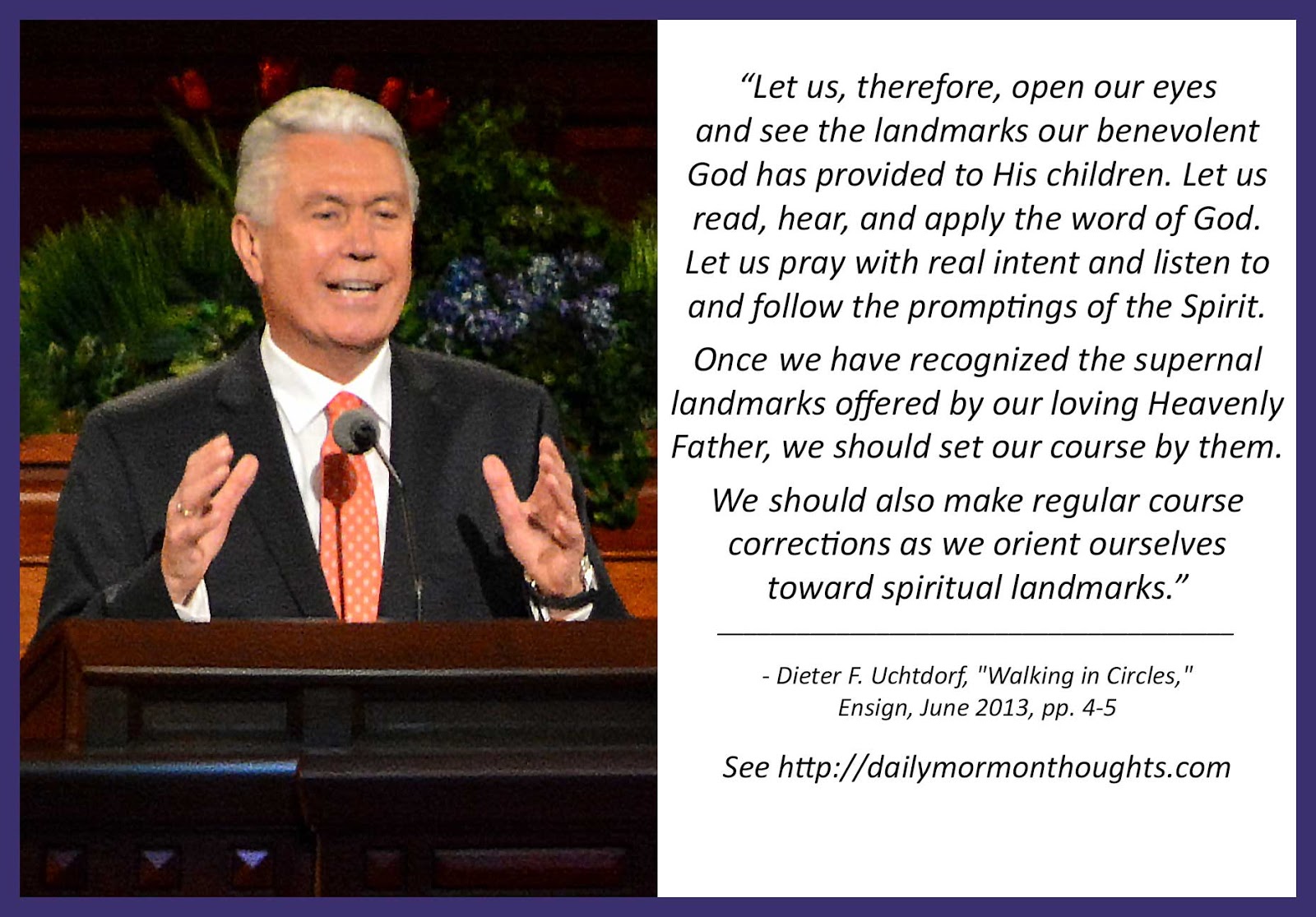
"Let us, therefore, open our eyes and see the landmarks our benevolent God has provided to His children. Let us read, hear, and apply the word of God. Let us pray with real intent and listen to and follow the promptings of the Spirit. Once we have recognized the supernal landmarks offered by our loving Heavenly Father, we should set our course by them. We should also make regular course corrections as we orient ourselves toward spiritual landmarks.
"In this way, we will not wander in circles but walk with confidence and certainty toward that great heavenly blessing that is the birthright of all who walk in the straight and narrow way of Christ’s discipleship."
- Dieter F. Uchtdorf, "Walking in Circles," Ensign, June 2013, pp. 4-5
Click here to read or listen to the full article

I love to hike in the mountains, and can appreciate the message Elder Uchtdorf shared about how we navigate in various circumstances. He cited studies that show that people tend to walk in circles when there are no visible landmarks. In order to attain a goal using only visual references, it's critical to use landmarks; being guided by our instincts or good intentions is not sufficient. And the same applies to spiritual "navigation" of the challenges of life; the "landmarks" provided by God for that journey become crucial. Elder Uchtdorf mentioned landmarks of scriptures and counsel from inspired leaders as examples.

An important point, though, is that the landmarks are useful "only if we recognize them and walk toward them." It requires noticing and responding in order to obtain benefit.


Learning, studying, listening, applying—great tools to help us discover and use the spiritual landmarks that are provided for our mortal journal. But perhaps the spiritual promptings from the Comforter are most important in helping us know what course to follow. All of those things help us make the "regular course corrections" that can keep us moving towards the right goals in life.

(Compilation and commentary by David Kenison, Orem, Utah, 2018)

Saturday, February 3, 2018

Elder Neil L. Andersen on the spiritual challenges of our time

Elder Neil L. Andersen (born August 9, 1951) served as a Seventy beginning in 1993, and was called to the Quorum of Twelve Apostles in 2009.
"My young brothers and sisters, how we love you, admire you, and pray for you. Don’t let the whirlwinds drag you down. These are your days—to stand strong as disciples of the Lord Jesus Christ. (See Helaman 7:9.)
"Build more firmly your foundation upon the rock of your Redeemer.
"Treasure more completely His incomparable life and teachings.
"Follow more diligently His example and His commandments.
"Embrace more deeply His love, His mercy and grace, and the powerful gifts of His Atonement.
"As you do, I promise you that you will see the whirlwinds for what they are—tests, temptations, distractions, or challenges to help you grow. And as you live righteously year after year, I assure you that your experiences will confirm to you again and again that Jesus is the Christ. The spiritual rock under your feet will be solid and secure. You will rejoice that God has placed you here to be a part of the final preparations for Christ’s glorious return.
"The Savior said, 'I will not leave you comfortless: I will come to you' (John 14:18). This is His promise to you. I know this promise is real. I know that He lives."
- Neil A. Andersen, "Spiritual Whirlwinds," General Conference April 2014
Click here to read or listen to the full article

In this conference address, Elder Andersen spoke especially to the young people of the Church, giving them instruction and warning about the challenges we face in our time—particularly the "spiritual whirlwinds" that threaten to disrupt our lives. It becomes a critical time in the history of the world to "stand strong as disciples of the Lord Jesus Christ." Elder Andersen gives these specific recommendations:


I love the promises that follow this invitation to act. Elder Andersen promises discernment to perceive the challenges of the world for what they really are. But then he also reminds us that as we continue faithful through the years, repeated confirmation will be given of the divine nature of the Savior and His role, and our foundation, built on Him, "will be solid and secure." There can be no better way to withstand the spiritual and temporal whirlwinds of our time!

(Compilation and commentary by David Kenison, Orem, Utah, 2018)

Friday, February 2, 2018

President Spencer W. Kimball on heaven as a place and as a condition

President Spencer W. Kimball (1895-1985) was ordained an apostle in 1943 and served as President of the Church from 1973 to 1985.
"Heaven is a place, but also a condition; it is home and family. It is understanding and kindness. It is interdependence and selfless activity. It is quiet, sane living; personal sacrifice, genuine hospitality, wholesome concern for others. It is living the commandments of God without ostentation or hypocrisy. It is selflessness. It is all about us. We need only to be able to recognize it as we find it and enjoy it. Yes... I’ve had many glimpses of heaven.”
Spencer W. Kimball, “Glimpses of Heaven,” General Conference October 1971
Click here to read or listen to the full talk

It's common to hear people speak about "getting to heaven" or "getting to the Celestial Kingdom" as if these were locations to be arrived at. President Kimball expands the understanding to suggest that they are also conditions or states of being that we attain to. This was a wonderful talk (worth reviewing the whole thing), in which he discussed a number of personal experiences and insights in having glimpsed "heaven on earth" in the lives of people he had contact with.


It's interesting to consider the list of virtues or conditions that President Kimball gave, to see how many of those are important or key to our personal environments:

  • home and family
  • understanding and kindness
  • interdependence and selfless activity
  • quiet, sane living
  • personal sacrifice
  • genuine hospitality
  • wholesome concern for others
  • living the commandments of God without ostentation or hypocrisy
  • selflessness

What wonderful virtues to focus on in our lives, so that we truly can find, or create, heaven,

(Compilation and commentary by David Kenison, Orem, Utah, 2018)

Thursday, February 1, 2018

President Howard W. Hunter on simple faith and obedience

President Howard W. Hunter (1907-1995) was called to the Quorum of Twelve in 1959.  He served as Church President from June 5, 1994 to his death on March 3, 1995.
"I think there is no more beautiful story in all of history than the simple, sweet story of the lad who went into the woods near his home, kneeling in prayer and receiving heavenly visitors.
"Now we look into his life and into his works. Many have pried into them to find the mystery of it all behind the written word, but there is no mystery.... There was a simple faith, the faith of a young boy who was to be trained in the things that pertained to God. And as time went by, this young man, without scholarly achievements and without education, was educated by the Lord for the things which should come.
"Now we have been given intelligence and a mind. We only need to train and cultivate it as the Lord instructed Joseph and have a simple faith as he had and be willing to follow simple instructions. When we do so and follow the path that [the Lord] would have us follow and learn the lessons that He would have us learn, we find that our lives are purged of all things which are contrary to the purposes of God, and so it was with Joseph. He came to be a man nearer perfection, for he had cleansed his soul and his mind and lived close to the Lord and could talk with Him and hear Him speak the things which he has left for us through his revelations. Through his spiritual eyes he has been able to see that which has passed and that which lies ahead, and we have had proof of the truthfulness of that which he has seen."
- Howard W. Hunter, "Joseph Smith the Seer," in The Annual Joseph Smith Memorial Sermons, 2 vols. (1966), 2:197–98

President Hunter summarizes the miracle of Joseph Smith's achievements this way: "There was a simple faith." The Lord was able to build on that faith over time to make him into a wonderful tool to achieve great things.


The basic tools of what made Joseph great are also in each of us: "intelligence and a mind" that can be trained along with that simple faith. As we learn to consistently "follow simple instructions" then we know we will be on the path the Lord would have us follow. In doing so, the things of the world fall away; "our lives are purged of all things which are contrary to the purposes of God." That's what happened to Joseph, and that's what can happen to us.

(Compilation and commentary by David Kenison, Orem, Utah, 2018)
// Customization to close archive widget on first view - DK 3/15