Monday, June 4, 2018

President James E. Faust on the power of the Savior's influence in our lives

President James E. Faust (1920-2007) was called as a Seventy in 1976, then as a member of the Quorum of Twelve in 1978. He served as a counselor to President Hinckley from 1995 until his death in 2007 at age 87.
"We should earnestly seek not just to know about the Master, but to strive, as He invited, to be one with Him (see John 17:21), to 'be strengthened with might by his Spirit in the inner man' (Eph. 3:16). We may not feel a closeness with Him because we think of Him as being far away, or our relationship may not be sanctifying because we do not think of Him as a real person.
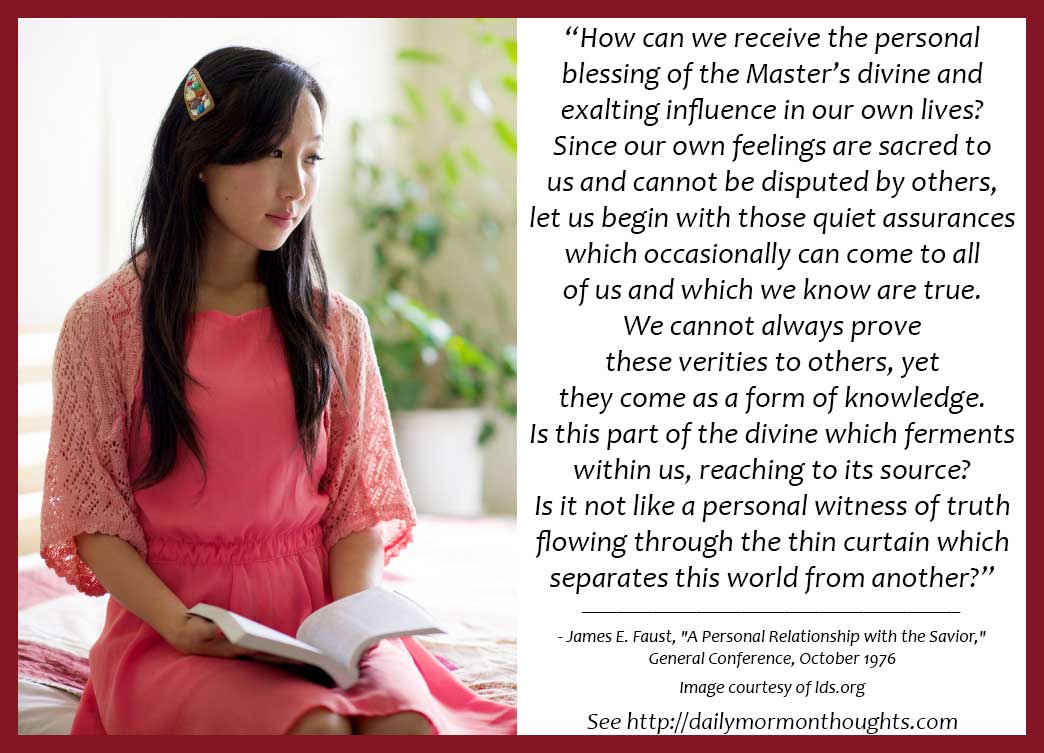
"How can we receive the personal blessing of the Master’s divine and exalting influence in our own lives? Since our own feelings are sacred to us and cannot be disputed by others, let us begin with those quiet assurances which occasionally can come to all of us and which we know are true. We cannot always prove these verities to others, yet they come as a form of knowledge. Is this part of the divine which ferments within us, reaching to its source? Is it not like a personal witness of truth flowing through the thin curtain which separates this world from another?
"Is there not a yearning to understand in your mind what is in your heart, a feeling which you cannot give utterance to because it is so unspeakably personal? The Master said that this quiet reality can 'speak peace to your mind concerning the matter.' (D&C 6:23.) ...
"It is my testimony that we are facing difficult times. We must be courageously obedient. My witness is that we will be called upon to prove our spiritual stamina, for the days ahead will be filled with affliction and difficulty. But with the assuring comfort of a personal relationship with the Savior, we will be given a calming courage."
- James E. Faust, "A Personal Relationship with the Savior," General Conference, October 1976
Click here to read or listen to the full talk

What can we do in our lives to feel more "connected" to the Savior? How can we feel more of His influence in our lives, His strength and love? President Faust suggests we start by examining our most inner, personal feelings and notice His influence that is already there::

We can indeed bridge the "thin curtain which separates this world from another" as we feel more of His love and influence. President Faust goes on to suggest five specific things we should strive to do:

  1. A daily communion involving prayer.
  2. A daily selfless service to another.
  3. A daily striving for an increased obedience and perfection in our lives.
  4. A daily acknowledgment of His divinity.
  5. A daily study of the scriptures.
As we are "courageously obedient" in our lives, we will feel His love and closeness, and be strengthened in a greater measure.


(Compilation and commentary by David Kenison, Orem, Utah, 2018)

Sunday, June 3, 2018

President Harold B. Lee on the importance of nurturing a testimony

President Harold B. Lee (1899-1973) was called to the Quorum of Twelve Apostles in 1941. He served as a counselor in the First Presidency from 1970-1972, then as Church president from July 1972 until his passing less than 18 months later in December 1973.
"A testimony can grow or diminish. [The Master said to Peter,] 'Satan hath desired to have you, that he may sift you as wheat: but I have prayed for thee, that thy faith fail not: and when thou art converted, strengthen thy brethren' (Luke 22:31-32). Now, mind you, He is saying that to the chiefest of the Twelve. I am praying for you; now go out and get converted, and when you get converted, then go strengthen your brother. It means [we can become] unconverted just as well as we can become converted.
"Your testimony is something that you have today but you may not have it always. That testimony is either going to increase and grow until you become as sure of the things, through faith, as you are that the sun shines; or if you allow it to dwindle, either through sin or through your ignorance or neglect, it's going to be just as dim and you are going to be standing in the dark more lost than if you had never seen.... When we see with our eyes what we ought to see, when we hear with our ears what we ought to hear, and when we understand with our hearts what we ought to understand, then we are converted. But by this same token, when we fail to do that, we can become unconverted."
- Harold B. Lee, address to Ricks College Student Body and Student Leaders, March 3, 1962; see also THBL 138

The idea of becoming "unconverted" is an intriguing one. Just as we can gain in light and knowledge, in our faith and surety—we can equally diminish and decline in those same qualities and characteristics. President Lee warns us to be careful about the direction we are heading. Even the chiefest of the ancient apostles was instructed by the Lord to nurture and strengthen his faith and testimony in order to be truly converted. But then be wary about drifting the other direction!


The things we do to become converted, will also help us to stay converted. President Lee warns that if we fail to do them, we risk losing our strength and testimony. What a great topic to ponder regularly as we consider our activities and our personal progress.

(Compilation and commentary by David Kenison, Orem, Utah, 2018)

Saturday, June 2, 2018

President Spencer W. Kimball on caring for homes and yards

President Spencer W. Kimball (1895-1985) was ordained an apostle in 1943 and served as President of the Church from 1973 to 1985.
"In an earlier conference we called attention to the fact that the Lord had created for us this beautiful world and gave command to our father Adam to till the ground and to dress the land and to make it habitable. That command continues to us.
"We recommend to all people that there be no undue pollution, that the land be taken care of and kept clean to be productive and to be beautiful. He gave to us the herbs and the good things which come of the earth for food and raiment and houses and barns and orchards and gardens and vineyards, each in the season thereof, and all of this is given for the benefit and use of man, both to please the eye and to gladden the heart; for food and for raiment, for taste and for smell, to strengthen the body and to enliven the soul. And it pleased God that he had given all these things unto man; for unto this end were they made to be used, with judgment. (See D&C 59:16–20.)
"We are concerned when we see numerous front and side and back yards that have gone to weeds, where ditch banks are cluttered and trash and refuse accumulate. It grieves us when we see broken fences, falling barns, leaning and unpainted sheds, hanging gates, and unpainted property. And we ask our people again to take stock of their own dwellings and properties.
"There is a story that President Brigham Young, having urged the people of certain communities to properly dress and clean their premises, refused to go back to them to preach to them, saying something like this: 'You didn’t listen to me when I urged you to fix up your premises. The same doors are off their hinges; the same barns are still unpainted; the same fences are partly fallen.'"
- Spencer W. Kimball, "Why Call Me Lord, Lord, and Do Not the Things Which I Say?," General Conference April 1975
Click here to read or listen to the full talk

President Kimball would often give very practical and more "day to day" advice in his conference talks, as well as discussing the doctrinal aspects of the gospel. On a number of occasions he encouraged Church members to care for their homes and yards, to beautify the environment and to have gardens and plants.

I love the encouragement, from the Lord and reiterated through a prophet, that we take advantage of "herbs and the good things which come of the earth" in our lives since they are given to us by God, "both to please the eye and to gladden the heart."


The story from Brigham Young is somewhat pointed; are we really listening to the counsel and instructions of the prophets? Listening and acting will prepare our hearts and minds to receive more counsel!

(Compilation and commentary by David Kenison, Orem, Utah, 2018)

Friday, June 1, 2018

President Brigham Young on growing in blessings from God

President Brigham Young (1801-1877) was part of the first Quorum of Twelve Apostles of this dispensation, called and ordained in 1835. He served as the second Church president, succeeding Joseph Smith, from 1847 until his death in 1877.
"Those who humble themselves before the Lord, and wait upon Him with a perfect heart and willing mind, will receive little by little, line upon line, precept upon precept, here a little, and there a little, 'Now and again,' as brother John Taylor says, until they receive a certain amount. Then they have to nourish and cherish what they receive, and make it their constant companion, encouraging every good thought, doctrine and principle and doing every good work they can perform, until by and by the Lord is in them a well of water, springing up unto everlasting life."
- Brigham Young, discourse in the Salt Lake Tabernacle, March 15, 1857; see Journal of Discourses 4:286–87
Click here to read the complete talk

President Young seemed to love the imagery of the "well of living water, springing up unto everlasting life" (D&C 63:23; see also John 4:14). He spoke of it on a number of occasions. In this instance, he describes the process of growing in our spiritual sensitivity. We start by being humble, trusting in God's timing and wisdom. As we do that, we will begin to receive gifts and blessings, endowments of understanding and power. We must cherish and nourish those gifts as they grow stronger and stronger within us:


We sometimes neglect the "follow-up work" that we should do after we receive inspiration or blessings; we should focus our personal efforts in "encouraging every good thought, doctrine and principle and doing every good work." That is what brings the greatest growth and progress, allowing the Lord's well of living water to spring forth in our hearts.

(Compilation and commentary by David Kenison, Orem, Utah, 2018)

Thursday, May 31, 2018

President Henry B. Eyring on sharing the legacy of testimony

President Henry B. Eyring (born May 31, 1933) served in the Presiding Bishopric from 1985-1992, as a Seventy from 1992-1995, then was called to the Quorum of Twelve Apostles. He has served in the First Presidency since 2007.
"We would, if we could, leave our families a legacy of testimony that it might reach through the generations.
"What we can do to create and transmit that legacy comes from an understanding of how testimony is instilled in our hearts. Since it is the Holy Ghost who testifies of sacred truth, we can do at least three things to make that experience more likely for our families. First, we can teach some sacred truth. Then we can testify that we know what we have taught is true. And then we must act so that those who hear our testimony see that our actions conform with what we said was true. The Holy Ghost will then confirm to them the truth of what we said and that we knew it to be true.
"That is how a legacy of testimony is created, preserved, and transmitted in a family. It isn’t easy, but ordinary people have done it....
"Some of the greatest opportunities to create and transmit a legacy of testimony cannot be planned. Tragedy, loss, and hurt often arrive unanticipated. How we react when we are surprised will tell our families whether what we have taught and testified lies deep in our hearts. Most of us will have taught our children of the power of the Savior to carry us through whatever befalls us....
"When tragedy strikes or even when it looms, our families will have the opportunity to look into our hearts to see whether we know what we said we knew. Our children will watch, feel the Spirit confirm that we lived as we preached, remember that confirmation, and pass the story across the generations."
- Henry B. Eyring, "A Legacy of Testimony," General Conference April 1996
Click here to read or listen to the full talk

When you have something precious and dear to you, the greatest desire is to share it with those you love most. Lehi displayed this principle; in the midst of his heavenly vision, as he discovered and partook of the fruit that was sweet and white and filled his soul with "exceedingly great joy," his first reaction was, "I began to be desirous that my family should partake of it also" (see 1 Nephi 8:10-12). He wanted to share the precious gift with those who mattered most to him.

President Eyring suggests ways to share the precious gift of testimony with those we love most. It's a simple process of teaching, testifying, and demonstrating:


Though the first two steps set the stage and allow the Holy Ghost to accompany teaching, it might be the third step that is the most important in helping to confirm our words. That's where we demonstrate that it's more than a learned concept or a passing idea we are describing; it's a fundamental part of our being in which we live and follow the principles and see their true fruit. Then our family can realize that the principle really matters to us, and feel confirmed in their hearts the truthfulness of our words.

(Compilation and commentary by David Kenison, Orem, Utah, 2018)

Wednesday, May 30, 2018

President Dallin H. Oaks on seeking learning through study and faith

President Dallin H. Oaks (born August 12, 1932) served as president of BYU from 1971-1980.  He was then appointed as a justice of the Utah Supreme Court, and resigned when he was called to the Quorum of Twelve Apostles in 1984. He became President of the Quorum of Twelve Apostles and also 1st Counselor in the First Presidency in January 2018.
"In modern revelation the Lord has told us to 'seek learning … by study and also by faith.' (D&C 109:7.)
"We seek learning by studying the accumulated wisdom of various disciplines and by using the powers of reasoning placed in us by our Creator.
"We should also seek learning by faith in God, the giver of revelation. I believe that many of the great discoveries and achievements in science and the arts have resulted from a God-given revelation. Seekers who have paid the price in perspiration have been magnified by inspiration.
"The acquisition of knowledge by revelation is an extra bonus to seekers in the sciences and the arts, but it is the fundamental method for those who seek to know God and the doctrines of his gospel. In this area of knowledge, scholarship and reason are insufficient.
"A seeker of truth about God must rely on revelation. I believe this is what the Book of Mormon prophet meant when he said, 'To be learned is good if they hearken unto the counsels of God.' (2 Ne. 9:29.) It is surely what the Savior taught when he said, 'Blessed art thou, Simon Bar-jona: for flesh and blood hath not revealed it unto thee, but my Father which is in heaven.' (Matt. 16:17.)
"The way to revelation is righteousness."
- Dallin H. Oaks, "Alternate Voices," General Conference April 1989
Click here to read or listen to the full talk

The admonition from the Lord to "seek learning … by study and also by faith" is an important one to remember. We apply ourselves to the first half of the process, though perhaps not enough—there is much we could study and learn if we made greater efforts to focus our personal study efforts. But we also often neglect the second part of the guideline, that of using faith to gain knowledge.

President Oaks points out that even our "secular" learning can benefit from spiritual assistance, as we find that those "who have paid the price in perspiration have been magnified by inspiration." But then, in the realm of matters of the spirit, we must apply both our study and our faith in order to truly benefit:


President Oaks gives wise counsel in this address about the process of learning through faith. We are blessed as we make those efforts to grow and expand in our learning, both temporally and spiritually!

(Compilation and commentary by David Kenison, Orem, Utah, 2018)

Tuesday, May 29, 2018

President Howard W. Hunter on the divine plan of faith in God and the Savior

President Howard W. Hunter (1907-1995) was called to the Quorum of Twelve in 1959.  He served as Church President from June 5, 1994 to his death on March 3, 1995.
"There is no tangible, concrete evidence of the existence of God or the divinity of the Master in the legal sense, but not all inquiry for truth results in proof by real or demonstrative evidence. It is fallacious to argue that because there is no demonstrative evidence of the existence of God he does not in fact exist. In the absence of evidence often thought necessary by the scientific world for positive proof, our search may take is into the realm of circumstantial evidence. We could spend hours describing the wonders of the universe, of the earth, of nature, of the human body the exactness of the laws of physics, and a thousand things, all of which dictate to the conscience of a truth seeker that there is a creator and one who rules over the universe.
"What would be the situation if the existence of God could be proven by demonstrative evidence? What would happen to the element of faith as the first step or principle of the gospel? One of the burdens of the teachings of the Master was to emphasize the importance of faith. Faith is the element that builds the bridge in the absence of concrete evidence. This is exactly what the writer of the epistle to the Hebrews was talking about when he referred to faith as 'the substance of things hoped for, the evidence of things not seen.' (Heb. 11:1.) In other words, faith is the assurance of the existence of a truth even though it is not evident or cannot be proved by positive evidence.
"Suppose that all things could be proven by demonstrative evidence. What then would become of the element of faith? There would be no need for faith and it would be eliminated, giving rise then to this query: If faith is the first step or principle of the gospel and is eliminated, what happens to the gospel plan? The very foundation will crumble. I submit that there is a divine reason why all things cannot be proven by concrete evidence."
- Howard W. Hunter, "Faith—The First Step," General Conference April 1975
Click here to read or listen to the full talk

Can we truly prove the existence of God, using traditional scientific means? President Hunter suggests that there is abundant circumstantial evidence for that understanding, including "the wonders of the universe, of the earth, of nature, of the human body the exactness of the laws of physics." but no concrete physical proof. And that aspect of faith in God is necessary for His plan for us in this life!


Faith builds the bridge for us in this life. The divine plan for our mortal experience requires that we learn to live by faith, and receive the blessings that follow. President Hunter's talk gives excellent suggestions for that most important process of mortality!

(Compilation and commentary by David Kenison, Orem, Utah, 2018)
// Customization to close archive widget on first view - DK 3/15