Tuesday, September 4, 2018

Elder Neil L. Andersen on recognizing God's hand in our life

Elder Neil L. Andersen (born August 9, 1951) served as a Seventy beginning in 1993, and was called to the Quorum of Twelve Apostles in 2009.
"Brothers and sisters, seeing and believing the Lord’s miracles in establishing His kingdom on earth can help us see and believe that the Lord’s hand is at work in our own lives as well.
"The Lord declared, 'I am able to do mine own work.' (2 Nephi 27:20.) We each try to do our part, but He is the grand architect. Under the direction of His Father, He created this world. 'All things were made by him; and without him was not any thing made that was made.' (John 1:3.) As we are spiritually awake and alert, we see His hand across the world and we see His hand in our own personal lives."
- Neil L. Andersen, "Thy Kingdom Come," General Conference, April 2015
Click here to read or listen to the full talk

The Lord's hand is at work among us. Elder Andersen testifies that we can witness its influence as we first recognize the evidence of divine work in the establishment of His kingdom on earth; that will lead to awareness of how the Lord works in more specific and personal ways:


I love the description and challenge contained in this phrase: "As we are spiritually awake and alert...." One who is spiritually awake is watching and noticing the spiritual things that are occurring in his life. Too often, we are dozing or distracted and don't even recognize God's hand as it influences our path, gives us help and encouragement, and blesses our lives. We need to awaken and be watching, and we'll be blessed to see that divine influence more than we expect!

(Compilation and commentary by David Kenison, Orem, Utah, 2018)

Monday, September 3, 2018

Elder D. Todd Christofferson on finding power in our relationship with God

Elder D. Todd Christofferson (b. January 24, 1945) was called to the Seventy in 1993, and as a member of the Quorum of Twelve Apostles in 2008.
"Of all your associations, it is your relationship with God, your Heavenly Father, who is the source of your moral power, that you must always put first in your life. Remember that Jesus’s power came through His single-minded devotion to the will of the Father. He never varied from that which pleased His Father. (See John 8:29.) Strive to be that kind of disciple of the Father and the Son, and your influence will never fade.
"And do not be afraid to apply that influence without fear or apology. 'Be ready always to give an answer to every [man, woman, and child] that asketh you a reason of the hope that is in you.' (1 Peter 3:15.) 'Preach the word; be instant in season, out of season; reprove, rebuke, exhort with all longsuffering and doctrine.' (2 Timothy 4:2.) 'Bring up your children in light and truth.' (D&C 93:40.) 'Teach [them] to pray, and to walk uprightly before the Lord.' (D&C 68:28.)"
- D. Todd Christofferson, "The Moral Force of Women," General Converence October 2013
Click here to read or listen to the full talk

In this conference talk, Elder Christofferson emphasized the unique contribution of women in the history of society, describing their "innate moral power" and encouraging them to further cultivate that gift, while also reminding the brethren that they have similar obligations to seek for goodness in their lives.

One of the keys to strengthening our "moral power" and influence in society is to focus on our relationship with God. As our discipleship and devotion to Him increase, so will our moral power and influence for good in society.


But then the key is to let that influence be felt. Elder Christofferson encourages us, through several scriptural exhortations, to speak up and let our voices be heard.

(Compilation and commentary by David Kenison, Orem, Utah, 2018)

Sunday, September 2, 2018

Elder David B. Haight on how the love of God blesses our lives

Elder David B. Haight (born Sept 2, 1906, died July 31, 2004) was sustained as a member of the Quorum of Twelve in 1976. He passed away at age 97, four days after attending the funeral of his colleague Neal A. Maxwell.  He was the oldest person to have served as an apostle in this dispensation.
"Love is a gift of God, and as we obey His laws and genuinely learn to serve others, we develop God’s love in our lives.
"Love of God is the means of unlocking divine powers which help us to live worthily and to overcome the world.
"The worldly methods of promoting great causes were discarded by the Savior. Money to buy influence—He had none. Publications—He never used. The sword was contrary to His purposes. The people of His own nation disowned Him. He planted His ideals in the hearts of only a few. They were mostly poor; but they met, listened, prayed, and believed in His words. As taught by the Master, they went among other men and by act and word passed on the new ideals, by love unfeigned and by friendship, not by force; and so the work spread.
"God accomplishes His purposes heart to heart."
- David B. Haight, "Love All," General Conference October 1982
Click here to read or listen to the full talk

The love of God is a fascinating concept to study and ponder—both the love He has for us, and the God-like love that we attempt to express to Him and to others. Elder Haight reminds us that we receive His love as a gift; we develop the capacity to love through obedience and service to others:


We are blessed more than we realize as we experience His love in our personal life, and as we learn to share and express it with those around us. Learning to "unlock divine powers" is truly a remarkable gift.

(Compilation and commentary by David Kenison, Orem, Utah, 2018)

Saturday, September 1, 2018

President J. Reuben Clark on the God's love for all His children

President J. Reuben Clark, Jr. (September 1, 1871 – October 6, 1961) was a prominent attorney who served as Under Secretary of State during the presidency of Calvin Coolidge, and later as the US Ambassador to Mexico. He was called as a counselor in the First Presidency to Heber J. Grant starting in April 1933, and was ordained an apostle a year and a half later. He went on to serve as counselor to Presidents George Albert Smith and David O. McKay before he passed away in 1961 at age 90.
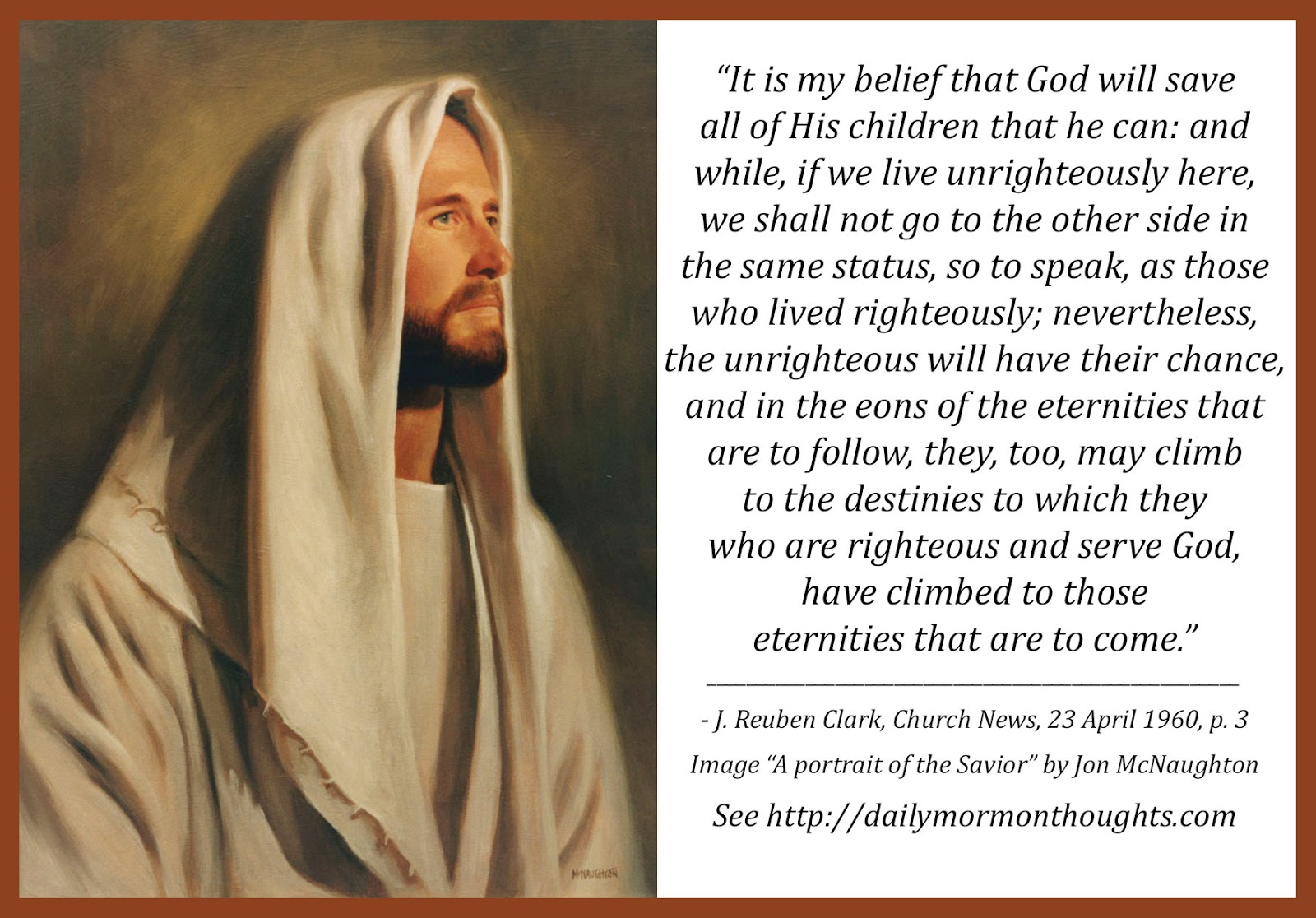
"I am not a strict constructionalist, believing that we seal our eternal progress by what we do here. It is my belief that God will save all of His children that he can: and while, if we live unrighteously here, we shall not go to the other side in the same status, so to speak, as those who lived righteously; nevertheless, the unrighteous will have their chance, and in the eons of the eternities that are to follow, they, too, may climb to the destinies to which they who are righteous and serve God, have climbed to those eternities that are to come."
- J. Reuben Clark, Church News, 23 April 1960, p. 3

This is a fascinating excerpt. There is much we don't understand about the eternities, and sometimes what we assume is a doctrine has not been officially pronounced to be so. That is the case when our eternal options of progression are considered.

President Clark comes down strongly on the "merciful and loving God" side of the discussion:


There is certainly much to anticipate and hope for in eternity. Joseph Smith pointed that out early in our dispensation:
"When you climb up a ladder, you must begin at the bottom, and ascend step by step, until you arrive at the top; and so it is with the principles of the Gospel you must begin with the first, and go on until you learn all the principles of exaltation. But it will be a great while after you have passed through the veil before you will have learned them. It is not all to be comprehended in this world; it will be a great work to learn our salvation and exaltation even beyond the grave."
- Joseph Smith, TPJS 348

We should be very grateful for a loving God who will do all He can to assist us in "working out our salvation" as long as we are willing to continue to do our part!

(Compilation and commentary by David Kenison, Orem, Utah, 2018)

Friday, August 31, 2018

Elder Quentin L. Cook on developing self-worth based on divine parentage

Elder Quentin L. Cook (b. 1940) was called as a Seventy in 1996, then as a member of the Quorum of Twelve Apostles in 2007.
"The Bible teaches that man and woman are created in the image of the Father (see Genesis 1:26–27). The science of genetics and personal observation both testify to the principle of offspring taking on the form, appearance, and traits of parents. Some build their sense of personal worth by comparing themselves to others. That approach can lead to feelings of inadequacy or superiority. It is preferable to look directly to our Father for our sense of self-worth.
"Our mortal pedigree charts show many generations winding backward through the ages. Our individual spiritual pedigree chart, however, has only two generations—our Father’s and ours. Our form is His form, without the glory. 'Now are we the sons [and daughters] of God, and ... when he shall appear, we shall be like him; for we shall see him as he is' (1 John 3:2; see also D&C 130:1). Within each of us lie the latent seeds of godliness that can be given flower and fruition by His blessing and by following the path of strict obedience shown to us by Jesus. There is power in saying or singing the words 'I am a child of God.'"
- Quentin L. Cook, "The Doctrine of the Father," Ensign, February 2012, p. 33
Click here to read the full article

Our personal self-concept develops in a variety of ways as we grow up, and changes frequently through the experiences of our lives. Elder Cook warns us of the tendency to develop that sense of self-worth by comparing ourselves to others around us; that can result in a skewed and inaccurate image, for a variety of reasons:

  • we evaluate others superficially, based on our brief glimpses of their public appearance
  • we don't fully know the challenges and concerns of others that may not be visible to us
  • we can't compare our gifts and abilities with others, since we are all granted such diverse "raw material" to work with
  • we can't alter the differing circumstances into which we are born, and to some extent, the things we face in life

So the caution is to develop our sense of self-worth by understanding our divine parentage and heritage, and the eternal potential within each of us:


Once we understand the nature of our "spiritual heritage" and the divine seeds that are within us, we can focus on developing a divine sense of self-worth in the things that truly matter most.

(Compilation and commentary by David Kenison, Orem, Utah, 2018)

Thursday, August 30, 2018

Elder David A. Bednar on maintaining the companionship of the Spirit

Elder David A. Bednar (born June 15, 1952) was serving as the president of BYU–Idaho when he was called and sustained as a member of the Quorum of Twelve Apostles in October 2004.
"In our individual study and classroom instruction, we repeatedly emphasize the importance of recognizing the inspiration and promptings we receive from the Spirit of the Lord. And such an approach is correct and useful. We should seek diligently to recognize and respond to promptings as they come to us. However, an important aspect of baptism by the Spirit may frequently be overlooked in our spiritual development.
"We should also endeavor to discern when we 'withdraw [ourselves] from the Spirit of the Lord, that it may have no place in [us] to guide [us] in wisdom’s paths that [we] may be blessed, prospered, and preserved' (Mosiah 2:36). Precisely because the promised blessing is that we may always have His Spirit to be with us, we should attend to and learn from the choices and influences that separate us from the Holy Spirit.
"The standard is clear. If something we think, see, hear, or do distances us from the Holy Ghost, then we should stop thinking, seeing, hearing, or doing that thing. If that which is intended to entertain, for example, alienates us from the Holy Spirit, then certainly that type of entertainment is not for us. Because the Spirit cannot abide that which is vulgar, crude, or immodest, then clearly such things are not for us. Because we estrange the Spirit of the Lord when we engage in activities we know we should shun, then such things definitely are not for us."
- David A. Bednar, "That We May Always Have His Spirit to Be with Us," General Conference April 2006
Click here to read or listen to the full talk

Learning to do the things that will bring the Holy Spirit into our lives is a key task of life. But Elder Bednar teaches that we must likewise learn to avoid doing the things that will drive that Spirit away from us. Each of these two aspects of our mortal experience is crucial to us, and he suggests that we sometimes don't give enough attention to the second part:


Joseph Smith taught beautifully about the process of bringing more spiritual influence into our life:
“A person may profit by noticing the first intimation of the spirit of revelation; for instance, when you feel pure intelligence flowing into you, it may give you sudden strokes of ideas, so that by noticing it, you may find it fulfilled the same day or soon; (i.e.) those things that were presented unto your minds by the Spirit of God, will come to pass; and thus by learning the Spirit of God and understanding it, you may grow into the principle of revelation, until you become perfect in Christ Jesus.”
- Joseph Smith, discourse on June 27, 1839; see History of the Church, 3:381

The corollary, as Elder Bednar instructs, would be to be alert enough to notice quickly when the spirit of revelation declines or disappears from our minds and lives. As we become more sensitive and more observant to spiritual promptings, we can more easily "fine-tune" our actions to increase the spiritual influence we receive.

(Compilation and commentary by David Kenison, Orem, Utah, 2018)

Wednesday, August 29, 2018

Elder Dieter F. Uchtdorf on God's unending love for His children

Elder Dieter F. Uchtdorf (born November 6, 1940) served as a Seventy from 1994-2004, when he was called as a member of the Quorum of Twelve.  He served as second counselor in the First Presidency from 2008 to 2018.
"As a child, when I would look at the little forget-me-nots, I sometimes felt a little like that flower—small and insignificant. I wondered if I would be forgotten by my family or by my Heavenly Father.
"Years later I can look back on that young boy with tenderness and compassion. And I do know now—I was never forgotten.
"And I know something else: as an Apostle of our Master, Jesus Christ, I proclaim with all the certainty and conviction of my heart—neither are you!
"You are not forgotten.
"Sisters, wherever you are, whatever your circumstances may be, you are not forgotten. No matter how dark your days may seem, no matter how insignificant you may feel, no matter how overshadowed you think you may be, your Heavenly Father has not forgotten you. In fact, He loves you with an infinite love.
"Just think of it: You are known and remembered by the most majestic, powerful, and glorious Being in the universe! You are loved by the King of infinite space and everlasting time!
"He who created and knows the stars knows you and your name....
"God loves you because you are His child. He loves you even though at times you may feel lonely or make mistakes.
"The love of God and the power of the restored gospel are redemptive and saving. If you will only allow His divine love into your life, it can dress any wound, heal any hurt, and soften any sorrow."
- Dieter F. Uchtdorf, "Forget Me Not," General Conference October 2011
Click here to read or listen to the full talk

This is one of President Uchtdorf's talks that is worth reviewing regularly. He spoke his words of encouragement and counsel to the sisters of the Church, but the counsel applies equally to brethren; we all need to remember that God has not forgotten nor forsaken us, and never will.


President Uchtdorf testified that God loves us, and will always love us, because we are His creation and His children. Even when we feel lonely or when we know we have made mistakes—perhaps especially at those times—we can be assured that He remembers us, cares for us, and is eager to help and sustain us. We need only allow His divine love into our life!

(Compilation and commentary by David Kenison, Orem, Utah, 2018)
// Customization to close archive widget on first view - DK 3/15