Friday, September 7, 2018

Elder Neal A. Maxwell on the gift of the Holy Ghost

Elder Neal A. Maxwell (1926-2004) served as a Seventy from 1976-1981, then as a member of the Quorum of Twelve until his death from cancer in 2004.
"The overall gift of the Holy Ghost truly is one of the greatest blessings available to members of the Church. We all need to stress—for ourselves and for those whom we teach—the vital connection with the gifts of the Holy Ghost. These gifts are vital at every stage of an individual's life and in every situation of life. Members of the Church have received the gift of the Holy Ghost, but in many it lies dormant—somewhat like the ancients who had received the gift but knew it not (see 3 Ne. 9:20).
"Consider the statement of Elder Parley P. Pratt (1807-57) of the Quorum of the Twelve Apostles:
"'The Holy Ghost ... quickens all the intellectual faculties, increases, enlarges, expands, and purifies all the natural passions and affections, and adapts them, by the gift of wisdom, to their lawful use. It inspires, develops, cultivates, and matures all the fine-toned sympathies, joys, tastes, kindred feelings, and affections of our nature' (Key to the Science of Theology [1978], 61).
"What a promise! No wonder we are instructed to 'seek ye ... the best gifts' and their attendant joys (D&C 46:8). We are not limited to just one gift, though that is the minimum each is given. Since the realization of so many blessings does lie latent, the Apostle Paul urged us to 'stir up the gift of God, which is in thee' (2 Tim. 1:6)."
- Neal A. Maxwell, "The Holy Ghost: Glorifying Christ," CES broadcast to religious educators, 2 February 2001; see Ensign, July 2002, pp. 56-61
Click here to read the full article
Elder Maxwell reminds us of the difference between "the overall gift of the Holy Ghost" and the diverse and varied "gifts of the Holy Ghost" that are available to those who seek them. Both play very important roles in our lives, and we should "stress... the vital importance" of obtaining and being blessed by those gifts!


I've always loved Parley P. Pratt's beautiful, poetic description of the ways we can be influenced and blessed by the Holy Ghost in our lives. What a rich and profound gift it truly is! But it is up to us to "seek... the best gifts" that are offered through that endowment. We are counseled to seek earnestly, not casually... it requires effort, attention, and focus. But who can question the value of the result!

(Compilation and commentary by David Kenison, Orem, Utah, 2018)

Thursday, September 6, 2018

President Spencer W. Kimball on spiritual education and training

President Spencer W. Kimball (1895-1985) was ordained an apostle in 1943 and served as President of the Church from 1973 to 1985.
"Our training must not only teach us how to build dams and store water to dampen parched earth to make the desert blossom as the rose and feed starving humanity, but it must prepare us to dam our carnal inclinations and desires with self-denial, creating reservoirs to be filled with spirituality.
"We must study not only to cultivate fertile acres, plant seeds therein, and nurture them on to harvests, but we must plant in the hearts of men seeds of cleanliness and righteous living and faith and hope and peace.
"We must not only know how to kill weeds and noxious plants which befoul our crops, but learn to eradicate from the souls of men the noxious theories and manmade sophistries which would cloud issues and bring heartache and distress to men.
"We must not only be trained to inoculate and vaccinate and immunize against disease, set broken limbs, and cure illnesses, but we must be trained to clarify minds, heal broken hearts and create homes where sunshine will make an environment in which mental and spiritual health may be nurtured....
"Our schooling must not only teach us how to bridge the Niagara River gorge, or the Golden Gate, but must teach us how to bridge the deep gaps of misunderstanding and hate and discord in the world."
- Spencer W. Kimball, Safford Arizona High School Commencement, 5/16/46; see TSWK 391

It's interesting to consider the setting for this quote. A young Spencer W. Kimball (48 at the time) had been serving as stake president in Safford, Arizona where he was raising his family and was co-owner of an insurance business. Shortly after being called as an apostle and moving to Salt Lake City, he's asked to return to his hometown to speak at high school graduation. This poetic excerpt is from that address. I love how he compares the training offered in our worldly pursuits with the spiritual training and skills that are even more important to our success and happiness.


Note how appropriate the examples are for a small rural community such as Safford was: storing water for irrigation, cultivating lands and raising crops, controlling weeks and invasive crops, dealing with diseases and injuries, and solving basic engineering tasks. For each of these he offers a spiritual corollary that he invites his listeners to seek as part of their life-training. Wonderful counsel for all of us, not just for high school graduates!

(Compilation and commentary by David Kenison, Orem, Utah, 2018)

Wednesday, September 5, 2018

President James E. Faust on the blessings of fundamentals

President James E. Faust (1920-2007) was called as a Seventy in 1976, then as a member of the Quorum of Twelve in 1978. He served as a counselor to President Hinckley from 1995 until his death in 2007 at age 87.
"The work of the Church depends upon basics such as paying tithes; taking care of family and priesthood duties; caring for the poor and the needy; having daily prayer, scripture study, and family home evening; home teaching; participation in quorum activity; and attending the temple. If called upon by the President of the Church, we would be ready, able, and willing to do 'some great thing,' such as working on the Nauvoo temple, but many are not quite so anxious to do some of these basics. 
"We are all familiar with the Old Testament story of Naaman, the captain of the Syrian hosts, who was a leper. A little Israelite servant told Naaman’s wife that there was a prophet in Israel who could heal him. Naaman came with his chariot and horses to the house of Elisha, who sent a messenger to instruct Naaman, 'Go and wash in Jordan seven times, and thy flesh shall come again to thee, and thou shalt be clean.' (2 Kings 5:10.)

"You younger boys know how it is when you show your hands to your mother: she’ll tell you to go and wash! But Naaman was not a young boy. He was the captain of the Syrian hosts, and he was offended by Elisha’s instruction to wash in the Jordan. So he 'went away in a rage.' (2 Kings 5:12.) One of Naaman’s servants with a wise head remonstrated with him and said: 'If the prophet had bid thee [to] do some great thing, wouldest thou not have done it? how much rather then, when he saith to thee, Wash, and be clean?' (2 Kings 5:13.) Naaman then repented and followed the counsel of the prophet. The leprosy disappeared, and 'his flesh came again like unto the flesh of a little child, and he was clean.' (2 Kings 5:14.) 'Some great thing' in this instance was extraordinarily simple and easy to do....
"In the parable of talents, the one who had increased his talents was told, 'Well done, good and faithful servant; thou hast been faithful over a few things, I will make thee ruler over many things: enter thou into the joy of thy lord.' (Matt. 25:23.) May we all be faithful in doing the day-to-day, ordinary things that prove our worthiness, for they will lead us to and qualify us for great things."
- James E. Faust, "Some Great Thing," General Conference October 2001
Click here to read or listen to the full talk

The Old Testament story of Captain Naaman shares such a great and timeless message. We get a little caught up in our pride and self-importance at times, expecting for the chance to be involved in "some great thing" to demonstrate our abilities or prove our faithfulness. But much more frequently, it's the basic tasks of life that bring both growth and happiness.


The basic things in life really are, usually, "extraordinarily simple and easy to do" if we commit to doing them faithfully and regularly. But President Faust testifies that those are exactly the things that will "lead us to and qualify us for great things." How important it is that we each regularly evaluate our performance in the fundamental, essential tasks of life and of the Gospel!

(Compilation and commentary by David Kenison, Orem, Utah, 2018)

Tuesday, September 4, 2018

Elder Neil L. Andersen on recognizing God's hand in our life

Elder Neil L. Andersen (born August 9, 1951) served as a Seventy beginning in 1993, and was called to the Quorum of Twelve Apostles in 2009.
"Brothers and sisters, seeing and believing the Lord’s miracles in establishing His kingdom on earth can help us see and believe that the Lord’s hand is at work in our own lives as well.
"The Lord declared, 'I am able to do mine own work.' (2 Nephi 27:20.) We each try to do our part, but He is the grand architect. Under the direction of His Father, He created this world. 'All things were made by him; and without him was not any thing made that was made.' (John 1:3.) As we are spiritually awake and alert, we see His hand across the world and we see His hand in our own personal lives."
- Neil L. Andersen, "Thy Kingdom Come," General Conference, April 2015
Click here to read or listen to the full talk

The Lord's hand is at work among us. Elder Andersen testifies that we can witness its influence as we first recognize the evidence of divine work in the establishment of His kingdom on earth; that will lead to awareness of how the Lord works in more specific and personal ways:


I love the description and challenge contained in this phrase: "As we are spiritually awake and alert...." One who is spiritually awake is watching and noticing the spiritual things that are occurring in his life. Too often, we are dozing or distracted and don't even recognize God's hand as it influences our path, gives us help and encouragement, and blesses our lives. We need to awaken and be watching, and we'll be blessed to see that divine influence more than we expect!

(Compilation and commentary by David Kenison, Orem, Utah, 2018)

Monday, September 3, 2018

Elder D. Todd Christofferson on finding power in our relationship with God

Elder D. Todd Christofferson (b. January 24, 1945) was called to the Seventy in 1993, and as a member of the Quorum of Twelve Apostles in 2008.
"Of all your associations, it is your relationship with God, your Heavenly Father, who is the source of your moral power, that you must always put first in your life. Remember that Jesus’s power came through His single-minded devotion to the will of the Father. He never varied from that which pleased His Father. (See John 8:29.) Strive to be that kind of disciple of the Father and the Son, and your influence will never fade.
"And do not be afraid to apply that influence without fear or apology. 'Be ready always to give an answer to every [man, woman, and child] that asketh you a reason of the hope that is in you.' (1 Peter 3:15.) 'Preach the word; be instant in season, out of season; reprove, rebuke, exhort with all longsuffering and doctrine.' (2 Timothy 4:2.) 'Bring up your children in light and truth.' (D&C 93:40.) 'Teach [them] to pray, and to walk uprightly before the Lord.' (D&C 68:28.)"
- D. Todd Christofferson, "The Moral Force of Women," General Converence October 2013
Click here to read or listen to the full talk

In this conference talk, Elder Christofferson emphasized the unique contribution of women in the history of society, describing their "innate moral power" and encouraging them to further cultivate that gift, while also reminding the brethren that they have similar obligations to seek for goodness in their lives.

One of the keys to strengthening our "moral power" and influence in society is to focus on our relationship with God. As our discipleship and devotion to Him increase, so will our moral power and influence for good in society.


But then the key is to let that influence be felt. Elder Christofferson encourages us, through several scriptural exhortations, to speak up and let our voices be heard.

(Compilation and commentary by David Kenison, Orem, Utah, 2018)

Sunday, September 2, 2018

Elder David B. Haight on how the love of God blesses our lives

Elder David B. Haight (born Sept 2, 1906, died July 31, 2004) was sustained as a member of the Quorum of Twelve in 1976. He passed away at age 97, four days after attending the funeral of his colleague Neal A. Maxwell.  He was the oldest person to have served as an apostle in this dispensation.
"Love is a gift of God, and as we obey His laws and genuinely learn to serve others, we develop God’s love in our lives.
"Love of God is the means of unlocking divine powers which help us to live worthily and to overcome the world.
"The worldly methods of promoting great causes were discarded by the Savior. Money to buy influence—He had none. Publications—He never used. The sword was contrary to His purposes. The people of His own nation disowned Him. He planted His ideals in the hearts of only a few. They were mostly poor; but they met, listened, prayed, and believed in His words. As taught by the Master, they went among other men and by act and word passed on the new ideals, by love unfeigned and by friendship, not by force; and so the work spread.
"God accomplishes His purposes heart to heart."
- David B. Haight, "Love All," General Conference October 1982
Click here to read or listen to the full talk

The love of God is a fascinating concept to study and ponder—both the love He has for us, and the God-like love that we attempt to express to Him and to others. Elder Haight reminds us that we receive His love as a gift; we develop the capacity to love through obedience and service to others:


We are blessed more than we realize as we experience His love in our personal life, and as we learn to share and express it with those around us. Learning to "unlock divine powers" is truly a remarkable gift.

(Compilation and commentary by David Kenison, Orem, Utah, 2018)

Saturday, September 1, 2018

President J. Reuben Clark on the God's love for all His children

President J. Reuben Clark, Jr. (September 1, 1871 – October 6, 1961) was a prominent attorney who served as Under Secretary of State during the presidency of Calvin Coolidge, and later as the US Ambassador to Mexico. He was called as a counselor in the First Presidency to Heber J. Grant starting in April 1933, and was ordained an apostle a year and a half later. He went on to serve as counselor to Presidents George Albert Smith and David O. McKay before he passed away in 1961 at age 90.
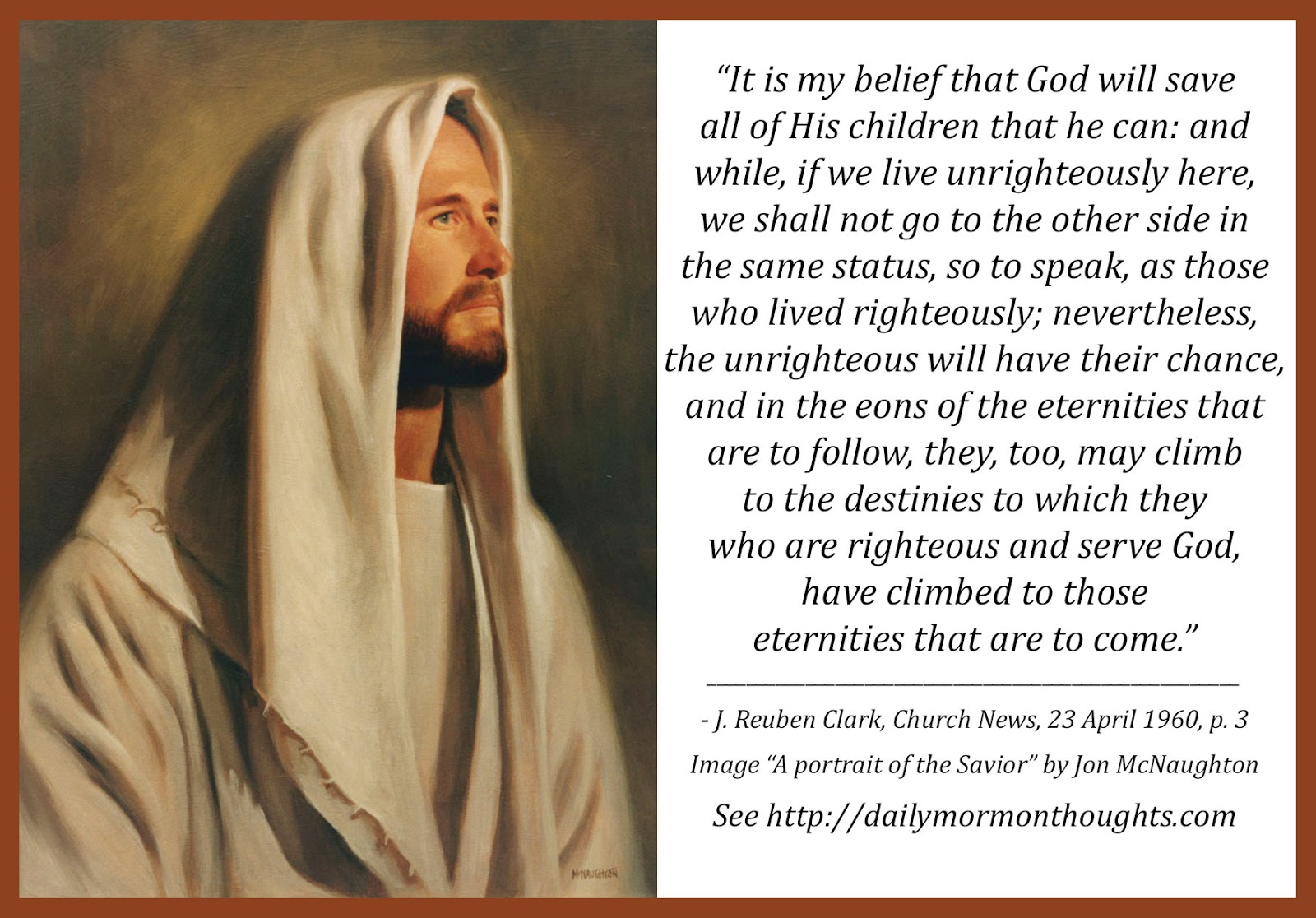
"I am not a strict constructionalist, believing that we seal our eternal progress by what we do here. It is my belief that God will save all of His children that he can: and while, if we live unrighteously here, we shall not go to the other side in the same status, so to speak, as those who lived righteously; nevertheless, the unrighteous will have their chance, and in the eons of the eternities that are to follow, they, too, may climb to the destinies to which they who are righteous and serve God, have climbed to those eternities that are to come."
- J. Reuben Clark, Church News, 23 April 1960, p. 3

This is a fascinating excerpt. There is much we don't understand about the eternities, and sometimes what we assume is a doctrine has not been officially pronounced to be so. That is the case when our eternal options of progression are considered.

President Clark comes down strongly on the "merciful and loving God" side of the discussion:


There is certainly much to anticipate and hope for in eternity. Joseph Smith pointed that out early in our dispensation:
"When you climb up a ladder, you must begin at the bottom, and ascend step by step, until you arrive at the top; and so it is with the principles of the Gospel you must begin with the first, and go on until you learn all the principles of exaltation. But it will be a great while after you have passed through the veil before you will have learned them. It is not all to be comprehended in this world; it will be a great work to learn our salvation and exaltation even beyond the grave."
- Joseph Smith, TPJS 348

We should be very grateful for a loving God who will do all He can to assist us in "working out our salvation" as long as we are willing to continue to do our part!

(Compilation and commentary by David Kenison, Orem, Utah, 2018)
// Customization to close archive widget on first view - DK 3/15