Monday, May 20, 2019

President Joseph F. Smith on the dangers of internal enemies

President Joseph F. Smith (1838-1918) was the son of Joseph's brother Hyrum. He was ordained an apostle in 1866 at age 28, and served as a counselor to Brigham Young and the three presidents who followed.  He became the 6th president of the Church in 1901, and served until his death in 1918 at age 80.
"For my part I do not fear the influence of our enemies from without, as I fear that of those from within. An open and avowed enemy, whom we may see and meet in an open field, is far less to be feared than a lurking, deceitful, treacherous enemy hidden within us, such as are many of the weaknesses of our fallen human nature, which are too often allowed to go unchecked, beclouding our minds, leading away our affections from God and his truth, until they sap the very foundations of our faith, and debase us beyond the possibility or hope of redemption either in this world or that to come. These are the enemies that we all have to battle with, they are the greatest that we have to contend with in the world, and the most difficult to conquer. They are the fruits of ignorance, generally arising out of unrebuked sin and evil in our own hearts. The labor that is upon us, is to subdue our passions, conquer our inward foes, and see that our hearts are right in the sight of the Lord, that there is nothing calculated to grieve his Spirit and lead us away from the path of duty.
"Those only who possess the light of the Spirit of God and the faith of the Gospel, which can only be possessed through faithfulness and obedience to the requirements of heaven, can discern and know the voice of the true Shepherd when they hear it. We need not expect to be able to discern the right from the wrong, the truth from error, and light from darkness, unless our eye is single, and we have declared ourselves for God and his work. If we are divided in our thoughts, affections, and interests, like the rest of the world, we need not expect to comprehend the will of the Lord when made known to us, no matter how powerfully or directly it may come."
- Joseph F. Smith, General Conference Oct. 6, 1875; Journal of Discourses 18:90-91
Click here to read the full talk

President Smith's insights are intriguing to me. We have many external enemies, physical and spiritual. But he warned us about the "lurking, deceitful, treacherous enemy hidden within us" when we fail to deal with our weakness or challenges, or resolving the "unrebuked sin" that we may have committed and not resolved. We must strive to "conquer our inward foes" and make our hearts right before God in order to overcome these inward enemies.


As we set our lives in order and fill our lives with the light of God's spirit, we will more readily recognize the Shepherd's voice and feel His assistance, support, and guidance in our lives.

(Compilation and commentary by David Kenison, Orem, Utah, 2019)

Sunday, May 19, 2019

President Harold B. Lee on the personal gift of revelation

President Harold B. Lee (1899-1973) was called to the Quorum of Twelve Apostles in 1941. He served as a counselor in the First Presidency from 1970-1972, then as Church president from July 1972 until his passing less than 18 months later in December 1973.
"Any Latter-day Saint who has been baptized and who has had hands laid upon him from those officiating, commanding him to receive the Holy Ghost, and who has not received a revelation of the spirit of the Holy Ghost, has not received the gift of the Holy Ghost to which he is entitled. Therein lies a very important matter....
"On what matters may you receive a revelation? Is it startling to you to hear that you—all members of the Church who have received the Holy Ghost—may receive revelation? Not for the president of the Church, not on how to look after the affairs pertaining to the ward, the stake, or the mission in which you live; but every individual within his own station has the right to receive revelation by the Holy Ghost.…
"Every man has the privilege to exercise these gifts and these privileges in the conduct of his own affairs; in bringing up his children in the way they should go; in the management of his business, or whatever he does. It is his right to enjoy the spirit of revelation and of inspiration to do the right thing, to be wise and prudent, just and good, in everything that he does. I know that is a true principle, and that is the thing that I would like the Latter-day Saints to know. Now then, all of us should try to strive and give heed to the sudden ideas that come to us, and if we’ll give heed to them and cultivate an ear to hear these promptings we too—each of us—can grow in the spirit of revelation....
"I bear you my solemn testimony that the Church today is guided by revelation. Every soul in it who has been blessed to receive the Holy Ghost has the power to receive revelation. God help you and me that we will always so live that the Lord can answer the prayers of the faithful through us."
- Harold B. Lee, Stand Ye in Holy Places, 140–42, 145

President Lee's message was a challenge to each member of the Church. When we were confirmed members of the Church, we were invited to receive the gift of the Holy Ghost. His reminder is that those who receive that companionship will also receive revelation, as they live worthy of that gift.


Every single person "within his own station," or within the reach of his stewardship and responsibilities, "has the right to receive revelation by the Holy Ghost." We should seek that gift; we should cherish it and use it wisely! One of the keys President Lee offered was that we should learn to "give heed to the sudden ideas that come to us" as we "grow in the spirit of revelation." We will soon discover that God is eager to assist in this grand experience of life.

(Compilation and commentary by David Kenison, Orem, Utah, 2019)

Saturday, May 18, 2019

President Spencer W. Kimball on the privilege of scripture study

President Spencer W. Kimball (1895-1985) was ordained an apostle in 1943 and served as President of the Church from 1973 to 1985.
"Besides the almost constant encouragement and prompting which we receive from our present-day Church leaders, the prophets of old seem to cry out to us in almost every page of the scriptures, urging us to study the word of the Lord, the holy scriptures, 'which are able to make thee wise unto salvation through faith which is in Christ Jesus.' (2 Tim. 3:15.) But we do not always hear, and we might well ask ourselves why.
"Sometimes it seems we take the scriptures too much for granted because we do not fully appreciate how rare a thing it is to possess them, and how blessed we are because we do have them. We seem to have settled so comfortably into our experiences in this world and become so accustomed to hearing the gospel taught among us that it is hard for us to imagine it could ever have been otherwise....
"In addition to our access to these precious works of scripture, we have, to an extent unknown at any other time in the history of the world, the education and the ability to use them, if we will.
"The ancient prophets knew that after the darkness there would come light. We live in that light—but do we fully comprehend it? With the doctrines of salvation easily within our grasp, I fear that some are still overcome with the 'spirit of slumber, eyes that they should not see, and ears that they should not hear.' (Rom. 11:8.)"
- Spencer W. Kimball, "How Rare a Possession—The Scriptures," Ensign September 1976, pp. 2-5
Click here to read the whole article

This excerpt comes from a "First Presidency Message" prepared by President Kimball, one of his truly classic articles. He shared his vision of the precious and sacred nature of the scriptures, and encouraged us to make better use of them in study and application. With a historical perspective, President Kimball warns us about the tendency to take our scriptural record for granted and thus fail to receive the benefits it offers to us:


In the 43 years since this article was published, it's interesting to note how much more our access to the sacred record has grown and improved. Most of us carry a complete copy in our pocket or purse as part of our digital devices; and we have the ability to search and study in ways that were not even dreamed of in past years. But again—do we take for granted that access and those abilities?? Or are we truly doing all we can to "live in the light"?

(Compilation and commentary by David Kenison, Orem, Utah, 2019)

Friday, May 17, 2019

President Ezra Taft Benson on finding hope in times of challenge

President Ezra Taft Benson (1899-1994) was called to the Quorum of Twelve Apostles in 1943, and served as the 13th President of the Church from 1985 until his death in 1994 at age 94.
"To press on in noble endeavors, even while surrounded by a cloud of depression, will eventually bring you out on top into the sunshine. Even our master Jesus the Christ, while facing that supreme test of being temporarily left alone by our Father during the crucifixion, continued performing his labors for the children of men, and then shortly thereafter he was glorified and received a fullness of joy. While you are going through your trial, you can recall your past victories and count the blessings that you do have with a sure hope of greater ones to follow if you are faithful. And you can have that certain knowledge that in due time God will wipe away all tears and that 'eye hath not seen, nor ear heard, neither have entered into the heart of man, the things which God hath prepared for them that love him.' (1 Cor. 2:9.)"
- Ezra Taft Benson, "Do Not Despair," General Conference October 1974
Click here to read or listen to the full talk

This was one of my favorite talks by Elder Benson; well worth reviewing the whole thing. He encourages us to maintain a perspective of hope and gratitude in spite of the challenges and difficulties of life—"even while surrounded by a cloud of depression." Pressing on through the clouds eventually leads to sunshine:


Three important strategies for success, in surviving times of challenge, are:

  • Remembering past achievements
  • Recognizing current blessings
  • Holding to promises for the future, knowing that "in due time God will wipe away all tears"

(Compilation and commentary by David Kenison, Orem, Utah, 2019)

Thursday, May 16, 2019

President Howard W. Hunter on our call to follow the Master

President Howard W. Hunter (1907-1995) was called to the Quorum of Twelve in 1959.  He served as Church President from June 5, 1994 to his death on March 3, 1995.
"Let us study the Master’s every teaching and devote ourselves more fully to his example. He has given us 'all things that pertain unto life and godliness.' He has 'called us to glory and virtue' and has 'given unto us exceeding great and precious promises: that by these [we] might be partakers of the divine nature' (2 Pet. 1:3–4).
"I believe in those 'exceeding great and precious promises,' and I invite all within the sound of my voice to claim them. We should strive to 'be partakers of the divine nature.' Only then may we truly hope for 'peace in this world, and eternal life in the world to come' (D&C 59:23)."
- Howard W. Hunter, "Exceeding Great and Precious Promises," General Conference October 1994
Click here to read or listen to the full talk

This excerpt is from President Hunter's first remarks just after he was formally sustained in a solemn assembly as the president of the Church in 1994. It was a beautiful invitation to "study the Master’s every teaching and devote ourselves more fully to his example." It's now been almost 25 years since that invitation was given, and perhaps in this year of renewed emphasis of gospel study in the home, we're responding to that invitation in better ways than before.


The promises from God to those who choose to accept His call are there; but it us up to each of us to claim them, and become "partakers of the divine nature."

(Compilation and commentary by David Kenison, Orem, Utah, 2019)

Wednesday, May 15, 2019

President Gordon B. Hinckley on finding real beauty in the world

President Gordon B. Hinckley (1910-2008) was called to the Quorum of Twelve in 1961. He served as a counselor in the First Presidency from 1981-1995, then as Church President until his death in 2008.
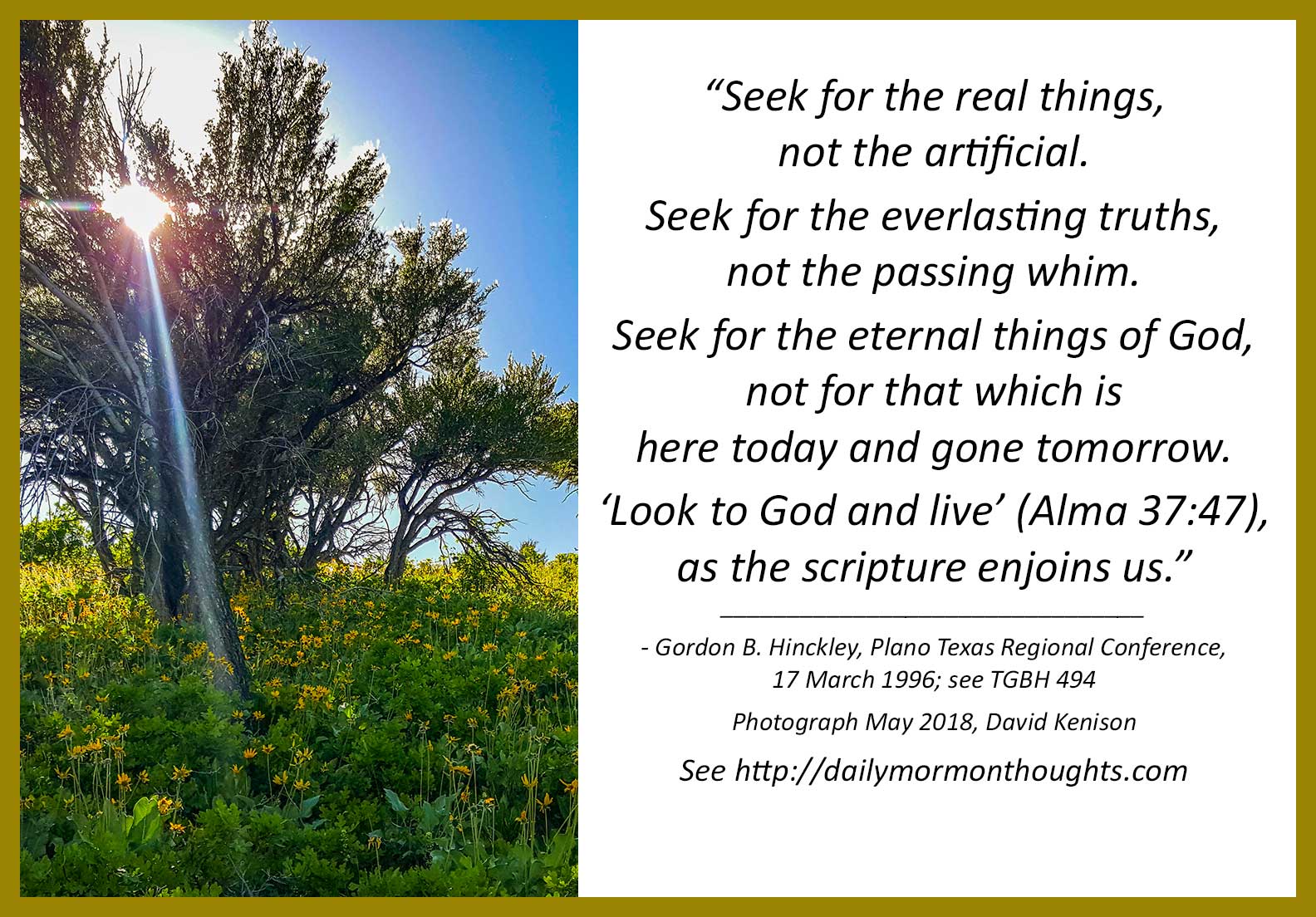
"There is much of beauty about [the people of the world], but without the root that finds itself in faith and conviction concerning God and the risen Lord, there isn't much of real substance when it comes to a crisis or a showdown of some kind. Seek for the real things, not the artificial. Seek for the everlasting truths, not the passing whim. Seek for the eternal things of God, not for that which is here today and gone tomorrow. 'Look to God and live' [Alma 37:47], as the scripture enjoins us."
- Gordon B. Hinckley, Plano Texas Regional Conference, 17 March 1996; see TGBH 494
Click here to read more about this event

Recognizing the beauty that exists in many ways in the world, President Hinckley adds his insight that beauty is enhanced by "faith and conviction concerning God and the risen Lord." That foundation of faith enables us to confront the crises of life that will surely come. And so President Hinckley shares this wise advice:


We would do well to evaluate our priorities:
  • Can I distinguish between real and artificial?
  • Do I make choices based on understanding the differences between things that bring everlasting joy and those that are temporary whims?
  • Am I truly focused on "the eternal things of God"?

(Compilation and commentary by David Kenison, Orem, Utah, 2019)

Tuesday, May 14, 2019

President Thomas S. Monson on responding to calls to serve

President Thomas S. Monson (1927–2018) was sustained to the Quorum of Twelve Apostles in 1963. He served as a counselor in the First Presidency with Presidents Benson, Hunter, and Hinckley and then became Church president in 2008. He led the Church for almost a decade until his passing in January 2018.
"Then and now, servants of God take comfort from the Master's assurance: 'I am with you alway' (Matt. 28:20). This magnificent promise sustains you....
"An abiding faith, a constant trust, a fervent desire have always characterized those who serve the Lord with all their hearts....
"The call to serve has ever characterized the work of the Lord. It rarely comes at a convenient time. It brings humility, it provokes prayer, and it inspires commitment."
- Thomas S. Monson, "Tears, Trials, Trust, Testimony," General Conference, April 1987
Click here to read or listen to the full talk

This message was shared in a Priesthood session of conference when President Monson was serving as a counselor to President Benson. He recognized the challenge that comes to all members of the Church when we are given callings to serve, as we have opportunities to help others in need. The "call" to serve can come as a formal invitation from a leader to fill a particular position or role; or it may be a less formal prompting of a need that we could address in our personal ministry. But for disciples of Christ, that urge to bless others should be a part of our souls.


President Monson himself characterized this inherent attitude of a willingness to serve and bless. His lifetime of formal service in callings was, in a way, almost secondary to the way he often willingly and eagerly followed promptings to bless others in need.

(Compilation and commentary by David Kenison, Orem, Utah, 2019)
// Customization to close archive widget on first view - DK 3/15