Tuesday, June 4, 2019

President M. Russell Ballard on innovation in callings

President M. Russell Ballard (born October 8, 1928) was called as a Seventy in 1976, and has served as a member of the Quorum of Twelve Apostles since 1985. He became acting president of the Twelve in January 2018.
"Be innovative. As we work to magnify our callings, we should seek the inspiration of the Spirit to solve problems in ways that will best help the people we serve. We have handbooks of instruction, and their guidelines should be followed. But within that framework are substantial opportunities to think, to be creative, and to make use of individual talents. The instruction to magnify our callings is not a command to embellish and complicate them. To innovate does not necessarily mean to expand; very often it means to simplify.
"Because the eternal principle of agency gives us the freedom to choose and think for ourselves, we should become increasingly able to solve problems. We may make the occasional mistake, but as long as we are following gospel principles and guidelines, we can learn from those mistakes and become more understanding of others and more effective in serving them.
"Being innovative also means that we do not have to be told everything we should do. The Lord said, 'It is not meet that I should command in all things; for he that is compelled in all things, the same is a slothful and not a wise servant' (D&C 58:26). We trust you, brothers and sisters, to use inspiration. We trust that you will do so within the framework of Church policies and principles. We trust that you will be wise in counseling together to help build faith and testimony in the lives of those whom you serve."
- M. Russell Ballard, "O Be Wise," General Conference October 2006
Click here to read or listen to the full talk

Most of us don't think about being "innovative" when we consider our callings. We too often feel like we have a standard, pre-determined set of duties to fulfill. President Ballard encourages us to be aware of guidelines given in handbooks and elsewhere, but to consider those things as a "framework"—and to seek for inspiration on creative use of our talents in order to better serve and bless.

But perhaps the most profound statement of the excerpt is, "To innovate does not necessarily mean to expand; very often it means to simplify." We don't always have to complicate or embellish in order to serve most effectively.


Using our agency most effectively, we will invoke divine inspiration to serve most effectively.

(Compilation and commentary by David Kenison, Orem, Utah, 2019)

Monday, June 3, 2019

President Joseph Smith on ministering with love and tenderness

Joseph Smith (December 23, 1805-June 27, 1844) was given the apostolic authority when the Church of Jesus Christ was organized on April 6, 1830 and he was designated the first president of the church at age 24. He was martyred in 1844 at age 38.
"Nothing is so much calculated to lead people to forsake sin as to take them by the hand and watch over them with tenderness. When persons manifest the least kindness and love to me, O what power it has over my mind, while the opposite course has a tendency to harrow up all the harsh feelings and depress the human mind.
"It is one evidence that men are unacquainted with the principle of godliness, to behold the contraction of feeling and lack of charity. The power and glory of Godliness is spread out on a broad principle to throw out the mantle of charity."
- Joseph Smith, Nauvoo Relief Society Minute Book, June 9, 1842; see also History of the Church, 5:23–24
Click here to read the full address from the Joseph Smith Papers project

This excerpt comes from an address by Joseph Smith to one of the early meetings of the Relief Society. He spoke very personally about how he responded to the actions of others toward him. If our goal or hope is to encourage others to "forsake sin" in any way, to come unto Christ, this is a lesson we should ponder:


The language Joseph used is so expressive. We don't just talk to people, instruct or counsel them—we "take them by the hand" and we "watch over them with tenderness." As we "show kindness and love" to others, it has power over their minds. As we spread out the "mantle of charity" in our interactions with others, we discover "the power and glory of Godliness" is also being spread. Such wonderful descriptions of true ministering with Christlike charity.

(Compilation and commentary by David Kenison, Orem, Utah, 2019)

Sunday, June 2, 2019

President Henry B. Eyring on the blessings of fasts and fast offerings

President Henry B. Eyring (born May 31, 1933) served in the Presiding Bishopric from 1985-1992, as a Seventy from 1992-1995, then was called to the Quorum of Twelve Apostles. He has served in the First Presidency since 2007.
"We do not know all the reasons why Jesus Christ went into the wilderness to fast and to pray. But we know at least one of the effects: the Savior completely resisted Satan’s temptations to misuse His divine power.
"The brief time we fast every month and the small amount we offer for the poor may give us only a small part of the change in our natures to have no more desire to do evil. But there is a great promise, even as we do all that we reasonably can to pray, to fast, and to donate for those in need:
"'Then shall thy light break forth as the morning, and thine health shall spring forth speedily: and thy righteousness shall go before thee; the glory of the Lord shall be thy rearward.
"'Then shalt thou call, and the Lord shall answer; thou shalt cry, and he shall say, Here I am.' (Isaiah 58:8–9)
"I pray that we will claim those great blessings for ourselves and for our families."
- Henry B. Eyring, "Is Not This the Fast That I Have Chosen?", General Conference April 2015
Click here to read or listen to the full talk

President Eyring's thoughts about fasting and fast offerings are thought-provoking and inspiring. We are blessed in so many ways by this important Gospel principle. This excerpt highlights one of them: the spiritual strength that comes as we fast.


Isaiah's beautiful promise for those who keep the law of the fast is available for us to claim. It includes:

  • increased spiritual light
  • an added measure of physical health
  • growing righteousness
  • protection from the Lord. 
  • answers to our prayers
Who would not desire those blessings?? We should seek them eagerly as we fast and make our offerings to the Lord.


(Compilation and commentary by David Kenison, Orem, Utah, 2019)

Saturday, June 1, 2019

President Brigham Young on overcoming sorrow in life

President Brigham Young (1801-1877) was part of the first Quorum of Twelve Apostles of this dispensation, called and ordained in 1835. He served as the second Church president, succeeding Joseph Smith, from 1847 until his death in 1877.
"You need never expect to see sorrow, unless your own conduct, conversation, and acts bring it to your hearts. Do you not know that sorrow to you can exist only in your own hearts? Though men or women were in the mountains perishing—though they be in overwhelming depths of snow, freezing to death, or be on a desolate island starving to death for want of food—though they perish by the sword or in any other way, yet, if the heart is cheerful, all is light and glory within: there is no sorrow within them.
"You never saw a true Saint in the world that had sorrow, neither can you find one. If persons are destitute of the fountain of living water, or the principles of eternal life, then they are sorrowful. If the words of life dwell within us, and we have the hope of eternal life and glory, and let that spark within us kindle to a flame, to the consuming of the least and last remains of selfishness, we never can walk in darkness and are strangers to doubt and fear.
"Yet we see people among us who are still selfish, and that principle we must abandon: we must strip off selfishness, and put covetousness far from us. We must become of one heart and mind, in order to fully enjoy the blessings we anticipate."
- Brigham Young, "Source of True Happiness," November 15, 1857; see JD 6:41
Click here to read the full talk

This is an interesting perspective. The people of the pioneer era experienced many trials and hardships. But President Young teaches an important principle: how we react to the experiences of life is up to us. Sorrow and sadness are not required in a life filled with hope and faith. "[I]f the heart is cheerful, all is light and glory within: there is no sorrow within them."


Sorrow comes when we are "destitute of the fountain of living water." But on the contrary, if we are filled with the spark of "the hope of eternal life and glory," we will never walk in darkness. It is up to each of us to fill our lives with that light and hope.

(Compilation and commentary by David Kenison, Orem, Utah, 2019)

Friday, May 31, 2019

President Henry B. Eyring on persuading others of gospel truths

President Henry B. Eyring (born May 31, 1933) served in the Presiding Bishopric from 1985-1992, as a Seventy from 1992-1995, then was called to the Quorum of Twelve Apostles. He has served in the First Presidency since 2007.
"You have at your best followed the example of Joseph Smith, as described by Arthur Henry King, in a talk published in his book, _The Abundance of the Heart_. In that book, Professor King recounted his experience in first reading of the First Vision as it appears in the Pearl of Great Price. Arthur Henry King reminds us that he was not a member of the Church at that time and that his education had taught him to be critical. He thus represents the very people to whom you may be most helpful. This is what he said:
"'I wasn't inclined to be impressed. As a stylistician, I have spent my life being disinclined to be impressed. So when I read his story, I thought to myself, this is an extraordinary thing. This is an astonishingly matter-of-fact and cool account. This man is not trying to persuade me of anything. He doesn't feel the need to. He is stating what happened to him, and he is stating it, not enthusiastically, but in quite a matter-of-fact way. He is not trying to make me cry or feel ecstatic. That struck me, and that began to build my testimony, for I could see that this man was telling the truth' (Salt Lake City: Bookcraft, 1986, pp. 200-201).
"A clear declaration of the truth is powerful enough, because truth exists and there is a Spirit of truth to confirm it. Because you believe that, your writing shows a trust in the clear declarative statement, without jargon, that would bless scholars and their readers in every field.
"Your work of highest value is to lead the children of God to discover the true origin of the Book of Mormon and thus let its message of Jesus Christ change their lives. Because of that, my hope would be that you will keep your focus on that scripture and on the aspects of it which are significant to the question: 'Should I pray to know if this book is truly the word of God, written and abridged by prophets on plates delivered by an angel to a boy who could only have translated them by the power of God?'
"Joseph Smith's account of the coming forth of the Book of Mormon is miraculous. The only place to go to verify a miracle is to God. I pray that your work and your example will lead many to go to Him in the earnest prayer of faith."
- Henry B. Eyring "The Marketplace of Ideas," annual F.A.R.M.S. banquet, 13 October 1994
Click here to read the full address

President Eyring was speaking in this address to members of the "Foundation for Ancient Research and Mormon Studies" (FARMS) organization. He encouraged their use of the Book of Mormon to help bring interest and conversion. He also taught of the power of pure and simple testimony in reaching out to those who are sincere in heart.

I heard Dr. King speak about the matter Elder Eyring references. King was a brilliant British scholar, a renowned Shakespearean expert, who understood language. He compared Oliver Cowdery's flowery, educated description of the translation process, contained in a footnote of the Pearl of Great Price, with Joseph's simple and pure narrative. It was a profound lesson to me of the power of pure and simple testimony.


Leading others to Christ through the Book of Mormon is an important and powerful message, one we need to remember and implement.

(Compilation and commentary by David Kenison, Orem, Utah, 2019)

Thursday, May 30, 2019

President Dallin H. Oaks on trusting the Lord's timing

President Dallin H. Oaks (born August 12, 1932) served as president of BYU from 1971-1980.  He was then appointed as a justice of the Utah Supreme Court, and resigned when he was called to the Quorum of Twelve Apostles in 1984. He became President of the Quorum of Twelve Apostles and also 1st Counselor in the First Presidency in January 2018.
"The Lord has His own timetable. 'My words are sure and shall not fail,' the Lord taught the early elders of this dispensation. 'But,' He continued, 'all things must come to pass in their time' (D&C 64:31-32).
"The first principle of the gospel is faith in the Lord Jesus Christ. Faith means trust—trust in God's will, trust in His way of doing things, and trust in His timetable. We should not try to impose our timetable on His. As Elder Neal A. Maxwell has said:
"'The issue for us is trusting God enough to trust also His timing. If we can truly believe He has our welfare at heart, may we not let His plans unfold as He thinks best? The same is true with the second coming and with all those matters wherein our faith needs to include faith in the Lord's timing for us personally, not just in His overall plans and purposes.' [Even As I Am (Salt Lake City: Deseret Book, 1982), 93]
"More recently, during last April conference, Elder Maxwell said: 'Since faith in the timing of the Lord may be tried, let us learn to say not only, "Thy will be done," but patiently also, "Thy timing be done"' (CR, April 2001, 76; or 'Plow in Hope,' Ensign, May 2001, 59).
"Indeed, we cannot have true faith in the Lord without also having complete trust in the Lord's will and in the Lord's timing."
- Dallin H. Oaks, "Timing," BYU Devotional, January 29, 2002
Click here to read or listen to the full talk

The relationship between faith and timing was a favorite theme of Elder Neal A. Maxwell, as quoted and expanded upon by Elder Oaks. It's tempting for us to claim or proclaim our faith in Jesus Christ, but to demonstrate a lack of faith in the timing with which blessings or responses or even deliverance from trials occurs in our life.


True faith in Jesus Christ necessarily includes absolute trust in His timing and the wisdom of His plan for each of us, and for all of us.

(Compilation and commentary by David Kenison, Orem, Utah, 2019)

Wednesday, May 29, 2019

President Russell M. Nelson on sacred personal prayer

President Russell M. Nelson (born Sept 9, 1924) was an internationally-renowned heart surgeon when he was called to serve as a member of the Quorum of Twelve Apostles in 1984. He became president of that quorum on July 15, 2015. Following the death of President Monson, he was set apart as president of the Church on January 14, 2018.
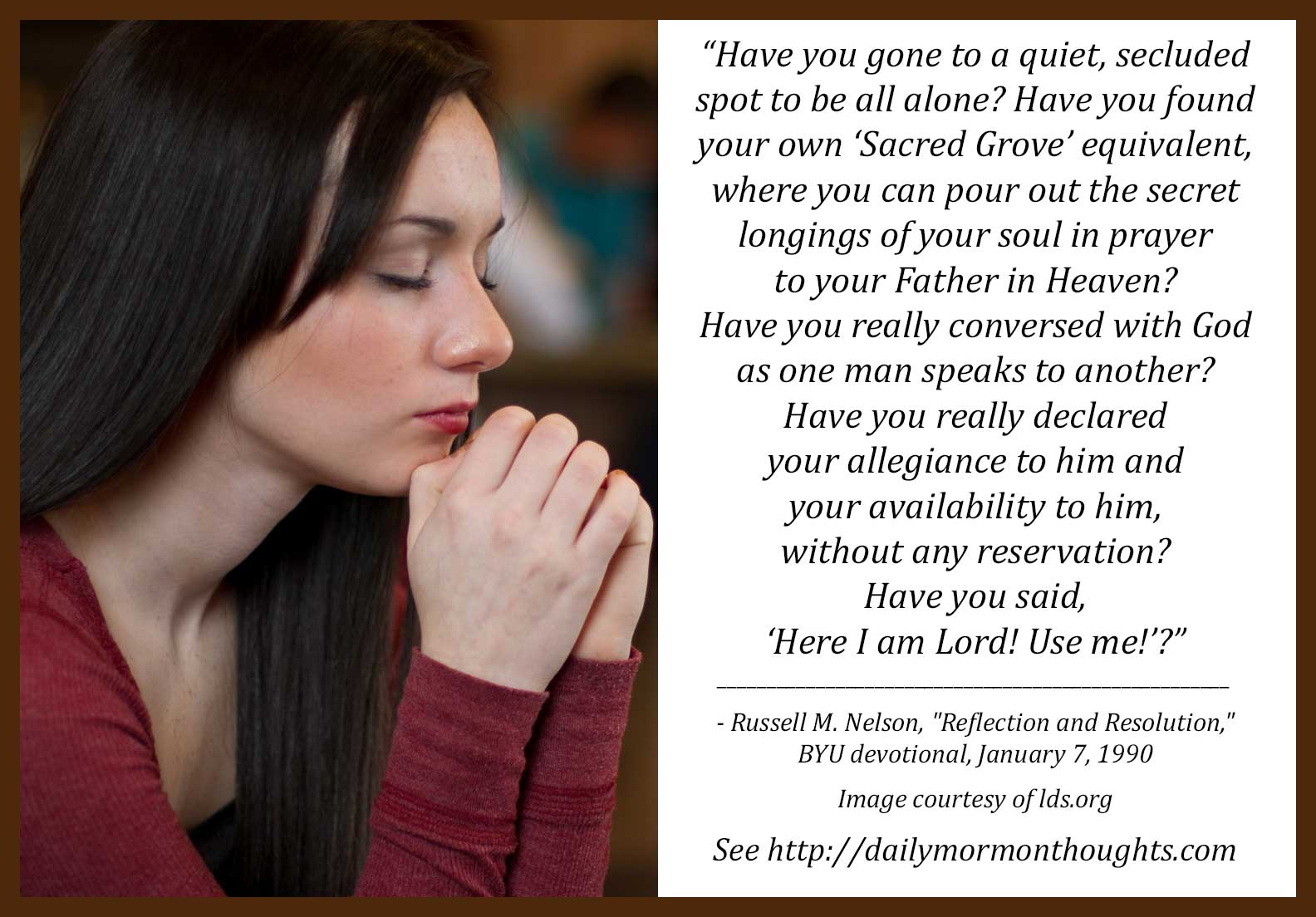
"Have you gone to a quiet, secluded spot to be all alone? Have you found your own 'Sacred Grove' equivalent, where you can pour out the secret longings of your soul in prayer to your Father in Heaven? Have you really conversed with God as one man speaks to another? Have you really declared your allegiance to him and your availability to him, without any reservation? Have you said, 'Here I am Lord! Use me!'? Have you pleaded with him, and as you did, have you put behind any counterfeit clichés that may have been part of your prayers in the past? Have you cleanly and completely declared your commitment to be a saint, an elder, a righteous disciple through good times and bad? Such a resounding resolution would bring joy to your Heavenly Father."
- Russell M. Nelson, "Reflection and Resolution," BYU devotional, January 7, 1990
Click here to read or listen to the full talk

This is an inspiring invitation from President Nelson. Speaking to BYU students almost two decades ago, he challenged them to a level of prayer that would bring them close to God and result in profound blessings.

The challenge starts with finding a "'Sacred Grove' equivalent" for our personal communication with God. The need for solitude and quiet peace is critical to making the process effective. Once we find that environment, we then are prepared to "pour out the secret longings of your soul in prayer."


The part of President Nelson's challenge that particularly inspired me was the level of commitment he invites us to make as part of our prayers. We not only "cleanly and completely" declare our allegiance to God and desire to follow Him in humble obedience, but also declare our availability—our willingness to participate and contribute in any way that God would ask of us. In effect, we consecrate our lives to Him. That is a level of powerful, profoundly sincere and humble prayer that we all should aspire to.

(Compilation and commentary by David Kenison, Orem, Utah, 2019)
// Customization to close archive widget on first view - DK 3/15