Friday, June 7, 2019

Elder David A. Bednar on receiving the Holy Ghost

Elder David A. Bednar (born June 15, 1952) was serving as the president of BYU–Idaho when he was called and sustained as a member of the Quorum of Twelve Apostles in October 2004.
"The simplicity of this ordinance may cause us to overlook its significance. These four words—'Receive the Holy Ghost'—are not a passive pronouncement; rather, they constitute a priesthood injunction—an authoritative admonition to act and not simply to be acted upon (see 2 Nephi 2:26). The Holy Ghost does not become operative in our lives merely because hands are placed upon our heads and those four important words are spoken. As we receive this ordinance, each of us accepts a sacred and ongoing responsibility to desire, to seek, to work, and to so live that we indeed 'receive the Holy Ghost' and its attendant spiritual gifts. 'For what doth it profit a man if a gift is bestowed upon him, and he receive not the gift? Behold, he rejoices not in that which is given unto him, neither rejoices in him who is the giver of the gift' (D&C 88:33).
"What should we do to make this authorized admonition to seek for the companionship of the third member of the Godhead an ongoing reality? Let me suggest that we need to (1) sincerely desire to receive the Holy Ghost, (2) appropriately invite the Holy Ghost into our lives, and (3) faithfully obey God’s commandments."
- David A. Bednar, "Receive the Holy Ghost," General Conference October 2010
Click here to read or listen to the full talk

Understanding that the injunction "receive the Holy Ghost" is an invitation for us to perform the action of receiving is a critical point. It's not an automatic, immediate action performed on our behalf; it's an offer to us to accept a gift.
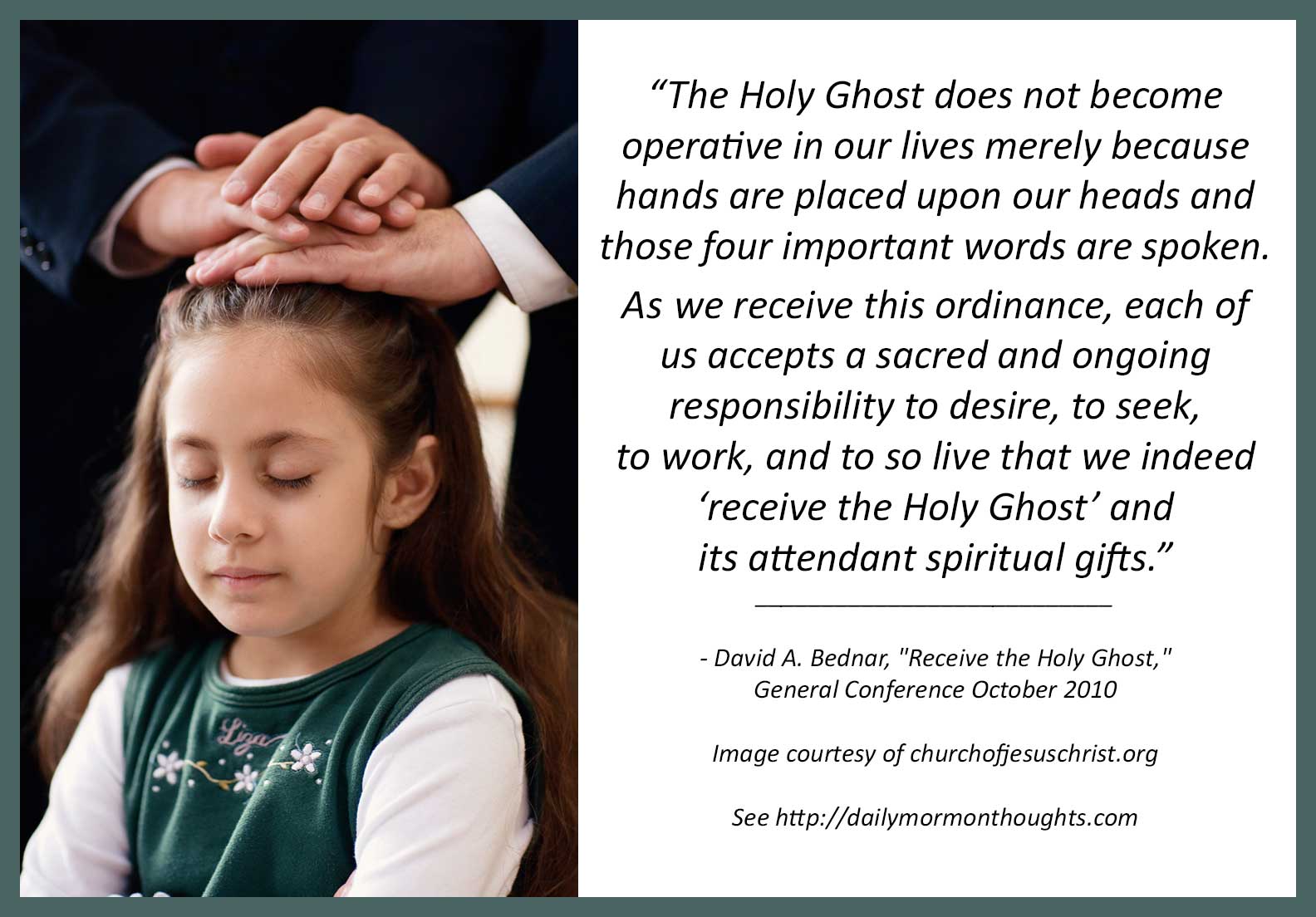

Elder Bednar explains in this insightful talk about the actions we can take to receive that gift of the Holy Ghost. They include both our desires and our actions. It's a process that we must undertake with humility and faithful discipleship.

(Compilation and commentary by David Kenison, Orem, Utah, 2019)

Thursday, June 6, 2019

Elder Dieter F. Uchtdorf on the joy of forgiveness

Elder Dieter F. Uchtdorf (born November 6, 1940) served as a Seventy from 1994-2004, when he was called as a member of the Quorum of Twelve.  He served as second counselor in the First Presidency from 2008 to 2018.
"Each of us is under a divinely spoken obligation to reach out with pardon and mercy and to forgive one another. There is a great need for this Christlike attribute in our families, in our marriages, in our wards and stakes, in our communities, and in our nations.
"We will receive the joy of forgiveness in our own lives when we are willing to extend that joy freely to others. Lip service is not enough. We need to purge our hearts and minds of feelings and thoughts of bitterness and let the light and the love of Christ enter in. As a result, the Spirit of the Lord will fill our souls with the joy accompanying divine peace of conscience (see Mosiah 4:2–3)."
- Dieter F. Uchtdorf, "Point of Safe Return," General Conference April 2007
Click here to read or listen to the full talk

Willingness to forgive others is crucial to our own spiritual progress. Elder Uchtdorf observes that we have much need for "this Christlike attribute" in all our personal and public interactions:


It is only as we truly, honestly, and completely forgive others, overcoming all "thoughts of bitterness," that we will fully feel "the light and the love of Christ" in our lives.

(Compilation and commentary by David Kenison, Orem, Utah, 2019)

Wednesday, June 5, 2019

Elder Jeffrey R. Holland on dealing with life's challenges

Elder Jeffrey R. Holland (born December 3, 1940) served as Church Commissioner of Education from 1976-1980, as the president of BYU from 1980-1989, as a Seventy from 1989-1994, and as a member of the Quorum of Twelve Apostles since 1994.
"If your prayers don’t always seem answered, take heart. One greater than you or President Kimball cried, 'Eli, Eli, lama sabachthani.… My God, My God, why hast thou forsaken me?' (Matt. 27:46.) If sometimes the harder you try, the harder it gets, take heart. So it has been with the best people who ever lived."
- Jeffrey R. Holland, "The Inconvenient Messiah," BYU Devotional, 2 February 1982; see Ensign February 1984, pp. 68-73
Click here to read the full talk

This is one of my favorite, most thought-provoking talks by Elder Holland. He teaches that the Messiah's message, and His path of discipleship, were not (and are not) convenient or easy; they require sacrifice and discipline. This principle applies in many ways.

It applies to the process of prayer. It takes work and effort to develop real communication with God. Elder Holland shared the particularly poignant example from the life of Spencer W. Kimball, describing his struggles in personal prayer following his call to the apostleship. Then came this thought:


Sometimes, life is hard. Sometimes, just trying harder doesn't solve the problems right away. Life is sometimes inconvenient! But Elder Holland encourages us to remember, in those times, to "take heart": patience, persistence, faith, endurance, trust, hope—those are eternal and divine principles.

(Compilation and commentary by David Kenison, Orem, Utah, 2019)

Tuesday, June 4, 2019

President M. Russell Ballard on innovation in callings

President M. Russell Ballard (born October 8, 1928) was called as a Seventy in 1976, and has served as a member of the Quorum of Twelve Apostles since 1985. He became acting president of the Twelve in January 2018.
"Be innovative. As we work to magnify our callings, we should seek the inspiration of the Spirit to solve problems in ways that will best help the people we serve. We have handbooks of instruction, and their guidelines should be followed. But within that framework are substantial opportunities to think, to be creative, and to make use of individual talents. The instruction to magnify our callings is not a command to embellish and complicate them. To innovate does not necessarily mean to expand; very often it means to simplify.
"Because the eternal principle of agency gives us the freedom to choose and think for ourselves, we should become increasingly able to solve problems. We may make the occasional mistake, but as long as we are following gospel principles and guidelines, we can learn from those mistakes and become more understanding of others and more effective in serving them.
"Being innovative also means that we do not have to be told everything we should do. The Lord said, 'It is not meet that I should command in all things; for he that is compelled in all things, the same is a slothful and not a wise servant' (D&C 58:26). We trust you, brothers and sisters, to use inspiration. We trust that you will do so within the framework of Church policies and principles. We trust that you will be wise in counseling together to help build faith and testimony in the lives of those whom you serve."
- M. Russell Ballard, "O Be Wise," General Conference October 2006
Click here to read or listen to the full talk

Most of us don't think about being "innovative" when we consider our callings. We too often feel like we have a standard, pre-determined set of duties to fulfill. President Ballard encourages us to be aware of guidelines given in handbooks and elsewhere, but to consider those things as a "framework"—and to seek for inspiration on creative use of our talents in order to better serve and bless.

But perhaps the most profound statement of the excerpt is, "To innovate does not necessarily mean to expand; very often it means to simplify." We don't always have to complicate or embellish in order to serve most effectively.


Using our agency most effectively, we will invoke divine inspiration to serve most effectively.

(Compilation and commentary by David Kenison, Orem, Utah, 2019)

Monday, June 3, 2019

President Joseph Smith on ministering with love and tenderness

Joseph Smith (December 23, 1805-June 27, 1844) was given the apostolic authority when the Church of Jesus Christ was organized on April 6, 1830 and he was designated the first president of the church at age 24. He was martyred in 1844 at age 38.
"Nothing is so much calculated to lead people to forsake sin as to take them by the hand and watch over them with tenderness. When persons manifest the least kindness and love to me, O what power it has over my mind, while the opposite course has a tendency to harrow up all the harsh feelings and depress the human mind.
"It is one evidence that men are unacquainted with the principle of godliness, to behold the contraction of feeling and lack of charity. The power and glory of Godliness is spread out on a broad principle to throw out the mantle of charity."
- Joseph Smith, Nauvoo Relief Society Minute Book, June 9, 1842; see also History of the Church, 5:23–24
Click here to read the full address from the Joseph Smith Papers project

This excerpt comes from an address by Joseph Smith to one of the early meetings of the Relief Society. He spoke very personally about how he responded to the actions of others toward him. If our goal or hope is to encourage others to "forsake sin" in any way, to come unto Christ, this is a lesson we should ponder:


The language Joseph used is so expressive. We don't just talk to people, instruct or counsel them—we "take them by the hand" and we "watch over them with tenderness." As we "show kindness and love" to others, it has power over their minds. As we spread out the "mantle of charity" in our interactions with others, we discover "the power and glory of Godliness" is also being spread. Such wonderful descriptions of true ministering with Christlike charity.

(Compilation and commentary by David Kenison, Orem, Utah, 2019)

Sunday, June 2, 2019

President Henry B. Eyring on the blessings of fasts and fast offerings

President Henry B. Eyring (born May 31, 1933) served in the Presiding Bishopric from 1985-1992, as a Seventy from 1992-1995, then was called to the Quorum of Twelve Apostles. He has served in the First Presidency since 2007.
"We do not know all the reasons why Jesus Christ went into the wilderness to fast and to pray. But we know at least one of the effects: the Savior completely resisted Satan’s temptations to misuse His divine power.
"The brief time we fast every month and the small amount we offer for the poor may give us only a small part of the change in our natures to have no more desire to do evil. But there is a great promise, even as we do all that we reasonably can to pray, to fast, and to donate for those in need:
"'Then shall thy light break forth as the morning, and thine health shall spring forth speedily: and thy righteousness shall go before thee; the glory of the Lord shall be thy rearward.
"'Then shalt thou call, and the Lord shall answer; thou shalt cry, and he shall say, Here I am.' (Isaiah 58:8–9)
"I pray that we will claim those great blessings for ourselves and for our families."
- Henry B. Eyring, "Is Not This the Fast That I Have Chosen?", General Conference April 2015
Click here to read or listen to the full talk

President Eyring's thoughts about fasting and fast offerings are thought-provoking and inspiring. We are blessed in so many ways by this important Gospel principle. This excerpt highlights one of them: the spiritual strength that comes as we fast.


Isaiah's beautiful promise for those who keep the law of the fast is available for us to claim. It includes:

  • increased spiritual light
  • an added measure of physical health
  • growing righteousness
  • protection from the Lord. 
  • answers to our prayers
Who would not desire those blessings?? We should seek them eagerly as we fast and make our offerings to the Lord.


(Compilation and commentary by David Kenison, Orem, Utah, 2019)

Saturday, June 1, 2019

President Brigham Young on overcoming sorrow in life

President Brigham Young (1801-1877) was part of the first Quorum of Twelve Apostles of this dispensation, called and ordained in 1835. He served as the second Church president, succeeding Joseph Smith, from 1847 until his death in 1877.
"You need never expect to see sorrow, unless your own conduct, conversation, and acts bring it to your hearts. Do you not know that sorrow to you can exist only in your own hearts? Though men or women were in the mountains perishing—though they be in overwhelming depths of snow, freezing to death, or be on a desolate island starving to death for want of food—though they perish by the sword or in any other way, yet, if the heart is cheerful, all is light and glory within: there is no sorrow within them.
"You never saw a true Saint in the world that had sorrow, neither can you find one. If persons are destitute of the fountain of living water, or the principles of eternal life, then they are sorrowful. If the words of life dwell within us, and we have the hope of eternal life and glory, and let that spark within us kindle to a flame, to the consuming of the least and last remains of selfishness, we never can walk in darkness and are strangers to doubt and fear.
"Yet we see people among us who are still selfish, and that principle we must abandon: we must strip off selfishness, and put covetousness far from us. We must become of one heart and mind, in order to fully enjoy the blessings we anticipate."
- Brigham Young, "Source of True Happiness," November 15, 1857; see JD 6:41
Click here to read the full talk

This is an interesting perspective. The people of the pioneer era experienced many trials and hardships. But President Young teaches an important principle: how we react to the experiences of life is up to us. Sorrow and sadness are not required in a life filled with hope and faith. "[I]f the heart is cheerful, all is light and glory within: there is no sorrow within them."


Sorrow comes when we are "destitute of the fountain of living water." But on the contrary, if we are filled with the spark of "the hope of eternal life and glory," we will never walk in darkness. It is up to each of us to fill our lives with that light and hope.

(Compilation and commentary by David Kenison, Orem, Utah, 2019)
// Customization to close archive widget on first view - DK 3/15