Tuesday, January 4, 2022

Elder Joseph B. Wirthlin on demonstrating love for the Lord

Elder Joseph B. Wirthlin (1917-2008) served as a Seventy from 1976 to 1986, then as a member of the Quorum of Twelve Apostles from 1986 until his passing in 2008 at age 91.
"Do you love the Lord?
"Spend time with Him. Meditate on His words. Take His yoke upon you. Seek to understand and obey, because 'this is the love of God, that we keep his commandments' (1 John 5:3). When we love the Lord, obedience ceases to be a burden. Obedience becomes a delight. When we love the Lord, we seek less for things that benefit us and turn our hearts toward things that will bless and uplift others.
"As our love for the Lord deepens, our minds and hearts become purified. We experience a 'mighty change in ... our hearts, that we have no more disposition to do evil, but to do good continually' (Mosiah 5:2).
"Brethren and sisters, as you prayerfully consider what you can do to increase harmony, spirituality, and build up the kingdom of God, consider your sacred duty to teach others to love the Lord and their fellowman. This is the central object of our existence. Without charity—or the pure love of Christ—whatever else we accomplish matters little. With it, all else becomes vibrant and alive."
- Joseph B. Wirthlin, "The Great Commandment," Ensign, Nov. 2007, pp. 28-31
Click here to read the full talk

What does it really mean to love the Lord? How is that kind of emotion expressed or manifest in our lives? Elder Wirthlin gives some thought-provoking suggestions.
  • "Spend time with Him." If we love someone, we naturally want to do this, We should spend time conversing, listening, feeling.
  • "Meditate on His words." Studying and pondering the scriptures and modern inspired teachings should be a natural and pleasant activity.
  • "Take His yoke upon you." Try to live, act, and serve as He did and does.
  • "Seek to understand and obey." The natural outgrowth of study is the change of behavior as we attempt to conform in our lives to the things He teaches.


Elder Wirthlin's promise is inviting: "As our love for the Lord deepens, our minds and hearts become purified." We become changed people; our hearts and desires are purified. And this second promise is even more glorious: "Without charity—or the pure love of Christ—whatever else we accomplish matters little. With it, all else becomes vibrant and alive."

(Compilation and commentary by David Kenison, Orem, Utah, 2022)
May 28, 2016

Monday, January 3, 2022

President Howard W. Hunter on the gospel of belief and action

President Howard W. Hunter (1907-1995) was called to the Quorum of Twelve in 1959.  He served as Church President for only nine months, from June 5, 1994 to his death on March 3, 1995.
"The greatest search of our time is the search for personal identity and for human dignity. Each of us wants life to be worthwhile and to have real meaning—a personal meaning—in the living we do from day to day. There is a search being made by people everywhere, a search as important as life itself for self-respect, for self-fulfillment, and for emotional maturity....
The friends we choose, the choices we make, and what we do about these choices are the determining guide lines that form and mold our lives; but choices alone are not enough. The best goals, the best of friends, and the best of opportunities are all meaningless unless they are translated into reality through our daily actions.
"Belief must be realized in personal achievement. Real Christians must understand that the gospel of Jesus Christ is not just a gospel of belief; it is a plan of action. His gospel is a gospel of imperatives, and the very nature of its substance is a call to action. He did not say 'observe' my gospel; he said 'live' it! He did not say, 'Note its beautiful structure and imagery'; he said, 'Go, do, see, feel, give, believe!' The gospel of Jesus Christ is full of imperatives, words that call for personal commitment and action—obligatory, binding, compulsory."
- Howard W. Hunter, Conference Report, April 1967, pp. 115-118; Improvement Era June 1967 p. 101
Click here to read the full talk

As the years go by and we encounter transitions and changes in our lives, we often find ourselves pondering the questions President Hunter mentions here: Is my life worthwhile? Does it have "real meaning"? What are the things that contribute to "self-respect" and "self-fulfillment" in this life? Those are grand questions.

The quote acknowledges that things like friends and choices are crucially formative. We can have wonderful friends, excellent opportunities, and inspiring goals; but they are all meaningless unless they result in a better reality filled with daily actions.  Christ's message was one of action; it is filled with imperatives, urging us to deeds of worship and goodness.


I aspire to be a "read Christian." I hope to heed the "call to action" in my life!

(Compilation and commentary by David Kenison, Orem, Utah, 2022)
January 3, 2016

Sunday, January 2, 2022

Elder Neil L. Andersen on choosing to nurture and grow in faith

Elder Neil L. Andersen (1951- ) served as a Seventy beginning in 1993, and was called to the Quorum of Twelve Apostles in 2009.
"Faith in the Lord Jesus Christ is not something ethereal, floating loosely in the air. Faith does not fall upon us by chance or stay with us by birthright. It is, as the scriptures say, 'substance..., the evidence of things not seen' (Hebrews 11:1). Faith emits a spiritual light, and that light is discernible (see Alma 32:35). Faith in Jesus Christ is a gift from heaven that comes as we choose to believe and as we seek it and hold on to it. Your faith is either growing stronger or becoming weaker. Faith is a principle of power, important not only in this life but also in our progression beyond the veil (LoF 3). By the grace of Christ, we will one day be saved through faith on His name (Ephesians 2:8). The future of your faith is not by chance, but by choice....
"How we live our lives increases or diminishes our faith. Prayer, obedience, honesty, purity of thought and deed, and unselfishness increase faith. Without these, faith diminishes. Why did the Savior say to Peter, 'I have prayed for thee, that thy faith fail not' (Luke 22:32)? Because there is an adversary who delights in destroying our faith! Be relentless in protecting your faith....
"Although your beginning fire of faith may be small, righteous choices bring greater confidence in God, and your faith grows. The difficulties of mortality blow against you, and evil forces lurk in the darkness, hoping to extinguish your faith. But as you continue to make good choices, trust in God, and follow His Son, the Lord sends increased light and knowledge, and your faith becomes settled and unwavering."
- Neil L. Andersen, "Faith Is Not by Chance, but by Choice," General Conference, October 2015, Priesthood session
Click here to read the full talk

Elder Andersen's instructions on what faith is, and how to nurture and grow in faith, gave good reminders of this all-encompassing principle. He reminds us that "faith does not fall upon us by chance or stay with us by birthright" — each of us must choose to do the things that bring faith into our lives and then the things that help us retain it.

Obtaining and retaining the gift of faith depends on eternal principles: "Prayer, obedience, honesty, purity of thought and deed, and unselfishness increase faith." But we have to be on guard from an adversary who "delights in destroying our faith"; we must "be relentless in protecting [our] faith." The goal is to have faith that is "settled and unwavering."


(Compilation and commentary by David Kenison, Orem, Utah, 2021)
October 20, 2015

Saturday, January 1, 2022

Elder Jeffrey R. Holland on the start of a new year

Elder Jeffrey R. Holland (born December 3, 1940) served as Church Commissioner of Education from 1976-1980, as the president of BYU from 1980-1989, as a Seventy from 1989-1994, and as a member of the Quorum of Twelve Apostles since 1994.
"The start of a new year is the traditional time to take stock of our lives and see where we are going, measured against the backdrop of where we have been. I don't want to talk about New Year's resolutions, but I do want to talk about the past and the future, with an eye toward any time of transition and change in our lives—and those moments come virtually every day....

"You can remember just enough to avoid repeating the mistake, but then put the rest of it all on the dung heap Paul spoke of to the Philippians (3:7-12). Dismiss the destructive, and keep dismissing it until the beauty of the Atonement of Christ has revealed to you your bright future and the bright future of your family, your friends, and your neighbors. God doesn't care nearly as much about where you have been as He does about where you are and, with His help, where you are willing to go....

"This is an important matter to consider at the start of a new year—and every day ought to be the start of a new year and a new life. Such is the wonder of faith, repentance, and the miracle of the gospel of Jesus Christ....

"Faith is for the future. Faith builds on the past but never longs to stay there. Faith trusts that God has great things in store for each of us and that Christ truly is the 'high priest of good things to come' (Hebrews 9:11).

"Keep your eyes on your dreams, however distant and far away. Live to see the miracles of repentance and forgiveness, of trust and divine love that will transform your life today, tomorrow, and forever. That is a New Year's resolution I ask you to keep."

- Jeffrey R. Holland, "The Best is Yet to Be," BYU devotional given January 13, 2009; see Ensign, January 2010, pp. 22-27
Click here to read the full talk

Today is January 1, and a new year begins. Elder Holland notes that "every day ought to be the start of a new year," but we tend to emphasize the accustomed calendar boundaries. As I "take stock" of my life this morning, I appreciate Elder Holland's encouragement to learn from the past but not dwell on it, allowing the "beauty of the Atonement of Christ" to guide me to the future.


This profound excerpt ought to be engraven on every heart: "God doesn't care nearly as much about where you have been as He does about where you are and, with His help, where you are willing to go." We can easily dwell too much on where we have been, the mistakes, the shortcomings, the challenges and frustrations. 

That's the New Year's resolution to focus on, keeping our eyes on our dreams and ensuring we are claiming "His help" as offered for every step.  And then, as promised, we will each witness "the miracles of repentance and forgiveness, of trust and divine love that will transform your life."

(Compilation and commentary by David Kenison, Orem, Utah, 2021)
January 1, 2015

Friday, December 31, 2021

Elder M. Russell Ballard on covenants, goals, and progress

President M. Russell Ballard (born October 8, 1928) was called as a Seventy in 1976, and has served as a member of the Quorum of Twelve Apostles since 1985. He became acting president of the Twelve in January 2018.
"A periodic review of the covenants we have made with the Lord will help us with our priorities and with balance in our lives. This review will help us see where we need to repent and change our lives to ensure that we are worthy of the promises that accompany our covenants and sacred ordinances. Working out our own salvation requires good planning and a deliberate, valiant effort....
"Set short-term goals that you can reach. Set goals that are well balanced—not too many nor too few, and not too high nor too low. Write down your attainable goals and work on them according to their importance. Pray for divine guidance in your goal setting....
"Not long ago, one of my children said, 'Dad, sometimes I wonder if I will ever make it.' The answer I gave to her is the same as I would give to you if you have had similar feelings. Just do the very best you can each day. Do the basic things and, before you realize it, your life will be full of spiritual understanding that will confirm to you that your Heavenly Father loves you. When a person knows this, then life will be full of purpose and meaning, making balance easier to maintain."
- M. Russell Ballard, "Keeping Life's Demands in Balance," Ensign, May 1987, pp. 13-15
Click here to read the full talk

What a worthwhile consideration: to make a "periodic review" of our covenants and priorities. As we think of "new year resolutions," it would be especially appropriate to consider the things of greatest import in our lives and evaluate our standing and progress. A resolution can be a form of repentance, if done well and properly. In particular, as we "work out our own salvation" we would be wise to engage in such a review frequently—much more than once a year!

Elder Ballard gives encouragement on the process of self-review and progress:


The other valuable counsel Elder Ballard offers in this excerpt is to not be discouraged by the seeming magnitude of the task. One day at a time, doing our best with the tasks at hand—that's all we can do. But the promise is wonderful: as we do those basic things, life soon becomes "full of spiritual understanding" and we feel the depth of our Heavenly Father's love. That gives us "purpose and meaning" and helps us maintain balance and perspective.

(Compilation and commentary by David Kenison, Orem, Utah, 2021)
December 31, 2015

Thursday, December 30, 2021

Elder Quentin L. Cook on goals, self-discipline, and humor

Elder Quentin L. Cook (b. 1940) was called as a Seventy in 1996, then as a member of the Quorum of Twelve Apostles in 2007.
"I encourage everyone, young and old, to review goals and objectives and strive to exercise greater discipline. Our daily conduct and choices should be consistent with our goals. We need to rise above rationalizations and distractions. It is especially important to make choices consistent with our covenants to serve Jesus Christ in righteousness (see D&C 76:5). We must not take our eyes off or drop that ball for any reason.
"This life is the time to prepare to meet God (see Alma 34:32). We are a happy, joyous people. We appreciate a good sense of humor and treasure unstructured time with friends and family. But we need to recognize that there is a seriousness of purpose that must undergird our approach to life and all our choices. Distractions and rationalizations that limit progress are harmful enough, but when they diminish faith in Jesus Christ and His Church, they are tragic."
- Quentin L. Cook, "Choose Wisely," Ensign, November 2014, pp. 46-49
Click here to read or listen to the full article

It's interesting to consider the relationship between goals and covenants, as suggested by Elder Cook. There is power in having goals to set targets for our long-term achievement, and to make sure we are focusing appropriately on those worthy objectives with the discipline reflected in our daily conduct and choices. But covenants are a type of goal; they also set standards for ongoing behavior and choices that help us stay on an established course.

In consideration of desires for long-term success in spiritual matters, Elder Cook suggests that there should be a balance between good humor and "seriousness of purpose" to define the focus of our lives:


I hope we never forget to be "a happy, joyous people." With the right eternal perspective, that can always be possible.

(Compilation and commentary by David Kenison, Orem, Utah, 2021)
December 29, 2016

Wednesday, December 29, 2021

Elder Neal A. Maxwell on feelings of inadequacy

Elder Neal A. Maxwell (1926-2004) served as a Seventy from 1976-1981, then as a member of the Quorum of Twelve until his death from cancer in 2004.
"Now may I speak, not to the slackers in the Kingdom, but to those who carry their own load and more; not to those lulled into false security, but to those buffeted by false insecurity, who, though laboring devotedly in the Kingdom, have recurring feelings of falling forever short.
"Earlier disciples who heard Jesus preach some exacting doctrines were also anxious and said, 'Who then can be saved?' (Mark 10:26.)
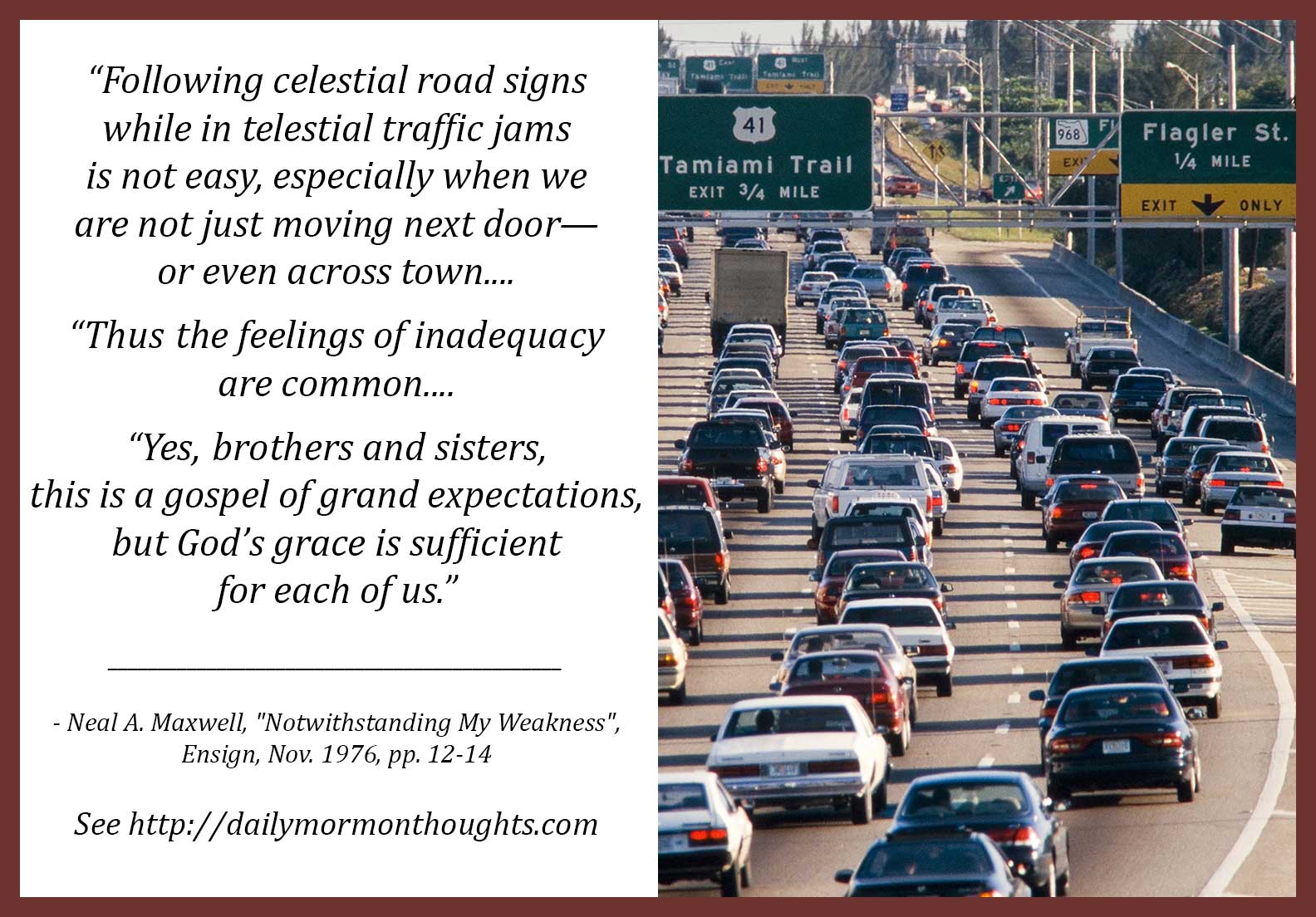
"The first thing to be said of this feeling of inadequacy is that it is normal. There is no way the Church can honestly describe where we must yet go and what we must yet do without creating a sense of immense distance. Following celestial road signs while in telestial traffic jams is not easy, especially when we are not just moving next door—or even across town....
"Thus the feelings of inadequacy are common. So are the feelings of fatigue; hence, the needed warning about our becoming weary of well-doing. (See D&C 64:33.)
"The scriptural advice, 'Do not run faster or labor more than you have strength' (D&C 10:4) suggests paced progress, much as God used seven creative periods in preparing man and this earth. There is a difference, therefore, between being 'anxiously engaged' and being over-anxious and thus underengaged....
"Yes, brothers and sisters, this is a gospel of grand expectations, but God's grace is sufficient for each of us. Discouragement is not the absence of adequacy but the absence of courage, and our personal progress should be yet another way we witness to the wonder of it all!"
- Neal A. Maxwell, "Notwithstanding My Weakness," Ensign, Nov. 1976, pp. 12-14
Click here to read the full talk

It's a marvelous gift to understand and share "things as they really are" (Jacob 4:13); it's a gift Elder Maxwell possessed. He speaks of feelings that so many of us experience — "false insecurity", inadequacy, spiritual fatigue, weariness in well-doing. Life is hard, and it sometimes gets harder because of how we react in our discouragement.

Elder Maxwell warns us to keep perspective; to be "anxiously engaged" without becoming overwhelmed. We are able to do that with God's grace, as we stay aware of our own "paced progress."


It's hard to be in the world, but not of the world. We must remember where our ultimate focus should be. When the world makes us feel inadequate, a divine understanding of our nature and possibilities can make all the difference.

(Compilation and commentary by David Kenison, Orem, Utah, 2021)
October 5, 2015
// Customization to close archive widget on first view - DK 3/15