Friday, February 13, 2015

Richard G. Scott on receiving God's help through prayer

Elder Richard G. Scott (1928- ) served as a Seventy from 1977-1988, when he was called to the Quorum of Twelve Apostles.
"Our Heavenly Father did not put us on earth to fail but to succeed gloriously. It may seem paradoxical, but that is why recognizing answers to prayer can sometimes be very difficult. Some face life with only their own experience and capacity to help them. Others seek, through prayer, divine inspiration to know what to do. When required, they qualify for power beyond their own capacity to do it.
"Communication with our Father in Heaven is not a trivial matter. It is a sacred privilege. It is based upon unchanging principles. When we receive help from our Father in Heaven, it is in response to faith, obedience, and the proper use of agency....
"Don't worry about your clumsily expressed feelings. Just talk to your Father. He hears every prayer and answers it in His way.
"When we explain a problem and a proposed solution, sometimes He answers yes, sometimes no. Often He withholds an answer, not for lack of concern, but because He loves us—perfectly. He wants us to apply truths He has given us. For us to grow, we need to trust our ability to make correct decisions. We need to do what we feel is right. In time, He will answer. He will not fail us."
- Richard G. Scott, "Learning to Recognize Answers to Prayer," Ensign, Nov. 1989, pp. 30-32; click here to read the full talk
This excerpt begins with a declaration that seems simple and obvious, but is full of meaning and critical to understanding Elder Scott's message:


I believe it's so important to understand and believe that statement. Any loving father or mother knows the truth of the principle; we yearn for the happiness and success of our children, in all the ways that matter most. If we truly believe our Father in Heaven feels that way about us, then it will guide our actions in many ways. In particular, related to the principle of prayer, we will know that our prayers matter, that they are heard, and that true communication will be established based on the unchanging principles that Elder Scott enumerates.


Another simple but profound principle. Just talk. Allow the real inner feelings of our heart to reach out to God, knowing that He truly does hear, and will answer — in His way and His timing. If we trust in his wisdom and love, we just need to learn to listen better, to act on what we know, and to be blessed in that process.

Thursday, February 12, 2015

M. Russell Ballard on how to find joy in life

Elder M. Russell Ballard (1928- ) was called as a Seventy in 1976, and has served as a member of the Quorum of Twelve Apostles since 1985.
"I believe there is one simple but profound—even sublime—principle that encompasses the entirety of the gospel of Jesus Christ. If we wholeheartedly embrace this principle and make it the focus of our lives, it will purify and sanctify us so we can live once again in the presence of God.
"The Savior spoke of this principle when He answered the Pharisee who asked, 'Master, which is the great commandment in the law?
"'Jesus said unto him, Thou shalt love the Lord thy God with all thy heart, and with all thy soul, and with all thy mind.
"'This is the first and great commandment.
"'And the second is like unto it, Thou shalt love thy neighbour as thyself' (Matthew 22:36-40).
"It is only when we love God and Christ with all of our hearts, souls, and minds that we are able to share this love with our neighbors through acts of kindness and service—the way that the Savior would love and serve all of us if He were among us today.
"When this pure love of Christ—or charity—envelops us, we think, feel, and act more like Heavenly Father and Jesus would think, feel, and act. Our motivation and heartfelt desire are like unto that of the Savior....
"The love the Savior described is an active love. It is not manifested through large and heroic deeds but rather through simple acts of kindness and service."
- M. Russell Ballard, "Finding Joy through Loving Service," Ensign, May 2011, pp. 46-49; click here to read the full talk
It would be an interesting test, to ask people if they can identify a simple, profound, sublime principle that encompasses the entire gospel and is capable alone of purifying and sanctifying those who are willing to embrace and follow it.

Full obedience to the first great commandment is the prerequisite for the second, the foundation on which the ability to give Christ-like service rests:


The additional point Elder Ballard makes is also very helpful.  It's encouraging to recognize that the key to this transforming power is in small and simple things, well within the reach of even the least among us.


Wednesday, February 11, 2015

Dallin H. Oaks on conversion and becoming

Elder Dallin H. Oaks (1932- ) was sustained to the Quorum of Twelve Apostles in 1984.
"The Final Judgment is not just an evaluation of a sum total of good and evil acts—what we have done. It is an acknowledgment of the final effect of our acts and thoughts—what we have become. It is not enough for anyone just to go through the motions. The commandments, ordinances, and covenants of the gospel are not a list of deposits required to be made in some heavenly account. The gospel of Jesus Christ is a plan that shows us how to become what our Heavenly Father desires us to become....
"We qualify for eternal life through a process of conversion. As used here, this word of many meanings signifies not just a convincing but a profound change of nature....
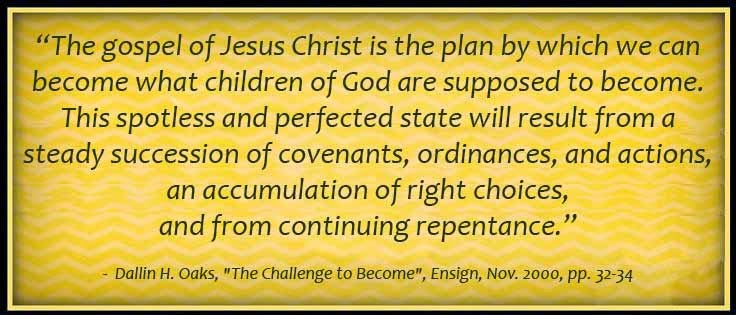
"The gospel of Jesus Christ is the plan by which we can become what children of God are supposed to become. This spotless and perfected state will result from a steady succession of covenants, ordinances, and actions, an accumulation of right choices, and from continuing repentance. 'This life is the time for men to prepare to meet God' (Alma 34:32).
"Now is the time for each of us to work toward our personal conversion, toward becoming what our Heavenly Father desires us to become."
- Dallin H. Oaks, "The Challenge to Become," Ensign, Nov. 2000, pp. 32-34; click here to read the full talk
This is a landmark address by Elder Oaks. His insight on the purpose of our existence helps us understand that we're not checking off a checklist of deeds, actions, even ordinances. We are transforming ourselves into the kind of person for whom all those things are natural occurrences.


The purpose of religion and obedience is conversion—the transformation of our natures, as we try to "become what our Heavenly Father desires us to become." And the encouraging message is that the transformation is gradual, but guaranteed, as we pursue the course that leads to it.


Tuesday, February 10, 2015

Harold B. Lee on being poor in spirit

President Lee (1899-1973) was called to the Quorum of Twelve Apostles in 1941. He served as a counselor in the First Presidency from 1970-1972, then as Church president from July 1972 until his passing less than 18 months later in December 1973.
"'Blessed are the poor in spirit...'
"To be poor in spirit is to feel yourselves as the spiritually needy, ever dependent upon the Lord for your clothes, and your food and the air you breathe, your health, your life; realizing that no day should pass without fervent prayer of thanksgiving, for guidance and forgiveness and strength sufficient for each day's need....  It is indeed a sad thing for one, because of wealth or learning or worldly position, to think himself independent of this spiritual need.  It is the opposite of pride or self-conceit.  To the worldly rich it is that 'he must possess his wealth as if he possessed it not,' and be willing to say without regret, if he were suddenly to meet financial disaster, as did Job, 'The Lord gave, and the Lord hath taken away; blessed by the name of the Lord.' Thus, if in your humility you sense your spiritual need, you are made ready for adoption into the 'Church of the First Born, and to become the elect of God.'"
- Harold B. Lee, "Decisions for Successful Living," pp. 57-58 or "Stand Ye in Holy Places (1974), 343-4
President Lee discussed the Savior's Beatitudes (Matthew 5:1-12) as "the constitution for a perfect life," and began with this explanation about being "poor in spirit." He points out that true humility, acknowledging our complete dependence on the Lord, is what ultimately leads us to the greatest blessings.


His remarks fit particularly well with the version of the Beatitudes from the Book of Mormon, which says, "Yea, blessed are the poor in spirit who come unto me, for theirs is the kingdom of heaven" (3 Nephi 12:3, emphasis added). The key is how we respond to the challenges of life, and true humility leads us to the source of all that truly matters.

Monday, February 9, 2015

Russell M. Nelson on facing the challenges of our time

Elder Russell M. Nelson (1924- ) has served as a member of the Quorum of Twelve since 1984.
"I share comforting counsel with you today. It comes from section 68 of the Doctrine and Covenants, where we read this commandment from our Master: 'Be of good cheer, and do not fear, for I the Lord am with you, and will stand by you; and ye shall bear record of me, even Jesus Christ, that I am the Son of the living God, that I was, that I am, and that I am to come' (D&C 68:6).
"Lovingly we cling to that promise. Difficult days are ahead for all mankind. Sin is on the increase. We live in a time of wars and rumors of wars. The Church and its members will come under attack and endure persecution. (See 2 Timothy 3:1–13; D&C 112:24.)
"Jesus descended below all things in order to rise above all things. He expects us to follow His example. Yoked with Him, we can rise above all challenges, no matter how difficult they may be. (See Matt 11:29-30.) Peter offered this counsel: 'If any man suffer as a Christian, let him not be ashamed; but let him glorify God on this behalf' (1 Peter 4:16).
"The time is coming when those who do not obey the Lord will be separated from those who do. Our safest insurance is to continue to be worthy of admission to His holy house. How blessed we are to have temples available. The greatest gift you could give to the Lord at this or any other time of year is to keep yourself unspotted from the world, worthy to attend His holy house. His gift to you will be the peace and security of knowing that you are worthy to meet Him, whenever that time shall come."
- Russell M. Nelson, "Christ the Savior is Born," BYU Devotional, 10 December 2002; click here to read the full address
The injunction to "be of good cheer" seems reasonable, until one is found in the proverbial "depths of despair." Those are the times when the only hope is to remember the Lord's promise that he will ever be with us, standing by us. As Elder Nelson counsels, we must lovingly cling to that promise. During the times of relative peace, we develop the ability to cling to it in the times when we need it most.


And I appreciate the emphasis Elder Nelson provides related to the temples and our need to stay worthy of regular attendance. Living up to that standard of worthiness is an indication to God that we are seeking His help; we are promised blessings of peace and security.


Sunday, February 8, 2015

L. Tom Perry on Sabbath Day observance

Elder L. Tom Perry (1922- ) has served as a member of the Quorum of Twelve Apostles since 1974.
"The Lord has not left us in the dark concerning the Sabbath day. In fact, the scriptures are filled with instructions on Sabbath-day observance.... [quotes Genesis 2:2-3.]
"Six days of labor are to be followed by a day of rest. It seems to me that the judge should be how we come out of bed on Monday morning. If you just crawl out, feeling tired and weary from a heavy weekend, probably the Sabbath-day observance has not been appropriate. You see, I believe you should come up out of those covers on Monday morning more refreshed, more alive, and more enthused than on any other day of the week. If this is not the case, we had better examine what we are doing on the Sabbath day. Test yourself tomorrow morning and see how you come out of bed.
"Now let's try another one, Exodus 20:8.
"'Remember the sabbath day, to keep it holy.'
"It appears that the Lord expects us to do more than just rest on this day. He expects us to keep it holy. 'Holy,' according to Webster, is 'to set apart to the service of God, to be spiritually pure.' This definition indicates that on this special day we are to keep our lives in harmony with the Lord—a day set apart for service, adoration, and reverence to him."
- L. Tom Perry, "Choose You This Day Whom Ye Will Serve", BYU fireside, 27 October 1985; click here to read the full talk
Elder Perry gives some interesting counsel for evaluating how well we are following the Lord's counsel about the Sabbath. First—how rested and refreshed, alive and enthused do we feel on Monday morning? That's an interesting approach, compared to the general perception most have of Monday mornings!


But even more important than resting from our labors on the Sabbath is the importance of keeping the day holy, in "service, adoration, and reverence" to God. We rest from our weekday labors but not from the worship and service of the Lord. The Sabbath Day should be a day filled with goodness.

Saturday, February 7, 2015

Boyd K. Packer on discouragement and February

President Packer (1924- ) served as an Assistant to the Quorum of the Twelve (a position that no longer exists) from 1961 to 1970, when he was called to the Quorum of Twelve Apostles.  He currently serves as the president of that Quorum.
"Did you know that it is normal and healthy to be depressed occasionally? As General Authorities, we face a long line of people who call upon us because they are unhappy—they are depressed. They are worried about this and that and really not certain what they are worried about. They are a little like the man who insisted: 'You can't tell me that worry doesn't help. The things I worry about never happen!'
   "When we search the revealed word for some evidence of the nature of man, we find statements such as this:
   "'For it must needs be, that there is an opposition in all things. If not so, ... righteousness could not be brought to pass, neither wickedness, neither holiness nor misery, neither good nor bad.' (2 Nephi 2:11.)
   "If you happen to hit a good sorry mood once in a while, relax and enjoy it—it is a good sign that you are normal. It is all right to worry about things now and again, I suppose, but when you get worried about being worried, that is when you are getting off the track....
   "Watch out for February! We learned in supervising teaching that after the interesting beginnings of school—you have the football season, the holidays, the beginning of the basketball season—then, after the first of the year, come the cold, dreary days of winter. We noted that at that time the teacher would fail and the students would have problems. Depressions are then accentuated. It has been interesting to notice this and to point it out when people come in during those dreary days of winter, depressed and unsettled. Then they find out that there was not anything wrong—it was just February. It is worthwhile to know that."
  - Boyd K. Packer, address at BYU, October 4, 1966; see Let Not Your Heart be Troubled, pp. 247-8
Since we're now a week into the month of February, this quote might be helpful for some of us! February, according to President Packer, is a time when it's somewhat normal to feel some discouragement and depression, as we deal with what is (normally) the "cold, dreary days of winter."


President Packer acknowledges in his article that there are serious cases of depression that require professional assistance. But his point is that all of us will deal with challenges from time to time; and with the proper perspective, with encouragement and with Divine help, we can survive the "opposition in all things" and move on with the "righteousness" and "holiness" that life has to offer.
// Customization to close archive widget on first view - DK 3/15