Thursday, January 14, 2016

Dieter F. Uchtdorf on doubt, faith, belief, and knowledge

President Dieter F. Uchtdorf (b. 1940) served as a Seventy from 1994-2004, when he was called as a member of the Quorum of Twelve.  He has served as second counselor in the First Presidency since 2008.
"Satan, our adversary, wants us to fail. He spreads lies as part of his effort to destroy our belief. He slyly suggests that the doubter, the skeptic, the cynic is sophisticated and intelligent, while those who have faith in God and His miracles are naive, blind, or brainwashed. Satan will advocate that it is cool to doubt spiritual gifts and the teachings of true prophets.
"I wish I could help everyone to understand this one simple fact: we believe in God because of things we know with our heart and mind, not because of things we do not know. Our spiritual experiences are sometimes too sacred to explain in worldly terms, but that doesn’t mean they are not real.
"Heavenly Father has prepared for His children a spiritual feast, offering every kind of exquisite food imaginable—and yet, instead of enjoying these spiritual gifts, the cynics content themselves with observing from a distance, sipping from their cups of skepticism, doubt, and disrespect.
"Why would anyone walk through life satisfied with the light from the candle of their own understanding when, by reaching out to our Heavenly Father, they could experience the bright sun of spiritual knowledge that would expand their minds with wisdom and fill their souls with joy?"
- Dieter F. Uchtdorf, "Be Not Afraid, Only Believe," Ensign, November 2015, pp. 76-79
Click here to read the full article

President Uchtdorf's talk to the recent Priesthood session of conference was beautiful and instructive. I appreciated the reminders about the blessings and importance of faith and belief; and the cautions about the tactics of the adversary in spreading doubt, skepticism, and cynicism. I have seen those tactics in play in those around me. We must never be "talked out of" the things we know and have experienced; our belief and faith are well-grounded, unless that subtle faulty logic is allowed to undermine them.

The two examples of contrast are helpful too.  We have an exquisite spiritual feast prepared by Heavenly Father. We should enjoy it deeply and personally, and not observe "from a distance" as do the skeptics, while they are "sipping from their cups of skepticism, doubt, and disrespect." How true is that description!  And then this analogy of light:


What a blessing and joy it is to live the Gospel life!

Wednesday, January 13, 2016

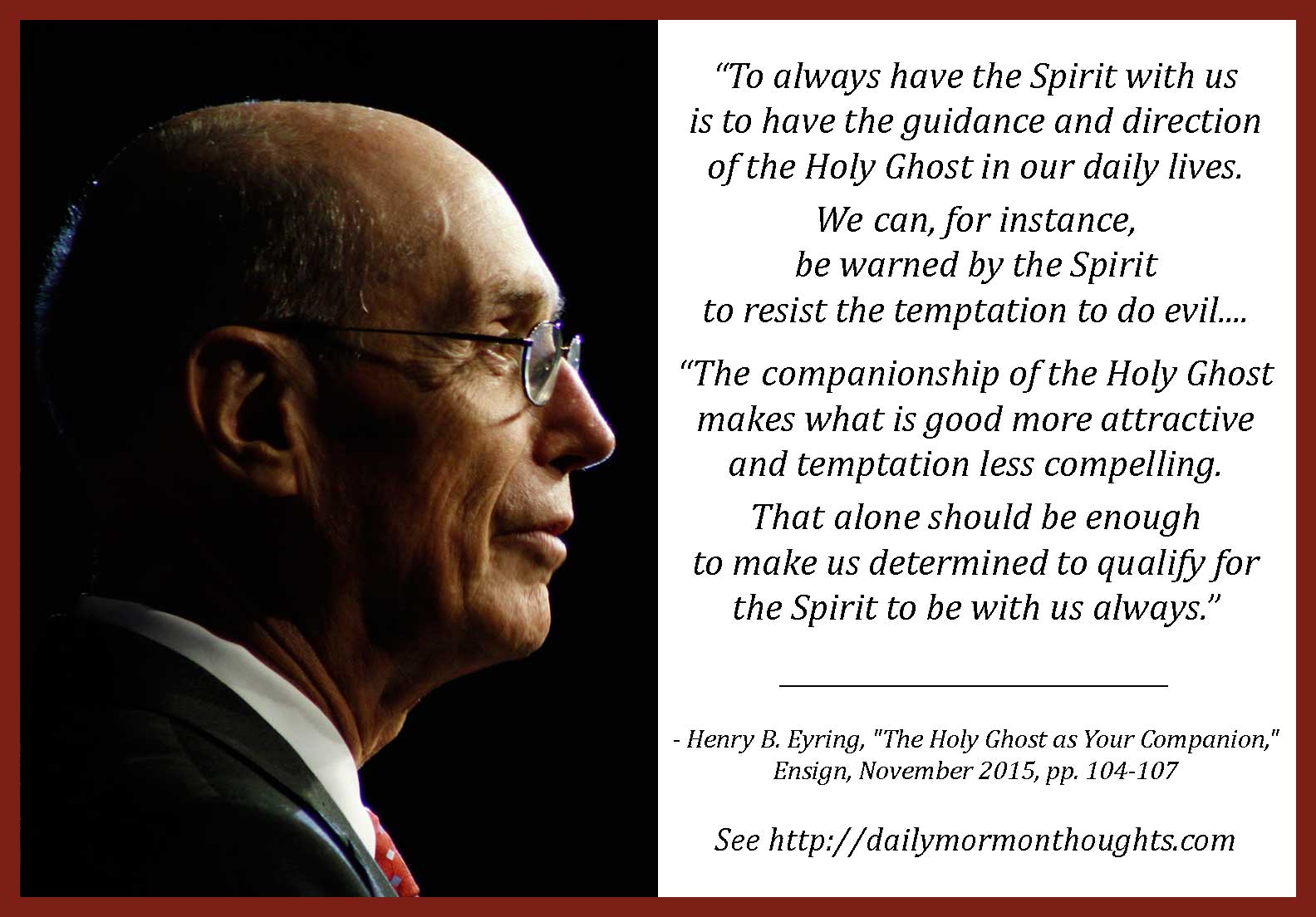
Henry B. Eyring on seeking the companionship of the Holy Ghost

President Henry B. Eyring (1933- ) served in the Presiding Bishopric from 1985-1992, as a Seventy from 1992-1995, then was called to the Quorum of Twelve Apostles. He has served in the First Presidency since 2007.
"My purpose today is to increase your desire and your determination to claim the gift promised to each of us after we were baptized. During our confirmation we heard these words: 'Receive the Holy Ghost.' From that moment, our lives changed forever.
"We can, if we live worthy of it, have the blessing of the Spirit to be with us, not only now and then, ... but always....
"To always have the Spirit with us is to have the guidance and direction of the Holy Ghost in our daily lives. We can, for instance, be warned by the Spirit to resist the temptation to do evil.
"For that reason alone, it is easy to see why the Lord’s servants have tried to increase our desire to worship God in our sacrament meetings. If we partake of the sacrament in faith, the Holy Ghost will then be able to protect us and those we love from the temptations that come with increasing intensity and frequency.
"The companionship of the Holy Ghost makes what is good more attractive and temptation less compelling. That alone should be enough to make us determined to qualify for the Spirit to be with us always.
"Just as the Holy Ghost strengthens us against evil, He also gives us the power to discern truth from falsehood. The truth that matters most is verified only by revelation from God. Our human reason and the use of our physical senses will not be enough. We live in a time when even the wisest will be hard-pressed to distinguish truth from clever deception."
- Henry B. Eyring, "The Holy Ghost as Your Companion," Ensign, November 2015, pp.
Click here to read the full article

President Eyring's talk in the recent general conference was very personal and tender. He shared family experiences and intimate feelings about the influence of the Holy Ghost. He spoke from his heart, and know whereof he spoke, regarding the blessing of "the blessing of the Spirit to be with us, not only now and then, ... but always." I was moved by these descriptions of some of the blessings of that gift.


So among the blessings are

  • increased guidance in our lives
  • warning in times of temptation
  • making good more attractive and temptation less
  • power to discern truth from falsehood

Marvelous things to consider.  Any of those things, as President Eyring states about one of them, "should be enough to make us determined to qualify for the Spirit to be with us always." What a gift to be treasured — to be earned, and then guarded carefully!

Tuesday, January 12, 2016

Thomas S. Monson on the power and blessings of obedience

President Thomas S. Monson (b. August 21, 1927) was sustained to the Quorum of Twelve Apostles in 1963. He served as a counselor in the First Presidency with Presidents Benson, Hunter, and Hinckley until becoming Church president in 2008.
"My message to you tonight is straightforward. It is this: keep the commandments.
"God’s commandments are not given to frustrate us or to become obstacles to our happiness. Just the opposite is true. He who created us and who loves us perfectly knows just how we need to live our lives in order to obtain the greatest happiness possible. He has provided us with guidelines which, if we follow them, will see us safely through this often treacherous mortal journey. We remember the words of the familiar hymn: 'Keep the commandments! In this there is safety; in this there is peace.' (“Keep the Commandments,” Hymns, no. 303.)
"Our Heavenly Father loves us enough to say: Thou shalt not lie; thou shalt not steal; thou shalt not commit adultery; thou shalt love thy neighbor as thyself; and so on. (See Exodus 20:1–17; Matthew 22:39.) We know the commandments. He understands that when we keep the commandments, our lives will be happier, more fulfilling, and less complicated. Our challenges and problems will be easier to bear, and we will receive His promised blessings. But while He gives us laws and commandments, He also allows us to choose whether to accept them or to reject them. Our decisions in this regard will determine our destiny."
- Thomas S. Monson, "Keep the Commandments," Ensign, November 2015, pp. 83-85
Click here to read the full talk

It matters so very much how we view God's commandments. Are they frustrating, limiting obstacles to happiness? President Monson teaches the opposite. They are instructions given by a loving Father to help us find peace and happiness.


Our Heavenly Father loves us enough to give commandments. They are manifestations of His love. What a wonderful perspective! That would make us eager to follow them as closely as we can, "and we will receive His promised blessings."

Monday, January 11, 2016

George Q. Cannon on God's support for His children

President George Q. Cannon (1827-1901) was called to the Quorum of Twelve in 1860. He served as counselor in the First Presidency to Brigham Young beginning in 1873, and then to the next three presidents, until his death in 1901.
"No matter how serious the trial, how deep the distress, how great the affliction, [God] will never desert us. He never has, and He never will. He cannot do it. It is not His character. He is an unchangeable being; the same yesterday, the same today, and He will be the same throughout the eternal ages to come.
"We have found that God. We have made Him our friend, by obeying His Gospel; and He will stand by us. We may pass through the fiery furnace; we may pass through deep waters; but we shall not be consumed nor overwhelmed. We shall emerge from all these trials and difficulties the better and purer for them, if we only trust in our God and keep His commandments."
- George Q. Cannon, "Freedom of the Saints," in Deseret Evening News, Mar. 7, 1891, p. 4; or Collected Discourses, comp. Brian H. Stuy, 2:185

I love the faith and optimism expressed in this thought. Not only do we believe God will never desert us in trials and afflictions, but he is not able to do so; his character and attributes insure that he will be with us and support us to the very end.


And the key, as always, is that "we have made Him our friend" through obedience and faithfulness. No matter the difficulty that comes, if we "trust in our God and keep His commandments," all will be well! What a beautiful expression of faith.

Sunday, January 10, 2016

David O. McKay on Sabbath Day worship

President David O. McKay (1873-1970) was called to the Quorum of Twelve Apostles in 1906.  He served as a counselor in the First Presidency to Heber J. Grant and George Albert Smith beginning in 1945, then then as the president of the Church from 1951 to his death in 1970 at age 96.
"Do you realize there is a duty you owe to your associates? We are social beings.
     There is a destiny which makes us brothers
     None lives to self alone;
     All that we send into the lives of others
     Comes back into our own.
"While it is sweet to worship in the woods, and while it is pleasant to go out and admire the beauties of nature, there is one form of worship which must ever be kept in mind. That is the worship of the group—when each one should go to give and contribute to the welfare of the whole, not merely to receive, or, what is worse, to sit by and criticize those who are trying to give.
"The Sabbath Day is made for the worship of God. The sense of immortality in our religion constitutes one of the foundation stones of happiness.
"I have mentioned these with the thought in view that the religious life is the happiest life you can live. 'There are heights in man which reach the highest heaven, and there are depths that sink to the lowest hell,' said Carlyle. You have the freedom to choose whether you will ascend or whether you will descend."
- David O. McKay, "A Religious Life Brings Happiness," Instructor October 1961, pp. 325-326
Click here to read the full article

This is an interesting approach to understanding the meaning of Sabbath worship. It's not just about me, alone, by myself; each individual has "a duty you owe to your associates." There is power and strength that comes from a community of believers, worshiping together!


President McKay boldly claims, "The religious life is the happiest life you can live." We can choose to accept that blessing in our life that will bring great joy, or we can choose to sink to great depths of unhappiness and despair. Our as

Saturday, January 9, 2016

Eldred G. Smith on spiritual communication through the Holy Ghost

Eldred G. Smith (1907-2013) served as "Patriarch to the Church" from 1947 to 1979, during which time he was sustained as a prophet, seer, and revelator along with the First Presidency and Quorum of the Twelve. He was then released and designated an emeritus general authority; he was not replaced as presiding patriarch. Elder Smith passed away on April 4, 2013 at age 106.
"I think if we will apply some of the laws of electronics, that is, radio and television, we will be aided in a possible understanding of how we can receive a message from the Holy Ghost. We have a spirit mind and a mortal mind. Our spirit mind can receive messages from the Holy Ghost, who is a spirit.
"In this room now there are many waves going by of sound, of pictures, and even of colored pictures. We cannot detect them with our mortal eyes or ears, but if we set up a receiving set and put it in tune, then we pick up the sound or pictures by the mortal ears or eyes. Similarly, the Holy Ghost may be constantly sending out messages like a broadcasting station. If you put yourself in tune, that is, knock or ask or seek, you may receive the message. It may be as if you were to open an imaginary window or door between your spirit mind and your physical mind and permit the message to come through. Spirit can talk to spirit, and you are part spirit—just open that imaginary door and let the mortal mind receive. To open it requires study, prayer, action or works, or knock, and it shall be opened unto you."
- Eldred G. Smith, "How to Obtain a Testimony," Conference Report, October 1964, pp. 9-11
Click here to read the full talk

Half a century ago, there was still enthusiasm over the relatively new development of colored television! Elder Smith makes an analogy with some of the basic principles of radio and television electronics, in which content is broadcast through "invisible" waves through the air. The proper kind of receiver can not only find those waves, but "decode" them into complex messages of sound and image:


The key in this now-common analogy is that the receiver has to be changed or prepared, it has to be in the proper state to receive the message. Otherwise the transmission is useless. The process of putting ourselves "in tune," Elder Smith says, involves knocking, asking, seeking, studying, praying. It's up to us to make the connection and allow the spiritual promptings to get through to us.

Friday, January 8, 2016

Bruce R. McConkie on music and worship

Elder Bruce R. McConkie (July 29, 1915 - April 19, 1985) served as a Seventy from 1946-1972 when he was called to the Quorum of Twelve.  He served in that assignment until his death from cancer at age 69.
"Music is part of the language of the Gods. It has been given to man so he can sing praises to the Lord. It is a means of expressing, with poetic words and in melodious tunes, the deep feelings of rejoicing and thanksgiving found in the hearts of those who have testimonies of the divine Sonship and who know of the wonders and glories wrought for them by the Father, Son, and Holy Spirit.
"Music is both in the voice and in the heart. Every true saint finds his heart full of songs of praise to his Maker. Those whose voices can sing forth the praises found in their hearts are twice blest.
"'Be filled with the Spirit,' Paul counseled, 'Speaking to yourselves in psalms and hymns and spiritual songs, singing and making melody in your heart to the Lord.' (Eph. 5:18-19.) Also: 'Let the word of Christ dwell in you richly in all wisdom; teaching and admonishing one another in psalms and hymns and spiritual songs, singing with grace in your hearts to the Lord.' (Col. 3:16.)"
- Bruce R. McConkie, The Promised Messiah, p. 553

Elder McConkie was known for his scriptural, doctrinal pronouncements.  This is an interesting statement, perhaps somewhat of a contrast from his normal topics: "Music is part of the language of the Gods." Language is anything that helps us communicate thoughts and emotions. so that's a valid interpretation. Music is given to man to "communicate praises to the Lord." Is that how we use it? Do we employ music to share "the deep feelings of rejoicing and thanksgiving" that are in our hearts?


I like that expression. The first blessing is just to appreciate the power of music; but one who has a voice capable of expressing what is in the heart is twice-blessed!
// Customization to close archive widget on first view - DK 3/15