Thursday, September 13, 2018

President Gordon B. Hinckley on the eternal purpose of each day

President Gordon B. Hinckley (1910-2008) was called to the Quorum of Twelve in 1961. He served as a counselor in the First Presidency from 1981-1995, then as Church President until his death in 2008.
"We are not chance creations in a universe of disorder. We lived before we were born. We were God’s sons and daughters who shouted for joy. (See Job 38:7.) We knew our Father; He planned our future. We graduated from that life and matriculated in this. The statement is simple; the implications are profound. Life is a mission, not just the sputtering of a candle between a chance lighting and a gust of wind that blows it out forever....
"While here, we have learning to gain, work to do, service to give. We are here with a marvelous inheritance, a divine endowment. How different this world would be if every person realized that all of his actions have eternal consequences. How much more satisfying our years may be if in our accumulation of knowledge, in our relationships with others, in our business affairs, in our courtship and marriage, and in our family rearing, we recognize that we form each day the stuff of which eternity is made. Brothers and sisters, life is forever. Live each day as if you were going to live eternally, for you surely shall."
- Gordon B. Hinckley, "Pillars of Truth," First Presidency Message, Ensign, January 1994, pp. 2-5
Click here to read the full article

I love President Hinckley's powerful and ringing testimony: "Life is a mission, not just the sputtering of a candle between a chance lighting and a gust of wind that blows it out forever." He believed with all his heart that there is meaning and purpose to our mortal existence, directed by a divine power, a loving Father. So we need to fill our life with learning, work, and service.


Each day of our mortal life points us towards eternity. The actions and decisions we make have profound significance. "Live each day as if you were going to live eternally, for you surely shall."

(Compilation and commentary by David Kenison, Orem, Utah, 2018)

Wednesday, September 12, 2018

President Henry B. Eyring on the sacred importance of each day

President Henry B. Eyring (born May 31, 1933) served in the Presiding Bishopric from 1985-1992, as a Seventy from 1992-1995, then was called to the Quorum of Twelve Apostles. He has served in the First Presidency since 2007.
"There is a danger in the word someday when what it means is 'not this day.' 'Someday I will repent.' 'Someday I will forgive him.' 'Someday I will speak to my friend about the Church.' 'Someday I will start to pay tithing.' 'Someday I will return to the temple.' 'Someday...'
"The scriptures make the danger of delay clear. It is that we may discover that we have run out of time. The God who gives us each day as a treasure will require an accounting. We will weep, and He will weep, if we have intended to repent and to serve Him in tomorrows which never came or have dreamt of yesterdays where the opportunity to act was past. This day is a precious gift of God. The thought 'Someday I will' can be a thief of the opportunities of time and the blessings of eternity."
- Henry B. Eyring, "This Day," General Conference April 2007
Click here to read or listen to the full talk

President Eyring points out the risks we take when we postpone important matters; waiting for "someday" can truly mean "never" if we wait too long. For many things, that probably doesn't matter so much, as our focus and priorities in life can change. But for some things, that is so very crucial. It's been said that the things that matter most should never be at the mercy of the things that matter less, and we too often allow that to happen.


So how do we avoid that trap? By being clear about priorities, and taking time regularly to reconsider our lives and establish what it is that truly matters. And by continuing to make those things happen, starting now, with a clear and helpful course of action! And in all things, but inviting the Spirit to help choose the priorities and commit to the paths of action.

(Compilation and commentary by David Kenison, Orem, Utah, 2018)

Tuesday, September 11, 2018

President Dallin H. Oaks on having a proper perspective on adversities

President Dallin H. Oaks (born August 12, 1932) served as president of BYU from 1971-1980.  He was then appointed as a justice of the Utah Supreme Court, and resigned when he was called to the Quorum of Twelve Apostles in 1984. He became President of the Quorum of Twelve Apostles and also 1st Counselor in the First Presidency in January 2018.
"I recall a memorable lesson I learned from Chicago Daily News columnist Sydney J. Harris. He wrote:
"I walked with my friend, a Quaker, to the newsstand the other night, and he bought a paper, thanking the newsie politely. The newsie didn’t even acknowledge it.
"'A sullen fellow, isn’t he?' I commented.
"'Oh, he’s that way every night,' shrugged my friend.
"'Then why do you continue to be so polite to him?' I asked.
"'Why not?' inquired my friend. 'Why should I let him decide how I’m going to act?'
"As I thought about this incident later, it occurred to me that the important word was act. My friend acts toward people; most of us react toward them. He has a sense of inner balance that is lacking in most of us; he knows who he is, what he stands for, how he should behave. He refuses to return incivility for incivility, because then he would no longer be in command of his conduct. ['Do You Act—Or React?' condensed from the Chicago Daily News]
"I like that example because it challenges each of us to focus our attention on the individual responses each of us must make to the individual personal adversities that are sure to hound us throughout our lives. Our responses will inevitably shape our souls and ultimately determine our status in eternity.
"We can take comfort in the fact that because opposition is divinely decreed for the purpose of helping man to grow, we have the assurance of God that in the long view of eternity, opposition will not be allowed to overcome us. We will prevail. Like the mortal life of which they are a part, adversities are temporary. What is permanent is what we become by the way we react to them."
- Dallin H. Oaks, "Adversity," BYU Devotional January 17, 1995
Click here to read or listen to the full talk

The story President Oaks quotes from Sydney Harris is one that has been quoted a number of times by speakers in our various meetings. It presents a great message, summarized in the title of the article from which it was taken: do we act, or react? Do we use our agency to pursue the course we think is right, including how we behave, how we treat others, how our moods and attitudes are determined? Or do we allow outside influences to unduly modify or manipulate our responses and choices? It's a great message to ponder.

And more specifically, President Oaks applies that concept to the adversities that will come to us in life. We can allow them to manipulate and demoralize us, or we can keep them in perspective and rise above them:


What a great and important thought: adversities are temporary, but what we become through how we respond to them is permanent.

(Compilation and commentary by David Kenison, Orem, Utah, 2018)

Monday, September 10, 2018

President Boyd K. Packer on remembering our spiritual pedigree

President Boyd K. Packer (1924-2015) served as an Assistant to the Quorum of the Twelve (a position that no longer exists) from 1961 to 1970, when he was called to the Quorum of Twelve Apostles.  He served as president of that Quorum from 1994 until his death on July 3, 2015 at age 90.
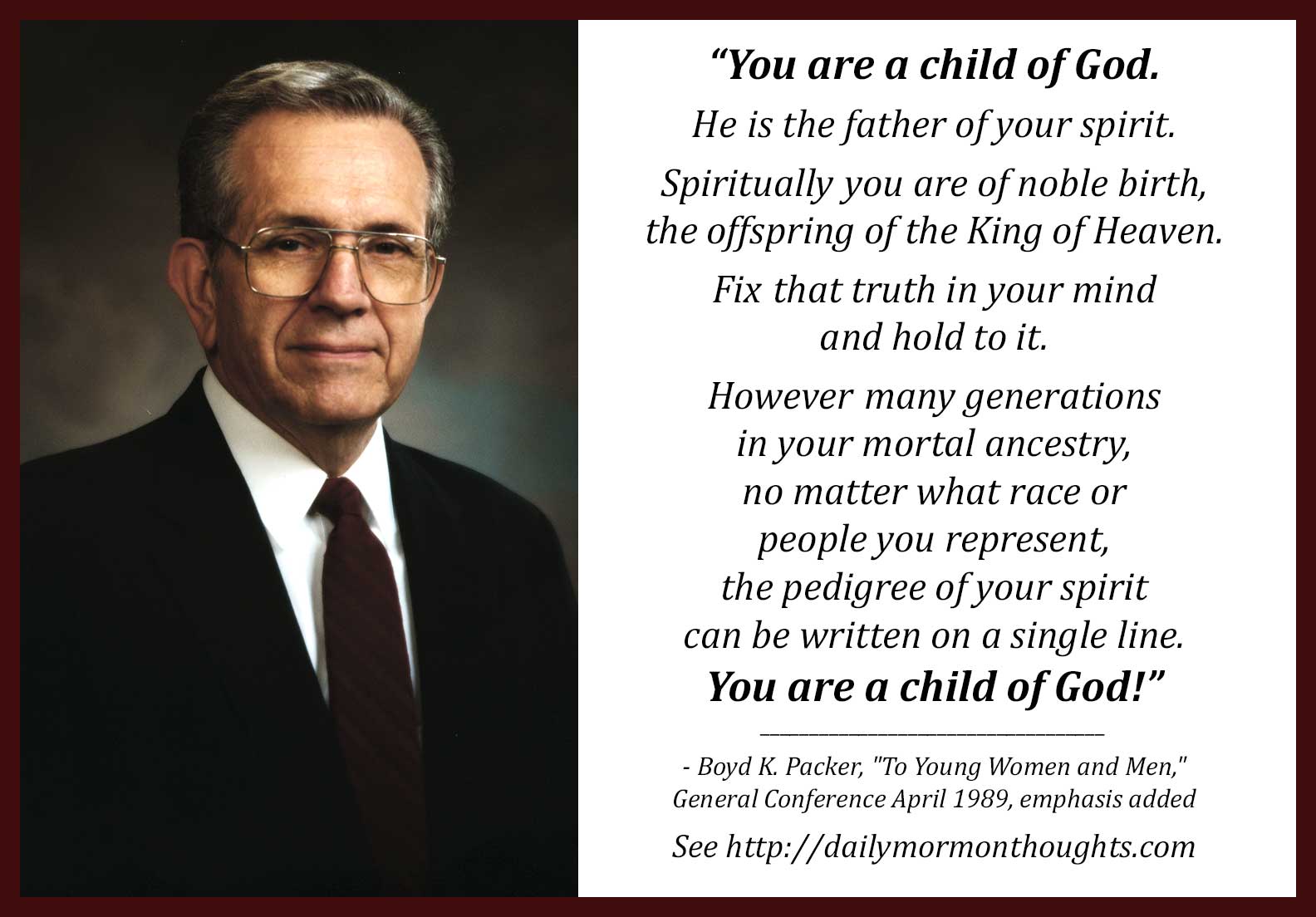
"You are a child of God. He is the father of your spirit. Spiritually you are of noble birth, the offspring of the King of Heaven. Fix that truth in your mind and hold to it. However many generations in your mortal ancestry, no matter what race or people you represent, the pedigree of your spirit can be written on a single line. You are a child of God!"
- Boyd K. Packer, "To Young Women and Men," General Conference April 1989
Click here to read or listen to the full talk

This is a simple but profound message from President Packer. "The pedigree of your spirit can be written on a single line."


It is a greater blessing than we recognize to "fix that truth in your mind and hold to it." With that foundational knowledge, the changing circumstances of our lives are put in perspective and the choices we need to make have an eternal context. Our entire nature is changed as we remember, and live up to, our simple spiritual pedigree!

(Compilation and commentary by David Kenison, Orem, Utah, 2018)

Sunday, September 9, 2018

President Russell M. Nelson on living well as we prepare to meet God

President Russell M. Nelson (born Sept 9, 1924) was an internationally-renowned heart surgeon when he was called to serve as a member of the Quorum of Twelve Apostles in 1984. He became president of that quorum on July 15, 2015. Following the death of President Monson, he was set apart as president of the Church on January 14, 2018.
"Meanwhile, we who tarry here have a few precious moments remaining 'to prepare to meet God.' (Alma 34:32.) Unfinished business is our worst business. Perpetual procrastination must yield to perceptive preparation. Today we have a little more time to bless others—time to be kinder, more compassionate, quicker to thank and slower to scold, more generous in sharing, more gracious in caring.
"Then when our turn comes to pass through the doors of death, we can say as did Paul: 'The time of my departure is at hand. I have fought a good fight, I have finished my course, I have kept the faith.' (2 Tim. 4:6–7.)
"We need not look upon death as an enemy. With full understanding and preparation, faith supplants fear. Hope displaces despair. The Lord said, 'Fear not even unto death; for in this world your joy is not full, but in me your joy is full.' (D&C 101:36.) He bestowed this gift: 'Peace I leave with you, my peace I give unto you: not as the world giveth, give I unto you. Let not your heart be troubled, neither let it be afraid.” (John 14:27.)'"
- Russell M. Nelson, "Doors of Death," General Conference, April 1992
Click here to read or listen to the full talk

This was a masterful discourse by then-Elder Nelson, in which he discussed the doctrine and understanding we have about the process of death and how it relates to our eternal life. His talk included this beautiful and tender observation: "Moreover, we can’t fully appreciate joyful reunions later without tearful separations now. The only way to take sorrow out of death is to take love out of life." But peace does come with understanding and perspective.

In this final part of his remarks, President Nelson spoke of the insights a death can bring to "we who tarry here." We are granted additional time, and we should recognize what a treasure and sacred gift each day is. We should use our "few precious moments" wisely:


It must be a singularly remarkable feeling to come to the end of mortality, which can happen at any moment, and be prepared, ready to say with Paul, "I have finished my course, I have kept the faith." President Nelson encourages each of us to ponder our own preparation, end our procrastination, and live each day in a more loving, compassionate, forgiving way—a more Christlike way. That is certainly how he has lived his life!

(Compilation and commentary by David Kenison, Orem, Utah, 2018)

Saturday, September 8, 2018

Elder Quentin L. Cook on seeking safety in a troubled world

Elder Quentin L. Cook (b. 1940) was called as a Seventy in 1996, then as a member of the Quorum of Twelve Apostles in 2007.
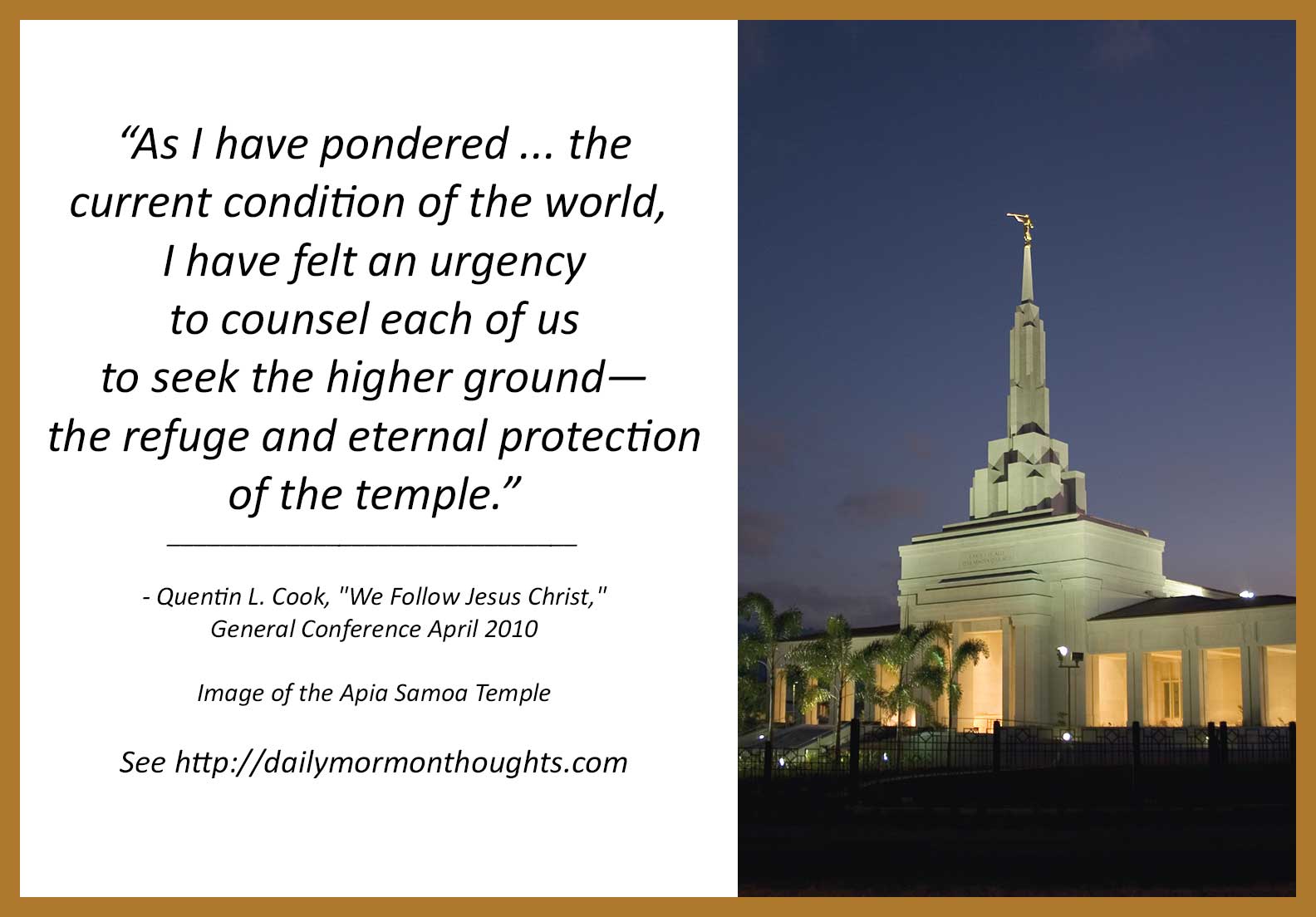
"As we met with the families in Samoa [following a devastating tsunami that occurred there in September 2009], the significance of spiritually going to the higher ground, living a better life, and clinging to saving ordinances was abundantly clear. The Savior’s example and life teach us to spiritually avoid the low pathway, where the things of this world dominate. As I shook hands with the members after our meeting, one sister told me her family had not been to the temple and they had lost a daughter. She tearfully said their goal now was to prepare themselves for the sacred ordinances of the temple so they can be together eternally.
"As I have pondered what this sister said and the current condition of the world, I have felt an urgency to counsel each of us to seek the higher ground—the refuge and eternal protection of the temple."
- Quentin L. Cook, "We Follow Jesus Christ," General Conference April 2010
Click here to read or listen to the full talk

In times of trial and difficulty, particularly when we lose those who are close to us in the midst of a disaster, accident, or even the normal course of life—those are times when the vision of eternity and the understanding of Gospel promises can have a powerful impact in our lives. Elder Cook experienced that as he interacted with many of the Saints who had gone through profound challenges. He summarized the perspective of what he learned in these words:


With that urgent counsel from an apostle of the Lord, we should be seeking "the refuge and eternal protection of the temple" in every opportunity we can. Our lives will certainly be blessed as we spend time in quiet contemplation, away from the world's cares, and especially as we ponder the perspective provided through sacred ordinances and through the teachings of the Lord's House.

(Compilation and commentary by David Kenison, Orem, Utah, 2018)

Friday, September 7, 2018

Elder Neal A. Maxwell on the gift of the Holy Ghost

Elder Neal A. Maxwell (1926-2004) served as a Seventy from 1976-1981, then as a member of the Quorum of Twelve until his death from cancer in 2004.
"The overall gift of the Holy Ghost truly is one of the greatest blessings available to members of the Church. We all need to stress—for ourselves and for those whom we teach—the vital connection with the gifts of the Holy Ghost. These gifts are vital at every stage of an individual's life and in every situation of life. Members of the Church have received the gift of the Holy Ghost, but in many it lies dormant—somewhat like the ancients who had received the gift but knew it not (see 3 Ne. 9:20).
"Consider the statement of Elder Parley P. Pratt (1807-57) of the Quorum of the Twelve Apostles:
"'The Holy Ghost ... quickens all the intellectual faculties, increases, enlarges, expands, and purifies all the natural passions and affections, and adapts them, by the gift of wisdom, to their lawful use. It inspires, develops, cultivates, and matures all the fine-toned sympathies, joys, tastes, kindred feelings, and affections of our nature' (Key to the Science of Theology [1978], 61).
"What a promise! No wonder we are instructed to 'seek ye ... the best gifts' and their attendant joys (D&C 46:8). We are not limited to just one gift, though that is the minimum each is given. Since the realization of so many blessings does lie latent, the Apostle Paul urged us to 'stir up the gift of God, which is in thee' (2 Tim. 1:6)."
- Neal A. Maxwell, "The Holy Ghost: Glorifying Christ," CES broadcast to religious educators, 2 February 2001; see Ensign, July 2002, pp. 56-61
Click here to read the full article
Elder Maxwell reminds us of the difference between "the overall gift of the Holy Ghost" and the diverse and varied "gifts of the Holy Ghost" that are available to those who seek them. Both play very important roles in our lives, and we should "stress... the vital importance" of obtaining and being blessed by those gifts!


I've always loved Parley P. Pratt's beautiful, poetic description of the ways we can be influenced and blessed by the Holy Ghost in our lives. What a rich and profound gift it truly is! But it is up to us to "seek... the best gifts" that are offered through that endowment. We are counseled to seek earnestly, not casually... it requires effort, attention, and focus. But who can question the value of the result!

(Compilation and commentary by David Kenison, Orem, Utah, 2018)
// Customization to close archive widget on first view - DK 3/15