Sunday, April 17, 2022

Elder Neal A. Maxwell on Christ's victory over death

Elder Neal A. Maxwell (1926-2004) served as a Seventy from 1976-1981, then as a member of the Quorum of Twelve until his death from cancer in 2004.
"The gift of immortality to all mankind through the reality of the Resurrection is so powerful a promise that our rejoicing in these great and generous gifts should drown out any sorrow, assuage any grief, conquer any mood, dissolve any despair, and tame any tragedy. Those who now see life as pointless will one day point with adoration to the performance of the Man of Galilee in those crowded moments of time known as Gethsemane and Calvary. Those who presently say life is meaningless will yet applaud the Atonement which saves us from meaninglessness. Christ's victory over death ended the human predicaments, and from these too we may be rescued by following the teachings of him who rescued us from general extinction.
"Our 'brightness of hope,' therefore, means that at funerals our tears are genuine, but not because of termination—rather because of interruption. Though just as wet, our tears are not of despair but are of appreciation and anticipation. Yes, for disciples, the closing of a grave is but the closing of a door which later will be flung open with rejoicing.
"We say, humbly but firmly that it is the garden tomb—not life—that is empty."
- Neal A. Maxwell, "All Hell Is Moved," BYU Devotional, Nov 8, 1977
Click here to read the full talk
Elder Maxwell provides a powerful suggestion. If we consider the magnitude of the "great and generous gifts" provided to us by the Savior through the Resurrection alongside the sorrows and despairs of mortality, the former should completely drown out and overwhelm the latter. What a marvelous perspective; if our understanding is deep enough, all else falls into place.


As an example, he discusses the challenge of dealing with the loss of a loved one to death. Real disciples, who understand the doctrine, respond differently to this part of life:


And that leads us to the profound but simple testimony that is at the core of Elder Maxwell's remarks, the Easter season, and indeed the very core of Christianity:


(Compilation and commentary by David Kenison, Orem, Utah, 2022)
April 1, 2015

Saturday, April 16, 2022

President Russell M. Nelson on the sublime message of Easter

President Russell M. Nelson (born Sept 9, 1924) was an internationally-renowned heart surgeon when he was called to serve as a member of the Quorum of Twelve Apostles in 1984. He became president of that quorum on July 15, 2015. Following the death of President Monson, he was set apart as president of the Church on January 14, 2018.
"We are part of His divine purpose: 'My work and my glory,' He said, is 'to bring to pass the immortality and eternal life of man' (Moses 1:39).  In order to achieve those objectives, 'God so loved the world, that he gave his only begotten Son, that whosoever believeth in him should not perish, but have everlasting life' (John 3:16). That act was a supernal manifestation of God’s love. 'For [He] sent not his Son into the world to condemn the world; but that the world through him might be saved' (John 3:17).
"Central to God’s eternal plan is the mission of His Son, Jesus Christ. He came to redeem God’s children. Because of the Lord’s Atonement, resurrection (or immortality) became a reality. Because of the Atonement, eternal life became a possibility for all who would qualify. Jesus so explained:
"'I am the resurrection, and the life: he that believeth in me, though he were dead, yet shall he live:
"'And whosoever liveth and believeth in me shall never die.' (John 11:25–26.)
"For the Atonement of the Lord and His gift of resurrection—for this sublime message of Easter—thanks be to God! ...
"God is the same yesterday, today, and forever, but we are not. Each day, ours is the challenge to access the power of the Atonement so that we can truly change, become more Christlike, and qualify for the gift of exaltation and live eternally with God, Jesus Christ, and our families. For these powers, privileges, and gospel gifts, thanks be to God!"
- Russell M. Nelson, "Thanks Be to God," General Conference April 2012
Click here to read or listen to the full talk

I love President Nelson's spirit of joyful gratitude. In acknowledging the "sublime message of Easter" and the supreme gifts given to us through the Atonement of the Savior, he reminds us first of the "supernal manifestation of God's love" on our behalf as He gave His Son to offer salvation, and the dual gifts of immortality and eternal life.

But the ongoing challenge and opportunity for us is expressed in these powerful words:


As we "access the power of the Atonement" of Jesus Christ in our daily lives, we find the ability to change and grow, to "become more Christlike" and thus to receive the fullness of what He offers to us. As President Nelson says with rejoicing, "Thanks be to God" for these manifestations of His love for us, and for the joy and peace that comes to us as we fully accept His gifts!

(Compilation and commentary by David Kenison, Orem, Utah, 2022)
April 1, 2018

Friday, April 15, 2022

Elder D. Todd Christofferson on God's promises to us

Elder D. Todd Christofferson (1945- ) was called to the Seventy in 1993, and as a member of the Quorum of Twelve Apostles in 2008.
"It truly is folly for us with our mortal myopia to presume to judge God, to think, for example, 'I’m not happy, so God must be doing something wrong.' To us, His mortal children in a fallen world, who know so little of past, present, and future, He declares, 'All things are present with me, for I know them all' (Moses 1:6). Jacob wisely cautions: 'Seek not to counsel the Lord, but to take counsel from his hand. For behold, ye yourselves know that he counseleth in wisdom, and in justice, and in great mercy, over all his works' (Jacob 4:10).

"Some misunderstand the promises of God to mean that obedience to Him yields specific outcomes on a fixed schedule. They might think, 'If I diligently serve a full-time mission, God will bless me with a happy marriage and children' or 'If I refrain from doing schoolwork on the Sabbath, God will bless me with good grades' or 'If I pay tithing, God will bless me with that job I’ve been wanting.' If life doesn’t fall out precisely this way or according to an expected timetable, they may feel betrayed by God. But things are not so mechanical in the divine economy. We ought not to think of God’s plan as a cosmic vending machine where we (1) select a desired blessing, (2) insert the required sum of good works, and (3) the order is promptly delivered.

"God will indeed honor His covenants and promises to each of us. We need not worry about that. The atoning power of Jesus Christ—who descended below all things and then ascended on high and who possesses all power in heaven and in earth—ensures that God can and will fulfill His promises. It is essential that we honor and obey His laws, but not every blessing predicated on obedience to law is shaped, designed, and timed according to our expectations. We do our best but must leave to Him the management of blessings, both temporal and spiritual."

- D. Todd Christofferson, "Our Relationship with God," General Conference April 2022, Saturday morning
Click here to read or listen to the full discourse


It's easy to fall into the trap that we can claim blessings by defining our level of obedience. We are sometimes tempted to set conditions for God - if I do "x" then I expect "y" - and when it doesn't happen quite as we plan, we can question God. But we should really question ourselves in that scenario! It's a pretty low quality of motivation when we will only obey if we get a blessing in return.

Elder Christofferson clarifies the principle. Obedience does bring blessings; but not according to our conditions, nor our timetable:


I appreciated his description of "a cosmic vending machine" of blessings that sometimes seems to be our mental model. Instead, we just need to learn to trust God - both His wisdom and His timetable. All will be well in the end.

(Compilation and commentary by David Kenison, Orem, Utah, 2022)

Thursday, April 14, 2022

Elder Quentin L. Cook on the fruits of true conversion

Elder Quentin L. Cook (1940- ) was called as a Seventy in 1996, then as a member of the Quorum of Twelve Apostles in 2007.
"In our day, many have adopted the concept that there should be no consequence for sin. They support the unconditional condoning of sin without repentance. Our revealed doctrine not only refutes the idea that most people would be eternally condemned to hell and damnation but also establishes that personal repentance is a commanded prerequisite to partake of the Savior’s Atonement and inherit the celestial kingdom. I testify that Joseph Smith was truly an instrument in the Lord’s hands in bringing forth the Restoration of His gospel!

"Because of the Restoration of the gospel of Jesus Christ, we understand the importance of both repentance and the 'works of righteousness' (D&C 59:23). We understand the overwhelming significance of the Savior’s Atonement and of His saving ordinances and covenants, including those performed in the temple.

"The 'works of righteousness' emanate from and are the fruits of conversion. True conversion is brought about by the conscious acceptance and commitment to follow the will of God. The banquet of consequences and blessings that flow from conversion is true and permanent peace and the personal assurance of ultimate happiness—despite the storms of this life.

"Conversion to the Savior changes a natural man into a sanctified, born again, purified person—a new creature in Christ Jesus."

- Quentin L. Cook, "Conversion to the Will of God," General Conference April 2022, Saturday afternoon
Click here to read or listen to the full discourse

So much incorrect or unclear doctrine in Christianity is clarified and corrected by the Restoration through Joseph Smith in the latter days! The interplay of grace, repentance, and obedience is a one of the most important of these.

The "works of righteousness" in our lives are a byproduct of true conversion:


As we truly commit to follow God's will, we become converted; and righteous works will follow that step. I love the description of "the banquet of consequences and blessings" - the ultimate happiness that comes only from Him, and will carry us through any storm in life.

(Compilation and commentary by David Kenison, Orem, Utah, 2022)

Wednesday, April 13, 2022

Elder David A. Bednar on heeding not the world's distractions

Elder David A. Bednar (b. 1952) was serving as the president of BYU–Idaho when he was called and sustained as a member of the Quorum of Twelve Apostles in October 2004.
"The word heed suggests taking notice of or paying attention to someone or something. Thus, the lyrics of the hymn 'Let Us All Press On' admonish us to make an affirmative decision to pay no attention to 'what the wicked may say.' And Lehi and the people with him who were partaking of the fruit of the tree provide a strong example of not paying attention to the mocking and scorn that so frequently come from the great and spacious building.

"The doctrine of Christ written 'with the Spirit of the living God … in fleshy tables of [our hearts]' (2 Cor 3:3) increases our capacity to 'heed not' the many distractions, taunts, and diversions in our fallen world. For example, faith focused in and on the Lord Jesus Christ fortifies us with spiritual strength. Faith in the Redeemer is a principle of action and of power. As we act in accordance with the truths of His gospel, we are blessed with the spiritual capacity to press forward through the challenges of mortality while focusing on the joys the Savior offers to us. Truly, 'if we do what’s right we have no need to fear, for the Lord, our helper, will ever be near' (Hymns 243)."

- David A. Bednar, "But We Heeded Them Not," General Conference April 2022, Saturday morning
Click here to read or listen to the full discourse


Elder Bednar used the phrase from "Let Us All Press On" to set the theme for his talk: "We will heed not what the wicked may say, but the Lord alone we will obey." Learning not to heed the world when it mocks from the "great and spacious building," or when it tempts from the depths of darkness, is the key to staying on the path that leads to our source of happiness.


The great key to this message, for me, was the thought that to fully be able to "heed not" one thing, we have to have a clear focus on what we do heed. The best way to take our focus away from the world is to have some other thing that we focus it on. If we are not heeding what the world says, it is because "the Lord alone we will obey." Our focus has to be on Him. As we do that, it becomes easy to ignore the negative aspects of the world around us.

(Compilation and commentary by David Kenison, Orem, Utah, 2022)

Tuesday, April 12, 2022

Elder Dieter F. Uchtdorf on the measure of discipleship

Elder Dieter F. Uchtdorf (b November 6, 1940) served as a Seventy from 1994-2004, when he was called as a member of the Quorum of Twelve. He served as second counselor in the First Presidency from 2008 until 2018.
"Just days before He gave His life for us, Jesus Christ was at the temple in Jerusalem, watching people make donations to the temple treasury. 'Many that were rich cast in much,' but then, along came a poor widow, 'and she threw in two mites.' It was such a small amount, it would hardly be worth recording.

"And yet this seemingly inconsequential donation caught the Savior’s attention. In fact, it impressed Him so deeply that 'he called unto him his disciples, and saith unto them, Verily I say unto you, That this poor widow hath cast more in, than all they which have cast into the treasury:

"'For all they did cast in of their abundance; but she of her want did cast in all that she had, even all her living.' (Mark 12:41–44.)

"With this simple observation, the Savior taught us how offerings are measured in His kingdom—and it’s quite different from the way we usually measure things. To the Lord, the value of the donation was measured not by the effect it had on the treasury but by the effect it had on the heart of the donor.

"In praising this faithful widow, the Savior gave us a standard to measure our discipleship in all of its many expressions. Jesus taught that our offering may be large or it may be small, but either way, it must be our heartfelt all."

- Dieter F. Uchtdorf, "Our Heartfelt All," General Conference April 2022, Sunday afternoon
Click here to read or listen to the full talk

The New Testament story of the widow's mite is a powerful and fascinating one. In the midst of a temple where prominent and powerful leaders are making their significant donations to the temple, an aged woman quietly slips in and makes a tiny, paltry donation. But to the Savior it is neither tiny nor paltry! He immediately discerns her heart, and points out to his disciples the significant difference in the motivation between the prominent, wealthy donors and this woman.

Elder Uchtdorf draws from this beautiful story to remind us that there is more to the story than an ancient example of the old woman and her coins. There is a direct application to each of us:


Our contributions never are equal to those around us. We all come from such different backgrounds and capacities. But the bottom line is not the effect on the treasury, but on the donor. And all the Lord asks of us is that we give our "heartfelt all." A faithful disciple will frequently review his motivation to ensure that he is not holding anything back from the Lord.

(Compilation and commentary by David Kenison, Orem, Utah, 2022)

Monday, April 11, 2022

Elder Jeffrey R. Holland on our loving Father in Heaven

Elder Jeffrey R. Holland (1940- ) served as Church Commissioner of Education from 1976-1980, as the president of BYU from 1980-1989, as a Seventy from 1989-1994, and as a member of the Quorum of Twelve Apostles since 1994.
"We, of all people, should be 'sing[ing] the song of redeeming love' (Alma 5:26), but that takes discipline—'discipleship,' if you will—the kind that guards against negative attitudes and destructive habits that would pull us off-key as we try to sing that song of eternal salvation.

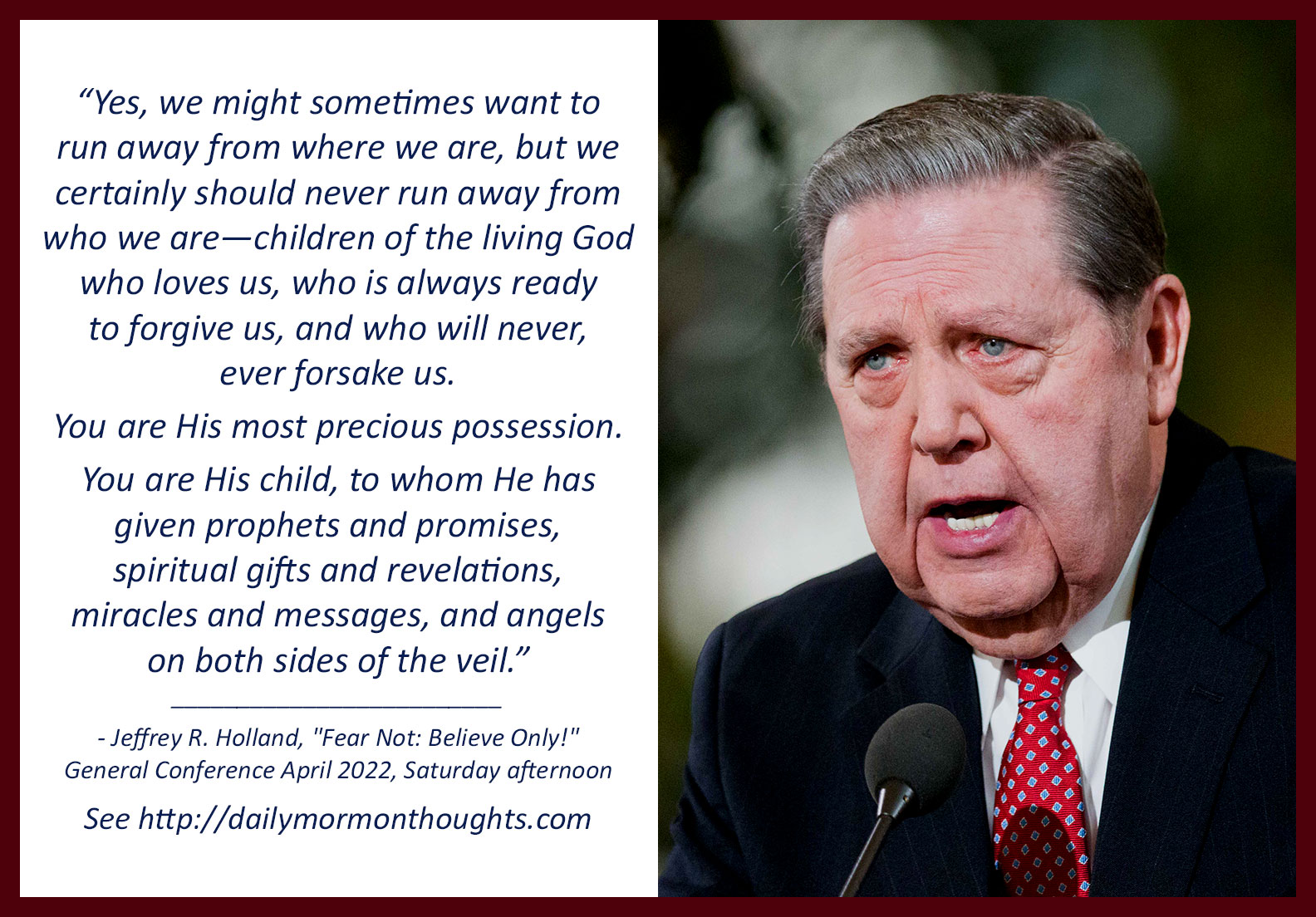
"Even as we stay 'on the sunny side of the street,' we do run into that fellow from time to time who is determined to find something bleak and dismal about everything. You know his motto: 'It is always darkest just before it goes pitch-black.' What a malignant vision, and what a miserable existence! Yes, we might sometimes want to run away from where we are, but we certainly should never run away from who we are—children of the living God who loves us, who is always ready to forgive us, and who will never, ever forsake us. You are His most precious possession. You are His child, to whom He has given prophets and promises, spiritual gifts and revelations, miracles and messages, and angels on both sides of the veil."

- Jeffrey R. Holland, "Fear Not: Believe Only!", General Conference April 2022, Saturday afternoon
Click here to read or listen to the complete address

Much of Elder Holland's address was directed to youth, but with powerful application to all of us. The challenges of life are often profound and heavy. But remembering who we really are, what our heritage is, the help that is available through the Savior's Atonement—those are all great keys to moving forward successfully in life.


We must never forget that we truly do have a loving Father! And that He has provided so many resources to help us with our challenges, and will continue to love and sustain us. Elder Holland's witness was powerful, and if it helps only one struggling youth, it will certainly have been worthwhile. But I believe it has power to help every one of us.

(Compilation and commentary by David Kenison, Orem, Utah, 2022)
// Customization to close archive widget on first view - DK 3/15