Thursday, May 21, 2015

Richard L. Evans on making and breaking habits

Elder Richard L. Evans (1906-1971) served as a Seventy from 1938-1953, when he was called to the Quorum of Twelve Apostles.  He died in 1971 at age 65.  He was known as "the voice of the Tabernacle Choir" from the beginning of its broadcasts in 1929 until his passing.
"Rip Van Winkle was depicted by one playwright as excusing himself every time he did what he shouldn't do, by saying, '"I won't count this time." Well, he may not count it,' said William James, 'and a kind heaven may not count it, but it is being counted nonetheless. Down among his nerve cells and fibres, the molecules are counting it, registering and scoring it up to be used against him when the next temptation comes. Nothing we ever do is in strict scientific literalness wiped out.'
"And then the celebrated William James said: 'Could the young but realize how soon they will become... walking bundles of habits, they would give more heed to their conduct.... We are spinning our own fates, good or evil.... Every smallest stroke of virtue or of vice leaves its never so little scar.... We are... imitators and copiers of our past selves.'
"But our habits, good or bad, weren't always habits. What we now do habitually we once did first—and then again—and then again. And since we become 'slaves to our own past performances,' we had better be particular about beginning anything that could become a habit.
"Obviously the reason we have bad habits is because we did the first time what shouldn't have been done at all. This may seem to offer little comfort to those who already have unwanted habits. Fortunately, however, bad habits aren't hopeless. But it takes more effort to get out of a rut than it does to get in one, and sometimes the only way to get out is to get out all at once. The best way to leave bad habits behind is simply to leave them behind, without lingering or looking back. The break has to come sometime. Sometime has to be the last time. And it isn't likely to be any easier later, because habits, like ruts, dig more deeply with time, even though at first we may think of them as something we can start or stop whenever we want to....
"The best time to break a bad habit is before the first time. The next best time is now—before the next time."
- Richard L. Evans, "I Won't Count This Time...", The Spoken Word, April 2, 1967; see Improvement Era, June 1967, p. 83
Elder Evans, quoting William James, provides interesting food for thought. We may think a single action doesn't matter much, but "down among... nerve cells and fibres, the molecules are counting" — and the impact is being registered at a level we may not comprehend. Each time we give in to a temptation, it becomes that much easier to give in next time as we slowly become "walking bundles of habits." The profound corollary is that it works just the same for virtues as vices; each good deed or act of obedience makes it that much easier to choose well next time, and the cells and molecules are impacted by every positive step just as they are by the negatives ones.

And as for changing the course once bad decisions or actions have started? Elder Evans advocates decisive and committed action:


I love the insight of this simple closing thought:


Wednesday, May 20, 2015

Joseph B. Wirthlin on living in thanksgiving daily

Elder Joseph B. Wirthlin (1917-2008) served as a Seventy from 1976 to 1986, then as a member of the Quorum of Twelve Apostles from 1986 until his passing in 2008 at age 91.
"I agree with Robert Louis Stevenson, who wrote, 'The man who forgets to be thankful has fallen asleep in life' (Quotationary, electronic quotation dictionary). Unfortunately, because the beauties of life are so abundant, sometimes we take them for granted.
"Our minds have a marvelous capacity to notice the unusual. However, the opposite is true as well: The more often we see the things around us—even the beautiful and wonderful things—the more they become invisible to us.
"That is why we often take for granted the beauty of this world: the flowers, the trees, the birds, the clouds—even those we love.
"Because we see things so often, we see them less and less.
"Those who live in thanksgiving daily, however, have a way of opening their eyes and seeing the wonders and beauties of this world as though seeing them for the first time.
"I encourage you to look around you. Notice the people you care about. Notice the fragrance of the flowers and the song of the birds. Notice and give thanks for the blue of the sky, the color of the leaves, and the white of the clouds. Enjoy every sight, every smell, every taste, every sound."
- Joseph B. Wirthlin, "Live in Thanksgiving Daily," BYU Devotional, 31 October 2000; see Ensign, Sept 2001, pp. 6-13
Click here to read the full talk

Elder Wirthlin warns of an interesting phenomenon—the tendency to take for granted the things around us. We become accustomed to both good and bad, and stop noticing. He's especially concerned about neglecting beauty, including flowers, trees, birds, clouds—simple things.


And the problem is magnified when it extends to "even those we love."

The solution is to "live in thanksgiving daily" by recognizing the blessings that continue to come and continue to surround us.


The key is to keep eyes open, and hearts open as we go about the sometimes routine events of our lives.


Tuesday, May 19, 2015

James E. Faust on standing in holy places

President James E. Faust (1920-2007) was called as a Seventy in 1976, then as a member of the Quorum of Twelve in 1978. He served as a counselor to President Hinckley until his death in 2007 at age 87.
"We are bombarded on all sides by a vast number of messages we don't want or need. More information is generated in a single day than we can absorb in a lifetime. To fully enjoy life, all of us must find our own breathing space and peace of mind. How can we do this? There is only one answer. We must rise above the evil that encroaches upon us. We must follow the counsel of the Lord, who said, 'It is my will, that all they who call on my name, and worship me according to mine everlasting gospel, should gather together, and stand in holy places' (D&C 101:22).
"We unavoidably stand in so many unholy places and are subjected to so much that is vulgar, profane, and destructive of the Spirit of the Lord that I encourage our Saints all over the world, wherever possible, to strive to stand more often in holy places. Our most holy places are our sacred temples. Within them is a feeling of sacred comfort....
"In addition to temples, surely another holy place on earth ought to be our homes. The feelings of holiness in my home prepared me for feelings of holiness in the temple....
"Our chapels are dedicated to the Lord as holy places. We are told we should go to the house of prayer and offer up our sacraments upon His holy day. (See D&C 59:9) ...
"We must try harder to be a holy people.... As children of the Lord we should strive every day to rise to a higher level of personal righteousness in all of our actions. We need to guard constantly against all of Satan's influences.
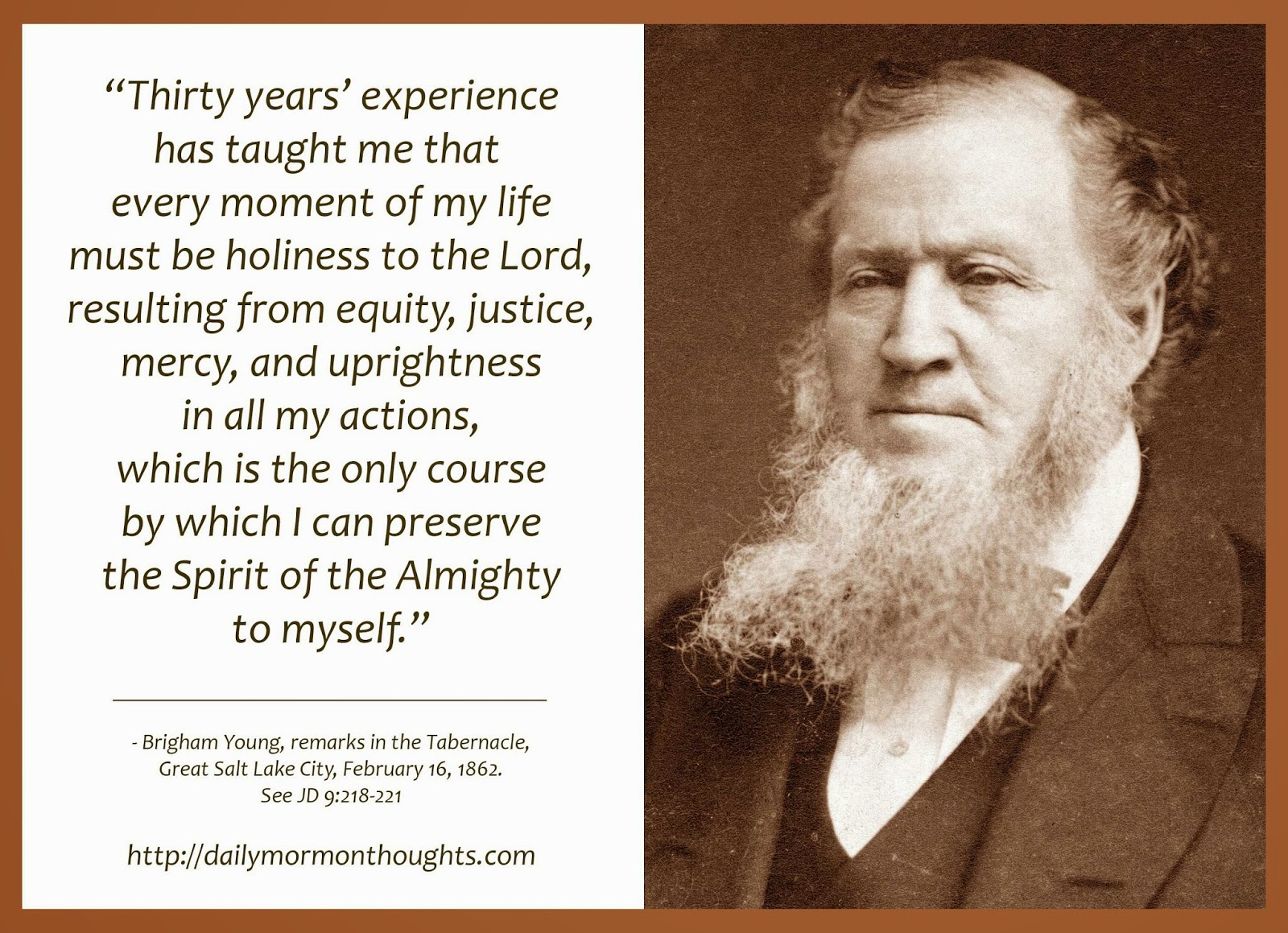
"As President Brigham Young taught, 'Every moment of [our lives] must be holiness to the Lord, ... which is the only course by which [we] can preserve the Spirit of the Almighty to [ourselves].' May the Lord bless each and all of us in our special responsibility to find holiness to the Lord by standing in holy places. That is where we will find the spiritual protection we need for ourselves and our families. That is the source of help to carry forth the word of the Lord in our time. Standing in holy places will help us rise above the evil influences of our time and draw us closer to our Savior."
- James E. Faust, "Standing in Holy Places," Ensign, May 2005, pp. 62-68
Click here to read the full talk
President Faust shares an interesting interpretation of one of the key challenges of our time. The word "bombarded" is particularly descriptive of the way we can be overwhelmed by information:


And that warning is followed by the key invitation of his message:


President Faust specifies the most important "holy places" we can find, establish, and visit:

  • sacred temples
  • our homes
  • chapels
But the next level of growth is not just to be in holy places, but to become holy ourselves by overcoming temptation and growing in righteousness.


I love the passage from Brigham Young that Pres. Faust excerpts:

Monday, May 18, 2015

Neal A. Maxwell on recognizing God's plan for our lives

Elder Neal A. Maxwell (1926-2004) served as a Seventy from 1976-1981, then as a member of the Quorum of Twelve until his death from cancer in 2004.
"I have been mercifully granted what might be called a 'delay en route.' Whether short or long, it is a wonderful blessing from the Lord! I have thereby learned, however, that there is another side to the 'Why me?' question, since some are not granted any 'delay en route' at all. Whichever side of that question, what is needed is mortal submission, even when there is no immediate divine explanation. Thus we are to press forward, whatever the length of the near horizon, while rejoicing in what awaits us on the far horizon....
"Mortality presents us with numerous opportunities to become more Christlike: first, by coping successfully with those of life's challenges which are 'common to man[kind]' (1 Cor. 10:13). In addition, there are also our customized trials such as experiencing illness, aloneness, persecution, betrayal, irony, poverty, false witness, unreciprocated love, et cetera. If endured well now, 'all these things' can be for our good and can 'greatly enlarge the soul,' including an enlarged capacity for joy (D&C 122:7; D&C 121:42). Meek suffering often does the excavating necessary for that enlarging! My admiration goes to my many spiritual superiors who so exemplify for us all. In the world to come, to these, the most faithful, our generous Father will give 'all that [He] hath' (D&C 84:38). Brothers and sisters, there isn't any more!"
- Neal A. Maxwell, "Apply the Atoning Blood of Christ," Ensign, November 1997, p. 22
Click here to read the full article

Elder Maxwell was diagnosed with leukemia in 1996. Against the odds, he was in remission by the time he spoke in the October 1997 general conference. As he discussed his "delay on route" he must have had particularly poignant feelings. I'm fascinated by his insight into the "why me?" question. We usually think of that when we're struggling or suffering; but we rarely do when we feel blessed or spared. I acknowledge a number of both types of "why me?" instances in my own life—but actually, quite a few more of the blessing kind!

And then this beautiful comment about faith and perspective:


The second part of this process is Elder Maxwell's description of "numerous opportunities to become more Christlike" that includes the variety of challenges we encounter. Things that "greatly enlarge the soul" also enlarge its capacity to experience joy. "Meek suffering often does the excavating necessary for that enlarging!" Elder Maxwell knew whereof he spoke, based on his recent experiences when he gave this address. But in conclusion, and perhaps in another of those "why me?" type of scenarios, there is this ultimate promise:


Sunday, May 17, 2015

Spencer W. Kimball on Sabbath Day worship

President Spencer W. Kimball (1895-1985) was ordained an apostle in 1943 and served as President of the Church from 1973 to 1985.
"The Sabbath is a holy day in which to do worthy and holy things. Abstinence from work and recreation is important, but insufficient. The Sabbath calls for constructive thoughts and acts, and if one merely lounges about doing nothing on the Sabbath, he is breaking it. To observe it, one will be on his knees in prayer, preparing lessons, studying the gospel, meditating, visiting the ill and distressed, writing letters to missionaries, taking a nap, reading wholesome material, and attending all the meetings of that day at which he is expected.
"One good but mistaken man I know claimed he could get more out of a good book on Sunday than he could get in attending church services, saying that the sermons were hardly up to his standards. But we do not go to Sabbath meetings to be entertained or even solely to be instructed. We go to worship the Lord. It is an individual responsibility, and regardless of what is said from the pulpit, if one wishes to worship the Lord in spirit and in truth, he may do so by attending his meetings, partaking of the sacrament, and contemplating the beauties of the gospel. If the service is a failure to you, you have failed. No one can worship for you; you must do your own waiting upon the Lord."
- Spencer W. Kimball, "The Sabbath—A Delight", Ensign, Jan 1978, pp. 2-7
Click here to read the full article

I think that a sign of a true disciple of Christ is that he or she appreciates the significance of the Sabbath Day and is naturally eager to "do worthy and holy things" including "constructive thoughts and acts."


Many are pleased to note that President Kimball's list of appropriate activities includes "taking a nap." We would do well to consider the other items he lists, and to add our own insights.

But the second paragraph is even more significant to me. It relates to our personal worship experience, and how we draw closer to God through Church meetings. President Kimball instructs that worship is a personal responsibility, but that it occurs best within the constraints the Lord has defined.


Saturday, May 16, 2015

Dieter F. Uchtdorf on being genuine and trusting God's power to bless our lives

President Dieter F. Uchtdorf (1940- ) served as a Seventy from 1994-2004, when he was called as a member of the Quorum of Twelve.  He has served as second counselor in the First Presidency since 2008.
"Whether your testimony is thriving and healthy or your activity in the Church more closely resembles a Potemkin village, the good news is that you can build on whatever strength you have. Here in the Church of Jesus Christ you can mature spiritually and draw closer to the Savior by applying gospel principles day by day.
"With patience and persistence, even the smallest act of discipleship or the tiniest ember of belief can become a blazing bonfire of a consecrated life. In fact, that's how most bonfires begin--as a simple spark.
"So if you feel small and weak, please simply come unto Christ, who makes weak things strong (see Ether 12:27). The weakest among us, through God's grace, can become spiritually strong, because God 'is no respecter of persons' (Acts 10:34)....
"My beloved brothers in Christ, the God of Creation, who breathed life into the universe, surely has the power to breathe life into you. Surely He can make of you the genuine, spiritual being of light and truth you desire to be."
- Dieter F. Uchtdorf, "On Being Genuine," General Conference April 2015; see Ensign, May 2015, pp. 80-83
Click here to read the full talk

President Uchtdorf began his discourse in the Priesthood session of the recent conference by telling the story of a historical incident from 18th-century Russia, during which a regional governor named Potemkin is said to have pulled off a deception by making villages appear prosperous during a tour by Catherine the Great.  The term "Potemkin village" has come to symbolize "any attempt to make others believe we are better than we really are."  President Uchtdorf warned about putting on façades or hiding our challenges and shortcomings, encouraging us to be "genuine" as we allow the Atonement and the Gospel to help us overcome the imperfections.


President Uchtdorf's message is one of hope and encouragement.  He wants us to believe that God has the power and desire to help us become what we sometimes pretend to be... or what we long to be.


Friday, May 15, 2015

Henry B. Eyring on the companionship and inspiration of the Holy Ghost

President Henry B. Eyring (1933- ) served in the Presiding Bishopric from 1985-1992, as a Seventy from 1992-1995, then was called to the Quorum of Twelve Apostles. He has served in the First Presidency since 2007.

This excerpt is from his address in the Priesthood session of the most recent general conference:
"As a priesthood holder, you are to be part of the warning voice of the Lord. But you need to heed the warning yourself. You will not survive spiritually without the protection of the companionship of the Holy Ghost in your daily life.
"You must pray for it and work to have it. Only with that guide will you be able to find your way along the strait and narrow path through the mists of evil. The Holy Ghost will be your guide as He reveals truth when you study the words of prophets.
"Getting that guidance will take more than casual listening and reading. You will need to pray and work in faith to put the words of truth down into your heart. You must pray that God will bless you with His Spirit, that He will lead you into all truth and show you the right way. That is how He will warn and guide you into the right path in your life."
- Henry B. Eyring, "Priesthood and Personal Prayer," General Conference, April 2015; see Ensign, May 2015, pp. 84-87
Click here to read the full talk
Many of the recent messages of Church leaders include encouragement to greater devotion and faithfulness. President Eyring spoke to Priesthood holders about that topic, linking their ability to serve effectively in the Priesthood with their personal prayers and other acts of devotion. The principles apply all members as we strive to draw on the powers of heaven for strength, guidance, and protection:


This final reminder that there is effort required to claim the blessing and reward should get our attention and lead us to evaluate our personal lives:


// Customization to close archive widget on first view - DK 3/15