Saturday, November 28, 2015

Heber J. Grant on being a faithful, unselfish servant

President Heber J. Grant (1856-1945) was ordained an apostle in 1862, and served as president of the Church from 1918 until his death in 1945 at age 88.  He served as president for over 26 years; only Brigham Young had a longer term (over 29 years).
"I heard a story of a brother (I have forgotten his name now) who attended a meeting in the early days. President Brigham Young made an appeal for donations to send to the Missouri River to help the Saints gather to Zion. He wanted everybody who could afford it, to give an ox or a cow or any other donation. One good brother jumped up and said, 'I will give a cow.' Another brother got up and said, 'I will give a cow.' The first brother had two cows and a large family; the other brother had a half-dozen cows and a small family.
"And, so the spirit [of the devil] came over the first man, [saying,] 'Now, look here, you cannot get along with your large family; you cannot possibly get along with one cow. Now, that other man has got a small family and six cows; he could just as well give two or three and still get along all right.' As he started home, he walked four or five blocks, all the time getting weaker and weaker. Finally he thought, 'I guess I won't,' and then he realized the difference in the spirit that was tempting him and the one that had prompted his promise to the President of the Church that he would give a cow. Here was a spirit telling him to fail to fulfill his obligation, to fail to be honest, to fail to live up to his promise.
"He stopped short and turned around and said, 'Mr. Devil, shut up or just as sure as I live, I will walk up to Brother Brigham's office and give him the other cow.' He was not tempted any more.
"Now, every Latter-day Saint ought to be a lifter and not a leaner."
- Heber J. Grant, "Settlement," Improvement Era, Jan. 1941, 56; see Teachings of the Presidents of the Church: Heber J. Grant, pp. 141-142

This is a wonderful little glimpse into Church history, and into the personality of President Grant. There have been times when members of the Church were asked to sacrifice for one another, to a degree we are not familiar with today. For someone to give up one of two cows for the good of the Church was a significant hardship. But that sacrifice was given, so many times.

President Grant also believed strongly in the conflict between faith and the Adversary. This story helps illustrate the battle between those opposing forces, and the role that agency plays in choosing the direction to follow.

I love the simple closing statement. We can either contribute our strength to the good of the kingdom, or be a drain on it!


Friday, November 27, 2015

Spencer W. Kimball on the happy, abundant life

President Spencer W. Kimball (1895-1985) was ordained an apostle in 1943 and served as President of the Church from 1973 to 1985.
"The happy and abundant life begins from within and then moves outward to other individuals and to our communities. If there is richness and righteousness in us, then we can make a difference in the lives of others and in our towns, just as key individuals have influenced the lives of each of us for good and made us richer than we otherwise would have been.
"What is our greatest potential? Is it not to be Christlike ourselves? And what are the qualities we must develop to achieve such greatness? We might consider intelligence, light, knowledge, and leadership. But perhaps the most essential godlike quality is that of compassion and love—compassion shown forth in service to others, unselfishness, that ultimate expression of concern for others we call love. Wherever our Father's children magnify their opportunities for loving service, they are learning to become more like Him."
- Spencer W. Kimball, "President Kimball Speaks Out on Service to Others," New Era, March 1981, pp. 58-59
Click here to read the full talk here

"If there is richness and righteousness in us, then we can make a difference in the lives of others and in our towns." As we examine our lives, do we see ourselves finding ways to "make a difference"? We should, according to President Kimball. One of the greatest messages of the Gospel is that the source of happiness and abundance in our lives is in the giving to others.

There is always wisdom and insight as we examine the life of the Savior and try to pattern our own actions and deeds after Him.


Thursday, November 26, 2015

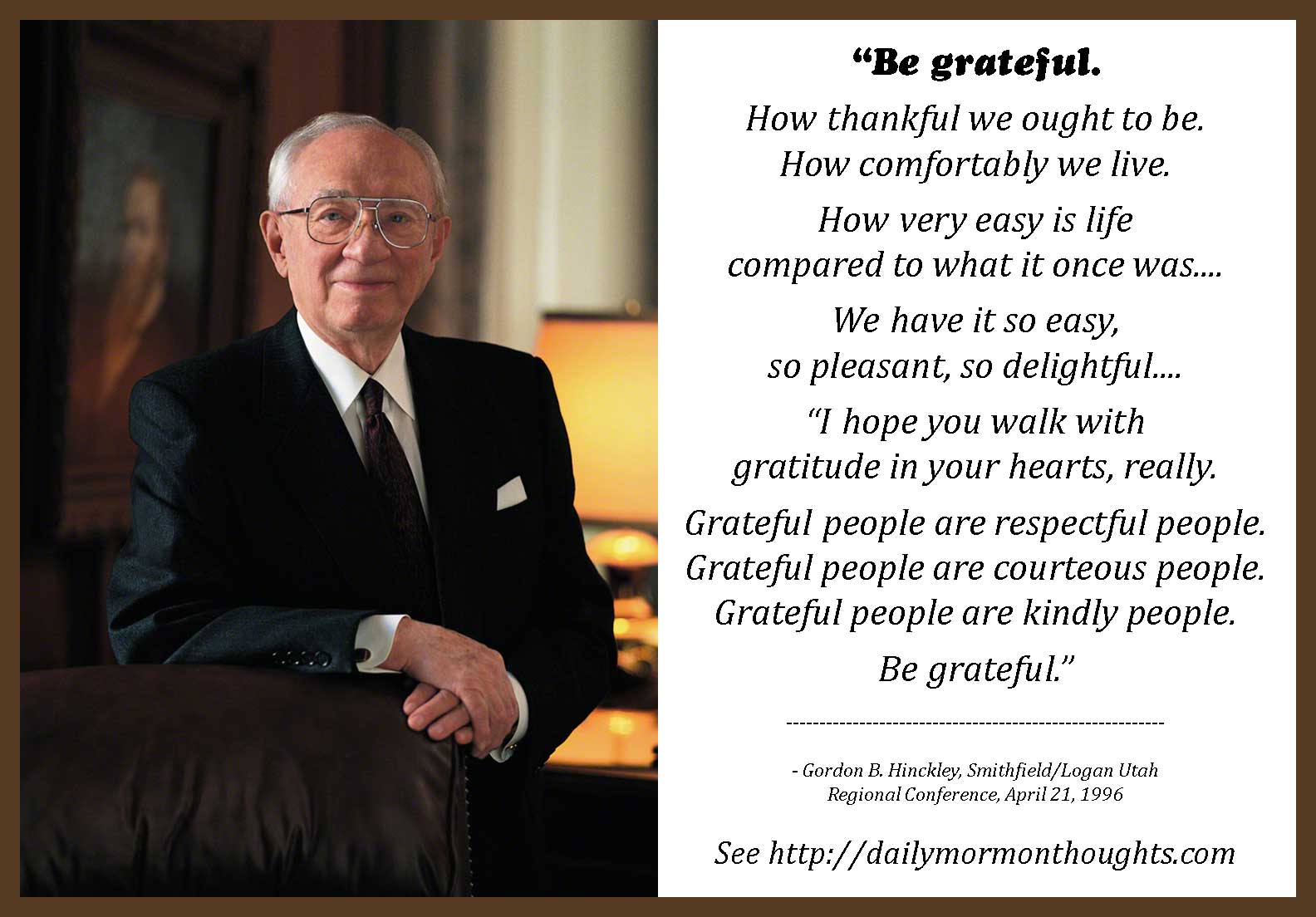
Gordon B. Hinckley on gratitude for life

President Gordon B. Hinckley (1910-2008) was called to the Quorum of Twelve in 1961, served as a counselor in the First Presidency from 1981-1995, then as Church President until his death in 2008 at age 97.
"Be grateful. How thankful we ought to be. How comfortably we live. How very easy is life compared to what it once was.... We have it so easy, so pleasant, so delightful. We ride in cars that are warm in the winter and cool in the summer.
"What a great season in the history of the world this is in which to be alive and in which to be young. Sometimes I wish that I were as young as you are—and then when I think of what I have been through I am glad I am not. But what a wonderful season to be alive....
"[We have] the miracles of medicine, the miracles of science, the miracles of communication, transportation, education—what a wonderful time in which to live. Of all of these wondrous, challenging things with which we live, I hope you regard it a blessing to be alive in this great age of the world.... I hope you walk with gratitude in your hearts, really. Grateful people are respectful people. Grateful people are courteous people. Grateful people are kindly people. Be grateful."
- Gordon B. Hinckley, Smithfield/Logan Utah Regional Conference, April 21, 1996; see TGBH p. 250

President Hinckley always seemed to maintain a wonderfully optimistic perspective on life. In this quote he reminds us how blessed we are in our modern lives. We have so much for which to be grateful, in our relatively pleasant and comfortable circumstances.


President Hinckley encourages us to remember the comfort and ease of our lives, along with the many miracles of our time—in medicine, science, communication, transportation, and education. Those miracles he described in 1996 are even further surpassed in the 20 years since then, in the explosion of the technology of our modern information age. Indeed, in so many ways, "what a wonderful time in which to live."

Wednesday, November 25, 2015

Marvin J. Ashton on giving thanks even in challenging times

Elder Marvin J. Ashton (1915-1994) served as a member of the Quorum of Twelve Apostles from 1971 until his death in 1994 at age 78.
"Today I hope my message will bring new consideration and meaning to those two important words thank you. Frankly, over the years I have been troubled by the admonition contained in D&C 98:1: 'Verily I say unto you my friends, fear not, let your hearts be comforted; yea, rejoice evermore, and in everything give thanks' (emphasis added).
"My inability to give thanks in all things, particularly those events or occasions that have caused disappointment, delay, and misunderstanding, has given me concern. My capacity to express thanks in everything has been quite inadequate. Without 'the passing of time factor' I would have failed miserably.
"Appreciation for all people and events that come into our lives is most important because it is God’s way of helping us to grow. The ultimate maturity is being able to feel and express appreciation promptly, being fully aware of the value and importance, and showing gratitude for it."
- Marvin J. Ashton, "And in Everything Give Thanks," BYU Devotional, September 1, 1991
Click here to read the full talk

I always appreciate the glimpses of the "human side" of someone I respect as much as I do Elder Ashton. In every exposure I had to him, he was a devoted, sensitive, thoughtful, and kind man. But in this excerpt he expresses a very normal characteristic—the struggle we often have to keep a broad perspective in the midst of trials or challenges. It's hard to follow the admonition, "in everything give thanks" when "events or occasions that have caused disappointment, delay, and misunderstanding."

It's not unusual for "the passing of time factor" to provide perspective that allows us to see and understand the subtle blessings of our challenges. But the "ultimate maturity" Elder Ashton describes is to have the faith and trust in the moments of difficulty that enable us to be truly grateful.


Tuesday, November 24, 2015

James E. Talmage on gratitude for God's blessings

Elder James E. Talmage (1862-1933) was born in England. He was a brilliant scholar, trained as a geologist and mathematician. But he's perhaps best known today among Church members for his classic writings, including "Jesus the Christ," "The Articles of Faith," and "The Holy Temple." He was called as an apostle in 1911 and served until his death in 1933 at age 70.
"Gratitude is an ennobling quality in man; and he in whose soul it has no place is defective....
"Gratitude is twin sister to humility; pride is a foe to both. The man who has come into close communion with God cannot fail to be thankful; for he feels, he knows, that for all he has and all he is, he is indebted to the Supreme Giver; and one would think that there is no need of commandment in the matter of thanksgiving. Yet we find that because of man's propensities toward forgetfulness and selfishness the Scriptures abound in admonitions to render thanks unto the Lord....
"God requires thanksgiving, praise and worship, not for His gratification as the recipient of adulation, but for the good of His children who thus recognize and acknowledge Him, and so develop that abiding faith, such as shall lead to repentance, without which none can attain salvation in His kingdom."
- James E. Talmage, "Sunday Night Talks by Radio," 1931, p. 483, 486

This is a beautiful, poetic description of the "ennobling quality" of gratitude:


The essence of gratitude, according to Elder Talmage, lies in our recognition of our relationship to God. For one who has reached a state of "close communion" with Divinity, gratitude comes naturally. We sense the source of our blessings because we are close to that source. Sadly, most of us need to be reminded to acknowledge and thank God; that implies we need to work harder on our personal relationship.

I appreciated Elder Talmage's suggestion too about why God asks for our gratitude. It's not for His sake, but for ours. Through our recognition of Him and expressions of thanks, we develop "abiding faith" in Him that can lead us to repentance and eventual salvation.

Monday, November 23, 2015

Hugh B. Brown on true gratitude

Elder Hugh B. Brown (October 24, 1883–December 2, 1975) was called as an Assistant to the Twelve in 1953, then as an apostle in 1958.  He served as a counselor to President David O. McKay from 1961 until President McKay's death in 1970, then for five more years as a member of the Quorum of Twelve until he passed away.
"How rich and radiant is the soul of a man who has a thankful heart. His gratitude increases with his unfolding awareness of himself, the universe and his Creator. Appreciation, like love, enriches both giver and receiver, and, when spontaneously expressed in word or deed, reveals a depth and delicacy of fine-grain character. True gratitude is motivated by a recognition of favors received. Its counterfeit is fawning anticipation of favors to come.
"Serious consideration of the mystery of life, its vastness and incalculability, gives depth to appreciation for blessings gratuitously bestowed. They who have eyes to see, ears to hear, understanding hearts, will see the bounteous love of God everywhere manifest and will be inclined to reverently remove their shoes and exclaim:
"For the rock and for the river,
The valley's fertile sod,
For the strength of the hills we bless thee,
Our God, our fathers' God.

['For the Strength of the Hills,' Hymns:35]"- Hugh B. Brown, "Gratitude Is a Spiritual Attribute," Instructor, Nov. 1957, p. 332

I love this description of what it means to have a thankful heart:


It's the "serious consideration of the mystery of life," according to Elder Brown, that leads to a greater appreciation of blessings. When we slow down to observe and ponder our lives, we begin to notice and acknowledge the "bounteous love of God everywhere manifest." What a good reminder for us all!

Sunday, November 22, 2015

Thomas S. Monson on feeling and expressing divine gratitude

President Thomas S. Monson (b. August 21, 1927) was sustained to the Quorum of Twelve Apostles in 1963. He served as a counselor in the First Presidency with Presidents Benson, Hunter, and Hinckley until becoming Church president in 2008.
"Do material possessions make us happy and grateful? Perhaps momentarily. However, those things which provide deep and lasting happiness and gratitude are the things which money cannot buy: our families, the gospel, good friends, our health, our abilities, the love we receive from those around us. Unfortunately, these are some of the things we allow ourselves to take for granted.
"The English author Aldous Huxley wrote, 'Most human beings have an almost infinite capacity for taking things for granted.'
"We often take for granted the very people who most deserve our gratitude. Let us not wait until it is too late for us to express that gratitude....
"A grateful heart, then, comes through expressing gratitude to our Heavenly Father for His blessings and to those around us for all that they bring into our lives. This requires conscious effort—at least until we have truly learned and cultivated an attitude of gratitude. Often we feel grateful and intend to express our thanks but forget to do so or just don't get around to it. Someone has said that 'feeling gratitude and not expressing it is like wrapping a present and not giving it.' [William Arthur Ward]...
"It is my prayer that in addition to all else for which we are grateful, we may ever reflect our gratitude for our Lord and Savior, Jesus Christ. His glorious gospel provides answers to life's greatest questions....
"Let us follow Him. Let us emulate His example. Let us obey His words. By so doing, we give to Him the divine gift of gratitude.
"My sincere, heartfelt prayer is that we may in our individual lives reflect that marvelous virtue of gratitude. May it permeate our very souls, now and evermore."
- Thomas S. Monson, "The Divine Gift of Gratitude," Ensign, Nov 2010, pp. 87-90
Click here to read the full talk

It's relatively easy to remember to thank God for "material possessions" — the conveniences of life or the objects that bring temporary pleasure. But President Monson identifies more profound and significant gifts that should make us deeply grateful, and which we should never take for granted; and for which we should never forget to express thanks.


I also appreciated the insight that a "grateful heart" grows within us as we make greater efforts to express gratitude. Blessings come to those who "have truly learned and cultivated an attitude of gratitude." And of course, the greatest gratitude of all is for the Savior, whose gospel and atoning gift blesses every life eternally.
// Customization to close archive widget on first view - DK 3/15