Sunday, February 7, 2016

LeGrand Richards on finding hope in a troubled world

Elder LeGrand Richards (1886-1983) served as the Presiding Bishop of the Church from 1938-1952, when he was called to the Quorum of Twelve Apostles.  He died in 1983 at age 96.  Many today remember him fondly for his spirited, usually extemporaneous talks in conference about missionary work or the plan of salvation.
"A few weeks ago, a young lady phoned me for an appointment; and when she came to the office, she sat there and cried for a little while and then she said: 'Bishop, what is there for the young people today? We have war. They are taking all the boys; it looks like another great war is ahead of us. What do we young people have to live for?'
"I looked at her for a few minutes and said, 'Have you ever thought of the other side of the story?'
"She said, 'What side?'
"'Well,' I said, 'you remember the story of the two buckets that went down in the well; as the one came up, it said, "This is surely a cold and dreary world. No matter how many times I come up full, I always have to go down empty?" Then the other bucket laughed and said, "With me it is different. No matter how many times I go down empty, I always come up full."'
"I said, 'Have you ever stopped to realize that of all the millions of our Father's children, you are one of the most favored? You are privileged to live in the Dispensation of the Fullness of Times that the prophets of old have looked forward to, when there is more revealed truth upon the earth than there has ever been in any other dispensation of the world's history, and where we enjoy blessings and comforts of life that kings did not enjoy a few years ago. Have you ever stopped to think of that side of the story?'
"And before she left, she decided that probably it wasn't as cold and dreary a world, after all, as it might be.
"I said, 'You just go on, and live right, and don't you lose your courage, and don't think that life isn't worth while and isn't worth living. Whether you live or whether you die or whether you are permitted to live a long life or a short life isn't going to be the thing that is going to determine the success or failure of your life; it's how you live. And if we only live right, it will not matter whether the time is short or long; we won't have to worry much about it.'"
- LeGrand Richards, "Signs of the Times," Conference Report, April 1951, pp. 39-45
Click here to read the full talk

It's easy to despair when we focus on the world with all its troubles and challenges. Sometimes we fall into that trap of wondering, "What do we young people [or older people too] have to live for?" Elder Richards instead counsels that we focus on all the blessings and opportunities instead of the challenges or concerns. That only happens when we have a true understanding of the eternal plan and our individual place in it.


The great and eternal key is to "live right" — then the rest really will not matter.

Saturday, February 6, 2016

Ronald A. Rasband on ministering one-by-one like the Savior

Elder Ronald A. Rasband (b. 1951) served as a Seventy beginning in 2000.  He was the senior president of the Seventy when he was called to the Quorum of Twelve Apostles in October 2015. This talk was given shortly after his call as a Seventy.
"Throughout my life, I have come to know through my own experiences that Heavenly Father hears and answers our personal prayers. I know that Jesus is the living Christ and that He knows each of us individually, or as the scriptures express it, 'one by one.'
"This sacred assurance is taught compassionately by the Savior Himself in His appearance to the people of Nephi. We read of this in 3 Nephi, chapter 11, verse 15:
"'And it came to pass that the multitude went forth, and thrust their hands into his side, and did feel the prints of the nails in his hands and in his feet; and this they did do, going forth one by one until they had all gone forth' (3 Ne. 11:15; emphasis added)....
"Certainly, there is a very profound and tender personal message here. Jesus Christ ministers to, and loves us all, one by one.
"As we reflect on our Savior’s way of loving, we sustain you dedicated stake and ward leaders, men and women of great faith. We gratefully recognize the many efforts of those of you working with the youth. And we express great appreciation to our caring Primary leaders and teachers for your Christlike service. We consider each of your one-by-one ministries and say thank you and please, please continue. Perhaps never in the history of mankind do we need to be serving on a one-by-one basis more than we do now....
"I have a testimony in my heart, brothers and sisters, that God, our Heavenly Father, and Jesus Christ know and love us individually. I’m not sure I fully understand how, I just know and have experienced that They do. I urge all of us in our own ministries, to our families and to our fellowman, to embrace the Savior’s warm invitation to come unto Him, one by one, and be perfected in Him."
- Ronald A. Rasband, "One by One," Ensign, November 2000, pp. 29-30
Click here to read the full talk

The very best teachers and leaders grasp the truth of this message almost intuitively: the service that has the most impact in a Church setting, or anywhere else for that matter, happens not as lessons are presented or activities occur, but as one-on-one interaction happens. In those times it's so much easier for heart to speak to heart, for spirits to reach and touch each other, for true love to be felt. As Elder Rasband points out, the Savior exemplifies that principle throughout His ministry.

Often it's in the activity setting — a girls camp or scout excursion — that those opportunities to interact occur. Sometimes it happens when a teacher or leader notices a concern and reaches out in other settings. I knew a young men leader recently who would often take his teachers out for a burger, one at a time (with parents' permission), just to have a chance to talk with them; later testimonies as they matured showed that he did immeasurable good with his loving kindness.


Friday, February 5, 2016

Lorenzo Snow on overcoming personal gloom by Christian love and service

Lorenzo Snow (1814-1901) was an early convert to the Church along with his sister Eliza R. Snow. He was called as an apostle by Brigham Young in 1849. He served as the 5th president of the Church from 1898 until his death in 1901.
"We should have before us a strong desire to do good to others. Never mind so much about ourselves. Good will come to us all right if we keep our minds outside of ourselves to a certain extent, and try to make others happier and draw them a little nearer to the Lord....
"When you find yourselves a little gloomy, look around you and find somebody that is in a worse plight than yourself; go to him and find out what the trouble is, then try to remove it with the wisdom which the Lord bestows upon you; and the first thing you know, your gloom is gone, you feel light, the Spirit of the Lord is upon you, and everything seems illuminated."
- Lorenzo Snow, Conference Report, Apr. 1899, pp. 2-3

This is an expression of true Christianity: if we worry less about our own happiness and more about the happiness of those around us, blessings will follow and all will be right. Our desire should be to "do good to others" and to "try to make others happier," and even more importantly, to "draw them a little nearer to the Lord."


I appreciated the clarity of this teaching: it's the Spirit of the Lord that accompanies acts of kindness and love, and helps drive away the gloom and despair that can consume us. As we show charity and concern to others in the way the Savior would, we find His spirit is with us.

Thursday, February 4, 2016

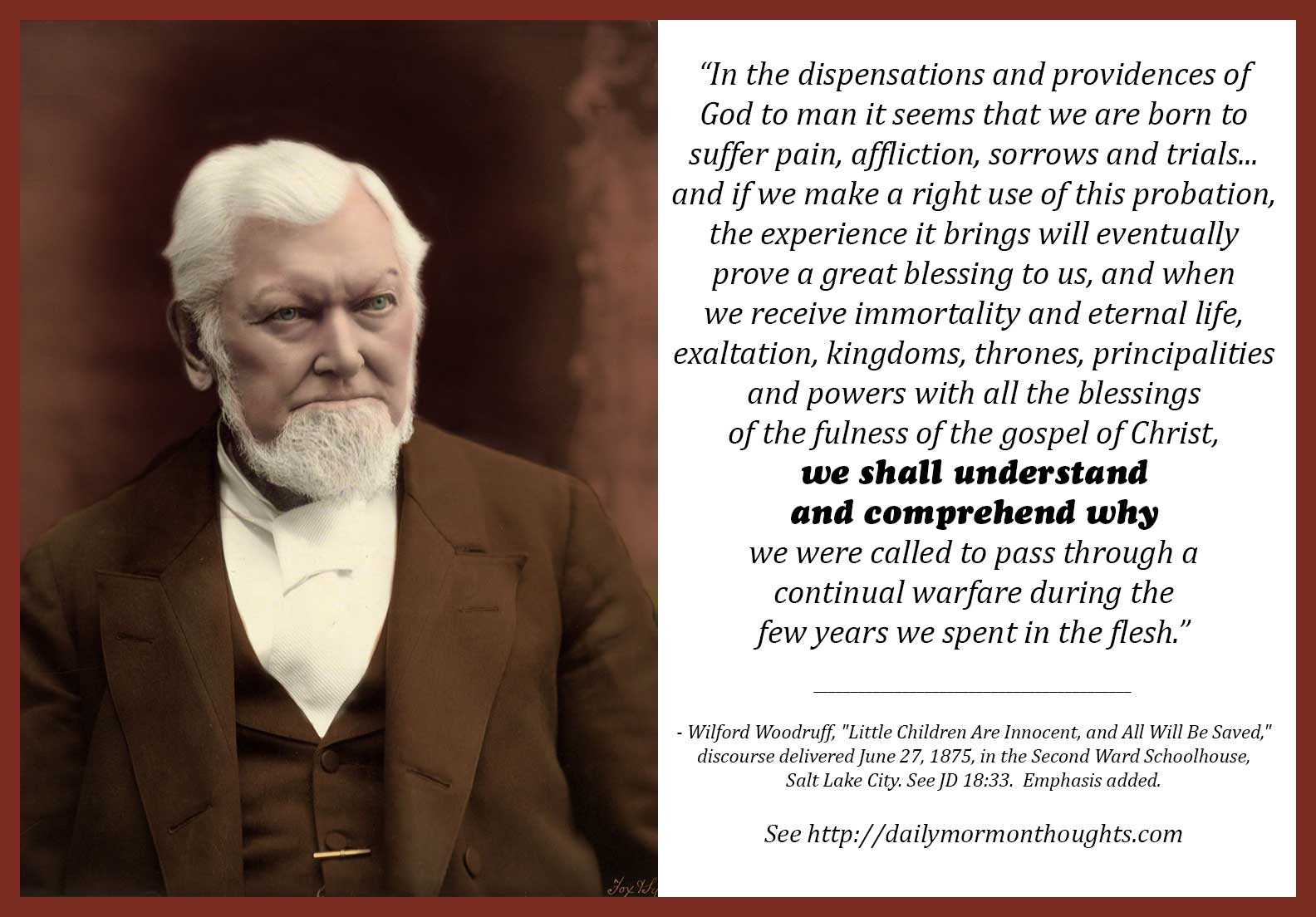
Wilford Woodruff on the Savior's help in enduring trials

Wilford Woodruff (1807-1898) was called as an apostle in 1839 by Joseph Smith, and sustained as the 4th president of the Church in 1889.  He served until his death in 1898 at age 91.
[Words given at the funeral services of John Houseman, aged six years, and Willie Franklin, aged four years, sons of William and Ann Wheeler, burned to death at Wanship, Summit County, U. T., June 24, 1875]
"Jesus... descended below all things that he might rise above all things and comprehend all things. No man descended lower than the Savior of the world. Born in a stable, cradled in a manger, he travelled from there to the cross through suffering mingled with blood to a throne of grace; and in all his life there was nothing of an earthly nature that seemed to be worth possessing. His whole life was passed in poverty, suffering, pain, affliction, labor, prayer, mourning and sorrow until he gave up the ghost on the cross. Still he was God's firstborn son and the Redeemer of the world....
"In the dispensations and providences of God to man it seems that we are born to suffer pain, affliction, sorrows and trials; this is what God has decreed that the human family shall pass through; and if we make a right use of this probation, the experience it brings will eventually prove a great blessing to us, and when we receive immortality and eternal life, exaltation, kingdoms, thrones, principalities and powers with all the blessings of the fulness of the gospel of Christ, we shall understand and comprehend why we were called to pass through a continual warfare during the few years we spent in the flesh."
- Wilford Woodruff, "Little Children Are Innocent, and All Will Be Saved," discourse delivered June 27, 1875, in the Second Ward Schoolhouse, Salt Lake City. See JD 18:33.
Click here to read the full article

What a tender setting that must have been when President Woodruff gave these remarks. Imagine the feelings of family and neighbors at the tragic death of two young boys. President Woodruff's remarks shared the depth of understanding and caring that the Savior had, truly and completely comprehending their "suffering, pain, affliction... mourning and sorrow." He reassures us that it will all make sense eventually; but the challenge for us, in this mortal proving-ground, is to retain the faithful perspective that would enable us to "understand and comprehend why we were called to pass through a continual warfare" during our brief time on the earth.


Wednesday, February 3, 2016

John Taylor on the blessings of the Holy Ghost in our lives

President John Taylor (1808–1887) was born in England and immigrated to Canada where he and his wife were converted after hearing Parley P. Pratt preach.  He was ordained an apostle in 1838, and became the third president of the Church in 1880, serving until his death in 1887 at age 78.
"Joseph Smith, upwards of forty years ago, said to me: 'Brother Taylor, you have received the Holy Ghost. Now follow the influence of that Spirit, and it will lead you into all truth, until by and by, it will become in you a principle of revelation.' Then he told me never to arise in the morning without bowing before the Lord, and dedicating myself to him during that day.
"Some people treat these things lightly. I do not, because I know that we derive our food, our raiment, and all earthly as well as spiritual blessings from the goodness of God our Heavenly Father.... I have no ideas only as God gives them to me; neither should you. Some people are very persistent in having their own way in carrying out their own peculiar theories. I have no thoughts of that kind, but I have a desire, when anything comes along, to learn the will of God, and then to do it, and to teach my brethren to do it, that we may all grow up unto Christ our living head, that we may be acquainted with correct principles and govern ourselves accordingly."
- John Taylor, October 19, 1881; see JD 22:314, or The Gospel Kingdom, 43-44
Click here to read the full talk

This counsel from Joseph Smith, as reported by President Taylor, is helpful to ponder. He describes a process of spiritual growth. The first step is to receive the gift of the Holy Ghost. But that is only the beginning. We must then follow its ongoing influence as it guides us to truth, and eventually becomes "a principle of revelation" in our lives. And perhaps one of the keys to that step-by-step ascent is the counsel he mentions next: start each day with a humble prayer of self-dedication to the Lord.


The second part of the quote helps point out the many blessings that come as we turn to God for help and blessings.  "Learn the will of God, and then... do it." What a clear and simple declaration of faith and commitment!

Tuesday, February 2, 2016

Neal A. Maxwell on the process of petitioning in prayer

Elder Neal A. Maxwell (1926-2004) served as a Seventy from 1976-1981, then as a member of the Quorum of Twelve until his death from cancer in 2004.
"Petitioning in prayer has taught me that the vault of heaven, with all its blessings, is to be opened only by a combination lock: one tumbler falls when there is faith, a second when there is personal righteousness, and the third, and final tumbler falls only when what is sought is (in God's judgment, not ours) 'right' for us.
"Sometimes we pound on the vault door for something we want very much, in faith, in reasonable righteousness, and wonder why the door does not open. We would be very spoiled children if that vault door opened any more easily than it does now.
"I can tell, looking back, that God truly loves me by the petitions that, in his perfect wisdom and love, he has refused to grant me. Our rejected petitions tell us not only much about ourselves, but also much about our flawless Father."
- Neal A. Maxwell, "Insights from My Life," BYU devotional address October 26, 1976; see also New Era, April 1978
Click here to read the full address

This is a wonderful insight. There are requirements for successful petitions we offer up to our Father in Heaven.  We often remember the first two but forget the third:


It's interesting to note that prayer requires effort on our part, "a form of work" as the Bible Dictionary tell us. If prayers were answered too easily, "we would be very spoiled children." The delays that result often work to develop the first two qualities Elder Maxwell lists: faith and personal righteousness.

The other remarkable insight is that as we consider petitions that are have not been granted in our lives, we learn about God's love for us. He often teaches us much about ourselves and about Himself as He considers our requests. It's that third tumbler of the vault lock that often comes into play; and in reviewing past petitions, a later perspective gives clarity and understanding that often is lacking in the midst of a trial or perceived need. A true disciple will learn to be grateful for denied petitions, knowing they represent a sign of divine love and tutoring.

Monday, February 1, 2016

Joseph Smith on personal spiritual growth

Joseph Smith had been given the apostolic authority when the Church of Jesus Christ was organized on April 6, 1830 and he was designated the first president of the church at age 24. He was martyred in 1844 at age 38.
"A fanciful and flowery and heated imagination beward of; becaust the things of God are of deep import; and time, and experience, and careful and ponderous and solemn thoughts can only find them out. Thy mind, O man! if thou wilt lead a soul unto salvation, must stretch as high as the utmost heavens, and search into and contemplate the darkest abyss, and the broad expanse of eternity—thou must commune with God. How much more dignified and noble are the thoughts of God, than the vain imaginations of the human heart! ...
"Let honesty, and sobriety, and candor, and solemnity, and virtue, and pureness, and meekness, and simplicity crown our heads in every place; and in fine, become as little children, without malice, guile or hypocrisy.
"And now, brethren, after your tribulations, if you do these things, and exercise fervent prayer and faith in the sight of God always, He shall give unto you knowledge by His Holy Spirit, yea by the unspeakable gift of the Holy Ghost." [See D&C 121:26]
- Joseph Smith, from a letter to Edward Partridge and the Church, Mar. 20, 1839, Liberty Jail, Liberty, Missouri; see History of the Church, 3:295–96; or Teachings of the Prophet Joseph Smith, p. 137

Joseph Smith had an understanding of the nature of man, and his eternal possibilities, that few can equal. He had been schooled by divine tutors and knew what it meant to "stretch as high as the utmost heaven." But the reminder is that it requires "time, and experience, and careful and ponderous and solemn thoughts" to more fully comprehend the things of God. It is well to consider if we are giving the effort that would bring the desired result.


The list of virtues in the second paragraph that qualify us to receive knowledge from the Holy Spirit is impressive and worth pondering: honesty, sobriety, candor, solemnity, virtue, pureness, meekness, and simplicity — and absence of malice, guile, and hypocrisy — along with fervent prayer and faith! It's a clear but challenging formula.
// Customization to close archive widget on first view - DK 3/15