Saturday, May 7, 2016

James E. Faust on gratitude for sacred motherhood

President James E. Faust (1920 - 2007) was called as a Seventy in 1976, then as a member of the Quorum of Twelve in 1978. He served as a counselor to President Hinckley from 1995 until his death in 2007 at age 87.
"The First Presidency of this church has said, 'Motherhood is near to divinity. It is the highest, holiest service to be assumed by mankind' (Messages of the First Presidency, 6:178). The priesthood cannot work out its destiny, nor can God's purposes be fulfilled, without our helpmates. Mothers perform a labor the priesthood cannot do. For this supernal gift of life the priesthood should have love unbounded for the mothers of their children. Men should give them honor, gratitude, reverence, respect, and praise. A man who fails to gratefully acknowledge his debt to his own mother who gave him life is insensitive to the Holy Spirit....
"I wish to repeat that I do not believe that God's purposes on earth will ever be achieved without the influence, strength, love, support, and special gifts of the elect women of God. They are entitled to our deepest veneration, our fullest appreciation, and our most profound respect. I believe angels attend them in their motherly ministry."
- James E. Faust, "The Highest Place of Honor," Ensign May 1988, p. 36
Click here to read the full talk

I've always loved the description of motherhood given by Heber J. Grant and his counselors in this message.


These words are part of a larger section of a great message, that includes these words:
"Motherhood is near to divinity. It is the highest, holiest service to be assumed by mankind. It places her who honors its holy calling and service next to the angels. To you mothers in Israel we say God bless and protect you, and give you the strength and courage, the faith and knowledge, the holy love and consecration to duty, that shall enable you to fill to the fullest measure the sacred calling which is yours. To you mothers and mothers-to-be we say: Be chaste, keep pure, live righteously, that your posterity to the last generation may call you blessed."
- Clark, Messages of the First Presidency, 6:178
President Faust goes on to share some of his own perspective on the sacred nature of the calling of mothers. He challenges men to fully understand and acknowledge the blessing that women are, and to demonstrate that appreciation.


Friday, May 6, 2016

Marvin J. Ashton on the efforts of mothers and fathers

Elder Marvin J. Ashton (1915-1994) served as a member of the Quorum of Twelve Apostles from 1971 until his death in 1994 at age 78.
"The Lord has promised that he will help us in our pursuit of happiness if we will trust in him and follow his path. The abundant life will be ours if we rely on his strength.... Ammon, in his comments to his brother Aaron in the twenty-sixth chapter of Alma, verse 12, points to a way of life that brings security: 'Yea, I know that I am nothing; as to my strength I am weak; therefore I will not boast of myself, but I will boast of my God, for in his strength I can do all things; ...for which we will praise his name forever.' All we need to do to enjoy eternal, happy lives is to live the gospel of Jesus Christ.
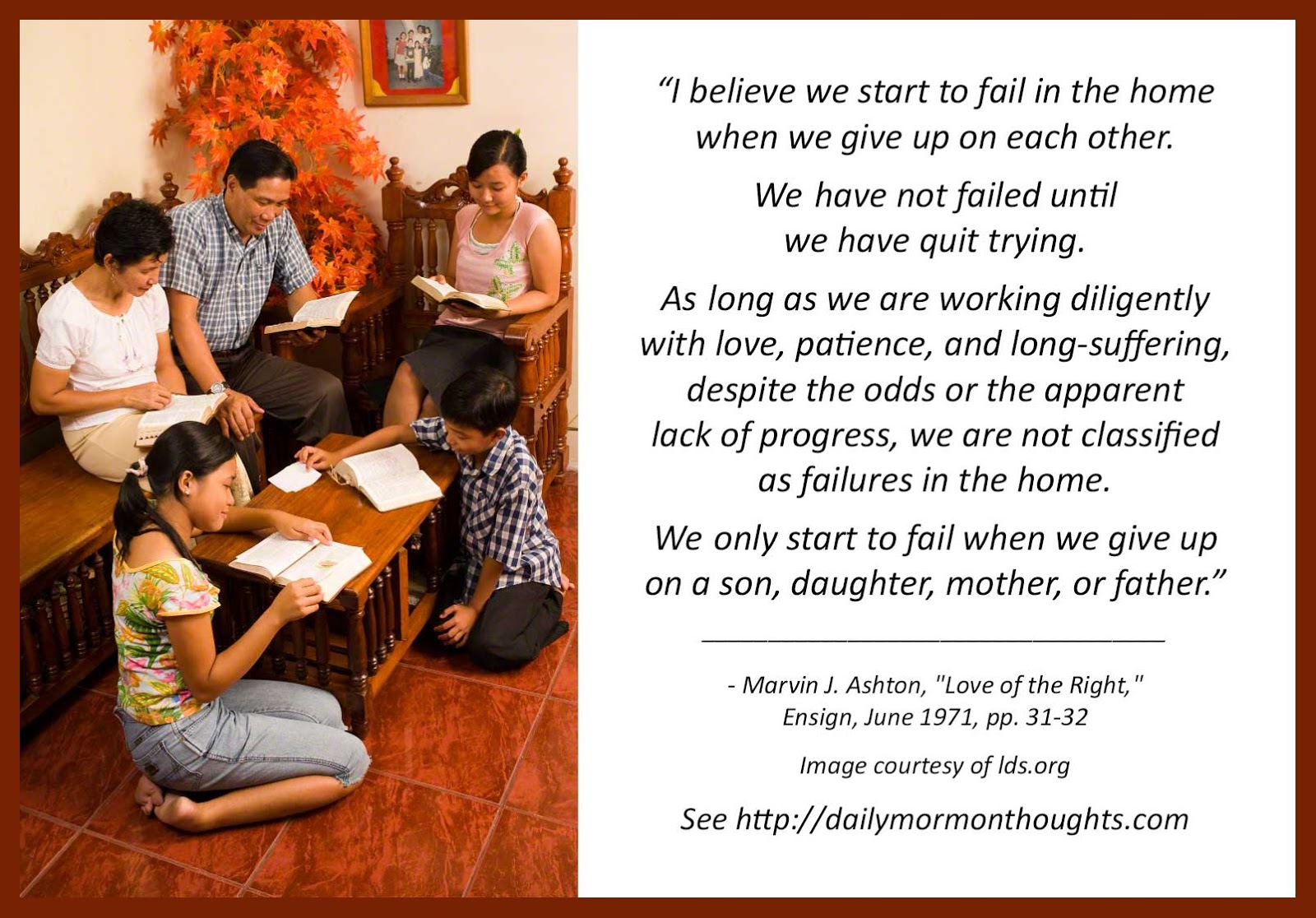
"Following one of our recent general conference sessions, a troubled mother approached me and said, 'I need to know what is meant by the statement, "No success can compensate for failure in the home."' Knowing a little of the burdens this friend of mine carries in her mind and heart because of a rebellious, wayward daughter, I shared this meaning with her: I believe we start to fail in the home when we give up on each other. We have not failed until we have quit trying. As long as we are working diligently with love, patience, and long-suffering, despite the odds or the apparent lack of progress, we are not classified as failures in the home. We only start to fail when we give up on a son, daughter, mother, or father."
- Marvin J. Ashton, "Love of the Right," Ensign, June 1971, pp. 31-32
Click here to read the full article

President David O. McKay was the first to use the famous statement, "No other success can compensate for failure in the home."
“The home is the first and most effective place for children to learn the lessons of life: truth, honor, virtue, self-control; the value of education, honest work, and the purpose and privilege of life. Nothing can take the place of home in rearing and teaching children, and no other success can compensate for failure in the home.”
- Family Home Evening Manual[1968], iii
The intent of the line, of course, was to teach and emphasize priorities in life; achievements in the community or workplace are far less significant than "rearing and teaching children" in the home. Elder Ashton's tender description of a mother who struggled with an apparent "failure" in her childrearing points out how careful we all need to be with generalizations, and he helps provide a better perspective on what the intent of the remark was and is:


There is profound truth in the opening words of this excerpt, that applies to individuals and families:
"The Lord has promised that he will help us in our pursuit of happiness if we will trust in him and follow his path. The abundant life will be ours if we rely on his strength."

Thursday, May 5, 2016

D. Todd Christofferson on the unequaled influence of mothers

Elder D. Todd Christofferson (b. January 24, 1945) was called to the Seventy in 1993, and as a member of the Quorum of Twelve Apostles in 2008.
"Women bring with them into the world a certain virtue, a divine gift that makes them adept at instilling such qualities as faith, courage, empathy, and refinement in relationships and in cultures....
"A woman's moral influence is nowhere more powerfully felt or more beneficially employed than in the home. There is no better setting for rearing the rising generation than the traditional family, where a father and a mother work in harmony to provide for, teach, and nurture their children. Where this ideal does not exist, people strive to duplicate its benefits as best they can in their particular circumstances.
"In all events, a mother can exert an influence unequaled by any other person in any other relationship. By the power of her example and teaching, her sons learn to respect womanhood and to incorporate discipline and high moral standards in their own lives. Her daughters learn to cultivate their own virtue and to stand up for what is right, again and again, however unpopular. A mother's love and high expectations lead her children to act responsibly without excuses, to be serious about education and personal development, and to make ongoing contributions to the well-being of all around them....
"My plea to women and girls today is to protect and cultivate the moral force that is within you. Preserve that innate virtue and the unique gifts you bring with you into the world. Your intuition is to do good and to be good, and as you follow the Holy Spirit, your moral authority and influence will grow."
- D. Todd Christofferson, "The Moral Force of Women," Ensign, Nov 2013, pp. 29-32
Click here to read the full talk

It's good to ponder and appreciate the unique qualities and characteristics that women have. Elder Christofferson describes "a divine gift" given to women, enabling them to be "adept at instilling" special qualities in others. I've witnessed that ability on many occasions! What a treasure that divine gift is, and how it should be appreciated, used, and magnified.

And particularly in the home setting, Elder Christofferson explains, where a mother's ability to instill those qualities can have such a lasting impact. It's a profound claim that "a mother can exert an influence unequaled by any other person in any other relationship" as she teaches her sons and daughters by word and example.

But gifts that are given must be received, developed, and implemented. Hence the plea of the closing paragraph to women and girls everywhere, to preserve and treasure that divine gift, allow it to grow in influence and goodness!


Wednesday, May 4, 2016

Richard L. Evans on heroic lives of service and love

Elder Richard L. Evans (1906-1971) served as a Seventy from 1938-1953, when he was called to the Quorum of Twelve Apostles.  He died in 1971 at age 65.  He was known as "the voice of the Tabernacle Choir" from the beginning of its broadcasts in 1929 until his passing.
"There are many in this world who live heroically in simple, daily, faithful service—people often unknown; often unnoticed; often discouraged; sometimes tried and tempted; sometimes feeling they must give up, that they can't go on—and yet they do go on, and, against discouragement, do their duty, daily: mothers abandoned, widowed, left with children; fathers left alone—grandmothers—children who care for each other. There are those who have little to live on, little relatively to brighten their lives, and yet do what they can with a loyal sense of duty. There are those who love and cherish and care for impaired children; those who faithfully care for dependent parents; those who care for loved ones who are long ill and dependent upon them; those who provide tender care, who perform essential tasks, with problems and disappointments, under difficult and discouraging conditions—weary hours, inconvenience, extra effort, going without, enduring difficulties.
"And life goes on as well as it does because there are those who do what needs to be done, when it needs to be done, often against difficulty and discouragement. Oh, you who have illness; people dependent upon you—you who stay with loved ones in loyalty—you who are discouraged in your work—you who are disappointed in others, in yourselves, in circumstances—you who feel you have little of the brightness of life—trust; have faith; do the best you can. Don't give up. Don't walk out on life. Don't leave loved ones. There may be a feeling of frustration in doing what you are doing, but there can be a greater frustration in not doing what is yours to do.
"To you who give humble daily, faithful service—often unnoticed, often discouraged, sometimes feeling you can't go on: You can. Others have—and do. Meet the events of each day, and satisfactions will come in ways you do not know. God bless you—and thanks to all of you who give such service."
- Richard L. Evans, "The Spoken Word," October 25, 1970; see Ensign January 1971
Click here to read the full article

I suspect that all of us know individuals "who live heroically in simple, daily, faithful service," often unappreciated, usually unrecognized, and always struggling with increased challenges of life, including "weary hours, inconvenience, extra effort, going without, enduring difficulties." I appreciated Elder Evans' tribute to them. Most mothers fall into this category, to some degree (some, including single mothers or those who care for disabled children, far more than others).

While paying tribute to these faithful servants and care-givers, Elder Evans encourages patient and faithful endurance. And he promises blessings of satisfactions that will come in unexpected ways:


I am grateful for those who have shown this kind of Christlike love to me, and have shown the example of serving others as I've watched.

Tuesday, May 3, 2016

Ezra Taft Benson on finding happiness in the Savior

President Ezra Taft Benson (1899-1994) was called to the Quorum of Twelve Apostles in 1943, and served as the 13th President of the Church from 1985 until his death in 1994 at age 94.
"The Lord wants us to be happy. He will do His part if we will do our part. The Christlike life is the life that brings true happiness. There is no true happiness without God. Sin brings sorrow, disappointment, and heartaches. Only the good life brings a happy new year. It pays to live the gospel of Jesus Christ. It pays to accept the teachings of the Master, to apply them in our lives, to be true to the standards of the Church, to be true to our covenants—to live the gospel. And if we do this we will be bigger and can be bigger than anything that can possibly happen to us. I am sure that is the desire of all of us because those who have this faith, and have a testimony of the divinity of this work, can endure anything and keep their spirits sweet."
- Ezra Taft Benson, "New Year 1961," Washington D.C. Ward, 31 December 1960; see Teachings of Ezra Taft Benson, p. 339

That eternal "search for happiness"! President Benson's testimony is simple: Happiness comes from righteousness. It comes from "the Christlike life." It follows obedience and striving to live Gospel principles. It will be the result of keeping covenants.


The person who is truly striving to live that kind of Christlike life "can endure anything and keep their spirits sweet"—what a beautiful phrase! It's not just a positive outward attitude; it's an inner conviction to the goodness and knowledge that "all is well" and God is in charge. While some allow their spirits to turn bitter, angry, or resentful in the midst of the challenges of life, the true disciple's spirit stays sweet.

Monday, May 2, 2016

Harold B. Lee on a symphony of reverence

President Harold B. Lee (1899-1973) was called to the Quorum of Twelve Apostles in 1941. He served as a counselor in the First Presidency from 1970-1972, then as Church president from July 1972 until his passing less than 18 months later in December 1973.
"Reverence is profound respect, mingled with love and awe, as for a holy being, or place, or an exalted thing...
"A symphony is a harmony of sounds. Before there can be a completeness of the realization of the objective of reverence, there has to be a weaving together. It has to be found in the individual, in the home, in the Church, and toward the priesthood and God. Then, as I thought of that, I thought of that old Chinese proverb, 'If there is righteousness in the heart, there will be beauty in the character. If there is beauty in the character, there will be harmony in the home. If there is harmony in the home, there will be order in the nation. If there is order in the nation, there will be peace in the world.'"
- Harold B. Lee, "Symphony of Reverence," 50th Annual Primary Conference, 5 April 1956; see THBL p. 201

The concept of "reverence" in the Gospel sense is such a beautiful one—so much deeper and more profound than we often consider it. As the children's song teaches, "Reverence is more than just quietly sitting...."  I love President Lee's description of "profound respect" combined with deep "love and awe" for something that is holy or sacred.

But especially interesting in this excerpt is the "weaving together" of the different aspects of reverence, helping us see how they are inter-related and can lead from one to the other.


Sunday, May 1, 2016

Gordon B. Hinckley on developing living, vital faith in Christ

President Gordon B. Hinckley (1910-2008) was called to the Quorum of Twelve in 1961, served as a counselor in the First Presidency from 1981-1995, then as Church President until his death in 2008 at age 97.
"When I discuss faith, I do not mean it in an abstract sense. I mean it as a living, vital force with recognition of God as our Father and Jesus Christ as our Savior. When we accept this basic premise, there will come an acceptance of their teachings and an obedience which will bring peace and joy in this life and exaltation in the life to come.
"Faith is not a theological platitude. It is a fact of life. Faith can become the very wellspring of purposeful living. There is no more compelling motivation to worthwhile endeavor than the knowledge that we are children of God, the Creator of the universe, our all-wise Heavenly Father! God expects us to do something with our lives, and he will give us help when help is sought....
"We were aboard a plane some years ago flying between Honolulu and Los Angeles. It was in the days when only propeller-driven aircraft were available. About midway in the journey one of the motors stopped. There was a decrease in speed, a lowering in altitude, and a certain amount of nervousness among those aboard. The fact of the matter was that much of the power was missing, and the hazards were increased accordingly. Without that power, we could not fly high, fast, and safely.
"It is so with our lives when we discount the need for faith and disregard knowledge of the Lord.
"Passive acceptance of the Lord is not enough. Vibrant testimony comes of anxious seeking. Strength comes of active service in the Master's cause."
- Gordon B. Hinckley, "With All Thy Getting Get Understanding," Ensign, Aug. 1988, pp. 2-5
Click here to read the full talk

President Hinckley was the epitome of a faithful man. His faith was certainly a "living, vital force" in his life, and he speaks from the heart about the "compelling motivation" that true faith provides in life.


President Hinckley uses the analogy of a failed airplane engine to underscore his message. The point is that when the power that moves us forward is lacking, speed is decreased and hazards increase accordingly. That power comes from our faith in Jesus Christ. And the challenges of today's world require all the power we can get. We need more "anxious seeking" and "active service" to develop "vibrant testimony" and strength of faith that will carry us safely home.
// Customization to close archive widget on first view - DK 3/15