Sunday, January 14, 2018

President Russell M. Nelson on making the Sabbath a delight

President Russell M. Nelson (born Sept 9, 1924) was an internationally-renowned heart surgeon when he was called to serve as a member of the Quorum of Twelve Apostles in 1984. He was set apart as president of the Quorum of Twelve on July 15, 2015. With the death of President Monson, at age 93 he currently presides over the Church as senior apostle.
"When Isaiah described the Sabbath as 'a delight,' he also taught us how to make it delightful. He said:
"'If thou turn away... from doing thy pleasure on my holy day; and call the sabbath a delight, ... and shalt honour [the Lord], not doing thine own ways, nor finding thine own pleasure, nor speaking thine own words:
"'Then shalt thou delight thyself in the Lord.' (Isaiah 58:13–14; emphasis added.)
"Not pursuing your 'own pleasure' on the Sabbath requires self-discipline. You may have to deny yourself of something you might like. If you choose to delight yourself in the Lord, you will not permit yourself to treat it as any other day. Routine and recreational activities can be done some other time.
"Think of this: In paying tithing, we return one-tenth of our increase to the Lord. In keeping the Sabbath holy, we reserve one day in seven as His. So it is our privilege to consecrate both money and time to Him who lends us life each day. (See Mosiah 2:21.)
"Faith in God engenders a love for the Sabbath; faith in the Sabbath engenders a love for God. A sacred Sabbath truly is a delight.
"Now, as this conference comes to a close, we know that wherever we live we are to be examples of the believers among our families, neighbors, and friends. (See 1 Timothy 4:12.) True believers keep the Sabbath day holy."
- Russell M. Nelson, "The Sabbath Is a Delight," General Conference April 2015
Click here to read or listen to the full talk

As we strive to "Remember the sabbath day, to keep it holy" (Genesis 20:8) President Nelson's counsel from this wonderful address is helpful. Not only can we remember it, but we can make it "a delight" as we follow the counsel to focus on the things of the Lord. It's one of the small things we can do to express our gratitude to God for the many blessings we receive from Him:


I like the association President Nelson makes between love for God and for the Sabbath. They build and reinforce each other. As "true believers" in Him, we should desire to continue to grow in that association and in those blessings.

(Compilation and commentary by David Kenison, Orem, Utah, 2018)

Saturday, January 13, 2018

President Russell M. Nelson on what it means to be a saint

President Russell M. Nelson (born Sept 9, 1924) was an internationally-renowned heart surgeon when he was called to serve as a member of the Quorum of Twelve Apostles in 1984. He was set apart as president of the Quorum of Twelve on July 15, 2015. With the death of President Monson, at age 93 he currently presides over the Church as senior apostle.
"Despite its use in ninety-eight verses of the Bible, the term saint is still not well understood. Some mistakenly think that it implies beatification or perfection. Not so! A saint is a believer in Christ and knows of His perfect love. The giving saint shares in a true spirit of that love, and the receiving saint accepts in a true spirit of gratitude. A saint serves others, knowing that the more one serves, the greater the opportunity for the Spirit to sanctify and purify.
"A saint is tolerant, and is attentive to the pleadings of other human beings, not only to spoken messages but to unspoken messages as well. A saint is different from an individual whose response to a concern might be a selfish 'What do I care' attitude. A real saint responds, 'What? I do care!' Do is an action verb, and it becomes the driving force in the reply of one who will care for another in need. (See 1 Cor. 12:25-27; 2 Cor. 7:12.)
"A saint 'refrain[s] from idleness' (Alma 38:12) and seeks learning by study, and also by faith....
"A saint resolves any differences with others honorably and peacefully and is constant in courtesy—even in traffic at the rush hour.
"A saint shuns that which is unclean or degrading and avoids excess even of that which is good.
"Perhaps above all, a saint is reverent. Reverence for the Lord, for the earth He created, for leaders, for the dignity of others, for the law, for the sanctity of life, for chapels and other buildings, are all evidences of saintly attitudes. (See Lev. 19:30; Alma 47:22; D&C 107:4; D&C 134:7.)
"A reverent saint loves the Lord and gives highest priority to keeping His commandments. Daily prayer, periodic fasting, payment of tithes and offerings are privileges important to a faithful saint.
"Finally, a saint is one who receives the gifts of the Spirit that God has promised to all His faithful sons and daughters. (See Joel 2:28–29; Acts 2:17–18.)"
- Russell M. Nelson, "Thus Shall my Church be Called," General Conference April 1990
Click here to read or listen to the full talk

The use of the term "saint" among Latter-day Saints is somewhat different from most of the rest of the world, as President Nelson points out. He begins his overview of the characteristics of saints with this summary:


So a saint not only believes in Christ, but knows of Christ's love for him. That implies a level of relationship beyond the casual, one that requires an intellectual understanding as well as spiritual experience. A saint can thus express love and feel gratitude.

But then those feelings and understandings are translated into action in the life of a true saint: service, tolerance, unselfishness; being active, peaceful, pure, reverent, and obedient. For those who profess to be latter-day saints, it's good to consider President Nelson's analysis and see how well it describes us, or perhaps to identify areas where improvement is needed!

Finally, this is a wonderful summary: "A saint is one who receives the gifts of the Spirit that God has promised to all His faithful sons and daughters." We should be feeling and experiencing those gifts in our lives!

(Compilation and commentary by David Kenison, Orem, Utah, 2018)

Friday, January 12, 2018

President Thomas S. Monson on serving others

President Thomas S. Monson (August 21, 1927–January 2, 2018) was sustained to the Quorum of Twelve Apostles in 1963. He served as a counselor in the First Presidency with Presidents Benson, Hunter, and Hinckley until becoming Church president in 2008. He led the Church for almost a decade.
"Many years ago I heard a poem which has stayed with me, by which I have tried to guide my life. It's one of my favorites:
"I have wept in the night
For the shortness of sight
That to somebody's need made me blind;
But I never have yet
Felt a tinge of regret
For being a little too kind.
(Anonymous)
"My brothers and sisters, we are surrounded by those in need of our attention, our encouragement, our support, our comfort, our kindness—be they family members, friends, acquaintances, or strangers. We are the Lord's hands here upon the earth, with the mandate to serve and to lift His children. He is dependent upon each of us....
"Just over a year ago, I was interviewed by the Church News prior to my birthday. At the conclusion of the interview, the reporter asked what I would consider the ideal gift that members worldwide could give to me. I replied, 'Find someone who is having a hard time or is ill or lonely, and do something for him or her.'"
- Thomas S. Monson, "What Have I Done for Someone Today?", General Conference October 2009
Click here to read and listen to the full talk

Today (January 12, 2018) is the day President Monson's mortal remains will be laid to rest. It seems appropriate that we remember what was probably the primary theme of not just his ministry, but his entire life.

In this excerpt, he shares the poem that included one of the guiding philosophies of his life: noticing the needs of those around him and acting on them with kindness. He reminds us that we are surrounded by family and friends who need attention, encouragement, support, comfort, and kindness.


As we remember President Monson, today when he is buried and in the days and years to come, perhaps we could remember this invitation and challenge. "Find someone who is having a hard time or is ill or lonely, and do something for him or her." I am certain President Monson would appreciate that not only as a birthday gift, but as an ongoing legacy.

(Compilation and commentary by David Kenison, Orem, Utah, 2018)

Thursday, January 11, 2018

Elder Dallin H. Oaks on understanding prayer and revelation

Elder Dallin H. Oaks (born August 12, 1932) served as president of BYU from 1971-1980.  He was then appointed as a justice of the Utah Supreme Court, and resigned when he was called to the Quorum of Twelve Apostles in 1984.
"What about those times when we seek revelation and do not receive it? We do not always receive inspiration or revelation when we request it. Sometimes we are delayed in the receipt of revelation, and sometimes we are left to our own judgment. We cannot force spiritual things. It must be so. Our life’s purpose to obtain experience and to develop faith would be frustrated if our Heavenly Father directed us in every act, even in every important act. We must make decisions and experience the consequences in order to develop self-reliance and faith.
"Even in decisions we think very important, we sometimes receive no answers to our prayers. This does not mean that our prayers have not been heard. It only means that we have prayed about a decision which, for one reason or another, we should make without guidance by revelation. Perhaps we have asked for guidance in choosing between alternatives that are equally acceptable or equally unacceptable. I suggest that there is not a right and wrong to every question....
"Similarly, the Spirit of the Lord is not likely to give us revelations on matters that are trivial. I once heard a young woman in testimony meeting praise the spirituality of her husband, indicating that he submitted every question to the Lord. She told how he accompanied her shopping and would not even choose between different brands of canned vegetables without making his selection a matter of prayer. That strikes me as improper. I believe the Lord expects us to use the intelligence and experience he has given us to make these kinds of choices. When a member asked the Prophet Joseph Smith for advice on a particular matter, the Prophet stated:
"'It is a great thing to inquire at the hands of God, or to come into His presence: and we feel fearful to approach Him on subjects that are of little or no consequence.' [Teachings, p. 22]
"Of course we are not always able to judge what is trivial. If a matter appears of little or no consequence, we can proceed on the basis of our own judgment. If the choice is important for reasons unknown to us, such as the speaking invitation I mentioned earlier or even a choice between two cans of vegetables when one contains a hidden poison, the Lord will intervene and give us guidance. When a choice will make a real difference in our lives—obvious or not—and when we are living in tune with the Spirit and seeking his guidance, we can be sure we will receive the guidance we need to attain our goal. The Lord will not leave us unassisted when a choice is important to our eternal welfare."
- Dallin H. Oaks, "Revelation," BYU Devotional, September 29, 1981
Click here to read or listen to the full talk

This was an important and insightful talk by Elder Oaks. The first part of the message included descriptions of eight different ways in which revelation comes from God to us; he did this "to persuade each of you to search your own experience and to conclude that you have already received revelations and that you can receive more revelations because communication from God to men and women is a reality."

But the concluding section of the talk, excerpted here, is just as important: what about when revelation doesn't come, and it seems our prayers go unanswered? What are we to learn or conclude from this?


In other words, God will not show us everything we are to do in this life. Sometimes the timing of answers is not up to us; and sometimes He wants us to choose and learn on our own, without divine guidance. We learn valuable lessons from our choices, even the wrong ones; and the self-reliance that results is an important part of our mortal schooling.

Elder Oaks goes on to further explain that sometimes we pray about a decision where it really doesn't matter; either direction or decision could provide learning and lessons; We just need to choose and move ahead. Or sometimes, we pray about things that are trivial and relatively unimportant, and need to learn how to prioritize what we take to the Lord.

Regardless, we have this important conditional assurance: "When we are living in tune with the Spirit and seeking his guidance, we can be sure we will receive the guidance we need to attain our goal. The Lord will not leave us unassisted when a choice is important to our eternal welfare."

(Compilation and commentary by David Kenison, Orem, Utah, 2018)

Wednesday, January 10, 2018

President Dieter F. Uchtdorf on being an answer to prayers

President Dieter F. Uchtdorf (born November 6, 1940) served as a Seventy from 1994-2004, when he was called as a member of the Quorum of Twelve.  He has served as second counselor in the First Presidency since 2008.
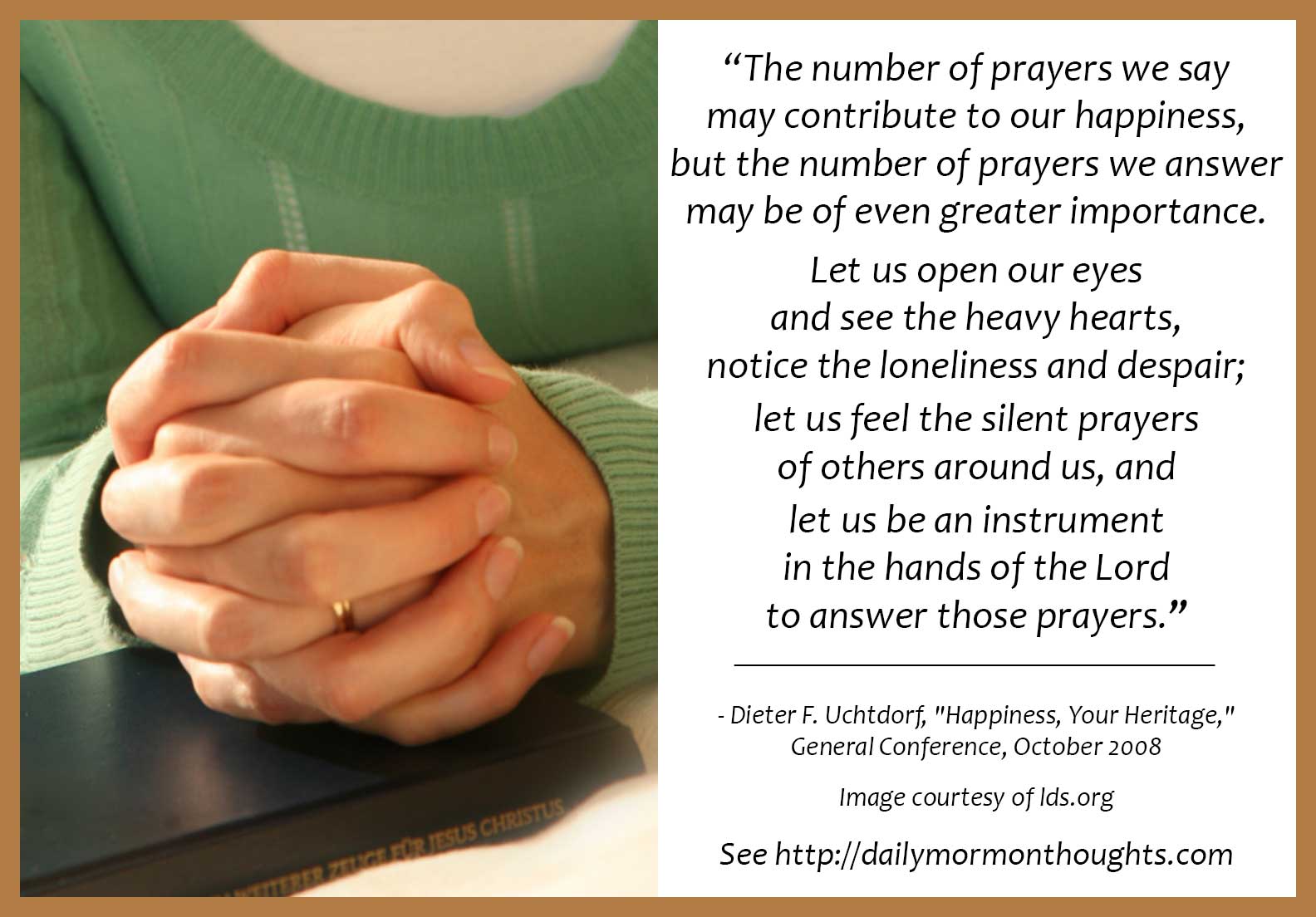
"In the end, the number of prayers we say may contribute to our happiness, but the number of prayers we answer may be of even greater importance. Let us open our eyes and see the heavy hearts, notice the loneliness and despair; let us feel the silent prayers of others around us, and let us be an instrument in the hands of the Lord to answer those prayers."
- Dieter F. Uchtdorf, "Happiness, Your Heritage," General Conference, October 2008
Click here to read or listen to the full talk

This is a beautiful thought from President Uchtdorf. It's critical for us to pray, and we are blessed as we do so; but often the greatest blessings will come to us as a result of reaching out to others and serving them in their times of need—in effect becoming the answer to their prayers:


President Uchtdorf suggests that we should strive to be more observant, watching for the needs around us that may include sadness, grief, and loneliness. Perhaps in addition to watching for those situations, we can actively seek inspiration from heaven for situations where our help might be such a blessing. Then we can be prepared to intercede as we are prompted.

I love this similar thought from President Spencer W. Kimball:
"God does notice us, and he watches over us. But it is usually through another person that he meets our needs. Therefore, it is vital that we serve each other in the kingdom. The people of the Church need each other’s strength, support, and leadership in a community of believers as an enclave of disciples. In the Doctrine and Covenants we read about how important it is to '… succor the weak, lift up the hands which hang down, and strengthen the feeble knees' (D&C 81:5)."
- Spencer W. Kimball, "Small Acts of Service," Ensign, December 1974
It's a beautiful, sacred invitation for each of us, to reach out in care and concern, fulfilling our covenants to "bear one another's burdens" and to "comfort those who stand in need of comfort."

(Compilation and commentary by David Kenison, Orem, Utah, 2018)

Tuesday, January 9, 2018

President Russell M. Nelson on the balance between learning and trusting in God

President Russell M. Nelson (born Sept 9, 1924) was an internationally-renowned heart surgeon when he was called to serve as a member of the Quorum of Twelve Apostles in 1984. He was set apart as president of the Quorum of Twelve on July 15, 2015. With the death of President Monson, at age 93 he currently presides over the Church as senior apostle.
"'Trust in the Lord with all thine heart; and lean not unto thine own understanding' (Proverbs 3:5). We experienced it firsthand. This doctrine, taught repeatedly in the scriptures (see, for example, Proverbs 11:28; Jeremiah 17:5; Romans 8:1; 2 Nephi 4:34-35; 2 Nephi 28:31; D&C 1:19-23), had now become our sure knowledge.
"Please do not misunderstand me, brothers and sisters. Of course we need to prepare for worthy work to do. Yes, we do need to do our work well, whatever we choose to do in life. We need to be able to render significant service. And before we can achieve that competence, we need an education. With us, education is a religious responsibility. The glory of God really is intelligence (see D&C 93:36).
"But the learning of man has its limitations. And sometimes... the combined learning of many experts cannot be applied when we need it most. We have to place our trust in the Lord....
"Those who cherish their faith in God—those who trust in Him—have been given this scriptural promise: 'Let no man glory in man, but rather let him glory in God.... These shall dwell in the presence of God and his Christ forever and ever' (D&C 76:61-62). May that be the ultimate destiny for each of us."
- Russell M. Nelson, "Neither Trust in the Arm of Flesh," BYU commencement address, April 23, 2009; see also Ensign, March 2010, p. 24
Click here to read or listen to the full speech

Speaking to a graduating class at BYU, President Nelson discussed the interplay between our personal efforts at learning and education, and the dependence we have on Divine help. In essence, we need to do all in our power to prepare for life and "significant service" to our fellowmen. But even with all of the learning we are able to do, we must acknowledge that the very best efforts fall short:


By truly learning to trust in God in our lives, our best efforts can be supplemented and magnified in wonderful ways. And in the process, we can "glory in God" and receive the fullness of His blessings.

(Compilation and commentary by David Kenison, Orem, Utah, 2018)

Monday, January 8, 2018

President Thomas S. Monson on loving God and our fellowmen

President Thomas S. Monson (August 21, 1927–January 2, 2018) was sustained to the Quorum of Twelve Apostles in 1963. He served as a counselor in the First Presidency with Presidents Benson, Hunter, and Hinckley until becoming Church president in 2008. He led the Church for almost a decade.
"We cannot truly love God if we do not love our fellow travelers on this mortal journey. Likewise, we cannot fully love our fellowmen if we do not love God, the Father of us all. The Apostle John tells us, 'This commandment have we from him, That he who loveth God love his brother also' (1 John 4:21). We are all spirit children of our Heavenly Father and, as such, are brothers and sisters. As we keep this truth in mind, loving all of God's children will become easier.
"Actually, love is the very essence of the gospel, and Jesus Christ is our Exemplar. His life was a legacy of love. The sick He healed; the downtrodden He lifted; the sinner He saved. At the end the angry mob took His life. And yet there rings from Golgotha's hill the words: 'Father, forgive them; for they know not what they do (Luke 23:34)—a crowning expression in mortality of compassion and love.
"There are many attributes which are manifestations of love, such as kindness, patience, selflessness, understanding, and forgiveness. In all our associations, these and other such attributes will help make evident the love in our hearts.
"Usually our love will be shown in our day-to-day interactions one with another. All important will be our ability to recognize someone's need and then to respond."
- Thomas S. Monson, "Love—the Essence of the Gospel," General Conference May 2014
Click here to read or listen to the full talk

President Monson teaches a significant truth: love of God and love of fellowmen are inseparably linked. When our understanding is complete, you can't truly have one without the other; increasing either one adds to the strength of the other.


The life of the Savior provides a model for us; He demonstrated love by his constant commitment to others. President Monson teaches the great truth (that his own life so well exemplified): love is not just a theory or emotion, but is "shown in our day-to-day interactions one with another." Learning to observe the needs of those around us, often with inspired insight and prompting, and then to respond to them, is the great key.

(Compilation and commentary by David Kenison, Orem, Utah, 2018)
// Customization to close archive widget on first view - DK 3/15