Wednesday, July 4, 2018

President Russell M. Nelson on loyalty to God and country

President Russell M. Nelson (born Sept 9, 1924) was an internationally-renowned heart surgeon when he was called to serve as a member of the Quorum of Twelve Apostles in 1984. He became president of that quorum on July 15, 2015. Following the death of President Monson, he was set apart as president of the Church on January 14, 2018.
"Citizens of many countries claim membership in the Church. Regardless of their flag or form of government, they find that allegiance to the Lord does not preclude their being loyal citizens of their nations. Fidelity to God enables one to develop a more profound patriotic allegiance and become a better citizen.
"In addition to their national citizenship, members of the Church are also citizens of God’s kingdom. (See Eph. 2:19.) Their commitment to it, however, may be variable. The great majority seek 'first to build up the kingdom of God, and to establish his righteousness.' (JST, Matt. 6:38.) Some allow their allegiance to God and His kingdom to slip below that of other interests in life. They have not yet determined which way they face. (See Joel 3:14.)"
- Russell M. Nelson, "Thou Shalt Have No Other Gods," General Conference April 1996
Click here to read or listen to the full talk

The Church of Jesus Christ of Latter-day Saints was founded in the United States and continues to be headquartered in that country. We recognize the place the USA has played in enabling the great latter-day Restoration. However, membership in the Church is growing dynamically throughout the world. One of the great messages of the Restoration is a declared allegiance to the laws and governments of the lands we live in, throughout the world—"being subject to kings, presidents, rulers, and magistrates, in obeying, honoring, and sustaining the law" (Article of Faith 12). President Nelson teaches that our obedience to the principles of the Gospel help us to be more loyal to our country:


But regardless, as grateful as we are for principles of freedom and liberty, and the privileges afforded us by our nation, we must never forget where our greatest loyalty lies: in our devotion to God and His kingdom, and not to any other interest. We must never forget in our "valley of decision" (Joel 3:14) which direction we are facing!

(Compilation and commentary by David Kenison, Orem, Utah, 2018)

Tuesday, July 3, 2018

President Henry B. Eyring on acting and serving in faithfulness

President Henry B. Eyring (born May 31, 1933) served in the Presiding Bishopric from 1985-1992, as a Seventy from 1992-1995, then was called to the Quorum of Twelve Apostles. He has served in the First Presidency since 2007.
"That day I remembered and understood better the prophetic words of the Prophet Joseph Smith: 'A man filled with the love of God, is not content with blessing his family alone, but ranges through the whole world, anxious to bless the whole human race' (Teachings of Presidents of the Church: Joseph Smith [2007], 426).
"We see such love in the lives of Latter-day Saints everywhere....
"That faith, put into action, which requires selfless sacrifice, brings the change of heart that allows them to feel the love of God.
"Our hearts, however, remain changed only as long as we continue to follow the prophet’s counsel. If we stop trying after one burst of effort, the change will fade.
"Faithful Latter-day Saints have increased their faith in the Lord Jesus Christ, in the Book of Mormon as the word of God, and in the restoration of priesthood keys in His true Church. That increased testimony has given us greater courage and concern for others of God’s children. But the challenges and the opportunities ahead will require even more.
"We cannot foresee the details, but we know the larger picture. We know that in the last days, the world will be in commotion. We know that in the midst of whatever trouble comes, the Lord will lead faithful Latter-day Saints to take the gospel of Jesus Christ to every nation, kindred, tongue, and people. And we know that the Lord’s true disciples will be worthy and prepared to receive Him when He comes again. We need not fear.
"So, as much as we have already built faith and courage in our hearts, the Lord expects more from us—and from the generations after us. They will need to be stronger and braver because they will do even greater and harder things than we have done. And they will face increasing opposition from the enemy of our souls."
- Henry B. Eyring, "Fear Not to Do Good," General Conference October 2017
Click here to read or listen to the full talk

I love the quote from Joseph Smith. When we truly feel the love of God in our hearts, it is reflected in our actions; our great desire becomes the blessing and happiness of those around us. Belief and devotion are translated into action; service to others becomes a motivating desire. And further, the selfless sacrifice of sincere service brings a change of heart that is one of life's greatest blessings.


A changed heart only remains changed when the conditions that brought about the change are maintained! What a great insight.

The final paragraph of this excerpt provides an interesting insight and a great challenge. President Eyring reminds us that "the Lord expects more from us" in order to deal with the challenges ahead. We will be asked to "do even greater and harder things than we have done" as the opposition becomes greater than ever. A frightening forecast, perhaps, but with the assurance of God's help, we can have faith that all will be well.

(Compilation and commentary by David Kenison, Orem, Utah, 2018)

Monday, July 2, 2018

President Dallin H. Oaks on intellectual principles and the gospel of Christ

President Dallin H. Oaks (born August 12, 1932) served as president of BYU from 1971-1980.  He was then appointed as a justice of the Utah Supreme Court, and resigned when he was called to the Quorum of Twelve Apostles in 1984. He became President of the Quorum of Twelve Apostles and also 1st Counselor in the First Presidency in January 2018.
"Those who govern their thoughts and actions solely by the principles of liberalism or conservatism or intellectualism cannot be expected to agree with all of the teachings of the gospel of Jesus Christ. As for me, I find some wisdom in liberalism, some wisdom in conservatism, and much truth in intellectualism—but I find no salvation in any of them.
"The role of a preacher or a practitioner of righteousness is not to be popular with the world or to be esteemed by any particular group, but to be right with God. Isaiah affirmed that fact when he condemned the rebellious 'which say to the seers, See not; and to the prophets, Prophesy not unto us right things, speak unto us smooth things, prophesy deceits.' (Isa. 30:10.) It is easy to preach freedom or truth. Praise for those subjects is usually safe and always popular. It is infinitely more difficult to preach how men and women should use freedom or truth. The preacher of that message may command respect, but he or she will not win popularity.
"I conclude with a message of hope. When Isaiah condemned the critics of his day, he concluded with a prophecy. He said that in time the children of God would sanctify his name and 'fear the God of Israel.' Continuing, he declared, 'They also that erred in spirit shall come to understanding, and they that murmured shall learn doctrine.' (Isa. 29:23–24.) In that spirit I pray for the day when all of us will know God and keep his commandments. In that day, as Isaiah foretold, the 'king shall reign in righteousness,' and 'the work of righteousness shall be peace; and the effect of righteousness quietness and assurance for ever.' (Isa. 32:1, 17.)"
- Dallin H. Oaks, "Critisicm," talk to an LDSSA fireside on 4 May 1986; see Ensign, February 1987, p. 68-70
Click here to read the full talk

This thought-provoking talk was shared with a gathering of young adults early in President Oaks' service as an apostle. His views on learning and philosophy are very interesting in light of that new focus of his life. I appreciate his open-minded description of finding merit in a variety of approaches to life and politics: liberalism, conservatism, and intellectualism. But the critical distinction is between finding wisdom and insight, and finding salvation:


President Oaks makes a critical distinction between the teaching of intellectual principles and the insights of the gospel. While it's one thing for a man to talk about ideas like truth and freedom, it's quite another to discuss how to use those ideas in practical daily living.

The key for us is to learn doctrine and to obey commandments. With those two priorities, the rest of the intellectual endeavors will fall into their proper places.

(Compilation and commentary by David Kenison, Orem, Utah, 2018)

Sunday, July 1, 2018

Elder Orson F. Whitney on the importance of spiritual learning

Elder Orson F. Whitney (1855-1931), a journalist, teacher, poet, and historian, was called to the Quorum of Twelve in 1906 and served until his death in 1931 at age 75.
"This people are the friends, not the foes, of education; that they are seekers after wisdom, lovers of light and truth, universal Truth, which, like the waters of earth, or the sunbeams of heaven, has but one Source, let its earthly origin be what it may.
     'Truth is truth, wher'er 'tis found,
     On Christian or on heathen ground,'
and worthy of our love and admiration, whether far or near, high or low, whether blazing as a star in the blue vault of heaven, or springing like a floweret from the soil.
"'Seek ye out of the best books words of wisdom; seek learning even by study, and also by faith.' (D&C 88:118)
"Why did the Lord so instruct his Prophet? Why did the Prophet so teach his people? It was because God had designed, and his prophet had foreseen, a great and glorious future for that people....
"Literature means learning, and it is from the 'best books' we are told to seek it. This does not merely mean the Bible, the Book of Mormon, the book of Doctrine and Covenants, Church works and religious writings—though these indeed are 'the best books,' and will ever be included in and lie at the very basis of our literature. But it also means history, poetry, philosophy, art and science, languages, government—all truth in fact, wherever found, either local or general, and relating to times past, present or to come.
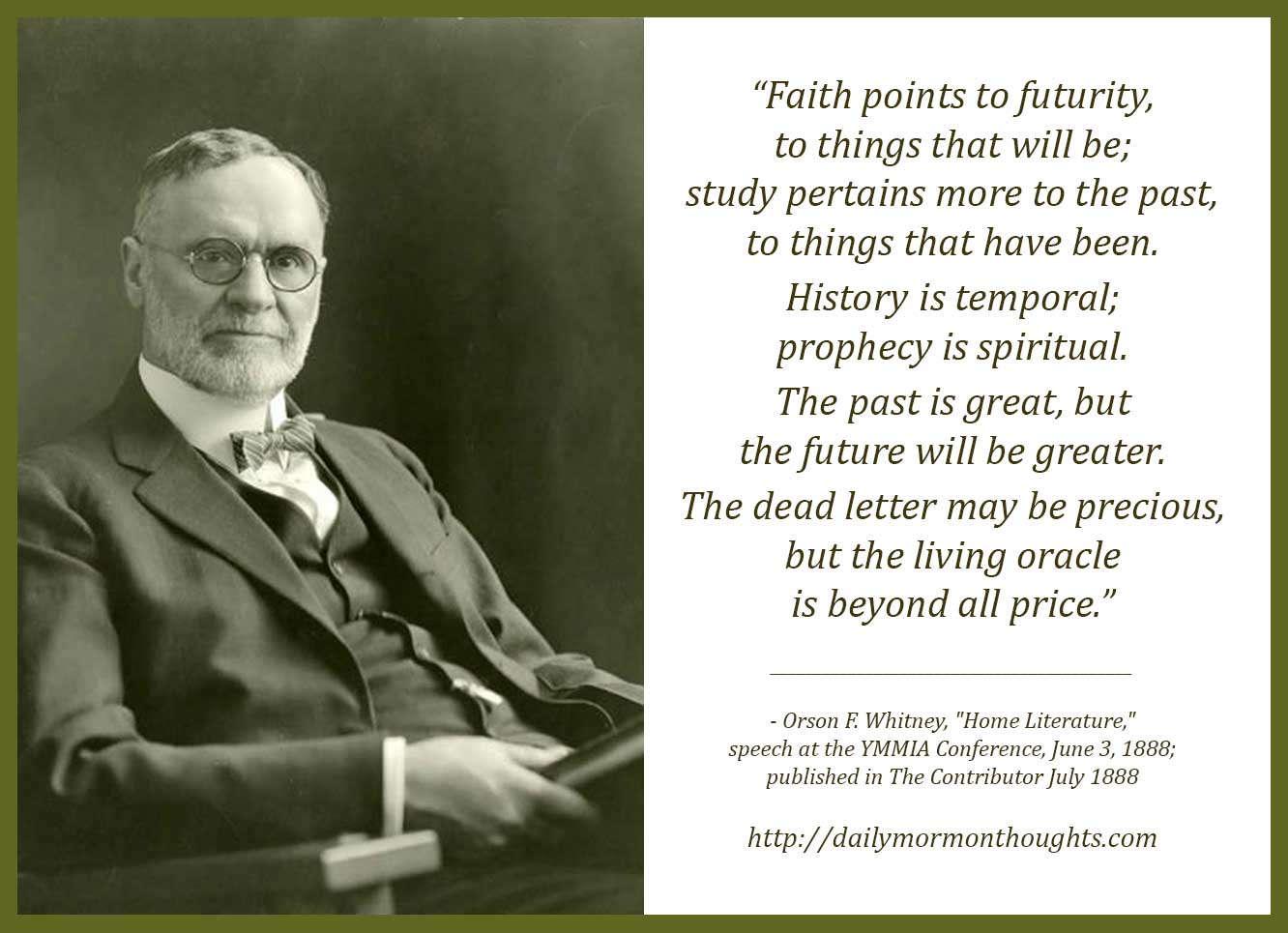
"Yes, the Prophet even meant revelation, inspiration. immediate and direct; for does he not say, 'seek learning by study and also by faith'? Faith points to futurity, to things that will be; study pertains more to the past, to things that have been. History is temporal; prophecy is spiritual. The past is great, but the future will be greater. The dead letter may be precious, but the living oracle is beyond all price."
- Orson F. Whitney, "Home Literature," speech at the YMMIA Conference, June 3, 1888, and subsequently published July 1888 in The ContributorClick here to read the full article

This is a fascinating article by Elder Whitney, in which he encouraged the Saints to focus on personal education in a variety of opportunities and settings; but especially to be advocates of "home literature" and to take every advantage of learning from personal efforts to read and study. Truth can be found in many sources, and we truly should "seek learning" by our study of "the best books" and by our faith. Well we might ask ourselves how we are doing in our pursuit of understanding in "history, poetry, philosophy, art and science, languages, government"—a wide variety of endeavors!


As we seek learning by revelation, this explanation of the relationship between faith and study is especially interesting. It helps to give some perspective to our efforts, and to make sure that all we do is grounded on a spiritual foundation.

(Compilation and commentary by David Kenison, Orem, Utah, 2018)

Saturday, June 30, 2018

President Russell M. Nelson on the blessings of sacred covenants

President Russell M. Nelson (born Sept 9, 1924) was an internationally-renowned heart surgeon when he was called to serve as a member of the Quorum of Twelve Apostles in 1984. He became president of that quorum on July 15, 2015. Following the death of President Monson, he was set apart as president of the Church on January 14, 2018.
"One of the most important concepts of revealed religion is that of a sacred covenant. In legal language, a covenant generally denotes an agreement between two or more parties. But in a religious context, a covenant is much more significant. It is a sacred promise with God. He fixes the terms. Each person may choose to accept those terms. If one accepts the terms of the covenant and obeys God’s law, he or she receives the blessings associated with the covenant. We know that 'when we obtain any blessing from God, it is by obedience to that law upon which it is predicated.' (D&C 130:21) ...
"Children of the covenant have the right to receive His doctrine and to know the plan of salvation. They claim it by making covenants of sacred significance. Brigham Young said: 'All Latter-day Saints enter the new and everlasting covenant when they enter this Church....  They enter the new and everlasting covenant to sustain the Kingdom of God.' (Teachings of Presidents of the Church: Brigham Young (1997), 62.) They keep the covenant by obedience to His commandments....
"When we realize that we are children of the covenant, we know who we are and what God expects of us. His law is written in our hearts. (See Isa 55:3.) He is our God and we are His people.(See Psalm 95:7.) Committed children of the covenant remain steadfast, even in the midst of adversity. When that doctrine is deeply implanted in our hearts, even the sting of death is soothed and our spiritual stamina is strengthened.
"The greatest compliment that can be earned here in this life is to be known as a covenant keeper. The rewards for a covenant keeper will be realized both here and hereafter."
- Russell M. Nelson, "Covenants," General Conference October 2011
Click here to read or listen to the full talk

President Nelson gives a wonderful summary of the doctrine of covenants in this address. He reminds us of the meaning of our sacred promises to God, of the obligations those promises imply, and of the blessings promised for fulfilling our part of the covenant in obedience to God.

The label "children of the covenant" occurs in that form in only one place in the scriptures (3 Ne 20:26) but the concept is described and implied in many others; I love the implications it offers for us as we enter into that special relationship with God. It gives us "the right to receive His doctrine and to know the plan of salvation."


What a wonderful achievement, to be known as one who keeps sacred covenants—according to President Nelson, the "greatest compliment that can be earned here in this life"!

(Compilation and commentary by David Kenison, Orem, Utah, 2018)

Friday, June 29, 2018

President James E. Faust on mutual respect for differing beliefs

President James E. Faust (1920-2007) was called as a Seventy in 1976, then as a member of the Quorum of Twelve in 1978. He served as a counselor to President Hinckley from 1995 until his death in 2007 at age 87.
"We believe that the fulness of the gospel of Christ has been restored, but this is no reason for anyone to feel superior in any way toward others of God’s children. Rather, it requires a greater obligation to invoke the essence of the gospel of Christ in our lives—to love, serve, and bless others.
"Indeed, as the First Presidency stated in 1978, we believe that 'the great religious leaders of the world such as Mohammed, Confucius, and the Reformers, as well as philosophers including Socrates, Plato, and others, received a portion of God’s light. Moral truths were given to them by God to enlighten whole nations and to bring a higher level of understanding to individuals.' (First Presidency statement, Feb. 15, 1978.) Thus, we have respect for the sincere religious beliefs of others and appreciate others extending the same courtesy and respect for the tenets we hold dear."
- James E. Faust, "The Restoration of All Things," General Conference April 2006
Click here to read or listen to the full talk

The essence of the Gospel perspective is humility and perspective—recognition that all of God's children have eternal worth and infinite potential, and any temporary advantage we might have in understanding or temporal situation does not in any way convey superiority to others. Our greatest desire must always be to lift and serve, to recognize the goodness in others, and to grow together towards the divine potential within us:


I have always appreciated the perspective of that First Presidency statement. There is goodness and truth in many sources and many beliefs around us; we should respect others and seek to learn from them, even as we hope to share with them the things that matter most to us.

(Compilation and commentary by David Kenison, Orem, Utah, 2018)

Thursday, June 28, 2018

President Howard W. Hunter on standing faithfully in the days of battle

President Howard W. Hunter (1907-1995) was called to the Quorum of Twelve in 1959.  He served as Church President from June 5, 1994 to his death on March 3, 1995.
"At a critical moment in the battle of Waterloo, when everything depended on the steadiness of the soldiery, an anxious courier dashed into the presence of the Duke of Wellington, announcing that unless the troops were immediately relieved or withdrawn, they must yield before the impending assault of the French army. The Duke replied, 'Stand firm!'
"'But we shall perish!' remonstrated the officer.
"'Stand firm!' again was the answer of the ironhearted Duke.
"'You’ll find us there!' rejoined the courier, as he galloped away.
"And, of course, the British were victorious that day as a result of such loyalty and determination (see Walter Baxendale, ed., Dictionary of Anecdote, Incident, Illustrative Fact, New York: Thomas Whittaker, 1889, p. 225).
"Today another battle of far more serious consequence is being waged. It is a battle being fought for the souls of men. Its outcome likewise depends on the steadiness of the soldiery. The clarion call of the chieftain is heard above the fierce artillery of the archenemy, 'Stand firm! Be true!'
"Brothers and sisters, I am grateful that most within the sound of my voice are standing firm and remaining true to the kingdom of God. Like Helaman’s stripling warriors, 'they stand fast in that liberty wherewith God has made them free; and they are strict to remember the Lord their God from day to day; yea, they do observe to keep his statutes, and his judgments, and his commandments continually; and their faith is strong in the prophecies concerning that which is to come' (Alma 58:40). I am referring to those members of the Church who live their Christian beliefs in the quiet commonplace of their daily lives."
- Howard W. Hunter, "Am I a 'Living” Member?,' General Coference April 1987
Click here to read or listen to the full talk

When faced with overwhelming odds, does it make sense for a military force to "stand firm" and not retreat? It might! Perhaps the commander is aware of circumstances or situations that would make that kind of defense the right thing to do. If a commander is certain that a stand will result eventually in victory, then the counsel is wise.

President Hunter used the example of British troops at Waterloo to illustrate this principle. With determination and resolve, at that moment "when everything depended on the steadiness of the soldiery," they were counseled to "stand firm" and they did, eventually winning the battle in spite of what appeared to be a hopeless and desperate situation.

In the battle we are fighting "for the souls of men" in our world today, our leaders and commanders are giving us that same message: stand firm!


The way we "stand firm" in the battles and challenges of our time is to "live [the] Christian beliefs in the quiet commonplace of [our] daily lives." That simple but powerful message is so critical for us. As we "observe to keep... his commandments continually" (not just occasionally, or when convenient) we will find that our "faith is strong in the prophecies concerning that which is to come" and we will be blessed and sustained.

(Compilation and commentary by David Kenison, Orem, Utah, 2018)
// Customization to close archive widget on first view - DK 3/15