Saturday, July 7, 2018

President Thomas S. Monson on American prosperity and dependence on God

President Thomas S. Monson (1927–2018) was sustained to the Quorum of Twelve Apostles in 1963. He served as a counselor in the First Presidency with Presidents Benson, Hunter, and Hinckley and then became Church president in 2008. He led the Church for almost a decade until his passing in January 2018.
"Too many Americans have been screaming ever louder for more and more of the things we cannot take with us and paying less and less attention to the real sources of the very happiness we seek. We have been measuring our fellowmen more by balance sheets and less by moral standards. We have developed frightening physical power and fallen into pathetic spiritual weakness. We have become so concerned over the growth of our earning capacity that we have neglected the growth of our character.
"As we view the disillusionment that engulfs countless thousands today, we are learning the hard way what an ancient prophet wrote out for us 3,000 years ago. 'He that loveth silver shall not be satisfied with silver; nor he that loveth abundance with increase' (Eccl. 5:10).
"The revered Abraham Lincoln accurately described our plight. 'We have been the recipients of the choicest bounties of heaven; we have been preserved these many years in peace and prosperity. We have grown in numbers, wealth, and power as no other nation has ever grown; but we have forgotten God. We have forgotten the gracious hand which preserved us in peace and multiplied and enriched and strengthened us. We have vainly imagined, in the deceitfulness of our hearts that all these blessings were produced by some superior wisdom and virtue of our own. Intoxicated with unbroken succession, we have become too self-sufficient to feel the necessity of preserving and redeeming grace, too proud to pray to God that made us.'
"Can we extricate ourselves from this frightful condition? Is there a way out? If so, what is the way? We can solve this perplexing dilemma by adopting the counsel given by Jesus to the inquiring lawyer who asked, 'Master, which is the great commandment in the law? Jesus said unto him, Thou shalt love the Lord thy God with all thy heart, and with all thy soul, and with all thy mind. This is the first and great commandment. And the second is like unto it, Thou shalt love thy neighbor as thyself.' (Matt. 22:36-39)
"First, then I would suggest that each American love the Lord, our God, and with our families serve Him in righteousness."
- Thomas S. Monson, "America Needs You," Conference Report, October 1964, pp. 140-142
Click here to read the full talk

A young Elder Monson (age 37) shared these thoughts the year after his call to the Quorum of Twelve. While he expressed gratitude for the privilege he felt as a resident of the United States, he also recognized the troubles of the country at the time, in the aftermath of the assassination of President Kennedy, racial rioting and other tensions, increases in crime, and so on.

It's always interesting to compare the perspective of a past generation. President Monson was concerned in 1964 about confused priorities: desire for physical wealth and prominence instead of things of more lasting value. In neglecting the things that matter most, he worried: "We have developed frightening physical power and fallen into pathetic spiritual weakness." So how do we fare, 54 years later? In general, we can only believe that conditions are at least as bad today!

And President Monson shifts the focus back even earlier, a full century before his time, when Abraham Lincoln described similar issues and concerns:


The antidote suggested by President Monson is that we remember the two great commandments: love God with all our hearts, souls, and minds; and love our neighbors as we love ourselves. As we learn to turn our hearts upward to God and outward to our neighbors, the proper perspective returns and the whole nation is blessed.

(Compilation and commentary by David Kenison, Orem, Utah, 2018)

Friday, July 6, 2018

Elder Neal A. Maxwell on the life process of trusting God

Elder Neal A. Maxwell (1926-2004) served as a Seventy from 1976-1981, then as a member of the Quorum of Twelve until his death from cancer in 2004.
"The object is for our wills to be finally 'swallowed up in the will of the Father' (Mosiah 15:7), eventually bringing to us the joys gladly given by the Father and constituting 'all that He hath' (Genesis 24:36). In a very real sense, therefore, what we can take now foretells what He can give later! This reality should be kept firmly in mind as we understandably pray for relief from short-term stress or long-term trauma. We would, if we could, put periods, if not exclamation points, where God is content to put commas in the process.
"Either way, the 'process of time' is needed to facilitate our incremental improvement (Moses 7:21). Therein, individual increments of personal improvement are often scarcely discernable by themselves, yet the cumulative process moves us ever closer to Home.
"Successfully traversed, the individual Sinais of stretching can facilitate our developing and better emulating Christlike attributes. Along with receiving His ordinances and keeping our covenants with Him, each of these attributes also certifies our eventual admissibility to the celestial kingdom.
"Hence, the stretching trek requires deep faith in God's existence, deep faith in God's purposes, and also deep faith in His timing. The latter is sometimes most difficult to develop, yet 'the cross comes before the crown.'"
- Neal A. Maxwell. The Promise of Discipleship [Deseret 2001], p. 36

Perhaps among the great purposes of this mortal experience is the need for us to learn to trust God completely and perfectly. The beautiful phrase used in Abinadi's description and witness, "the will of the Son being swallowed up in the will of the Father," helps us understand that process. Eventually, as we come to truly trust Him, we'll understand that it's not about what I want, but it's about what He wants for me.


We must learn to use "the process of time" to gradually draw nearer to that perfect understanding. Those small and steady "increments of personal improvement" are the essence of eternal progress. They are the steps in developing the "Christlike attributes" that prepare us to return to Him as we learn to have faith in His timing.

(Compilation and commentary by David Kenison, Orem, Utah, 2018)

Thursday, July 5, 2018

Elder Robert D. Hales on the blessing of true friends

Elder Robert D. Hales (August 24, 1932-October 1, 2017) served as a Seventy from 1976 to 1985, when he was called as a member of the Quorum of Twelve Apostles.
"We need to measure very carefully who our true friends are. The measure of a true friend is one who will not have us choose between his way and the Lord’s way. A true friend makes it easier for us to live the commandments of the Lord. A true friend will not let us do anything we want. True friends will correct us when we do something wrong and bring us back on the straight and narrow path that leads to exaltation.
"Every one of us needs to know when to walk or run away from those who would call themselves friends but in reality are not. Joseph of old recognized the evil in Potiphar’s wife and ran from it (see Genesis 39:7–12). We too must recognize evil and shun it. If we allow machoism to overtake our personal lives and influence choices and decisions we make, we can severely limit our progression in this life and in the eternities."
- Robert D. Hales, "Return with Honor," CES fireside address on 3 May 1998; see Ensign, June 1999, 12
Click here to read the full talk

The value and importance of "true friends" is hard to quantify. I love this description from Elder Hales about what that kind of friendship includes:


The ability to choose friends wisely becomes critical in our time. We need to carefully avoid those who might offer a form of friendship, but in ways that are more detrimental than beneficial to us. That only underscores the value of a true friend. It's a rare gift, one that should be treasured and held closely!

(Compilation and commentary by David Kenison, Orem, Utah, 2018)

Wednesday, July 4, 2018

President Russell M. Nelson on loyalty to God and country

President Russell M. Nelson (born Sept 9, 1924) was an internationally-renowned heart surgeon when he was called to serve as a member of the Quorum of Twelve Apostles in 1984. He became president of that quorum on July 15, 2015. Following the death of President Monson, he was set apart as president of the Church on January 14, 2018.
"Citizens of many countries claim membership in the Church. Regardless of their flag or form of government, they find that allegiance to the Lord does not preclude their being loyal citizens of their nations. Fidelity to God enables one to develop a more profound patriotic allegiance and become a better citizen.
"In addition to their national citizenship, members of the Church are also citizens of God’s kingdom. (See Eph. 2:19.) Their commitment to it, however, may be variable. The great majority seek 'first to build up the kingdom of God, and to establish his righteousness.' (JST, Matt. 6:38.) Some allow their allegiance to God and His kingdom to slip below that of other interests in life. They have not yet determined which way they face. (See Joel 3:14.)"
- Russell M. Nelson, "Thou Shalt Have No Other Gods," General Conference April 1996
Click here to read or listen to the full talk

The Church of Jesus Christ of Latter-day Saints was founded in the United States and continues to be headquartered in that country. We recognize the place the USA has played in enabling the great latter-day Restoration. However, membership in the Church is growing dynamically throughout the world. One of the great messages of the Restoration is a declared allegiance to the laws and governments of the lands we live in, throughout the world—"being subject to kings, presidents, rulers, and magistrates, in obeying, honoring, and sustaining the law" (Article of Faith 12). President Nelson teaches that our obedience to the principles of the Gospel help us to be more loyal to our country:


But regardless, as grateful as we are for principles of freedom and liberty, and the privileges afforded us by our nation, we must never forget where our greatest loyalty lies: in our devotion to God and His kingdom, and not to any other interest. We must never forget in our "valley of decision" (Joel 3:14) which direction we are facing!

(Compilation and commentary by David Kenison, Orem, Utah, 2018)

Tuesday, July 3, 2018

President Henry B. Eyring on acting and serving in faithfulness

President Henry B. Eyring (born May 31, 1933) served in the Presiding Bishopric from 1985-1992, as a Seventy from 1992-1995, then was called to the Quorum of Twelve Apostles. He has served in the First Presidency since 2007.
"That day I remembered and understood better the prophetic words of the Prophet Joseph Smith: 'A man filled with the love of God, is not content with blessing his family alone, but ranges through the whole world, anxious to bless the whole human race' (Teachings of Presidents of the Church: Joseph Smith [2007], 426).
"We see such love in the lives of Latter-day Saints everywhere....
"That faith, put into action, which requires selfless sacrifice, brings the change of heart that allows them to feel the love of God.
"Our hearts, however, remain changed only as long as we continue to follow the prophet’s counsel. If we stop trying after one burst of effort, the change will fade.
"Faithful Latter-day Saints have increased their faith in the Lord Jesus Christ, in the Book of Mormon as the word of God, and in the restoration of priesthood keys in His true Church. That increased testimony has given us greater courage and concern for others of God’s children. But the challenges and the opportunities ahead will require even more.
"We cannot foresee the details, but we know the larger picture. We know that in the last days, the world will be in commotion. We know that in the midst of whatever trouble comes, the Lord will lead faithful Latter-day Saints to take the gospel of Jesus Christ to every nation, kindred, tongue, and people. And we know that the Lord’s true disciples will be worthy and prepared to receive Him when He comes again. We need not fear.
"So, as much as we have already built faith and courage in our hearts, the Lord expects more from us—and from the generations after us. They will need to be stronger and braver because they will do even greater and harder things than we have done. And they will face increasing opposition from the enemy of our souls."
- Henry B. Eyring, "Fear Not to Do Good," General Conference October 2017
Click here to read or listen to the full talk

I love the quote from Joseph Smith. When we truly feel the love of God in our hearts, it is reflected in our actions; our great desire becomes the blessing and happiness of those around us. Belief and devotion are translated into action; service to others becomes a motivating desire. And further, the selfless sacrifice of sincere service brings a change of heart that is one of life's greatest blessings.


A changed heart only remains changed when the conditions that brought about the change are maintained! What a great insight.

The final paragraph of this excerpt provides an interesting insight and a great challenge. President Eyring reminds us that "the Lord expects more from us" in order to deal with the challenges ahead. We will be asked to "do even greater and harder things than we have done" as the opposition becomes greater than ever. A frightening forecast, perhaps, but with the assurance of God's help, we can have faith that all will be well.

(Compilation and commentary by David Kenison, Orem, Utah, 2018)

Monday, July 2, 2018

President Dallin H. Oaks on intellectual principles and the gospel of Christ

President Dallin H. Oaks (born August 12, 1932) served as president of BYU from 1971-1980.  He was then appointed as a justice of the Utah Supreme Court, and resigned when he was called to the Quorum of Twelve Apostles in 1984. He became President of the Quorum of Twelve Apostles and also 1st Counselor in the First Presidency in January 2018.
"Those who govern their thoughts and actions solely by the principles of liberalism or conservatism or intellectualism cannot be expected to agree with all of the teachings of the gospel of Jesus Christ. As for me, I find some wisdom in liberalism, some wisdom in conservatism, and much truth in intellectualism—but I find no salvation in any of them.
"The role of a preacher or a practitioner of righteousness is not to be popular with the world or to be esteemed by any particular group, but to be right with God. Isaiah affirmed that fact when he condemned the rebellious 'which say to the seers, See not; and to the prophets, Prophesy not unto us right things, speak unto us smooth things, prophesy deceits.' (Isa. 30:10.) It is easy to preach freedom or truth. Praise for those subjects is usually safe and always popular. It is infinitely more difficult to preach how men and women should use freedom or truth. The preacher of that message may command respect, but he or she will not win popularity.
"I conclude with a message of hope. When Isaiah condemned the critics of his day, he concluded with a prophecy. He said that in time the children of God would sanctify his name and 'fear the God of Israel.' Continuing, he declared, 'They also that erred in spirit shall come to understanding, and they that murmured shall learn doctrine.' (Isa. 29:23–24.) In that spirit I pray for the day when all of us will know God and keep his commandments. In that day, as Isaiah foretold, the 'king shall reign in righteousness,' and 'the work of righteousness shall be peace; and the effect of righteousness quietness and assurance for ever.' (Isa. 32:1, 17.)"
- Dallin H. Oaks, "Critisicm," talk to an LDSSA fireside on 4 May 1986; see Ensign, February 1987, p. 68-70
Click here to read the full talk

This thought-provoking talk was shared with a gathering of young adults early in President Oaks' service as an apostle. His views on learning and philosophy are very interesting in light of that new focus of his life. I appreciate his open-minded description of finding merit in a variety of approaches to life and politics: liberalism, conservatism, and intellectualism. But the critical distinction is between finding wisdom and insight, and finding salvation:


President Oaks makes a critical distinction between the teaching of intellectual principles and the insights of the gospel. While it's one thing for a man to talk about ideas like truth and freedom, it's quite another to discuss how to use those ideas in practical daily living.

The key for us is to learn doctrine and to obey commandments. With those two priorities, the rest of the intellectual endeavors will fall into their proper places.

(Compilation and commentary by David Kenison, Orem, Utah, 2018)

Sunday, July 1, 2018

Elder Orson F. Whitney on the importance of spiritual learning

Elder Orson F. Whitney (1855-1931), a journalist, teacher, poet, and historian, was called to the Quorum of Twelve in 1906 and served until his death in 1931 at age 75.
"This people are the friends, not the foes, of education; that they are seekers after wisdom, lovers of light and truth, universal Truth, which, like the waters of earth, or the sunbeams of heaven, has but one Source, let its earthly origin be what it may.
     'Truth is truth, wher'er 'tis found,
     On Christian or on heathen ground,'
and worthy of our love and admiration, whether far or near, high or low, whether blazing as a star in the blue vault of heaven, or springing like a floweret from the soil.
"'Seek ye out of the best books words of wisdom; seek learning even by study, and also by faith.' (D&C 88:118)
"Why did the Lord so instruct his Prophet? Why did the Prophet so teach his people? It was because God had designed, and his prophet had foreseen, a great and glorious future for that people....
"Literature means learning, and it is from the 'best books' we are told to seek it. This does not merely mean the Bible, the Book of Mormon, the book of Doctrine and Covenants, Church works and religious writings—though these indeed are 'the best books,' and will ever be included in and lie at the very basis of our literature. But it also means history, poetry, philosophy, art and science, languages, government—all truth in fact, wherever found, either local or general, and relating to times past, present or to come.
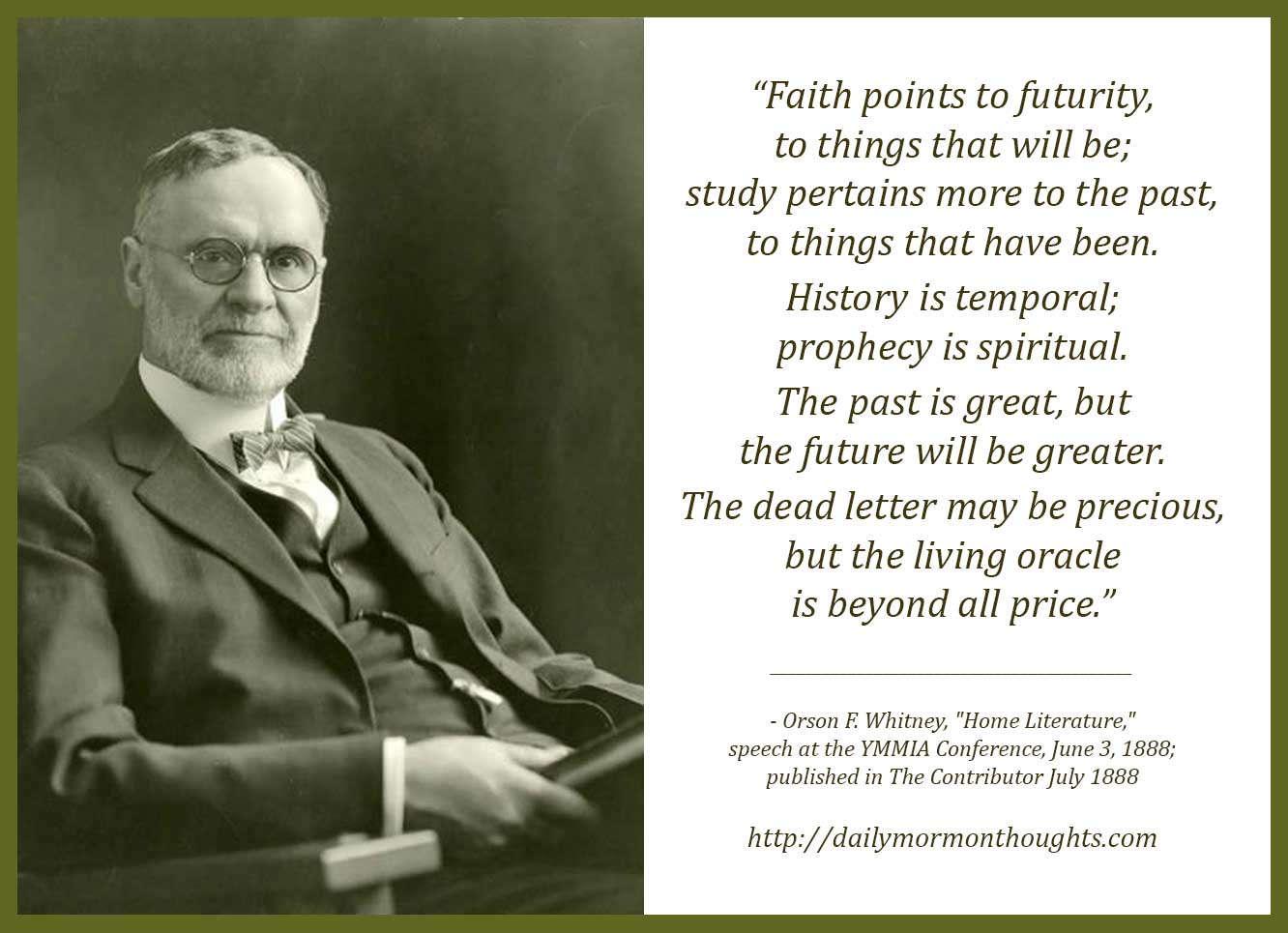
"Yes, the Prophet even meant revelation, inspiration. immediate and direct; for does he not say, 'seek learning by study and also by faith'? Faith points to futurity, to things that will be; study pertains more to the past, to things that have been. History is temporal; prophecy is spiritual. The past is great, but the future will be greater. The dead letter may be precious, but the living oracle is beyond all price."
- Orson F. Whitney, "Home Literature," speech at the YMMIA Conference, June 3, 1888, and subsequently published July 1888 in The ContributorClick here to read the full article

This is a fascinating article by Elder Whitney, in which he encouraged the Saints to focus on personal education in a variety of opportunities and settings; but especially to be advocates of "home literature" and to take every advantage of learning from personal efforts to read and study. Truth can be found in many sources, and we truly should "seek learning" by our study of "the best books" and by our faith. Well we might ask ourselves how we are doing in our pursuit of understanding in "history, poetry, philosophy, art and science, languages, government"—a wide variety of endeavors!


As we seek learning by revelation, this explanation of the relationship between faith and study is especially interesting. It helps to give some perspective to our efforts, and to make sure that all we do is grounded on a spiritual foundation.

(Compilation and commentary by David Kenison, Orem, Utah, 2018)
// Customization to close archive widget on first view - DK 3/15