Thursday, March 7, 2019

Elder Robert D. Hales on the influence of parents on youth

Elder Robert D. Hales (August 24, 1932-October 1, 2017) served as a Seventy from 1976 to 1985, when he was called as a member of the Quorum of Twelve Apostles.
"It is impossible to overestimate the influence of parents who understand the hearts of their children. Research shows that during the most important transitions of life—including those periods when youth are most likely to drift away from the Church—the greatest influence does not come from an interview with the bishop or some other leader but from the regular, warm, friendly, caring interaction with parents....
"For our interactions with youth to truly touch their hearts, we have to pay attention to them just as we would pay attention to a trusted adult colleague or close friend. Most important is asking them questions, letting them talk, and then being willing to listen—yes, listen and listen some more—even hearken with spiritual ears!"
- Robert D. Hales, "Our Duty to God: The Mission of Parents and Leaders to the Rising Generation," General Conference April 2010
Click here to read or listen to the full talk

This message from Elder Hales is filled with warm, personal examples and stories that illustrate his counsel. Parents and church leaders have separate but very critical roles in the guidance and encouragement of young people. But the role of the parent is so critical:


It becomes so critical that parents cultivate a relationship with their children that is loving and trusting. A child needs to know that his or her parent truly cares. That is often demonstrated by the time a parent is able or willing to devote in personal interaction with the child, and by the respect we show for their thoughts and challenges. Sometimes parents need to be creative in finding that time; Elder Hales suggests we take better advantage of times such as driving in the car or meal times. But clearly, all parents should be sure they have set this as a very high priority in their life!

(Compilation and commentary by David Kenison, Orem, Utah, 2019)

Wednesday, March 6, 2019

Elder L. Tom Perry on building a character of integrity and trust

Elder L. Tom Perry (1922-2015) was called as an Assistant to the Twelve in 1972, then as a member of the Quorum of Twelve Apostles in 1974. At the time of his passing at age 92, he was the oldest living general authority and the third in seniority among the leading quorum.
"Our world today is increasingly fast moving and complex. There are always opportunities for individuals to play fast and loose. Many people like to play to activities that produce quick windfalls and often take advantage of others who try to play according to the rules established by good practices. This fast-moving world has heightened the temptation for people to play the game with their own set of rules.
"However, we must always answer to the law of the harvest. 'For whatsoever ye sow, that shall ye also reap; therefore, if ye sow good ye shall also reap good for your reward' (D&C 6:33). This is a law that will never be repealed....
"A good character is something you must make for yourself. It cannot be inherited from parents. It cannot be created by having extraordinary advantages. It isn’t a gift of birth, wealth, talent, or station. It is the result of your own endeavor. It is the reward that comes from living good principles and manifesting a virtuous and honorable life.
"With that noble quality of trust comes the reputation of one who is honest and possesses integrity. These are character traits that will ensure a long and successful career. The greatest asset you can put into your bank is the reputation of being a person of trust."
- L. Tom Perry, address delivered 1/15/2010 at Utah Valley University: see "The Tradition of a Balanced, Righteous Life," Ensign, Aug. 2011, 36
Click here to read the full talk

Elder Perry warns that we are sometimes tempted in today's world to "play fast and loose": to ignore the established rules and conventions, choosing to "play the game with [our] own set of rules." We are sometimes tempted to rationalize our behavior and act inappropriately. But he warns that these choices will have consequences eventually, as the "law of the harvest" brings us our eventual dues.

Instead, we should endeavor always to make the choices and follow the actions that will result in good character:


Then, having built our life on "living good principles and manifesting a virtuous and honorable life," we can be assured that we become someone full of integrity who is worthy of trust. There is no more desirable quality in the world we live in!

(Compilation and commentary by David Kenison, Orem, Utah, 2019)

Tuesday, March 5, 2019

Elder Marvin J. Ashton on being fully committed to the gospel

Elder Marvin J. Ashton (1915-1994) served as a member of the Quorum of Twelve Apostles from 1971 until his death in 1994 at age 78.
"I’m thinking of a five-year-old boy who fell out of bed during the night and came crying to his mother’s bedside. To her question, 'Why did you fall out of bed?' he replied, 'I fell out because I wasn’t in far enough!'
"It has been my experience over the years that, generally speaking, those who fall out of the Church are those who aren’t in far enough.
"In a simple statement, the difference between those committed and those who are not is the difference between the words want and will. For example, 'I want to pay tithing, but our funds are so limited,' or 'I will pay my tithing.' 'I want to go to sacrament meeting if I have time,' or 'I will go to sacrament meeting.' 'I would like to be a good teacher, but the children are so noisy,' or 'I will be a good teacher.'
"To reap the full benefits of life, we must fill our days with commitment to worthy goals and principles. There is no other way. As these commitments lead us to action, we will find added growth and dimension which will guide us toward a productive life here on earth and open the door for eternal life with our Father in Heaven."
- Marvin J. Ashton, "The Word is Commitment," General Conference October 1983
Click here to read or listen to the full talk

Elder Ashton's analogy of the boy falling out of bed is interesting—they boy said he fell because he wasn't in far enough, and Elder Ashton applies that to people who "drop out" of participation in the Church. What does it mean to be "in far enough"? Perhaps to be more thoroughly involved, more deeply committed, more deeply converted. As our membership in the Church becomes a more significant and meaningful part of our life, we'll understand the analogy better.

Elder Ashton continues by suggesting a characteristic of a member who is "in far enough"—the level of commitment that is demonstrated by our attitude towards assignments or obligations, as expressed in the words want and will. Do we just desire to do good things, or are we committed to make them happen?


Blessings come to us when we "fill our days with commitment to worthy goals and principles" that will then lead us to action and growth.

(Compilation and commentary by David Kenison, Orem, Utah, 2019)

Monday, March 4, 2019

President Joseph Smith on intellectual and spiritual growth

Joseph Smith (December 23, 1805-June 27, 1844) was given the apostolic authority when the Church of Jesus Christ was organized on April 6, 1830 and he was designated the first president of the church at age 24. He was martyred in 1844 at age 38.
"We consider that God has created man with a mind capable of instruction, and a faculty which may be enlarged in proportion to the heed and diligence given to the light communicated from heaven to the intellect; and that the nearer man approaches perfection, the clearer are his views, and the greater his enjoyments, till he has overcome the evils of his life and lost every desire for sin; and like the ancients, arrives at that point of faith where he is wrapped in the power and glory of his Maker and is caught up to dwell with Him. But we consider that this is a station to which no man ever arrived in a moment: he must have been instructed in the government and laws of that kingdom by proper degrees, until his mind is capable in some measure of comprehending the propriety, justice, equality, and consistency of the same."
- Joseph Smith, from "The Elders of the Church in Kirtland, to Their Brethren Abroad," Jan. 22, 1834, published in Evening and Morning Star, Feb. 1834, p. 135; see History of the Church, 2:8

It's a basic premise that all of us in this life are capable of learning and growth. But Joseph teaches of a greater capability, a spiritual capacity to grow "in proportion to the heed and diligence given to the light communicated from heaven to the intellect." As we learn to heed the light from heaven, we progress in the ways that matter most. But that does not happen all at once:


In that gradual process of spiritual and intellectual growth, we find wonderful things happening along the way. The description Joseph offers of the process is inspiring. We find greater enjoyment as our thoughts and desires become purified, and we lose our desire for sin. Ultimately we will be "wrapped in the power and glory of [our] Maker."

(Compilation and commentary by David Kenison, Orem, Utah, 2019)

Sunday, March 3, 2019

President Brigham Young on the sacredness of the sacrament

President Brigham Young (1801-1877) was part of the first Quorum of Twelve Apostles of this dispensation, called and ordained in 1835. He served as the second Church president, succeeding Joseph Smith, from 1847 until his death in 1877.
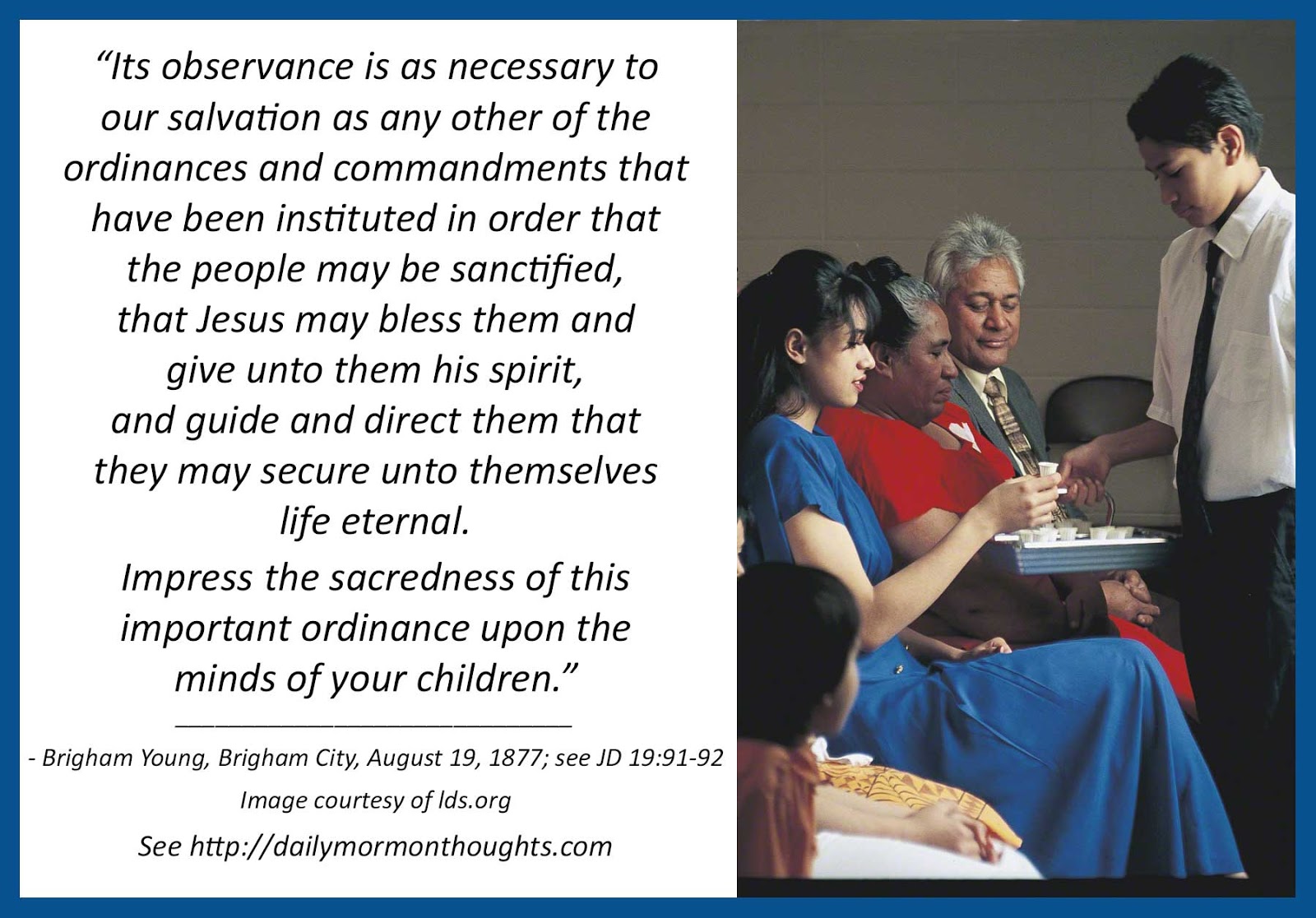
"I would exhort my brethren and sisters to receive this ordinance [the sacrament] every Sabbath, when they meet together....
"We are in the habit of partaking of the contents of the cup each Sabbath when we meet together, and I do pray you my brethren and sisters to contemplate this ordinance thoroughly, and seek unto the Lord with all your hearts that you may obtain the promised blessings by obedience to it. Teach its observance to your children; impress upon them its necessity. Its observance is as necessary to our salvation as any other of the ordinances and commandments that have been instituted in order that the people may be sanctified, that Jesus may bless them and give unto them his spirit, and guide and direct them that they may secure unto themselves life eternal. Impress the sacredness of this important ordinance upon the minds of your children."
- Brigham Young, Brigham City, Sunday Afternoon, August 19, 1877; see JD 19:91-92
Click here to read the full talk

Speaking of the sacrament, President Young exhorts us to "contemplate this ordinance thoroughly" in order to know how to claim its promised blessings through obedience. We profit by doing this often; there is so much to be learned from the symbolism, the prayers, the associated covenants, and even the method of administration and distribution.


The observance of the sacrament is critical to our salvation, as much as any other ordinance of our day. How we should focus on its meaning and blessings in our lives! Truly, it does enable us to "be sanctified" or made holy before God, and to receive a greater measure of His spirit and guidance in our lives.

(Compilation and commentary by David Kenison, Orem, Utah, 2019)

Saturday, March 2, 2019

President John Taylor on trusting God and growing as families

President John Taylor (1808–1887) was born in England and immigrated to Canada where he and his wife were converted after hearing Parley P. Pratt preach.  He was ordained an apostle in 1838, and became the third president of the Church in 1880, serving until his death in 1887 at age 78.
"We have got to put our trust in God, let the consequences be as they may. And as long as we do this, and as long as we keep the holy covenants we have entered into with him and with one another, Zion will triumph; and the wicked will waste away until there will be no place found for them; and the man or the nation that lifts up his hand against Zion will wither before Almighty God. I will prophecy that in the name of Jesus Christ, and I will meet the consequences of what I say.
"But I will tell you what we have to do, my brethren and sisters, we must fear God in our hearts; we must lay aside our covetousness and our waywardness, our self-will and foolishness of every kind.… We must humble ourselves before the Lord, repenting of our sins, and henceforth preserve our bodies and spirits pure, that we may be fit receptacles for the Spirit of the living God, and be guided by him in all our labors both for the living and the dead. Our desires must be for God and his righteousness, until we shall exclaim with one of old: O God, search me, and try me, and if there be any way of wickedness in me, bid it depart [see Psalm 139:23–24]. It is for us, as fathers and mothers, to go before the Lord in all humility and call upon him that his peace may be in our hearts; and wherein we may have done wrong, confess that wrong and repair it as far as we possibly can; and in this way let every man and woman in Israel begin to set their houses in order, and forever cultivate the spirit of peace, the spirit of union and love.
"And if the families of Israel do this throughout all the land of Zion, all fearing God and working righteousness, cherishing the spirit of humility and meekness, and putting our trust in him, there is no power in existence that can injure us; for God will stand by and sustain his people, and he will deliver them out of the hands of their enemies."
- John Taylor, discourse at Grantsville, Sunday evening, 10/29/1882; see JD 23:337
Click here to read the full talk

Learning to "trust in God" is one of the keys to peace and happiness in this life. President Taylor begins this excerpt with a testimony and a prophecy, that as we keep our covenants with God and with each other, Zion will be blessed and protected from wicked influence. We need that blessing more than ever!

The key for us is to learn to repent, obey, and purify our hearts. The passage President Taylor quotes from the Psalms is so beautiful:
Search me, O God, and know my heart: try me, and know my thoughts:
And see if there be any wicked way in me, and lead me in the way everlasting.
(Psalm 139:23-24)
Those words express the humility we need to strive to be pure and holy in His sight, so that we might be worthy of His help and blessings. Then, we can lead our families in that path:


Then President Taylor promises that as families do that, collectively, "all fearing God and working righteousness, cherishing the spirit of humility and meekness, and putting our trust in him," we will feel God's power together and be protected from our enemies in divine ways. What a blessing, and how much we need it today, in a time when our enemies are so much more subtle and insidious than in the past!

(Compilation and commentary by David Kenison, Orem, Utah, 2019)

Friday, March 1, 2019

President Wilford Woodruff on finding happiness in times of affliction

President Wilford Woodruff  (born March 1, 1807—212 years ago today; died 1898) was called as an apostle in 1839 by Joseph Smith, and sustained as the 4th president of the Church in 1889.  He served until his death in 1898 at age 91.
"I have often thought that I never saw this people more happy than in their seasons of greatest poverty, drivings and afflictions, for the word of God and the testimony of Jesus. The Spirit of God has been with them, and in their humility and sufferings, the Holy Ghost, the Comforter has been their constant companion, and they have been filled with joy and consolation, and have rejoiced before the Lord for all these things. They would not have felt so if they had not been trying to keep the commandments of the Lord."
- Wilford Woodruff, Deseret News, February 22, 1865, 162; see Teachings of the Presidents of the Church: Wilford Woodruff, chapter 21

It's one thing to be patient in affliction knowing that our trials "shall be but a small moment" (D&C 121:7). But can we also be happy in affliction? President Woodruff testifies that Church members were "never... more happy than in their seasons of greatest poverty, drivings and afflictions." And the reason that was possible? Because they were filled with God's word and with testimony, and were worthy to feel the sweetness of the Comforter in their lives.


Great blessings come when we are found "trying to keep the commandments of the Lord."

(Compilation and commentary by David Kenison, Orem, Utah, 2019)
// Customization to close archive widget on first view - DK 3/15