Saturday, May 15, 2021

Elder Neal A. Maxwell on the road to consecration

Elder Neal A. Maxwell (1926-2004) served as a Seventy from 1976-1981, then as a member of the Quorum of Twelve until his death from cancer in 2004.
"Each of us might well ask, 'In what ways am I shrinking or holding back?' Meek introspection may yield some bold insights! For example, we can tell much by what we have already willingly discarded along the pathway of discipleship. It is the only pathway where littering is permissible, even encouraged. In the early stages, the debris left behind includes the grosser sins of commission. Later debris differs; things begin to be discarded which have caused the misuse or underuse of our time and talent. 
"Along this pathway leading to consecration, stern and unsought challenges sometimes hasten this jettisoning, which is needed to achieve increased consecration (see Hel. 12:3). If we have grown soft, hard times may be necessary. If we are too contented, a dose of divine discontent may come. A relevant insight may be contained in reproof. A new calling beckons us away from comfortable routines wherein the needed competencies have already been developed. One may be stripped of accustomed luxury so that the malignant mole of materialism may be removed. One may be scorched by humiliation so pride can be melted away. Whatever we lack will get attention, one way or another.... 
"Consecration is thus both a principle and a process, and it is not tied to a single moment. Instead, it is freely given, drop by drop, until the cup of consecration brims and finally runs over." 
- Neal A. Maxwell, "Swallowed Up in the Will of the Father," General Conference, October 1995
Click here to read the full talk

One of Elder Maxwell's favorite topics was discipleship; he gave some wonderful counsel about what it means to be a true disciple of Jesus Christ. In this excerpt, he notes that sometimes what we perceive to be challenges and frustrations in life may be the things needed to lead us to deeper discipleship. Our "meek introspection" can bring "bold insights" into our personal situation.

But I especially love the analogy about the process of becoming a true disciple — following the path, "jettisoning" the parts of our life that don't belong as we move ahead. In Moroni's memorable language, it means that we "deny [ourselves] of all ungodliness" (Moroni 10:32), gradually and steadily removing those things from our lives and discarding them, like litter along the pathway.

It's interesting to ponder the progression of that process that Elder Maxwell mentions, starting with "the grosser sins of commission" but then, as we mature spiritually, moving forward to eliminate things like "the misuse or underuse of our time and talent." And that's where the "meek introspection" should help me find what is the next thing that needs to be left behind in my life.


Thank you, Elder Maxwell, for always stretching us by your deep thoughts and beautiful expressions.

(Compilation and commentary by David Kenison, Orem, Utah, 2021)
February 23, 2015

Friday, May 14, 2021

President Harold B. Lee on being poor in spirit

President Lee (1899-1973) was called to the Quorum of Twelve Apostles in 1941. He served as a counselor in the First Presidency from 1970-1972, then as Church president from July 1972 until his passing less than 18 months later in December 1973.
"'Blessed are the poor in spirit...' 
"To be poor in spirit is to feel yourselves as the spiritually needy, ever dependent upon the Lord for your clothes, and your food and the air you breathe, your health, your life; realizing that no day should pass without fervent prayer of thanksgiving, for guidance and forgiveness and strength sufficient for each day's need.... 
"It is indeed a sad thing for one, because of wealth or learning or worldly position, to think himself independent of this spiritual need.  It is the opposite of pride or self-conceit.  To the worldly rich it is that 'he must possess his wealth as if he possessed it not,' and be willing to say without regret, if he were suddenly to meet financial disaster, as did Job, 'The Lord gave, and the Lord hath taken away; blessed by the name of the Lord.' Thus, if in your humility you sense your spiritual need, you are made ready for adoption into the 'Church of the First Born, and to become the elect of God.'" 
- Harold B. Lee, Decisions for Successful Living pp. 57-58 or Stand Ye in Holy Places (1974), 343-4

President Lee discussed the Savior's Beatitudes (Matthew 5:1-12) as "the constitution for a perfect life," and began with this explanation about being "poor in spirit." He points out that true humility, acknowledging our complete dependence on the Lord, is what ultimately leads us to the greatest blessings.


His remarks fit particularly well with the version of the Beatitudes from the Book of Mormon, which says, "Yea, blessed are the poor in spirit who come unto me, for theirs is the kingdom of heaven" (3 Nephi 12:3, emphasis added). The key is how we respond to the challenges of life, and true humility leads us to the source of all that truly matters.

(Compilation and commentary by David Kenison, Orem, Utah, 2021)
February 10, 2015

Thursday, May 13, 2021

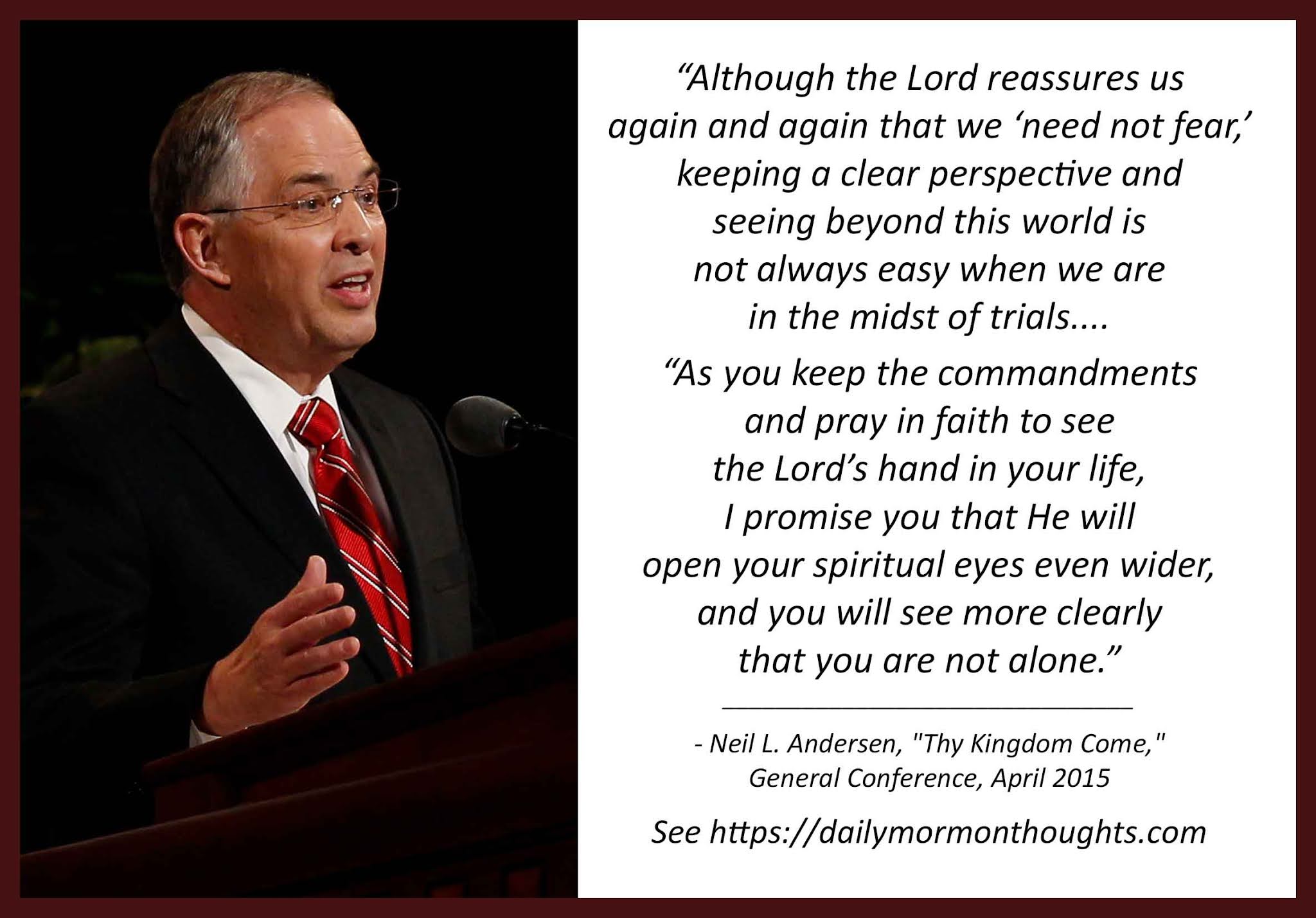
Elder Neil L. Andersen on seeing God's hand and help in our lives

Elder Neil L. Andersen (1951- ) served as a Seventy beginning in 1993, and was called to the Quorum of Twelve Apostles in 2009 (the most recent member called).
"Although the Lord reassures us again and again that we 'need not fear' (D&C 10:55), keeping a clear perspective and seeing beyond this world is not always easy when we are in the midst of trials....
"Seeing and believing the Lord's miracles in establishing His kingdom on earth can help us see and believe that the Lord's hand is at work in our own lives as well....
"Sometimes we can see the hand of the Lord in the lives of others but wonder, 'How can I more clearly see His hand in my own life?' ...
"Remember the young man who cried out to the prophet Elisha as they were surrounded by enemies: 'Alas, [what] shall we do?' (2 Kings 6:15)
"Elisha answered:
"'Fear not: for they that be with us are more than they that be with them.
"'[Then] Elisha prayed, ... Lord, ... open his eyes, that he may see. And the Lord [did open] the eyes of the young man; and he [did see that] the mountain was full of horses and chariots of fire.' (2 Kings 6:16–17)
"As you keep the commandments and pray in faith to see the Lord's hand in your life, I promise you that He will open your spiritual eyes even wider, and you will see more clearly that you are not alone."
- Neil L. Andersen, "Thy Kingdom Come," General Conference, April 2015
Click here to read the full talk

Elder Andersen's assertion is that seeing and recognizing God's hand in the lives of others, or in the events of the Restoration and other world situations, leads us to see and recognize His hand in our own lives. I believe that is true! One of the blessings and privileges of serving in the Church is that you are often exposed to that kind of divine intervention. I have often been blessed as I've seen the hand of God at work around me.

The brief story about Elijah and the "young man" is one if my favorites from the Old Testament. I have enjoyed pondering the imagery of the prophet mentoring the youth in word; but then praying for him that he might see and understand. The teacher knew he had a responsibility greater than just "preaching" — he wanted to make sure the message was received and understood, and so he devoted spiritual efforts in addition to his physical ones.  God then was the one who intervened, and opened the eyes of the boy.


We have the promise that we, tool, will see God's hand in our life as we draw hear to Him. How we need that strength and confidence in today's world!

(Compilation and commentary by David Kenison, Orem, Utah, 2021)
April 30, 2015

Wednesday, May 12, 2021

President Gordon B. Hinckley on accentuating the positive

President Gordon B. Hinckley (1910-2008) was called to the Quorum of Twelve in 1961. He served as a counselor in the First Presidency from 1981-1995, then as Church President until his death in 2008.
"I am asking that we stop seeking out the storms and enjoy more fully the sunlight. I am suggesting that as we go through life we 'accentuate the positive.' I am asking that we look a little deeper for the good, that we still voices of insult and sarcasm, that we more generously compliment virtue and effort. I am not asking that all criticism be silenced. Growth comes of correction. Strength comes of repentance. Wise is the man who can acknowledge mistakes pointed out by others and change his course. 
"What I am suggesting is that each of us turn from the negativism that so permeates our society and look for the remarkable good among those with whom we associate, that we speak of one another's virtues more than we speak of one another's faults, that optimism replace pessimism, that our faith exceed our fears. When I was a young man and was prone to speak critically, my father would say: 'Cynics do not contribute, skeptics do not create, doubters do not achieve.'" 
- Gordon B. Hinckley, "The Continuing Pursuit of Truth," Ensign, April 1986, p. 2
Click here to read the full article

Storms are a part of life. They come from time to time, and in spite of the challenges they bring, they also bring benefits. That's true in the physical world. But symbolically, President Hinckley warns about the tendency to "seek out" storms, or to focus only on the challenges to be found in our lives:


Each of us can try harder to compliment the good we encounter and overlook the negative. As we seek virtues and strengths instead of shortcomings, our interactions will improve and our whole outlook on life will be blessed.

(Compilation and commentary by David Kenison, Orem, Utah, 2021)
March 2, 2015

Tuesday, May 11, 2021

Elder D. Todd Christofferson on the consecrated life and work

Elder D. Todd Christofferson (1945- ) was called to the Seventy in 1993, and as a member of the Quorum of Twelve Apostles in 2008.
"To consecrate is to set apart or dedicate something as sacred, devoted to holy purposes. True success in this life comes in consecrating our lives—that is, our time and choices—to God's purposes (see John 17:1, 4; D&C 19:19). In so doing, we permit Him to raise us to our highest destiny.... 
"A consecrated life is a life of labor. Beginning early in His life, Jesus was about His Father's business (see Luke 2:48-49). God Himself is glorified by His work of bringing to pass the immortality and eternal life of His children (see Moses 1:39). We naturally desire to participate with Him in His work, and in so doing, we ought to recognize that all honest work is the work of God. In the words of Thomas Carlyle: 'All true Work is sacred; in all true Work, were it but true hand-labour, there is something of divineness. Labour, wide as the Earth, has its summit in Heaven.' (Thomas Carlyle, Past and Present (1843), 251) 
"God has designed this mortal existence to require nearly constant exertion. I recall the Prophet Joseph Smith's simple statement: 'By continuous labor [we] were enabled to get a comfortable maintenance' (JS-H 1:55). By work we sustain and enrich life. It enables us to survive the disappointments and tragedies of the mortal experience. Hard-earned achievement brings a sense of self-worth. Work builds and refines character, creates beauty, and is the instrument of our service to one another and to God. A consecrated life is filled with work, sometimes repetitive, sometimes menial, sometimes unappreciated but always work that improves, orders, sustains, lifts, ministers, aspires." 
- D. Todd Christofferson, "Reflections on a Consecrated Life", General Conference October 2010; Click here to read the full talk

I love the phrase "a consecrated life." It denotes a quality of living that is no longer self-centered or self-serving, no longer distracted by worldliness; but is "set apart" or dedicated "as sacred, devoted to holy purposes." Elder Christofferson notes that in that kind of a mindset, we recognize that we are a part of God's work—and can be in any type of labor. With the consecrated mindset, "all honest work is the work of God."

I remember in my youth hearing a Seminary teacher whom I greatly respected quote 2 Nephi 26:31, "But the laborer in Zion shall labor for Zion; for if they labor for money they shall perish." He used the passage to explain why he was a professional Seminary teacher. I was impressed by that, and wondered if I should follow in his professional shoes. But that misses the whole point. It's not about the vocation; it's about the motivation. Are we laboring for money, for personal gain and prosperity? Or are we laboring "for Zion," as a consecrated life, desiring to aid and build up the kingdom of God and do His work, regardless of the vocation?

And further, Elder Christofferson explains, it's the work itself that helps to ennoble and purify us in the process. The labor of a consecrated individual "enables us to survive the disappointments and tragedies of the mortal experience." What a great promise!


(Compilation and commentary by David Kenison, Orem, Utah, 2021)
February 22, 2015

Monday, May 10, 2021

Elder David A. Bednar on being quick to observe

Elder Bednar (1952- ) was sustained as a member of the Quorum of Twelve Apostles in 2004. The following year, he spoke at a BYU devotional and shared thoughts about the spiritual gifts of observation and discernment:
"I hope you also are learning about and becoming quick to observe. Your future success and happiness will in large measure be determined by this spiritual capacity. 
"Please consider the significance of this important spiritual gift. As used in the scriptures, the word observe has two primary uses. One use denotes 'to look' or 'to see' or 'to notice'—as we learn in Isaiah 42:20: 'Seeing many things, but thou observest not; opening the ears, but he heareth not' (emphasis added). 
"The second use of the word observe suggests 'to obey' or 'to keep'—as is evident in the Doctrine and Covenants: 'But blessed are they who have kept the covenant and observed the commandment, for they shall obtain mercy' (D&C 54:6; emphasis added). 
"Thus when we are quick to observe, we promptly look or notice and obey. Both of these fundamental elements—looking and obeying—are essential to being quick to observe.... 
"Quick to observe. Prompt to watch and to obey. A simple gift that blesses us individually and in our families and extends blessings to so many other people. Each of us can and should strive to be worthy of this significant spiritual gift—even the capacity of being quick to observe." 
- David A. Bednar, "Quick to Observe," BYU devotional, May 10, 2005
Click here to read the full talk
Elder Bednar often gives wonderfully thoughtful and thought-provoking addresses. This was a good example. He teaches some great principles, and then gives some beautiful and touching examples that illustrate those concepts—how to observe faithful examples from those around us in order to learn and emulate, and a key to observing needs where we might make a difference for someone.


Elder Bednar then continues to note that "being quick to observe is an antecedent to and is linked with the spiritual gift of discernment. And for you and for me, discernment is a light of protection and direction in a world that grows increasingly dark."  He goes on to discuss this second spiritual gift in further detail. See the link at the end of the quote above to read the full talk; it's worth a few minutes to study and ponder!

We need to strive to develop this gift—learn to be "quick to observe." I love that concept of being able and willing to promptly "notice and obey." How blessed we would be to develop that level of humility, trust, and faith.
 
(Compilation and commentary by David Kenison, Orem, Utah, 2021)
January 19, 2015

Saturday, May 8, 2021

Elder Dallin H. Oaks on conversion and becoming

Elder Dallin H. Oaks (1932- ) was sustained to the Quorum of Twelve Apostles in 1984.
"The Final Judgment is not just an evaluation of a sum total of good and evil acts—what we have done. It is an acknowledgment of the final effect of our acts and thoughts—what we have become. It is not enough for anyone just to go through the motions. The commandments, ordinances, and covenants of the gospel are not a list of deposits required to be made in some heavenly account. The gospel of Jesus Christ is a plan that shows us how to become what our Heavenly Father desires us to become.... 
"We qualify for eternal life through a process of conversion. As used here, this word of many meanings signifies not just a convincing but a profound change of nature.... 
"The gospel of Jesus Christ is the plan by which we can become what children of God are supposed to become. This spotless and perfected state will result from a steady succession of covenants, ordinances, and actions, an accumulation of right choices, and from continuing repentance. 'This life is the time for men to prepare to meet God' (Alma 34:32). 
"Now is the time for each of us to work toward our personal conversion, toward becoming what our Heavenly Father desires us to become." 
- Dallin H. Oaks, "The Challenge to Become," General Conference Oct 2000;
Click here to read the full talk
This was a landmark address by Elder Oaks. His insight on the purpose of our existence helps us understand that we're not checking off a checklist of deeds, actions, even ordinances. We are transforming ourselves into the kind of person for whom all those things are natural occurrences.


So it's not about what we do; it's all about what we become. The purpose of religion and obedience is conversion—the transformation of our natures, as we try to "become what our Heavenly Father desires us to become." And the encouraging message is that the transformation is gradual, but guaranteed, as we pursue the course that leads to it. As we change our natures, as we become more like the Savior, then the actions are a natural outcome.

(Compilation and commentary by David Kenison, Orem, Utah, 2021)
February 11, 2015
// Customization to close archive widget on first view - DK 3/15