Sunday, March 13, 2022

President Russell M. Nelson on Christlike service to others

President Russell M. Nelson (born Sept 9, 1924) was an internationally-renowned heart surgeon when he was called to serve as a member of the Quorum of Twelve Apostles in 1984. He became president of that quorum on July 15, 2015. Following the death of President Monson, he was set apart as president of the Church on January 14, 2018.
"Relationships with neighbors, friends, and associates will be enhanced as we approach them with 'the pure love of Christ' (Moro. 7:47). A desire to emulate the Lord provides powerful motivation for good. Our craving for compassion will cause us to act in accord with the Golden Rule (Matt. 7:12). By so doing, we will find joy in feeding the poor, clothing the naked, or doing volunteer work of worth.
"Service to neighbors takes on new stature when we first look to God. In the Church, when priesthood and auxiliary leaders face their congregations, quorums, and classes as would the Lord, they learn that it does not matter where they serve, but how. Position in the Church does not exalt anyone, but faithfulness does. On the other hand, aspiring to a visible position—striving to become a master rather than a servant—can destroy the spirit of the worker and the work....
"In rendering service to others, which way do we face? From the right or the left, we can only push or pull. We can lift only from a higher plane. To reach it we don't look sideways; we look up to our Master. Just as we must look to God to live well, so we must look to God to serve well."
- Russell M. Nelson, "Thou Shalt Have No Other Gods," General Conference April 1996
Click here to read or listen to the full talk

One of the greatest blessings and challenges of the Gospel vision of life is the call to love and serve one another. We emulate the Savior as we do so; and striving always to see those around us as He would see them facilitates that service. And the results are promised: "By so doing, we will find joy in feeding the poor, clothing the naked, or doing volunteer work of worth." It doesn't require a calling or position of leadership to serve in this way; only a desire to do the Lord's work faithfully.


I was grateful for President Nelson's assurance that as we "look to God" we will be better able to live, and better able to serve.

(Compilation and commentary by David Kenison, Orem, Utah, 2022)
December 26, 2016

Saturday, March 12, 2022

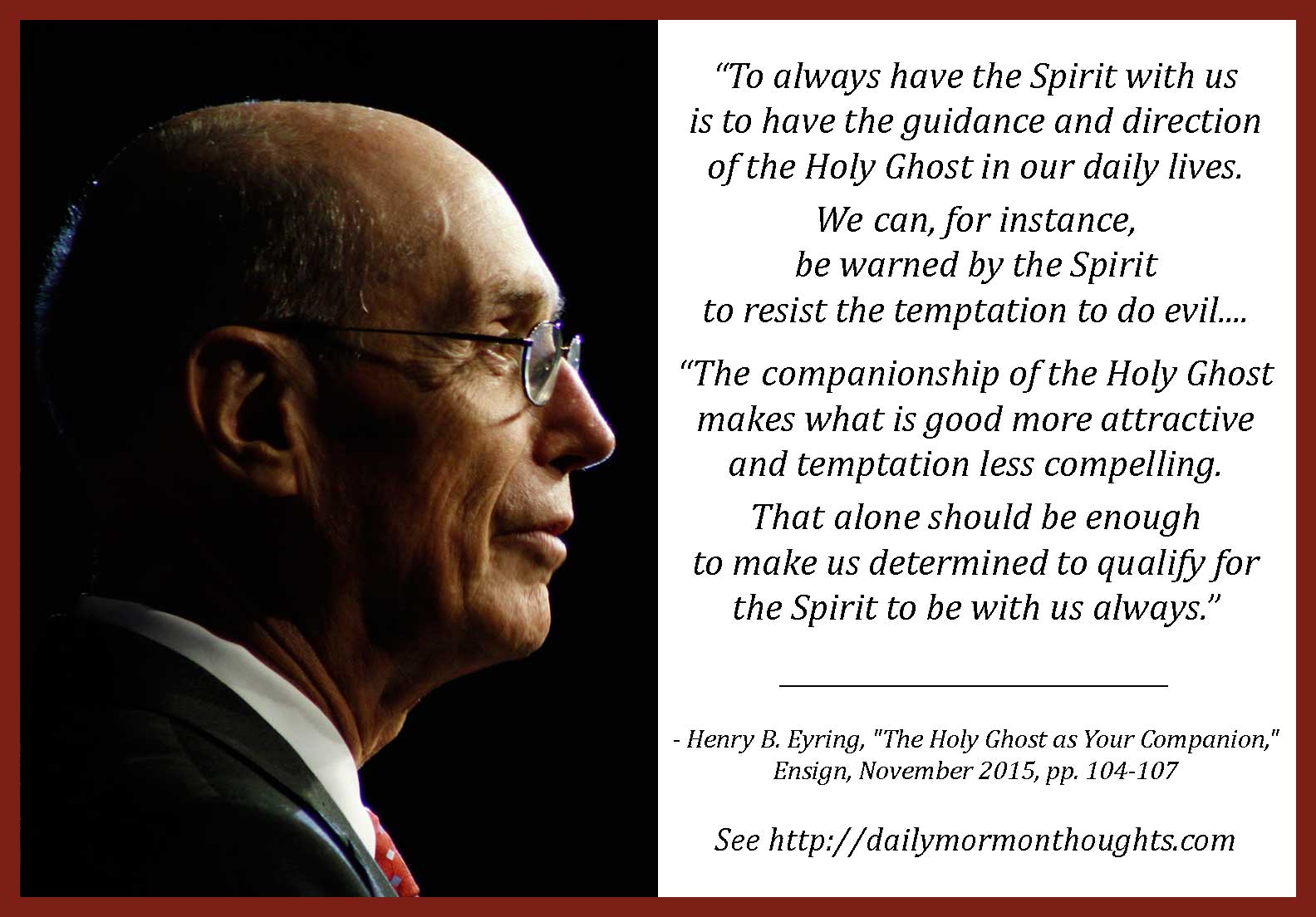
President Henry B. Eyring on seeking the companionship of the Holy Ghost

President Henry B. Eyring (1933- ) served in the Presiding Bishopric from 1985-1992, as a Seventy from 1992-1995, then was called to the Quorum of Twelve Apostles. He has served in the First Presidency since 2007.
"My purpose today is to increase your desire and your determination to claim the gift promised to each of us after we were baptized. During our confirmation we heard these words: 'Receive the Holy Ghost.' From that moment, our lives changed forever.
"We can, if we live worthy of it, have the blessing of the Spirit to be with us, not only now and then, ... but always....
"To always have the Spirit with us is to have the guidance and direction of the Holy Ghost in our daily lives. We can, for instance, be warned by the Spirit to resist the temptation to do evil.
"For that reason alone, it is easy to see why the Lord’s servants have tried to increase our desire to worship God in our sacrament meetings. If we partake of the sacrament in faith, the Holy Ghost will then be able to protect us and those we love from the temptations that come with increasing intensity and frequency.
"The companionship of the Holy Ghost makes what is good more attractive and temptation less compelling. That alone should be enough to make us determined to qualify for the Spirit to be with us always.
"Just as the Holy Ghost strengthens us against evil, He also gives us the power to discern truth from falsehood. The truth that matters most is verified only by revelation from God. Our human reason and the use of our physical senses will not be enough. We live in a time when even the wisest will be hard-pressed to distinguish truth from clever deception."
- Henry B. Eyring, "The Holy Ghost as Your Companion," Ensign, November 2015, pp.
Click here to read the full article

President Eyring's talk in the October 2015 general conference was very personal and tender. He shared family experiences and intimate feelings about the influence of the Holy Ghost. He spoke from his heart, and know whereof he spoke, regarding the blessing of "the blessing of the Spirit to be with us, not only now and then, ... but always." I was moved by these descriptions of some of the blessings of that gift.


So among the blessings are:
  • increased guidance in our lives
  • warning in times of temptation
  • making good more attractive and temptation less
  • power to discern truth from falsehood
Marvelous things to consider.  Any of those things, as President Eyring states about one of them, "should be enough to make us determined to qualify for the Spirit to be with us always." What a gift to be treasured — to be earned, and then guarded carefully!

(Compilation and commentary by David Kenison, Orem, Utah, 2022)
January 13, 2016

Friday, March 11, 2022

President Dieter F. Uchtdorf on choosing things that matter most

Elder Dieter F. Uchtdorf (born November 6, 1940) served as a Seventy from 1994-2004, when he was called as a member of the Quorum of Twelve.  He served as second counselor in the First Presidency from 2008 to 2018.
"The tendency to focus on the insignificant at the expense of the profound happens... to everyone. We are all at risk. The driver who focuses on the road has a far greater chance of arriving at his destination accident free than the driver who focuses on sending text messages on his phone.
"We know what matters most in life—the Light of Christ teaches this to everyone. We as faithful Latter-day Saints have the Holy Ghost as a 'constant companion' to teach us the things of eternal value. I imagine that any priesthood holder listening to my voice today, if asked to prepare a talk on the subject 'what matters most,' could and would do an excellent job. Our weakness is in failing to align our actions with our conscience.
"Pause for a moment and check where your own heart and thoughts are. Are you focused on the things that matter most? How you spend your quiet time may provide a valuable clue. Where do your thoughts go when the pressure of deadlines is gone? Are your thoughts and heart focused on those short-lived fleeting things that matter only in the moment or on things that matter most?"
- Dieter F. Uchtdorf, "We Are Doing a Great Work and Cannot Come Down," Ensign, May 2009, pp. 59-62
Click here to read the full talk

"Our weakness is in failing to align our actions with our conscience." That's a powerful warning. We know so much more than we do, and even when the promptings come, we don't always heed and act.

President Uchtdorf gives a "litmus test" to help evaluate the real intent of our hearts. How do we spend our "quiet time," the moments when there is no pressure of deadlines or requirements to fulfill duties? Do we choose to focus that time on "things that matter most"?


We need to "pause for a moment" more often in our lives to "check where [our] own hearts and thoughts are." What a difference that would make!

(Compilation and commentary by David Kenison, Orem, Utah, 2022)
November 6, 2015

Thursday, March 10, 2022

President Gordon B. Hinckley on loving life and reaching our divine potential

President Gordon B. Hinckley (1910-2008) was called to the Quorum of Twelve in 1961, served as a counselor in the First Presidency from 1981-1995, then as Church President until his death in 2008 at age 97.
"For you, my dear friends, the sky is the limit. You can be excellent in every way. You can be first class. There is no need for you to be a scrub. Respect yourself. Do not feel sorry for yourself. Do not dwell on unkind things others may say about you.... Polish and refine whatever talents the Lord has given you. Go forward in life with a twinkle in your eye and a smile on your face, but with great and strong purpose in your heart. Love life and look for its opportunities, and forever and always be loyal to the Church.
"Never forget that you came to earth as a child of the divine Father, with something of divinity in your very makeup. The Lord did not send you here to fail. He did not give you life to waste it. He bestowed upon you the gift of mortality that you might gain experience—positive, wonderful, purposeful experience—that will lead to life eternal."
- Gordon B. Hinckley, "How Can I Become the Woman of Whom I Dream?", Ensign, May 2001, pp. 93-95
Click here to read the full talk

Scrub Oaks on a Utah hillside
President Hinckley, with his perpetually optimistic and encouraging attitude, used the image "don't be a scrub" on more than one occasion in his speeches. Growing up in Utah, the first exposure I had to that word was in describing trees as "scrub oaks" — the small, stunted trees that cover the foothills of the Wasatch mountains. They are often not much more than 6 or 8 feet high, and grow in groups or clusters, competing for the limited water of the annual rainfall. I assume it's the lack of reliable water that has made them adapt, never growing very large.

When I lived on the east coast after graduating college, I discovered that oak trees can be massive, majestic, stunning specimens — living for hundreds of years and growing to impressive heights, their widespread branches offering shade and protection. This is the contrast, perhaps, that President Hinckley was pointing out. We each have the ability to be "first class" and come to realize that "the sky is the limit" as we learn to "be excellent in every way."

So the invitation from this remarkable man is to "love life" and know that God will sustain and bless us to ultimately succeed in every worthy way.


(Compilation and commentary by David Kenison, Orem, Utah, 2022)
October 31, 2015

Wednesday, March 9, 2022

President Harold B. Lee on the most important commandment

President Harold B. Lee (1899-1973) was called to the Quorum of Twelve Apostles in 1941. He served as a counselor in the First Presidency from 1970-1972, then as Church president from July 1972 until his passing less than 18 months later in December 1973.
"Now, if you have made mistakes, make today the beginning of a change of your lives. Turn from the thing that you have been doing that is wrong. The most important of all the commandments of God is that one that you are having the most difficulty keeping today. If it is one of dishonesty, if it is one of unchastity, if it is one of falsifying, not telling the truth, today is the day for you to work on that until you have been able to conquer that weakness. Put that aright and then you start on the next one that is most difficult for you to keep. That's the way to sanctify yourself by keeping the commandments of God."
- Harold B. Lee, Devotional, Long Beach California, 4/29/73; see The Teachings of Harold B. Lee, p. 82
I love the New Testament story of the lawyer who asks the Savior about the greatest of the commandments. He hoped to trap the Savior into an answer that could be criticized; but the response was incapable of dispute: "Thou shalt love the Lord thy God with all thy heart, and with all thy soul, and with all thy mind" (see Matthew 22:34-40). That guideline would encompass all others; we show our love for Him by allowing His teachings and commandments to direct our lives.

President Lee may not have been asked the question directly, but his response provides a simple and clear way to focus on our personal progress. All we need to do is "conquer that weakness"—the one troubling us currently—one by one, and eventually we'll achieve the complete devotion God asks of us.


This is a powerful reminder on where we should focus our attention and efforts!

(Compilation and commentary by David Kenison, Orem, Utah, 2022)
June 10, 2015

Tuesday, March 8, 2022

Elder Marvin J. Ashton on perspective and sensitivity in our accomplishments

Elder Marvin J. Ashton (1915-1994) served as a member of the Quorum of Twelve Apostles from 1971 until his death in 1994 at age 78.
"How easy it is for man to believe that temporal success has been achieved by his own skills and labor. Everything good comes from the Lord.
"Consideration for the feelings of others should always be important to worthy Latter-day Saints. Rightfully we may be happy about the number of children with which we have been blessed, the missionaries who have served, the temple marriages of our offspring, and the accomplishments of family members; but others who are not so fortunate may have feelings of guilt or inadequacy. They may have been praying long and hard for the same blessings about which we are boasting. These people may feel that they are out of favor with God.
"For this reason our appreciation should be sincerely felt and gratitude expressed frequently to our Father in Heaven—but not too vocally to the world.
"May we all be gratefully aware of the source of our blessings and strengths and refrain from taking undue credit for personal accomplishments.
"Oftentimes when we dwell on where we have been and where we are now, and what we have now spiritually or financially, we can create resentment rather than respect.
"Boasting, whether it be done innocently or otherwise, is not good. Too frequently it creates an impression of more interest in self than in others."
- Marvin J. Ashton, "Neither Boast of Faith Nor of Mighty Works," Ensign, May 1990, p. 65
Click here to read the full article

Many years ago, not long before this conference talk was given, I attended a stake conference in Colorado at which Elder Ashton presided. One of the speakers in the meeting was a woman who was obviously very proud of her accomplished husband and her large family, and their many wonderful achievements; she spoke at some length about the joy of her family's successes.

When it was Elder Ashton's turn to speak, he gave a gentle but firm rebuke in much the same spirit of this quote—his decision to speak on this topic in conference was likely a result of this experience, and others like it. In our stake, he pointed out that as fortunate and blessed as the sister was, there were others in the room who, through no fault of their own and no lack of worthiness and effort, didn't have the same blessings; and did she recognize how truly fortunate and blessed she was, far beyond anything she had done to earn or merit the blessings? He went on to reassure all present that God loved them equally as much, and would bless them appropriately (in His own time and way) for their faithfulness.

Elder Ashton was a master teacher, and presented that message in a way that was not in any way hurtful or critical, but only offering loving counsel to all of us that we should be much more aware of those around us and sensitive to their feelings. I am one who has occasionally felt "feelings of guilt or inadequacy" when some of these kinds of things have been expressed, wondering why I was not deserving of the blessings that someone else was receiving. And I have likely been one who has made others uncomfortable as I have unwittingly expressed gratitude that came across as boasting.


This is the tender suggestion from Elder Ashton: "our appreciation should be sincerely felt and gratitude expressed frequently to our Father in Heaven—but not too vocally to the world." And this results naturally from remembering that God is the source of our blessings, and we should never take "undue credit for personal accomplishments."

(Compilation and commentary by David Kenison, Orem, Utah, 2022)
November 25, 2016

Monday, March 7, 2022

President Ezra Taft Benson on suggestions for prayer

President Ezra Taft Benson (1899-1994) was called to the Quorum of Twelve Apostles in 1943, and served as the 13th President of the Church from 1985 until his death in 1994 at age 94.
"For what should we pray? We should pray about our work, against the power of our enemies and the devil, for our welfare and the welfare of those around us. (Alma 34:20, 22-25, 27.) We should counsel with the Lord pertaining to all our decisions and activities. (Alma 37:36-37.) We should be grateful enough to give thanks for all we have. (D&C 59:21.) We should confess His hand in all things. Ingratitude is one of our great sins....
"We should ask for what we need, taking care that we not ask for things that would be to our detriment. (James 4:3.) We should ask for strength to overcome our problems. (Alma 31:31-33.) We should pray for the inspiration and well-being of the president of the Church, the General Authorities, our stake president, our bishop, our quorum president, our home teachers, family members, and our civic leaders. Many other suggestions could be made; but with the help of the Holy Ghost, we will know about what we should pray. (Rom. 8:26.)
"After making a request through prayer, we have a responsibility to assist in its being granted. We should listen. Perhaps while we are on our knees, the Lord wants to counsel us.
"'Sincere praying implies that when we ask for any virtue or blessing we should work for the blessing and cultivate the virtue.' (David O. McKay, True to the Faith, Bookcraft, 1966, p. 208.)"
- Ezra Taft Benson, "Prayer," Ensign, May 1977, pp. 32-34
Click here to read the full talk

Anciently, the Savior's disciples asked Him, "Lord, teach us to pray" (Luke 11:1). It's a question that we all should continue to ask, as we endeavor to improve our communication with our Father in Heaven. President Benson gives some suggestions that are worth pondering:


After offering additional suggestions, President Benson makes the most important observation: "Many other suggestions could be made; but with the help of the Holy Ghost, we will know about what we should pray." Clearly, that is our best and most personal teacher.

(Compilation and commentary by David Kenison, Orem, Utah, 2022)
September 5, 2016
// Customization to close archive widget on first view - DK 3/15