Monday, May 25, 2015

Gordon B. Hinckley on remembrance and gratitude for military service

President Gordon B. Hinckley (1910-2008) was called to the Quorum of Twelve in 1961. He served as a counselor in the First Presidency from 1981-1995, then as Church President until his death in 2008.
"I deeply appreciate those who have sacrificed their lives for the cause of human liberty. I hate war, with all its mocking panoply. It is a grim and living testimony that Satan, the father of lies, the enemy of God, lives. War is earth's greatest cause of human misery. It is the destroyer of life, the promoter of hate, the waster of treasure. It is man's costliest folly, his most tragic misadventure....
"Can anyone in a free land be less than grateful for those who have given their lives that liberty might flourish?
"I have stood at the Tomb of the Unknown Soldier in Arlington National Cemetery, where are remembered those who have died for the freedom of the United States. I have stood by the Cenotaph at Whitehall in London, where are remembered the dead of Britain. I have seen the flame that always burns beneath the Arch of Triumph in Paris, in remembrance of the men of France who died in the cause of freedom. At each of these sacred places I have felt a deep and moving sense of gratitude to those there remembered. I have stood beside my own brother's grave in the U.S. military cemetery in Suresnes, France, and thanked the Lord for the liberty preserved by the sacrifices of those who gave their lives in the cause of human liberty. I have walked reverently on that quiet ground known as the Punch Bowl in Hawaii, where lie the remains of thousands who made the ultimate sacrifice....
"In such places, hallowed by the blood of patriots, I have thought of a scene in the Maxwell Anderson play Valley Forge. The scene depicts soldiers of the American Revolution, cold, hungry, and filled with despair, burying a dead comrade in the frozen earth. General Washington says with a touch of bitterness: 'This liberty will look easy by and by, when nobody dies to get it.'
"When I was a boy in school, each Armistice Day at eleven o'clock we all stood with bowed heads for a minute of silent and grateful remembrance. I am sorry we have forgotten that practice in the rush of our lives....
"May the Lord bless our brethren in the service, wherever they may be, for their faithfulness. May the Lord remind us of the debt of gratitude we owe them, and may he awaken within us a resolution to live worthy of their sacrifice."
- Gordon B. Hinckley, "In Grateful Remembrance," Ensign, March 1971, p. 20
Click here to read the full address
This is such a touching tribute and reminder from President Hinckley. He starts with this vivid description of war's "mocking panoply" that he attributes directly to Satan:


President Hinckley then documents his own personal gratitude, giving examples of those who have sacrificed in war to preserve freedom—including his own brother.

This reminder warns that we are losing the patriotism of the past as it subtly fades:


And I think this concluding prayer and challenge sums up the message.


Sunday, May 24, 2015

Boyd K. Packer on learning to listen and live with faith

President Boyd K. Packer (1924- ) served as an Assistant to the Quorum of the Twelve (a position that no longer exists) from 1961 to 1970, when he was called to the Quorum of Twelve Apostles.  He currently serves as the president of that Quorum.
"Shortly after I was called as a General Authority, I went to Elder Harold B. Lee for counsel. He listened very carefully to my problem and suggested that I see President David O. McKay. President McKay counseled me as to the direction I should go. I was very willing to be obedient but saw no way possible for me to do as he counseled me to do.
"I returned to Elder Lee and told him that I saw no way to move in the direction I was counseled to go. He said, 'The trouble with you is you want to see the end from the beginning.' I replied that I would like to see at least a step or two ahead. Then came the lesson of a lifetime: 'You must learn to walk to the edge of the light, and then a few steps into the darkness; then the light will appear and show the way before you.' Then he quoted these eighteen words from the Book of Mormon: 'Dispute not because ye see not, for ye receive no witness until after the trial of your faith.' (Ether 12:56)
"Those eighteen words from Moroni have been like a beacon light to me."
- Boyd K. Packer, "The Edge of the Light," BYU eighteen-stake fireside, March 4, 1990
Click here to read the full talk
President Packer, in his younger years, received this very wise and very applicable counsel. There are times in life when it seems we are asked to demonstrate our faith by action in the face of uncertainty. If we have received counsel from a wise leader, or even more importantly, if we have felt inspiration from the Holy Spirit, then we should act in faith. Sometimes that means being willing to take a few steps when there does not appear to be a clear path ahead.


I believe one of the great needs in this life is learning to recognize the whisperings of the Holy Spirit, so that when they come, we know we are being prompted and guided. As we act upon those promptings and see the results, two things happen: we grow in faith so that it becomes easier to act next time; and also, the Spirit knows we can be trusted and will prompt more often.

Saturday, May 23, 2015

Thomas S. Monson on divine guidance in life's journey

President Thomas S. Monson (1927- ) was sustained to the Quorum of Twelve Apostles in 1963.  He served as a counselor in the First Presidency with Presidents Benson, Hunter, and Hinckley until becoming Church president in 2008.

"Like the vital rudder of a ship, brethren, we have been provided a way to determine the direction we travel. The lighthouse of the Lord beckons to all as we sail the seas of life. Our purpose is to steer an undeviating course toward our desired goal—even the celestial kingdom of God. A man without a purpose is like a ship without a rudder, never likely to reach home port. To us comes the signal: chart your course, set your sail, position your rudder, and proceed....
"Our Father provided the sun, the moon, and the stars—heavenly galaxies to guide mariners who sail the lanes of the sea. To us, as we walk the pathway of life, He provides a clear map and points the way toward our desired destination. He cautions: beware the detours, the pitfalls, the traps. We cannot be deceived by those who would lead us astray, those clever pied pipers of sin beckoning here or there. Instead, we pause to pray; we listen to that still, small voice which speaks to the depths of our souls the Master's gentle invitation, 'Come, follow me.' (Luke 18:22.)"
- Thomas S. Monson, "Guided Safely Home," Ensign, November 2014, pp. 67-69
Click here to read the full talk
President Monson loves the imagery of lighthouses, the sea, and navigation. In this recent example, he links the ability to direct our lives with the image of a rudder; lacking a rudder is like having no purpose in life, and thus no ability to navigate.


There are some key words in this quote, such as "vital" and "undeviating" —  a reminder of the need for constancy and faithfulness.

He goes on to remind us that a loving Heavenly Father provided his children with a variety of "navigation aids" that can help us make good choices in life and stay on the proper path, avoiding "the detours, the pitfalls, the traps." The key for us is to choose to heed them by following the Savior in every way.

Friday, May 22, 2015

David O. McKay on finding happiness in life

President David O. McKay (1873-1970) was called to the Quorum of Twelve Apostles in 1906.  He served as a counselor in the First Presidency to Heber J. Grant and George Albert Smith beginning in 1945, then then as the president of the Church from 1951 to his death in 1970 at age 96.
"All mankind desire happiness. Many also strive sincerely to make the most and best of themselves. Surprisingly few, however, realize that a sure guide to such achievement may be found in the following declaration by Jesus of Nazareth: 'Whosoever will save his life shall lose it: And whosoever will lose his life for my sake shall find it.' [Matthew 16:25.] This significant passage contains a secret more worthy of possession than fame or dominion, something more valuable than all the wealth of the world.
"It is a principle the application of which promises to supplant discouragement and gloom with hope and gladness; to fill life with contentment and peace everlasting. This being true its acceptance would indeed be a boon today to this distracted, depression-ridden world. Why, then, do men and nations ignore a thing so precious? ...
"Specifically stated, this law is, 'We live our lives most completely when we strive to make the world better and happier.' The law of pure nature, survival of the fittest, is self-preservation at the sacrifice of all else; but in contrast to this the law of true spiritual life is, deny self for the good of others."
- David O. McKay, Conference Report, Apr. 1936, 45-46

The "search for happiness" has been one of the continual quests of mankind. President McKay finds a simple solution to the search in the invitation of the Savior to commit to Him and His work — to "lose his life for my sake." And he sees a stark contrast between the world's frequent priority and the "law of true spiritual life":


Given the promise that this course of action "promises to supplant discouragement and gloom with hope and gladness; to fill life with contentment and peace everlasting" — the searching question is, "Why, then, do men and nations ignore a thing so precious?"

Thursday, May 21, 2015

Richard L. Evans on making and breaking habits

Elder Richard L. Evans (1906-1971) served as a Seventy from 1938-1953, when he was called to the Quorum of Twelve Apostles.  He died in 1971 at age 65.  He was known as "the voice of the Tabernacle Choir" from the beginning of its broadcasts in 1929 until his passing.
"Rip Van Winkle was depicted by one playwright as excusing himself every time he did what he shouldn't do, by saying, '"I won't count this time." Well, he may not count it,' said William James, 'and a kind heaven may not count it, but it is being counted nonetheless. Down among his nerve cells and fibres, the molecules are counting it, registering and scoring it up to be used against him when the next temptation comes. Nothing we ever do is in strict scientific literalness wiped out.'
"And then the celebrated William James said: 'Could the young but realize how soon they will become... walking bundles of habits, they would give more heed to their conduct.... We are spinning our own fates, good or evil.... Every smallest stroke of virtue or of vice leaves its never so little scar.... We are... imitators and copiers of our past selves.'
"But our habits, good or bad, weren't always habits. What we now do habitually we once did first—and then again—and then again. And since we become 'slaves to our own past performances,' we had better be particular about beginning anything that could become a habit.
"Obviously the reason we have bad habits is because we did the first time what shouldn't have been done at all. This may seem to offer little comfort to those who already have unwanted habits. Fortunately, however, bad habits aren't hopeless. But it takes more effort to get out of a rut than it does to get in one, and sometimes the only way to get out is to get out all at once. The best way to leave bad habits behind is simply to leave them behind, without lingering or looking back. The break has to come sometime. Sometime has to be the last time. And it isn't likely to be any easier later, because habits, like ruts, dig more deeply with time, even though at first we may think of them as something we can start or stop whenever we want to....
"The best time to break a bad habit is before the first time. The next best time is now—before the next time."
- Richard L. Evans, "I Won't Count This Time...", The Spoken Word, April 2, 1967; see Improvement Era, June 1967, p. 83
Elder Evans, quoting William James, provides interesting food for thought. We may think a single action doesn't matter much, but "down among... nerve cells and fibres, the molecules are counting" — and the impact is being registered at a level we may not comprehend. Each time we give in to a temptation, it becomes that much easier to give in next time as we slowly become "walking bundles of habits." The profound corollary is that it works just the same for virtues as vices; each good deed or act of obedience makes it that much easier to choose well next time, and the cells and molecules are impacted by every positive step just as they are by the negatives ones.

And as for changing the course once bad decisions or actions have started? Elder Evans advocates decisive and committed action:


I love the insight of this simple closing thought:


Wednesday, May 20, 2015

Joseph B. Wirthlin on living in thanksgiving daily

Elder Joseph B. Wirthlin (1917-2008) served as a Seventy from 1976 to 1986, then as a member of the Quorum of Twelve Apostles from 1986 until his passing in 2008 at age 91.
"I agree with Robert Louis Stevenson, who wrote, 'The man who forgets to be thankful has fallen asleep in life' (Quotationary, electronic quotation dictionary). Unfortunately, because the beauties of life are so abundant, sometimes we take them for granted.
"Our minds have a marvelous capacity to notice the unusual. However, the opposite is true as well: The more often we see the things around us—even the beautiful and wonderful things—the more they become invisible to us.
"That is why we often take for granted the beauty of this world: the flowers, the trees, the birds, the clouds—even those we love.
"Because we see things so often, we see them less and less.
"Those who live in thanksgiving daily, however, have a way of opening their eyes and seeing the wonders and beauties of this world as though seeing them for the first time.
"I encourage you to look around you. Notice the people you care about. Notice the fragrance of the flowers and the song of the birds. Notice and give thanks for the blue of the sky, the color of the leaves, and the white of the clouds. Enjoy every sight, every smell, every taste, every sound."
- Joseph B. Wirthlin, "Live in Thanksgiving Daily," BYU Devotional, 31 October 2000; see Ensign, Sept 2001, pp. 6-13
Click here to read the full talk

Elder Wirthlin warns of an interesting phenomenon—the tendency to take for granted the things around us. We become accustomed to both good and bad, and stop noticing. He's especially concerned about neglecting beauty, including flowers, trees, birds, clouds—simple things.


And the problem is magnified when it extends to "even those we love."

The solution is to "live in thanksgiving daily" by recognizing the blessings that continue to come and continue to surround us.


The key is to keep eyes open, and hearts open as we go about the sometimes routine events of our lives.


Tuesday, May 19, 2015

James E. Faust on standing in holy places

President James E. Faust (1920-2007) was called as a Seventy in 1976, then as a member of the Quorum of Twelve in 1978. He served as a counselor to President Hinckley until his death in 2007 at age 87.
"We are bombarded on all sides by a vast number of messages we don't want or need. More information is generated in a single day than we can absorb in a lifetime. To fully enjoy life, all of us must find our own breathing space and peace of mind. How can we do this? There is only one answer. We must rise above the evil that encroaches upon us. We must follow the counsel of the Lord, who said, 'It is my will, that all they who call on my name, and worship me according to mine everlasting gospel, should gather together, and stand in holy places' (D&C 101:22).
"We unavoidably stand in so many unholy places and are subjected to so much that is vulgar, profane, and destructive of the Spirit of the Lord that I encourage our Saints all over the world, wherever possible, to strive to stand more often in holy places. Our most holy places are our sacred temples. Within them is a feeling of sacred comfort....
"In addition to temples, surely another holy place on earth ought to be our homes. The feelings of holiness in my home prepared me for feelings of holiness in the temple....
"Our chapels are dedicated to the Lord as holy places. We are told we should go to the house of prayer and offer up our sacraments upon His holy day. (See D&C 59:9) ...
"We must try harder to be a holy people.... As children of the Lord we should strive every day to rise to a higher level of personal righteousness in all of our actions. We need to guard constantly against all of Satan's influences.
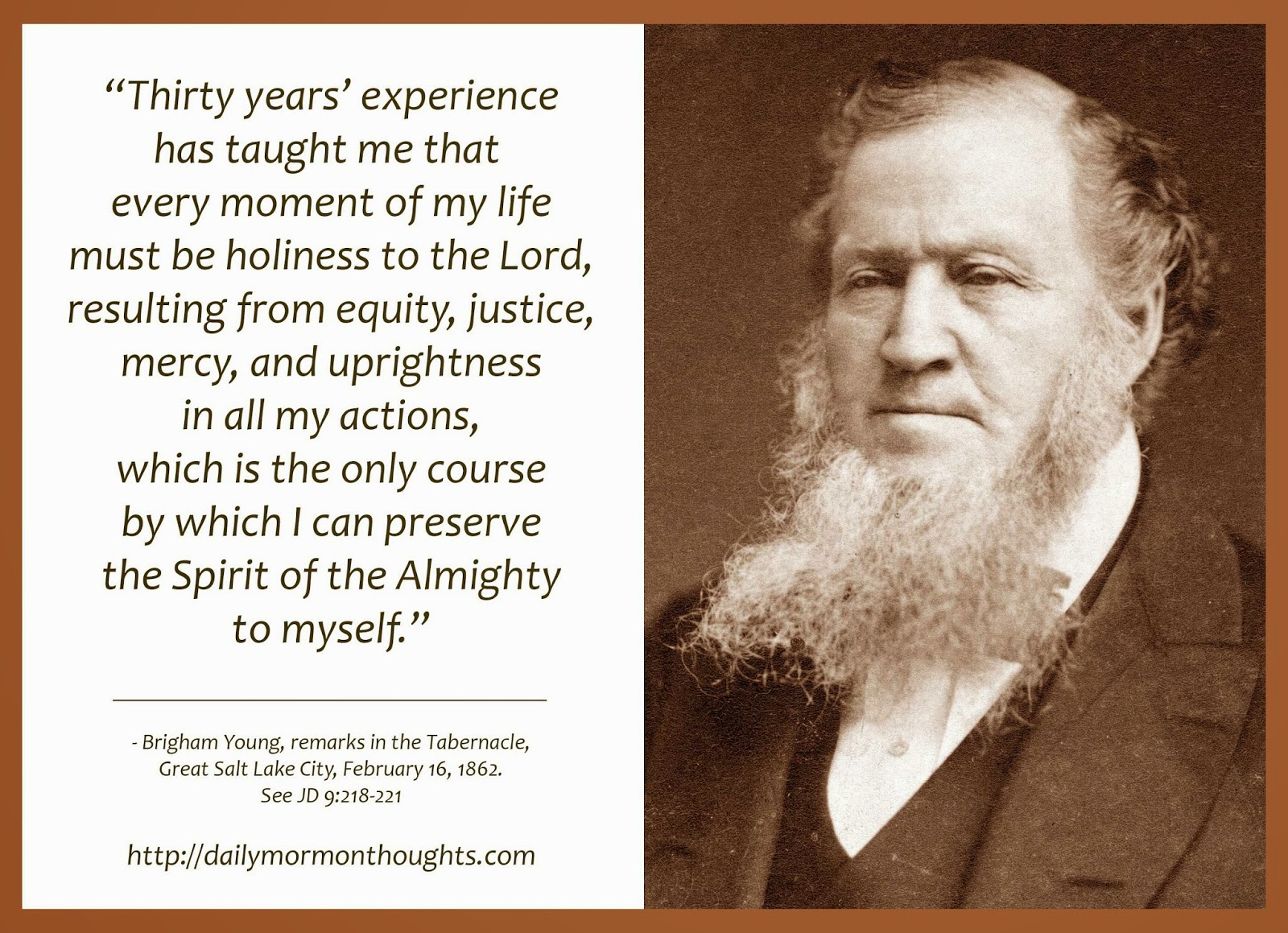
"As President Brigham Young taught, 'Every moment of [our lives] must be holiness to the Lord, ... which is the only course by which [we] can preserve the Spirit of the Almighty to [ourselves].' May the Lord bless each and all of us in our special responsibility to find holiness to the Lord by standing in holy places. That is where we will find the spiritual protection we need for ourselves and our families. That is the source of help to carry forth the word of the Lord in our time. Standing in holy places will help us rise above the evil influences of our time and draw us closer to our Savior."
- James E. Faust, "Standing in Holy Places," Ensign, May 2005, pp. 62-68
Click here to read the full talk
President Faust shares an interesting interpretation of one of the key challenges of our time. The word "bombarded" is particularly descriptive of the way we can be overwhelmed by information:


And that warning is followed by the key invitation of his message:


President Faust specifies the most important "holy places" we can find, establish, and visit:

  • sacred temples
  • our homes
  • chapels
But the next level of growth is not just to be in holy places, but to become holy ourselves by overcoming temptation and growing in righteousness.


I love the passage from Brigham Young that Pres. Faust excerpts:

// Customization to close archive widget on first view - DK 3/15