Monday, September 21, 2015

James E. Talmage on a comparison of happiness and pleasure

Elder James E. Talmage was born in England on September 21, 1862 – 153 years ago today. He was a brilliant scholar, trained as a geologist and mathematician. But he's perhaps best known today among Church members for his classic writings, including "Jesus the Christ," "The Articles of Faith," and "The Holy Temple." He was called as an apostle in 1911 and served until his death in 1933 at age 70.
"Happiness is genuine gold, pleasure but gilded brass, which corrodes in the hand, and is soon converted into poisonous verdigris. Happiness is as the genuine diamond, which, rough or polished, shines with its own inimitable luster; pleasure is as the paste imitation that glows only when artificially embellished. Happiness is as the ruby, red as the heart's blood, hard and enduring; pleasure, as stained glass, soft, brittle, and of but transitory beauty.
"Happiness is true food, wholesome, nutritious and sweet; it builds up the body and generates energy for action, physical, mental and spiritual; pleasure is but a deceiving stimulant which, like spirituous drink, makes one think he is strong when in reality enfeebled; makes him fancy he is well when in fact stricken with deadly malady.
"Happiness leaves no bad after-taste, it is followed by no depressing reaction; it calls for no repentance, brings no regret, entails no remorse; pleasure too often makes necessary repentance, contrition, and suffering; and, if indulged to the extreme, it brings degradation and destruction.
"True happiness is lived over and over again in memory, always with a renewal of the original good; a moment of unholy pleasure may leave a barbed sting, which, like a thorn in the flesh, is an ever-present source of anguish.
"Happiness is not akin with levity, nor is it one with light-minded mirth. It springs from the deeper fountains of the soul, and is not infrequently accompanied by tears. Have you never been so happy that you have to weep? I have."
- James E. Talmage, "A Greeting to the Missionaries," Improvement Era, December 1913, pp. 172-174
Click here to read the full article

Terms like "happiness" and "pleasure" can have various definitions and applications, and often depend on context. But Elder Talmage makes a clear and definite distinction between the concept of a deep, true, lasting happiness and the superficial, fleeting pleasure. I love his analogies and comparisons, each of which teaches an aspect of true happiness. He was a gifted author, and this is an example of his ability to express a concept clearly and powerfully.

HappinessPleasure
Genuine, lasting goldGilded brass, easily corroded
Diamond shining with lusterPaste imitation with no inherent beauty
Red ruby, hard and enduringStained glass, soft and brittle
Wholesome nutritious foodDeceiving stimulant
No bad aftertasteRegret, remorse, anguish
Springs from deep in the soul    Shallow and superficial

The final point about expressing emotion also rang true to me. Many times in life we are driven to shed tears of sadness, frustration, disappointment, or anguish; but tears of joy are also very real and are perhaps an outward expression of the deepest happiness:


Sunday, September 20, 2015

David A. Bednar on sustained progress in life

Elder David A. Bednar (1952- ) was sustained as a member of the Quorum of Twelve Apostles in 2004.
"We will not attain a state of perfection in this life, but we can and should press forward with faith in Christ along the strait and narrow path and make steady progress toward our eternal destiny. The Lord's pattern for spiritual development is 'line upon line, precept upon precept, here a little and there a little' (2 Nephi 28:30). Small, steady, incremental spiritual improvements are the steps the Lord would have us take. Preparing to walk guiltless before God is one of the primary purposes of mortality and the pursuit of a lifetime; it does not result from sporadic spurts of intense spiritual activity.
"I witness that the Savior will strengthen and assist us to make sustained, paced progress."
- David A. Bednar, "Clean Hands and a Pure Heart," Ensign, November 2007, pp. 80-83
Click here to read the full talk

This is such a valuable perspective! There are times when we feel our progress is not fast enough. We want to rush towards our goals, especially the very important ones. We think if we just give a bigger effort that we can dramatically transition quickly to where we want to be.

But Elder Bednar reminds us that in most cases, we make "small, steady, incremental spiritual improvements" towards those eventual goals. We have to be seasoned in experience, developing along the way. And we do that through constant and steady efforts, and not through "sporadic spurts of intense spiritual activity."

I've always loved the word that the Lord used to describe the Nephi in the Book of Mormon — "unwearyingness" (see Helaman 10:4-5). It conveys to me that kind of patient, steady, faithful commitment to the Lord's work that Elder Bednar is encouraging in all of us.


Saturday, September 19, 2015

Orson Pratt on God's wondrous universe

Elder Orson Pratt (1811-1881) was one of the members of the original Quorum of Twelve ordained in 1835.  His scientific and mathematical training often gave him a unique perspective as he applied Gospel principles. This insight was shared at the conclusion of a lecture on astronomy:
"Nothing is calculated to inspire the mind of man with a more profound reverence for the Great Author of nature than the contemplation of his marvelous works. For the exact mathematical adjustments of the various forces of nature—the consummate wisdom and skill exhibited Deuteronomy 29:4in every department of the universe, accessible to finite minds—the omnipotent power and grandeur displayed in the construction of the magnificent machinery of creation—proclaim the majesty and glory of Him who formed and governs the mighty fabric."
- Orson Pratt, a lecture on astronomy given in Salt Lake City on August 11, 1875; in Lundwall, comp., Wonders of the Universe, pp. 36, 75, 193

There are those who have "eyes to see and ears to hear," and a "heart to understand" (see Deuteronomy 29:4) and others who see and experience the same thing but don't perceive the same underlying cause. Elder Pratt both saw and understood.

Centuries earlier, a prophet named Alma saw and understood, while his challenger, Korihor, refused to acknowledge the witnesses all around but instead demanded a more direct sign. In Alma's mind, he was immersed in evidence: "The scriptures are laid before thee, yea, and all things denote there is a God; yea, even the earth, and all things that are upon the face of it, yea, and its motion, yea, and also all the planets which move in their regular form do witness that there is a Supreme Creator." (Alma 30:44)


The challenge to each of us is to both see, and understand.

Friday, September 18, 2015

Dieter F. Uchtdorf on overcoming despair through hope

President Dieter F. Uchtdorf (1940- ) served as a Seventy from 1994-2004, when he was called as a member of the Quorum of Twelve.  He has served as second counselor in the First Presidency since 2008.
"The adversary uses despair to bind hearts and minds in suffocating darkness. Despair drains from us all that is vibrant and joyful and leaves behind the empty remnants of what life was meant to be. Despair kills ambition, advances sickness, pollutes the soul, and deadens the heart. Despair can seem like a staircase that leads only and forever downward.
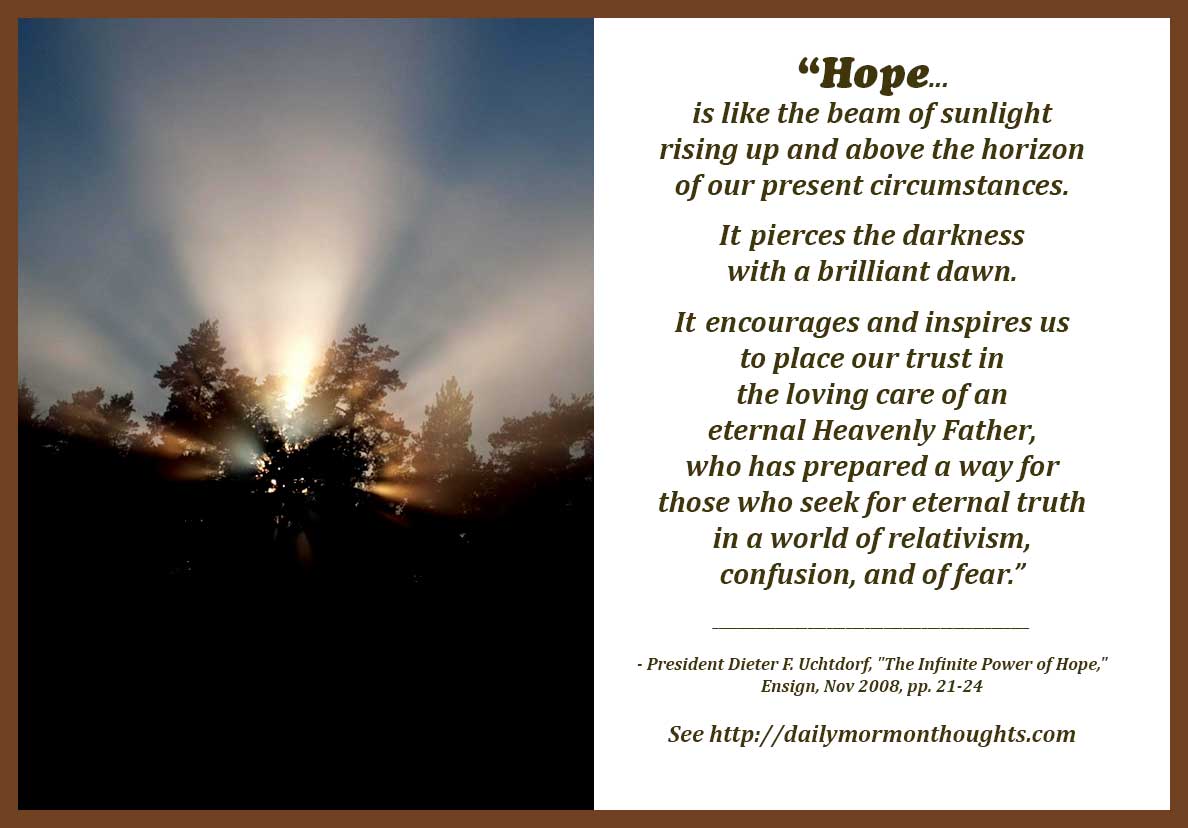
"Hope, on the other hand, is like the beam of sunlight rising up and above the horizon of our present circumstances. It pierces the darkness with a brilliant dawn. It encourages and inspires us to place our trust in the loving care of an eternal Heavenly Father, who has prepared a way for those who seek for eternal truth in a world of relativism, confusion, and of fear."
- President Dieter F. Uchtdorf, "The Infinite Power of Hope," Ensign, Nov 2008, pp. 21-24
Click here to read the full talk

"Suffocating darkness" is a very descriptive phrase for the despair used by Satan to "drain" away "all that is vibrant and joyful" as he "bind[s] hearts and minds." The results of a life of despair can include:
  • kills ambition
  • advances sickness
  • pollutes the soul
  • deadens the heart
What a contrast between that imagery, the adversary's path, and the path of hope provided by our Heavenly Father!


Thursday, September 17, 2015

Henry B. Eyring on service and spiritual strength

President Henry B. Eyring (1933- ) served in the Presiding Bishopric from 1985-1992, as a Seventy from 1992-1995, then was called to the Quorum of Twelve Apostles. He has served in the First Presidency since 2007.
"The more faithful service you give, the more the Lord asks of you. Your smile is a happy one because you know that He increases our power to carry the heavier load.
"The tough part of that reality, however, is that for Him to give you that increased power you must go in service and faith to your outer limits.
"It is like building muscle strength. You must break down your muscles to build them up. You push muscles to the point of exhaustion. Then they repair themselves, and they develop greater strength. Increased spiritual strength is a gift from God which He can give when we push in His service to our limits. Through the power of the Atonement of Jesus Christ, our natures can be changed. Then our power to carry burdens can be increased more than enough to compensate for the increased service we will be asked to give."
- Henry B. Eyring, "O Ye That Embark," Ensign, Nov. 2008, pp. 57-60
Click here to read the full talk

This is an interesting perspective. We grow in our ability to serve as we spend more time serving; and the Lord is able to ask more from those who are better trained and prepared to give more. But in order to reach the greatest capacity to give, one must push "to your outer limits" in preparation.


Wednesday, September 16, 2015

Jeffrey R. Holland on the help of angels in our lives

Elder Jeffrey R. Holland (1940- ) served as Church Commissioner of Education from 1976-1980, as the president of BYU from 1980-1989, as a Seventy from 1989-1994, and as a member of the Quorum of Twelve Apostles since 1994.
"I have spoken here of heavenly help, of angels dispatched to bless us in time of need. But when we speak of those who are instruments in the hand of God, we are reminded that not all angels are from the other side of the veil. Some of them we walk with and talk with—here, now, every day. Some of them reside in our own neighborhoods. Some of them gave birth to us, and in my case, one of them consented to marry me. Indeed heaven never seems closer than when we see the love of God manifested in the kindness and devotion of people so good and so pure that angelic is the only word that comes to mind....
"I testify of angels, both the heavenly and the mortal kind. In doing so I am testifying that God never leaves us alone, never leaves us unaided in the challenges that we face. '[N]or will he, so long as time shall last, or the earth shall stand, or there shall be one man [or woman or child] upon the face thereof to be saved' (Moroni 7:36). On occasions, global or personal, we may feel we are distanced from God, shut out from heaven, lost, alone in dark and dreary places. Often enough that distress can be of our own making, but even then the Father of us all is watching and assisting. And always there are those angels who come and go all around us, seen and unseen, known and unknown, mortal and immortal."
- Jeffrey R. Holland, "The Ministry of Angels," Ensign, Nov 2008, pp. 29-31
Click here to read the full talk

There are times in life when we all need help — physical help, temporal assistance, encouragement, moral support. We are blessed at those times to be "surrounded by angels" in very real ways, as Elder Holland points out.


President Spencer W. Kimball put it this way: "God does notice us, and he watches over us. But it is usually through another person that he meets our needs" (Spencer W. Kimball, "Small Acts of Service," Ensign, Dec 1974, 2).


How blessed we are to have a loving Father who cares for us in this way.

How blessed we are to feel the love and ministry of those angels in our lives.

How blessed we are to sometimes have the privilege to be that kind of angel.

Tuesday, September 15, 2015

Robert D. Hales on gaining and growing in testimony

Elder Robert D. Hales (b. August 24, 1932) served as a Seventy from 1976 to 1985, when he was called as a member of the Quorum of Twelve Apostles.
"People often ask me, 'How do you know?' 'How can you know that God lives and that Jesus is the Christ?' While there seems to be no exact formula by which each of us receives a testimony, there does seem to be a discernable pattern. Though prayer is important in gaining a testimony, we cannot merely ask in prayer for a testimony and expect it to be given immediately to us.
"Generally, testimony emerges over time and through life's experiences. We can compare testimony to the process of watching a photograph develop. Powerful impressions of the Spirit come like flashes of light on receptive photographic film. Like the chemicals needed to develop the picture, certain spiritual conditions and experiences are needed in our lives for our personal testimony to develop into a certain truth and knowledge. And like a photograph, a testimony, if not carefully preserved, will fade with time.
"Testimonies often come when there is willingness to serve where we are called. They come when a decision is made to strive to be obedient. Testimonies come during efforts to help, lift, and strengthen others. They come from prayer and from studying the scriptures and applying them in our lives. Whatever our circumstances, there seem to be moments in each of our lives when we can be given the knowledge that God lives and that Jesus is the Christ. There is no greater search in life that we can embark upon than the quest to gain a testimony of the truth."
- Robert D. Hales, "The Importance of Receiving a Personal Testimony," Ensign, November 1994, pp. 20-22
Click here to read the full talk

Elder Hales emphasizes the gradual process of gaining a testimony. Though the imagery of developing a photographic negative and making a print in a darkroom is starting to fade from our societal consciousness (and is likely completely unknown to most youth), perhaps many of us remember it just enough to understand the point he is making:


I appreciated the additional insight about the process of gaining, and "growing," a testimony, which happens more readily when these conditions exist:

  • Willingness to serve.
  • Commitment to obedience.
  • During efforts to serve and bless others.
  • Prayer and scripture study.
It's good to ponder what kinds of conditions we each are presenting in our lives to facilitate this development, and what changes might increase the growth.  The excerpt concludes by providing this important perspective:  "There is no greater search in life that we can embark upon than the quest to gain a testimony of the truth."
// Customization to close archive widget on first view - DK 3/15