Saturday, March 25, 2017

President Joseph Fielding Smith on living in the world but avoiding the world

Joseph Fielding Smith (1876-1972) was the son of Joseph F. Smith, 6th president of the Church, and grandson of Hyrum Smith, brother of the Prophet Joseph. He was called as an apostle in 1910, and served as the 10th president of the Church from 1970 until his death in 1972 at age 95.
"In the wonderful prayer of our Redeemer, as recorded in the seventeenth chapter of John—I can hardly read this chapter without tears coming to my eyes—wherein our Lord, in praying to his Father in the tenderness of all his soul because he knew the hour had come for him to offer himself as a sacrifice, prayed for his disciples. In that prayer he said,
"'I pray not that thou shouldest take them out of the world, but that thou shouldest keep them from the evil.
"'They are not of the world, even as I am not of the world.
"'Sanctify them through thy truth: thy word is truth.' (John 17:15-17.)
"If we are living the religion which the Lord has revealed and which we have received, we do not belong to the world. We should have no part in all its foolishness. We should not partake of its sins and its errors—errors of philosophy and errors of doctrine, errors in regard to government, or whatever those errors may be—we have no part in it.
"The only part we have is the keeping of the commandments of God. That is all, being true to every covenant and every obligation that we have entered into and taken upon ourselves."
- Joseph Fielding Smith, "Fulfillment of Prophecy," Conference Report, Apr. 1952, pp. 26-28
Click here to read the full talk

This message from President Smith addresses one of the great challenges we face. We live in a world that seems to be increasingly contrary to the laws and principles of the gospel. We have no choice but to be exposed to those influences. How do we manage to stay above them, protected from them?

The key, according to President Smith, is simply to live our religion and obey the commandments of God. As we focus our efforts and dedicate ourselves to the principles of the Lord's gospel, we can be in the world but "have no part in all its foolishness."


Note that we don't just avoid the actions and deeds of the world that are contrary to the appropriate behaviors the gospel defines for us, but we also avoid "errors of philosophy and errors of doctrine, errors in regard to government, or whatever those errors may be." How critical it is that we are "true to every covenant and every obligation that we have entered into and taken upon ourselves."

Friday, March 24, 2017

President Joseph F. Smith on finding the rest of the Lord in this life

President Joseph F. Smith (1838-1918) was the son of Joseph's brother Hyrum. He was ordained an apostle in 1866 at age 28, and served as a counselor to Brigham Young and the three presidents who followed.  He became the 6th president of the Church in 1901, and served until his death in 1918 at age 80.
"The particular part that I wish to call your attention to is that which refers to 'entering into the rest of the Lord' (see Moro 7:3.); not unrest, fear, doubt, and trembling. What does it mean to enter into the rest of the Lord? Speaking for myself, it means that through the love of God I have been won over to Him, so that I can feel at rest in Christ, that I may no more be disturbed by every wind of doctrine, by the cunning and craftiness of men, whereby they lie in wait to deceive; and that I am established in the knowledge and testimony of Jesus Christ, so that no power can turn me aside from the straight and narrow path that leads back into the presence of God, to enjoy exaltation in His glorious kingdom; that from this time henceforth I shall enjoy that rest until I shall rest with Him in the heavens.
"I desire to impress this thought upon your minds, for I want you to understand that this is the meaning intended to be conveyed by the words, 'entering into the rest of God.' Let me assure you that that man who is not thoroughly established in the doctrine of Christ, who has not yielded his whole soul unto the Lord, and to the Gospel He has taught to the world, has not yet entered into that rest. He is still at sea, so to speak, wandering, unstable, lacking firmness, lacking the faith that cannot be moved, ready to be overtaken by the cunning and craftiness of him who lies in wait to deceive and mislead into error and darkness.
"While he that has received the testimony of Jesus Christ in his heart, he that has yielded his all to the kingdom of God and to the will of the Father, is so established. His heart is fixed; his mind is made up; doubts have been dispelled; fears have all been removed; he knows in whom to trust; he is thoroughly established in his purposes and in his determination that, as for him and his house he will serve God, keep His commandments and walk, as far as it is possible for human creatures to walk, in purity of life, in honor, fidelity, and uprightness before the Lord."
- Joseph F. Smith, "At Rest in Christ," address at Provo, Utah, on 13 January 1907; see Millennial Star, 30 May 1907, 337-49
Click here to read the full talk

Too many face life with "unrest, fear, doubt, and trembling." President Smith suggests that's the alternate to living in "the rest of the Lord." When we "rest in Christ" we are at peace, untroubled by the forces of the world around us, moving untroubled through the world's tribulations and the various "winds of doctrine."


The key is to be "established in the doctrine of Christ" and to have "yielded his whole soul unto the Lord." So the process begins with learning, studying, pondering the doctrine; and then applying it in a way that brings total devotion. The result is that peaceful state when the man so committed has doubts and fears dispelled, and is committed to God in obedience and service. He then is able to "walk, as far as it is possible for human creatures to walk, in purity of life, in honor, fidelity, and uprightness before the Lord." That's a beautiful and treasured state.

The "rest of the Lord" can begin in this life, and not just in the eternities!

Thursday, March 23, 2017

Elder Richard L. Evans on consistently living our beliefs

Elder Richard L. Evans (1906-1971) served as a Seventy from 1938-1953, when he was called to the Quorum of Twelve Apostles.  He died in 1971 at age 65.  He was known as "the voice of the Tabernacle Choir" from the beginning of its broadcasts in 1929 until his passing.
"I am reminded of the story of Jacob in the Old Testament, in Genesis, when he was traveling in a strange land. Up to that time he had had limited experience and had been held close to home ties. But in this strange place he awoke one night after a dream and said. 'Surely the Lord is in this place; and I knew it not.' (Genesis 28:16) I would like our young men to remember that wherever they are, God is in that place and they must take Him into their confidence and conduct themselves in His ways.
"We cannot departmentalize the eternal record of our lives. It is one continued story. As Latter-day Saints we don't behave one way in the army and one way in business and another in Church. That is, not if we give heed to our principles. We do not behave one way at home and another way away from home. Wherever we are, remember that God is in this place also, and when the final record is written and read, all that we have done and thought, at home and abroad, in all the occupations and in all the pursuits that we may be called upon to undertake, is all a part of the eternal record of all of us, and it stands unalterably for us or against us."
- Richard L. Evans, Conference Report, April 1941, p. 53
Click here to read the full talk

I am impressed by that wonderful Old Testament insight from Jacob's life. We can find God in many places where we may not expect to see Him, and should never assume that He is not near. We just may not have the spiritual sensitivity and maturity to notice Him at times; what a challenge to work on!

The idea of "departmentalizing" our lives also rings true. We are not part-time disciples. We must look to Him in every thought (see D&C 6:36) and every deed.


Elder Jeffrey R, Holland told more recently of an experience when LDS members behaved badly as members of an audience at a sporting event, saying they "check their religion at the door" so they can enjoy the game with vocal abuse and taunting. Elder Holland stated:
"Lesson number one for the establishment of Zion in the 21st century: You never 'check your religion at the door.' Not ever.
"My young friends, that kind of discipleship cannot be—it is not discipleship at all. As the prophet Alma has taught the young women of the Church to declare every week in their Young Women theme, we are 'to stand as witnesses of God at all times and in all things, and in all places that ye may be in,' not just some of the time, in a few places, or when our team has a big lead."
- Jeffrey R. Holland, "Israel, Israel, God Is Calling," CES Devotional broadcast from Dixie State College, St. George Utah, September 9, 2012
Elder Evans reminds us that "we don't behave one way in the army and one way in business and another in Church." God is in every place where we are, and we must behave as one who understands that vital principle.

Wednesday, March 22, 2017

Elder Joseph B. Wirthlin on finding peace in a troubled world

Elder Joseph B. Wirthlin (1917-2008) served as a Seventy from 1976 to 1986, then as a member of the Quorum of Twelve Apostles from 1986 until his passing in 2008 at age 91.
"While we yearn for peace, we live in a world burdened with hunger, pain, anguish, loneliness, sickness, and sorrow. We see divorce with all of its attendant conflict and heartache, especially among the innocent children caught in the middle. Wayward, disobedient children cause their parents grief and anxiety. Financial problems cause distress and loss of self-respect. Some loved ones slip into sin and wickedness, forsake their covenants, and walk in their 'own way, and after the image of [their] own god.' (D&C 1:16.)
"The value of peace within our hearts cannot be measured. When we are at peace, we can be free of worry and fear, knowing that with the Lord's help, we can do all that is expected or required of us. We can approach every day, every task, and every challenge with assurance and confidence in the outcome. We have freedom of thought and action, freedom to be happy.... Few, if any, blessings from God are more valuable to our spiritual health than the reward of peace within. In modern-day revelation the Savior said, 'But learn that he who doeth the works of righteousness shall receive his reward, even peace in this world, and eternal life in the world to come.' (D&C 59:23.)
"Despite dismal conditions in the world and the personal challenges that come into every life, peace within can be a reality. We can be calm and serene regardless of the swirling turmoil all about us. Attaining harmony within ourselves depends upon our relationship with our Savior and Redeemer, Jesus Christ, and our willingness to emulate him by living the principles he has given us. He has extended to us an invitation: 'Come unto me, all ye that labour and are heavy laden, and I will give you rest. Take my yoke upon you, and learn of me; for I am meek and lowly in heart: and ye shall find rest unto your souls. For my yoke is easy, and my burden is light.' (Matt. 11:28-30.)"
- Joseph B. Wirthlin, "Peace Within," Ensign, May 1991, pp. 36-38
Click here to read or listen to the full article

Church leaders frequently acknowledge the challenges of our times; they are aware of the difficulties we face. While we sometimes assume they "have it all together" and are beyond such problems in areas of "hunger, pain, anguish, loneliness, sickness, and sorrow," I am certain they either face or have faced many of them, and they see challenges faced by their acquaintances and own loved ones. Add to these the situations of divorce, wayward children, financial struggles, those who choose to forsake covenants, and we have a pretty good picture of the difficulties of living in our time.

But there is hope! With the Lord's help, we can find peace in the world, in spite of these challenges. To be "calm and serene regardless of the swirling turmoil all about us" is the invitation Elder Wirthlin presents. That "peace within" comes from "doing the works of righteousness."


So much depends on our relationship with the Lord, our understanding of His plan, and our level of commitment to His path. We don't choose the trials and adversity we face; but we choose whether to have peace in our life.

Tuesday, March 21, 2017

President Gordon B. Hinckley on the blessings of temple worthiness and attendance

President Gordon B. Hinckley (1910-2008) was called to the Quorum of Twelve in 1961. He served as a counselor in the First Presidency from 1981-1995, then as Church President until his death in 2008.
"Our people cannot partake of all of the blessings of the gospel unless they can receive their own temple ordinances and then make these ordinances available to those of their kindred dead and others....
"These unique and wonderful buildings, and the ordinances administered therein, represent the ultimate in our worship. These ordinances become the most profound expressions of our theology. I urge our people everywhere, with all of the persuasiveness of which I am capable, to live worthy to hold a temple recommend, to secure one and regard it as a precious asset, and to make a greater effort to go to the house of the Lord and partake of the spirit and the blessings to be had therein. I am satisfied that every man or woman who goes to the temple in a spirit of sincerity and faith leaves the house of the Lord a better man or woman. There is need for constant improvement in all of our lives. There is need occasionally to leave the noise and the tumult of the world and step within the walls of a sacred house of God, there to feel His spirit in an environment of holiness and peace."
- Gordon B. Hinckley, "Of Missions, Temples, and Stewardship," Ensign, Nov. 1995, p. 53
Click here to read or listen to the complete talk

President Hinckley's vision of the importance of the temple in our lives changed the direction of the Church in a significant way. The dramatic expansion of temple-building worldwide provides a profound opportunity for all to experience the sacred ordinances, to serve their "kindred dead," and to return regularly for the blessings that are promised for faithful attendance.

In the temple, President Hinckley states, we experience the "ultimate in our worship." We go to be close to God, to learn of Him and His plan for our lives, and to be strengthened by His power.

I am touched by President Hinckley's urging "with all of the persuasiveness of which I am capable" that we live worthy of a temple recommend, and make a greater effort to attend the temple. It's clear he feels the eternal significance and present importance of that standard of worthiness, and of the opportunity it offers worthy holders of the recommend.


Those are wonderful blessings promised: personal growth and improvement, escape from the pressures and frustrations of a noisy world, and immersion in a setting of holiness and peace. We should all make a greater effort to claim those blessings!

Monday, March 20, 2017

President James E. Faust on God working miracles through willing servants

President James E. Faust (1920-2007) was called as a Seventy in 1976, then as a member of the Quorum of Twelve in 1978. He served as a counselor to President Hinckley from 1995 until his death in 2007 at age 87.
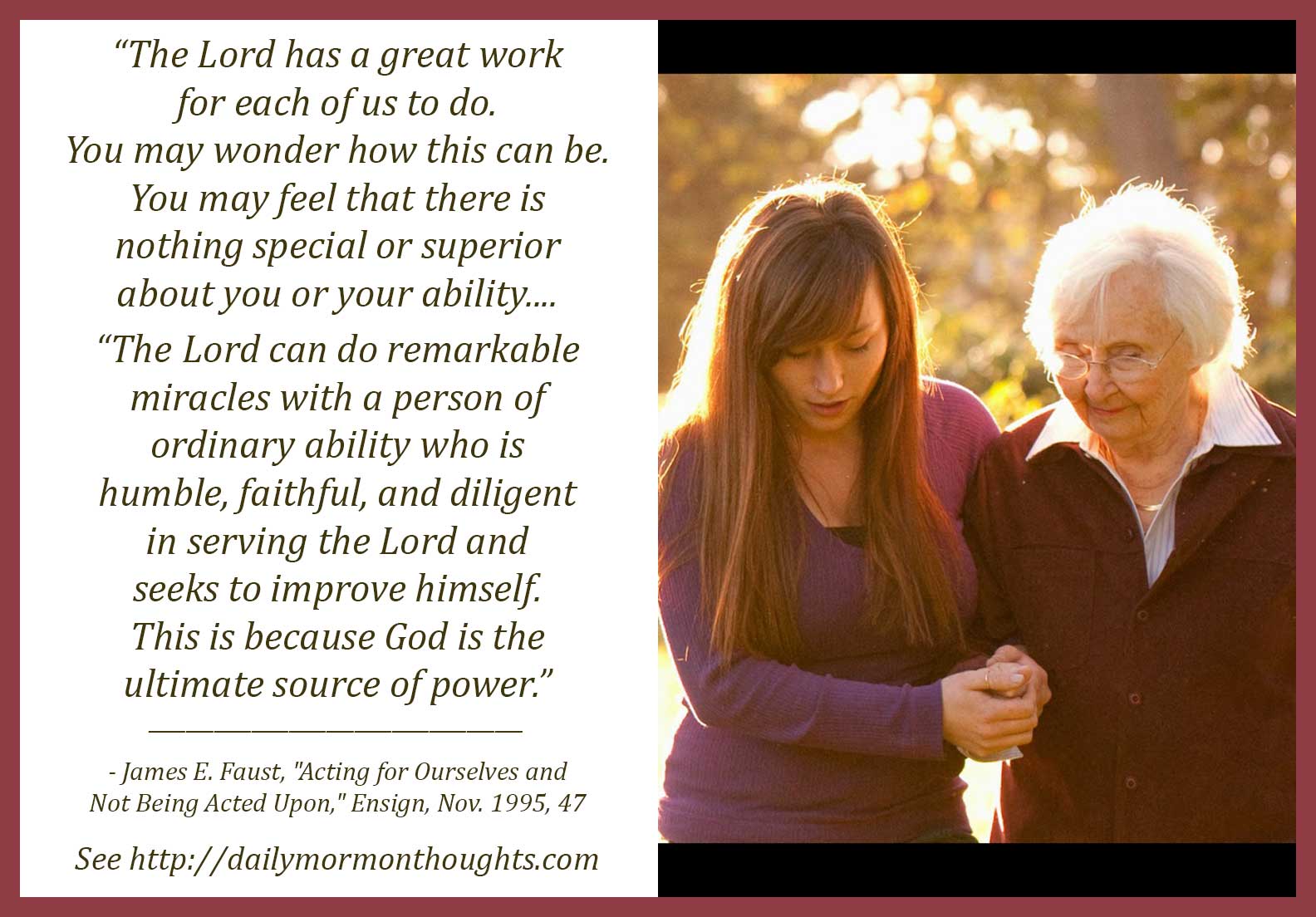
"The Lord has a great work for each of us to do. You may wonder how this can be. You may feel that there is nothing special or superior about you or your ability. Perhaps you feel, or have been told, that you are stupid. Many of us have felt that and some of us have been told that. Gideon felt this when the Lord asked him to save Israel from the Midianites. Gideon said, 'My family is poor in Manasseh, and I am the least in my father's house' (Judges 6:15). He had only three hundred men, but with the help of the Lord, Gideon defeated the armies of the Midianites (see Judges 7).
"The Lord can do remarkable miracles with a person of ordinary ability who is humble, faithful, and diligent in serving the Lord and seeks to improve himself. This is because God is the ultimate source of power."
- James E. Faust, "Acting for Ourselves and Not Being Acted Upon," Ensign, Nov. 1995, 47
Click here to read or listen to the complete talk

There are times in life when each of us probably has the experience of feeling surrounded by super-achievers, by remarkable people with gifts that lift and bless so many, by individuals who seem to "have it all together" while we are struggling just to hang on. Or worse, as President Faust notes, some have the chronic feeling that they are "stupid" or don't measure up in critical ways.

What a sense of bright encouragement to know that in spite of our perceived shortcomings, if we are humble and faithful, "The Lord can do remarkable miracles" with each of us:


Not only can the Lord do great things with and through each of us, but He will do them. As President Faust points out, "The Lord has a great work for each of us to do." It should be a major quest for each of us to discover that mission as we seek His help in our lives, strive to be humble and faithful, and offer ourselves as willing servants in His work.

Sunday, March 19, 2017

Elder Neal A. Maxwell on submitting our will to God

Elder Neal A. Maxwell (1926-2004) served as a Seventy from 1976-1981, then as a member of the Quorum of Twelve until his death from cancer in 2004.
"Seventy years ago, Lord Moulton coined a perceptive phrase, 'obedience to the unenforceable,' describing 'the obedience of a man to that which he cannot be forced to obey' ('Law And Manners,' Atlantic Monthly, July 1924, p. 1). God's blessings, including those associated with consecration, come by unforced obedience to the laws upon which they are predicated (see D&C 130:20–21). Thus our deepest desires determine our degree of 'obedience to the unenforceable.' God seeks to have us become more consecrated by giving everything. Then, when we come home to Him, He will generously give us 'all that [He] hath' (D&C 84:38).
"The submission of one's will is really the only uniquely personal thing we have to place on God's altar. The many other things we 'give,' brothers and sisters, are actually the things He has already given or loaned to us. However, when you and I finally submit ourselves, by letting our individual wills be swallowed up in God's will, then we are really giving something to Him! It is the only possession which is truly ours to give!
"Consecration thus constitutes the only unconditional surrender which is also a total victory!"
- Neal A. Maxwell, "'Swallowed Up in the Will of the Father'," Ensign, Nov 1995, pp. 22-24
Click here to read or listen to the complete talk

The concept of consecration is one of the most beautiful and sacred gospel doctrines. In humility, we offer all that we have to God—everything. We hold nothing back, dedicating every possession and every ability to Him and His work. At that point, He is able to bless us in ways he could not before, including giving us "all that He hath."

I love Elder Maxwell's analysis of what it is we can really give to God. He helps us see that no possession or ability is really ours to give; it's only our will, our agency, our commitment that we can truly and wholly offer to Him:


There's a verse in our hymn "God Loved Us So He Sent His Son" that I love. It's one of those "extra" verses printed at the bottom of the page that we sometimes neglect to sing. But consider the beauty and truth of these words written by Edward P. Kimball:
In word and deed he doth require
My will to his, like son to sire,
Be made to bend, and I, as son,
Learn conduct from the Holy One.

Hymns No. 187
How truly blessed is one who learns to bend his will to God, and thus learn conduct directly from Him! As we consecrate all that we possess, we are blessed with all that He possesses.
// Customization to close archive widget on first view - DK 3/15