Monday, March 4, 2019

President Joseph Smith on intellectual and spiritual growth

Joseph Smith (December 23, 1805-June 27, 1844) was given the apostolic authority when the Church of Jesus Christ was organized on April 6, 1830 and he was designated the first president of the church at age 24. He was martyred in 1844 at age 38.
"We consider that God has created man with a mind capable of instruction, and a faculty which may be enlarged in proportion to the heed and diligence given to the light communicated from heaven to the intellect; and that the nearer man approaches perfection, the clearer are his views, and the greater his enjoyments, till he has overcome the evils of his life and lost every desire for sin; and like the ancients, arrives at that point of faith where he is wrapped in the power and glory of his Maker and is caught up to dwell with Him. But we consider that this is a station to which no man ever arrived in a moment: he must have been instructed in the government and laws of that kingdom by proper degrees, until his mind is capable in some measure of comprehending the propriety, justice, equality, and consistency of the same."
- Joseph Smith, from "The Elders of the Church in Kirtland, to Their Brethren Abroad," Jan. 22, 1834, published in Evening and Morning Star, Feb. 1834, p. 135; see History of the Church, 2:8

It's a basic premise that all of us in this life are capable of learning and growth. But Joseph teaches of a greater capability, a spiritual capacity to grow "in proportion to the heed and diligence given to the light communicated from heaven to the intellect." As we learn to heed the light from heaven, we progress in the ways that matter most. But that does not happen all at once:


In that gradual process of spiritual and intellectual growth, we find wonderful things happening along the way. The description Joseph offers of the process is inspiring. We find greater enjoyment as our thoughts and desires become purified, and we lose our desire for sin. Ultimately we will be "wrapped in the power and glory of [our] Maker."

(Compilation and commentary by David Kenison, Orem, Utah, 2019)

Sunday, March 3, 2019

President Brigham Young on the sacredness of the sacrament

President Brigham Young (1801-1877) was part of the first Quorum of Twelve Apostles of this dispensation, called and ordained in 1835. He served as the second Church president, succeeding Joseph Smith, from 1847 until his death in 1877.
"I would exhort my brethren and sisters to receive this ordinance [the sacrament] every Sabbath, when they meet together....
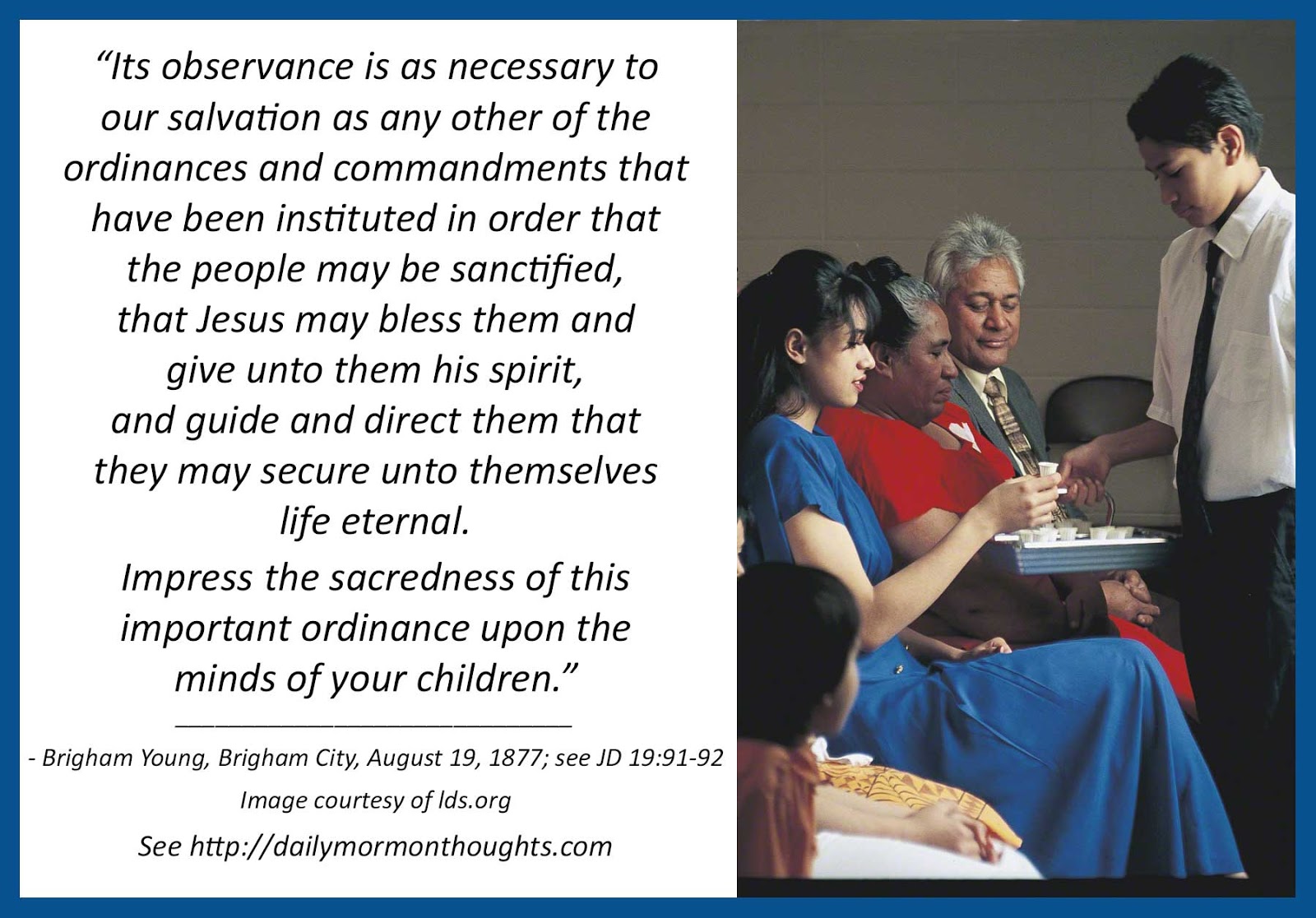
"We are in the habit of partaking of the contents of the cup each Sabbath when we meet together, and I do pray you my brethren and sisters to contemplate this ordinance thoroughly, and seek unto the Lord with all your hearts that you may obtain the promised blessings by obedience to it. Teach its observance to your children; impress upon them its necessity. Its observance is as necessary to our salvation as any other of the ordinances and commandments that have been instituted in order that the people may be sanctified, that Jesus may bless them and give unto them his spirit, and guide and direct them that they may secure unto themselves life eternal. Impress the sacredness of this important ordinance upon the minds of your children."
- Brigham Young, Brigham City, Sunday Afternoon, August 19, 1877; see JD 19:91-92
Click here to read the full talk

Speaking of the sacrament, President Young exhorts us to "contemplate this ordinance thoroughly" in order to know how to claim its promised blessings through obedience. We profit by doing this often; there is so much to be learned from the symbolism, the prayers, the associated covenants, and even the method of administration and distribution.


The observance of the sacrament is critical to our salvation, as much as any other ordinance of our day. How we should focus on its meaning and blessings in our lives! Truly, it does enable us to "be sanctified" or made holy before God, and to receive a greater measure of His spirit and guidance in our lives.

(Compilation and commentary by David Kenison, Orem, Utah, 2019)

Saturday, March 2, 2019

President John Taylor on trusting God and growing as families

President John Taylor (1808–1887) was born in England and immigrated to Canada where he and his wife were converted after hearing Parley P. Pratt preach.  He was ordained an apostle in 1838, and became the third president of the Church in 1880, serving until his death in 1887 at age 78.
"We have got to put our trust in God, let the consequences be as they may. And as long as we do this, and as long as we keep the holy covenants we have entered into with him and with one another, Zion will triumph; and the wicked will waste away until there will be no place found for them; and the man or the nation that lifts up his hand against Zion will wither before Almighty God. I will prophecy that in the name of Jesus Christ, and I will meet the consequences of what I say.
"But I will tell you what we have to do, my brethren and sisters, we must fear God in our hearts; we must lay aside our covetousness and our waywardness, our self-will and foolishness of every kind.… We must humble ourselves before the Lord, repenting of our sins, and henceforth preserve our bodies and spirits pure, that we may be fit receptacles for the Spirit of the living God, and be guided by him in all our labors both for the living and the dead. Our desires must be for God and his righteousness, until we shall exclaim with one of old: O God, search me, and try me, and if there be any way of wickedness in me, bid it depart [see Psalm 139:23–24]. It is for us, as fathers and mothers, to go before the Lord in all humility and call upon him that his peace may be in our hearts; and wherein we may have done wrong, confess that wrong and repair it as far as we possibly can; and in this way let every man and woman in Israel begin to set their houses in order, and forever cultivate the spirit of peace, the spirit of union and love.
"And if the families of Israel do this throughout all the land of Zion, all fearing God and working righteousness, cherishing the spirit of humility and meekness, and putting our trust in him, there is no power in existence that can injure us; for God will stand by and sustain his people, and he will deliver them out of the hands of their enemies."
- John Taylor, discourse at Grantsville, Sunday evening, 10/29/1882; see JD 23:337
Click here to read the full talk

Learning to "trust in God" is one of the keys to peace and happiness in this life. President Taylor begins this excerpt with a testimony and a prophecy, that as we keep our covenants with God and with each other, Zion will be blessed and protected from wicked influence. We need that blessing more than ever!

The key for us is to learn to repent, obey, and purify our hearts. The passage President Taylor quotes from the Psalms is so beautiful:
Search me, O God, and know my heart: try me, and know my thoughts:
And see if there be any wicked way in me, and lead me in the way everlasting.
(Psalm 139:23-24)
Those words express the humility we need to strive to be pure and holy in His sight, so that we might be worthy of His help and blessings. Then, we can lead our families in that path:


Then President Taylor promises that as families do that, collectively, "all fearing God and working righteousness, cherishing the spirit of humility and meekness, and putting our trust in him," we will feel God's power together and be protected from our enemies in divine ways. What a blessing, and how much we need it today, in a time when our enemies are so much more subtle and insidious than in the past!

(Compilation and commentary by David Kenison, Orem, Utah, 2019)
Friday, March 1, 2019

President Wilford Woodruff on finding happiness in times of affliction

President Wilford Woodruff  (born March 1, 1807—212 years ago today; died 1898) was called as an apostle in 1839 by Joseph Smith, and sustained as the 4th president of the Church in 1889.  He served until his death in 1898 at age 91.
"I have often thought that I never saw this people more happy than in their seasons of greatest poverty, drivings and afflictions, for the word of God and the testimony of Jesus. The Spirit of God has been with them, and in their humility and sufferings, the Holy Ghost, the Comforter has been their constant companion, and they have been filled with joy and consolation, and have rejoiced before the Lord for all these things. They would not have felt so if they had not been trying to keep the commandments of the Lord."
- Wilford Woodruff, Deseret News, February 22, 1865, 162; see Teachings of the Presidents of the Church: Wilford Woodruff, chapter 21

It's one thing to be patient in affliction knowing that our trials "shall be but a small moment" (D&C 121:7). But can we also be happy in affliction? President Woodruff testifies that Church members were "never... more happy than in their seasons of greatest poverty, drivings and afflictions." And the reason that was possible? Because they were filled with God's word and with testimony, and were worthy to feel the sweetness of the Comforter in their lives.


Great blessings come when we are found "trying to keep the commandments of the Lord."

(Compilation and commentary by David Kenison, Orem, Utah, 2019)

Thursday, February 28, 2019

President Lorenzo Snow on rewards that follow trials

Lorenzo Snow (1814-1901) was an early convert to the Church along with his sister Eliza R. Snow. He was called as an apostle by Brigham Young in 1849. He served as the 5th president of the Church from 1898 until his death in 1901.
"The sacrifices you have made, the hardships you have endured and the privations you have suffered will … sink into insignificance, and you will rejoice that you have obtained the experience which they have furnished.… Some things we have to learn by that which we suffer, and knowledge secured in that way, though the process may be painful, will be of great value to us in the other life....
"I know that your lives have not been all sunshine; you have doubtless passed through many a trial, and perhaps have come up through much tribulation; but by continued integrity you will soon emerge from the shadows into the glorious sunshine of the celestial world."
- Lorenzo Snow, Deseret Evening News, July 2, 1901, 1

This is a message of hope and testimony. President Snow reassured his listeners that he was aware of the challenges and struggles many of them had faced. But in an eternal perspective, such things "sink into insignificance" in due time after they have provided us with the needed experience for which they are designed. There are, apparently, some things which must be learned in that way, and the benefits of those lessons extend not only through this life but into eternity.


The powerful image of returning to sunlight is always a blessing to us. When we seem to be in shadows and darkness, we must cling to these promises that we "will soon emerge... into the glorious sunshine."

(Compilation and commentary by David Kenison, Orem, Utah, 2019)

Wednesday, February 27, 2019

President Joseph F. Smith on submitting our will to God

President Joseph F. Smith (1838-1918) was the son of Joseph's brother Hyrum. He was ordained an apostle in 1866 at age 28, and served as a counselor to Brigham Young and the three presidents who followed.  He became the 6th president of the Church in 1901, and served until his death in 1918 at age 80.
"The Gospel is calculated to remove from us everything that is not consistent with God and the plan of salvation which he has revealed to men. It is designed to qualify us to live so that we may enjoy a fulness of the light of truth, and understand the purposes of God, and be able to live so near to Him that we may be in harmony with His wishes constantly. The principles of the Gospel are calculated to make us unselfish, to broaden our minds, to give breadth to our desires for good, to remove hatred, animosity, envy and anger from our hearts, and make us peaceful, tractable, teachable, and willing to sacrifice our own desires, and perchance our own interests, for the welfare of our fellow-creatures, and for the advancement of the Kingdom of God. A man who cannot sacrifice his own wishes, who cannot say in his heart, 'Father, Thy will be done, not mine,' is not a truly and thoroughly converted child of God; he is still, to some extent, in the grasp of error and in the shades of darkness that hover around the world, hiding God from the presence of mankind."
- Joseph F. Smith, "Blind Obedience and Tithing," Millennial Star, 20 Jan. 1893, p. 79

I've always been fascinated by the wording of Moroni 10:32, near the end of the Book of Mormon:
Yea, come unto Christ, and be perfected in him, and deny yourselves of all ungodliness; and if ye shall deny yourselves of all ungodliness, and love God with all your might, mind and strength, then is his grace sufficient for you, that by his grace ye may be perfect in Christ; and if by the grace of God ye are perfect in Christ, ye can in nowise deny the power of God. (emphasis added)

Note that Moroni didn't say, fill your life with godly traits. He said, "deny yourselves of all ungodliness." We become perfect in Christ as we eliminate everything from our life that is not Christ-like. President Smith echoes this doctrine as he teaches, "The Gospel is calculated to remove from us everything that is not consistent with God." Part of the process of repentance is that gradual and consistent elimination of ungodly traits as we come unto Him. The Gospel works in our lives by eliminating the bad qualities and characteristics, and teaching and enhancing the good.


True conversion, true discipleship are evident in our lives when we are devoted fully to the counsel and will of God. These thoughts are powerfully expressed in the little-sung 4th verse of the beautiful LDS hymn, "God Loved Us, So He Sent His Son" (Hymns #187).
In word and deed he doth require
My will to his, like son to sire,
Be made to bend, and I, as son,
Learn conduct from the Holy One.
(Compilation and commentary by David Kenison, Orem, Utah, 2019)

Tuesday, February 26, 2019

President Heber J. Grant on the benefits of faithful prayer

President Heber J. Grant (1856-1945) was ordained an apostle in 1882 when he was 25 years old.  He served as president of the Church from 1918 until his death in 1945 at age 88.  His tenure as president lasted over 26 years; only Brigham Young had a longer term (over 29 years).
"The minute a man stops supplicating God for his spirit and directions just so soon he starts out to become a stranger to him and his works. When men stop praying for God’s spirit, they place confidence in their own unaided reason, and they gradually lose the spirit of God, just the same as near and dear friends, by never writing to or visiting with each other, will become strangers. We should all pray that God may never leave us alone for a moment without his spirit to aid and assist us in withstanding sin and temptation."
- Heber J. Grant, Conference Report, Oct. 1944, p. 9; see Teachings of the Presidents of the Church: Heber J. Grant, p. 174

Oh, how we need to maintain our connection to our Father in Heaven! In our busy temporal world, it's so easy to lose contact with our friends when we don't make efforts to maintain communication—especially if distance or circumstances separate us. I have found that to be the case, in moving to a new neighborhood; quickly the associations of the past fade away unless there is significant effort to maintain them. Just so, we must make constant efforts to maintain our communication with, and connection to God.


So we must regularly "[supplicate] God for his spirit and directions" and "pray that God may never leave us alone for a moment without his spirit" to help with the challenges of our lives.

(Compilation and commentary by David Kenison, Orem, Utah, 2019)
// Customization to close archive widget on first view - DK 3/15